
Explore Paul McCartney’s Journey Here!
- 🎧 Listen to This Article
- No. 7: “Another Day”
- First, listen to the official YouTube recording.
- Turning “a Day When Nothing Happens” into a Song
- The Bright Melody Makes the Story Even Sadder
- Nearly Five Years After “Eleanor Rigby”—Another Lonely Woman
- The Fascinating Choice for His First Solo Single
- Paul and Linda—A New Partnership for the 1970s
- Why I Chose This Song as No. 7
- In Closing—The Story Hidden Inside an “Ordinary Day”
🎧 Listen to This Article
You can quickly catch the key points of this article through narration.
Recommended if you want to get a feel for “Another Day” and understand the overall flow of the article before reading.
🎶 English Narration
This audio introduces the content of the article in English.
🎵 Japanese Narration
This audio introduces the content of the article in Japanese.
Listening first can help you better grasp the atmosphere of “Another Day” and the key points of the article.
No. 7: “Another Day”
Released on February 19, 1971, “Another Day” was Paul McCartney’s first solo single after the breakup of the Beatles.
The song was recorded during the sessions for RAM, but it was not included on the original album released in May 1971. Instead, it appeared as a standalone single.
For his first solo single, Paul did not choose a grand declaration of a new beginning. He portrayed an unnamed woman getting up in the morning, preparing for work, heading to the office, drinking coffee, and reaching the end of another ordinary day.
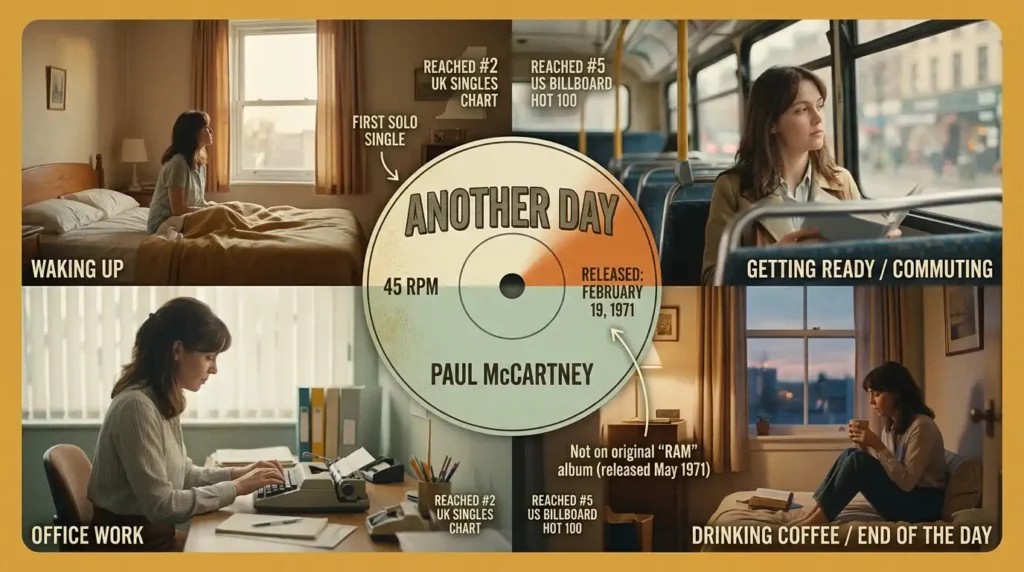
Yet the response was anything but ordinary. The single reached No. 2 on the UK Singles Chart and No. 5 on the US Billboard Hot 100. Just after leaving behind the enormous presence of the Beatles, Paul scored his first major solo hit with a song built around the smallest details of everyday life.
My Interpretation of the Lyrics
Every morning, she gets ready in the same familiar way and heads to the same workplace.
In the middle of an uneventful day, loneliness suddenly becomes almost unbearable.
The man she has dreamed of may appear, but he remains beside her only briefly.
Then morning comes again—and yet another ordinary day begins.
First, listen to the official YouTube recording.
Paul McCartney – “Another Day” (1993 Remaster)
Written by Paul McCartney and Linda McCartney
℗ 1993 MPL Communications Inc/Ltd
Provided by Universal Music Group
Official YouTube audio
In Two Lines
Released in 1971, “Another Day” was Paul McCartney’s first solo single.
Behind its bright, immediately appealing melody lies the story of a woman carrying a deep sense of loneliness through her everyday life.
Turning “a Day When Nothing Happens” into a Song
Almost nothing dramatic happens in “Another Day.” The woman wets her hair in the morning, gets dressed, and goes to work. At the office she is surrounded by papers, and during her break she drinks coffee. Everything described in the song could belong to an entirely ordinary life.
What Paul does so skillfully is turn that very ordinariness into a story. Her life proceeds without disruption, but that does not mean her heart is fulfilled. There is a quiet distance between the life visible from the outside and the emotions known only to the woman herself.

“Another Day” Is Not a Phrase of Hope
“Another Day” sounds like the simplest of expressions: just one more day. Yet in this song, it conveys less a sense of hope for a new morning than the feeling that another day much like yesterday is beginning all over again.
Life goes on as if nothing is wrong.
But no one can see the loneliness hidden inside.
The simplicity of the title mirrors the woman’s life itself. One unnamed, unremarkable day follows another. That repetition gives the song its distinctive sense of melancholy.
The Bright Melody Makes the Story Even Sadder
Judging from the subject matter alone, a darker musical setting would hardly have been surprising. Yet “Another Day” is remarkably light on its feet. The acoustic-guitar-driven arrangement moves easily, while Paul and Linda’s voices blend with a gentle warmth.
There is even an unforgettable “doo-doo-doo” chorus, making the song sound at first like an inviting piece of pop. That very accessibility makes the contrast with the woman’s loneliness all the more striking.
Paul does not portray a sad person using sad music alone. That contrast is one of the song’s great strengths.
Because the woman continues quietly through her life inside such a bright melody, the listener is almost inevitably drawn toward what may be hidden beneath the surface.
Even When the Man of Her Dreams Appears, Nothing Really Changes
At one point, the man she has been waiting for appears. In a conventional love song, this would probably be the moment when the story begins moving toward happiness.

But although he is with her for a time, by the next day he is gone. Even the hope that someone might arrive and change her life lasts only briefly, and she returns once again to the same familiar routine.
That is why I do not hear “Another Day” as simply a song about lost love. What stays with me more strongly is the structure of the story itself: an ordinary life seems, for just a moment, as though it might change—only to settle back into exactly what it was before.
Nearly Five Years After “Eleanor Rigby”—Another Lonely Woman
Many listeners will probably think of “Eleanor Rigby” when they hear “Another Day.” In the 1966 Beatles song, Paul had already explored loneliness through the life of a solitary woman.
But the situations of the two women are very different. Eleanor Rigby seems almost disconnected from society itself. The woman in “Another Day,” by contrast, goes to work every day and spends her time surrounded by other people.
Being surrounded by people is not the same as not being alone.
“Another Day” reveals that distinction through the ordinary actions of daily life. Rather than explaining loneliness directly, Paul lets us experience it by following one woman through her day. The characterization has something of the precision of a short story.
The Fascinating Choice for His First Solo Single
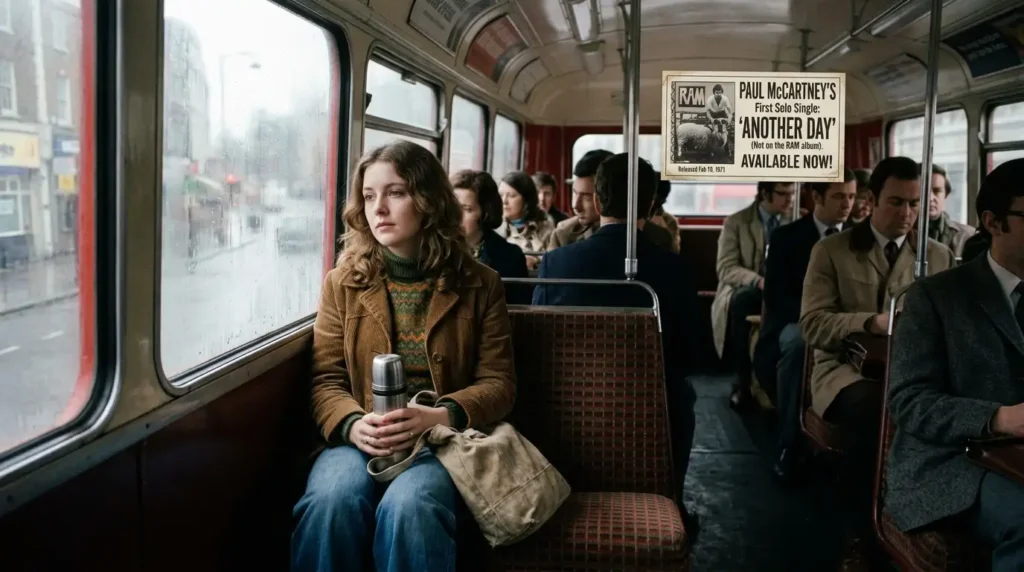
After the Beatles had effectively broken apart in 1970, the world was naturally watching to see what Paul would do next. He had already released his solo album McCartney, but “Another Day” became his first single as a solo artist.
Considering his position at the time, it would not have been surprising if he had chosen something far more spectacular—an anthem announcing the arrival of a “new Paul McCartney.” Instead, his first single was neither about himself nor a reflection on his years with the Beatles.
The central character is an unnamed woman. At a moment when the entire world was watching his own new beginning, Paul chose to use his first solo single to portray a single day in somebody else’s life. To me, that choice says a great deal about Paul McCartney as a songwriter.
Recording Began on the First Day of the RAM Sessions
The basic track for “Another Day” was recorded on October 12, 1970, at CBS Studios in New York. It was also the day the main recording sessions for RAM began.
Paul did not have a permanent backing band at the time. After holding auditions, he brought in drummer Denny Seiwell and guitarist David Spinozza.
Paul played acoustic guitar and recorded a guide vocal, Seiwell played drums, and Spinozza played guitar. Additional overdubs were added later.
Seiwell would later become an early member of Wings. So “Another Day” is not only a hit single; it is also a document of the period when Paul, having left the four-man world of the Beatles behind, began building new music with a different group of musicians.
Paul and Linda—A New Partnership for the 1970s
The songwriting credit goes to Paul McCartney and Linda McCartney. Linda also contributed backing vocals, and the blend of their voices would continue through RAM and later into Wings.
During the Beatles years, Paul had John Lennon as his longtime songwriting partner.
After the breakup, however, he did not simply try to recreate that relationship with someone else. Instead, Paul and Linda began developing a sound of their own.
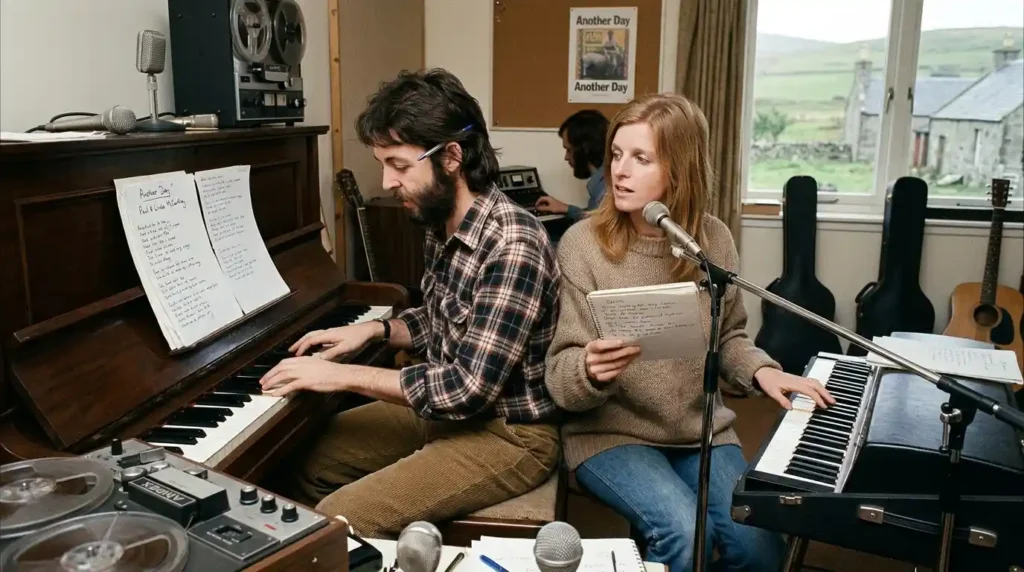
Looking back from the perspective of the fully established Wings of later years, it becomes clear that “Another Day” was one of the places where that new chapter began.
The song therefore marked not only a musical transition, but also the beginning of a new answer to the question of who Paul would make music with in the years ahead.
The Co-Writing Credit with Linda Led to a Lawsuit
However, the joint songwriting credit given to Paul and Linda did not remain merely a musical matter.
In July 1971, Northern Songs and Maclen Music filed a lawsuit, arguing that crediting Linda as a co-writer on songs including “Another Day” violated Paul’s contractual obligations.
At the time, Paul was already dealing with the legal consequences of the Beatles’ breakup, while also facing complicated issues involving publishing rights and contractual agreements.
Against that background, placing the songwriting credit “Paul and Linda McCartney” on his first solo single became symbolic of the direction his career would take in the years that followed.
It is difficult to imagine such legal friction when listening to the friendly, approachable sound of “Another Day,” but behind the music, Paul was also confronting the practical complications of moving from the Beatles era into a completely new phase of his career.
Why I Chose This Song as No. 7
“Another Day” has none of the dramatic sweep of “Live and Let Die,” nor the structural surprises of “Band on the Run.” Even so, I chose it as my No. 7.
The reason is simple: after the song ends, I can still see the woman it describes. Her morning preparations, stockings, raincoat, paperwork, coffee, and the office at the end of the day. Rather than relying on abstract expressions, Paul constructs a character through specific objects and everyday actions.

Paul’s brilliance as a melody writer hardly needs explanation. But whenever I listen to “Another Day,” I am reminded of another side of his talent: his ability as a writer to make us imagine an entire human being within the space of a pop song lasting only a few minutes.
In Closing—The Story Hidden Inside an “Ordinary Day”
The woman at the center of “Another Day” has no name. We are never told where she lives, what company she works for, or why she is alone. Paul leaves much of her life unexplained.
Instead, he gives us fragments of a single day. What emerges from those fragments is not limited to life in 1971. It can just as easily overlap with the life of someone living today.
Even a day that appears perfectly ordinary from the outside can contain a story known only to the person living it.
For his first solo single after the Beatles, Paul did not choose to sing about his own new beginning. Instead, he portrayed one woman living through “Another Day.”
After the light melody fades away, I somehow continue to picture her. For me, “Another Day” is a song that reminds me that Paul McCartney is not only an extraordinary melody maker, but also a remarkably gifted storyteller.



音楽ファン同士の交流・リクエストはこちら / Connect & Request Songs Here