Click here for Yosui Inoue’s History!
- 🎧 Enjoy This Article in Audio
- The Remaining Two Tracks from “Koori no Sekai (Ice World)” Not Covered in the Best 30
- “Machibouke” — The Lightness and Loneliness Placed in “Koori no Sekai”
- “Hajimari” — An Indispensable Track Transitioning from “Akazu no Fumikiri” to “Kaerenai Futari”
- What Can Be Seen Through a Different Way of Listening from the Best 30
- Conclusion
🎧 Enjoy This Article in Audio
You can quickly grasp the main points of this article through narration.
Recommended for those who want to catch the vibe of the music and the flow of the article before reading.
🎶 English Narration
An English audio introduction to the contents of this article.
⌛ Duration: Approx. 4 mins
🎵 Japanese Narration
A Japanese audio introduction to the contents of this article.
⌛ Duration: Approx. 3 mins 45 secs
* Listening to the audio before reading helps you better understand the world of the music and the main points of the article.
The Remaining Two Tracks from “Koori no Sekai (Ice World)” Not Covered in the Best 30
In “My Personal Best 30 [Yosui Inoue Edition],” I have introduced the songs of Yosui Inoue from 30th to 1st place.
However, because I selected two songs for the 10th place, the actual number of songs covered is 31.
Among them, surprisingly, 11 out of all 13 tracks from the album “Koori no Sekai (Ice World)” ended up being featured.
With so many songs introduced, there are only two tracks left untouched in “Koori no Sekai (Ice World).”
Since “Koori no Sekai (Ice World)” is an album I absolutely want everyone to listen to, I decided to take this opportunity to complete the introduction of all the tracks as a “Special Edition.”
Those two tracks are “Machibouke (Waiting in Vain)” and “Hajimari (The Beginning)”, which we will focus on today.
“Machibouke” has the fascination of suddenly changing the mood within a dense album.
“Hajimari” has a way of being heard (and a specific effect) that can only be understood within the track order of the album, rather than as a single piece.
“Machibouke” — The Lightness and Loneliness Placed in “Koori no Sekai”
Liberal Translation: The World of “Machibouke”
Only the time spent waiting for someone stretches out strangely long.
The person you are waiting for does not come. Yet, you cannot bring yourself to leave the place.
Though you are truly lonely, that loneliness is never turned into an exaggerated tragedy.
Within this slightly awkward, hollow time, the comicality and sadness of waiting for someone gently seep through.
💡 You might also like: View the lyrics(External site)
If the lyrics are displayed only in Japanese, you can use your browser’s translation feature or an AI translation tool to understand the general meaning.
First, please listen to “Machibouke” via the YouTube video
Track 1 (Studio recording version). Please click the image below.
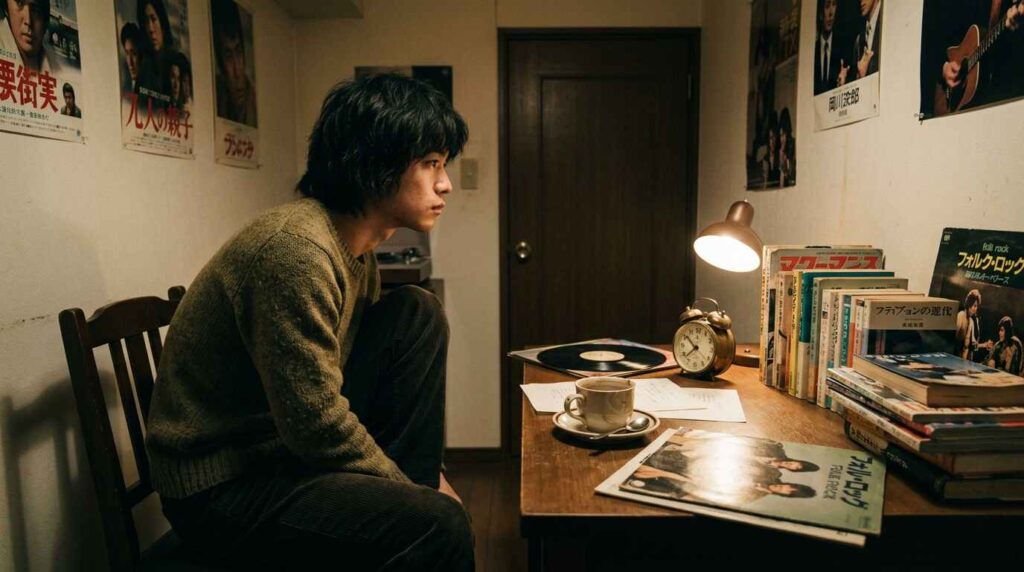
Song Title: Machibouke (Waiting in Vain)
Vocal: Yosui Inoue
Lyrics & Composition: Yosui Inoue
Recorded Album: "Koori no Sekai (Ice World)"
Album Release Date: December 1, 1973
Two-Line Commentary
"Machibouke" is a track that shows a slightly different expression from the tense isolation and deep passion found elsewhere in "Koori no Sekai." Its lightness, which avoids becoming overly serious, and its somewhat dry humor add a different texture to this album.
Track 2 Live performance from the Utsunomiya City Culture Hall concert on April 27, 2014. Please click the image below.
Credits
Yosui Inoue "Machibouke (Live)"
Lyrics & Composition: Yosui Inoue
Recorded Album: "Koori no Sekai Tour 2014 Live the Best"
Release Date: September 10, 2014
Audio Source: April 27, 2014・Utsunomiya City Culture Hall Performance
Two-Line Commentary
"Machibouke" wraps the sweetness and futility of waiting for someone in Yosui Inoue's characteristic playful wordplay. In this live audio, the sense of loneliness underlying the humorous lyrics resonates even deeper through Yosui's voice as he has aged.
*For videos that are not officially distributed, based on copyright considerations, this blog adopts a format where we link to external sites from uniquely prepared images instead of directly embedding the videos.
What “Machibouke” Adds to the Album
The album “Koori no Sekai” features a line-up of several songs that strongly capture the listener’s heart.
In “Kaerenai Futari (The Two Who Cannot Return),” there is the coldness of the night and the poignant distance between two people.
In “Shiroi Ichinichi (A White Day),” there is an indescribable silence and the density of a quiet daily life.
In “Kokoro Moyou (Mind Scenery),” there is a deep loneliness borrowing the form of a letter.
In “Jiko Keno (Self-Loathing),” there is the pain of staring at oneself.
Among them, “Machibouke” stands in a slightly different place.
This track is not a piece that sinks heavily into depression.
Nor is it a song that draws the listener in with intense drama.
Rather, it has a somewhat light, slightly aloof tone.
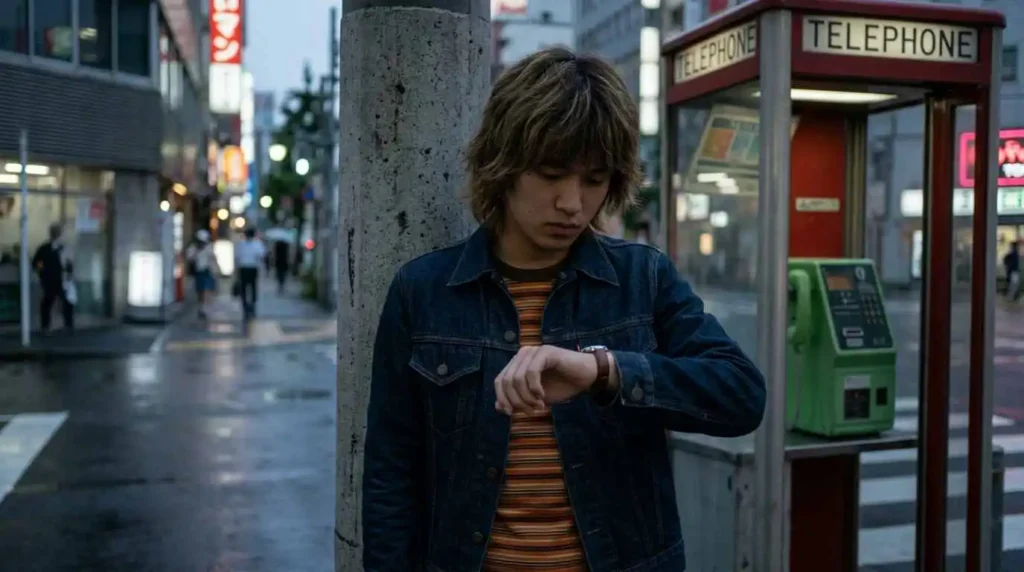
Even though you are waiting, the other person doesn’t come.
You don’t even know if they will come or not.
You should just go home, but you can’t seem to bring yourself to leave.
Looking only at this situation, it wouldn’t be surprising if emotions of loneliness or missing out came to the forefront.
However, Yosui Inoue does not portray that state with exaggeration. Instead of singing about sadness directly from the front, he observes it from a slight angle. In that exquisite distance, there is a unique flavor and humor characteristic of early Yosui.
“Koori no Sekai” is not an album that just lines up great songs.
Coldness, loneliness, love, daily life, self-loathing, and even detached humor are all contained within a single record.
Within it, “Machibouke” softens the album’s expression a little.
It is not a track that delivers a fierce blow.
However, because this song exists, “Koori no Sekai” does not become entirely dominated by heaviness.
It makes the listener gently relax their shoulders.
“Machibouke” has such a mysterious way of working.
“Hajimari” — An Indispensable Track Transitioning from “Akazu no Fumikiri” to “Kaerenai Futari”
The World of “Hajimari”
💡 You might also like: View the lyrics(External site)
If the lyrics are displayed only in Japanese, you can use your browser’s translation feature or an AI translation tool to understand the general meaning.
First, please listen to “Hajimari” via the YouTube video
Track 1… First, please view the official video.
Credits
Yosui Inoue "Hajimari (Remastered 2018)"
Recorded Album: "Koori no Sekai"
Release: December 1, 1973
Lyrics & Composition: Yosui Inoue
Acoustic Guitar: Yosui Inoue
Two-Line Commentary
Placed at the entrance (2nd track) of "Koori no Sekai," "Hajimari" is a track that, though short, quietly announces the tension and lonely atmosphere of the entire album. Yosui Inoue's voice and acoustic guitar slowly open the door to the dense world that is about to begin.
Track 2: The performance from the Tokyo NHK Hall concert on May 22, 2014. Please click the image below.
Credits
Yosui Inoue "Hajimari"
Footage: From "Koori no Sekai Tour 2014 Live the Best"
Concert: May 22, 2014, Tokyo・NHK Hall Performance
Lyrics & Composition: Yosui Inoue
Arrangement: Katz Hoshi
Original Recorded Album: "Koori no Sekai"
Two-Line Commentary
It is a short introductory piece that feels like reopening the 1973 masterpiece album "Koori no Sekai" on stage 40 years later.
Though the performance lasts only about 41 seconds, Yosui Inoue's voice instantly changes the air in the venue, quietly creating the entrance to the album's world.
*For videos that are not officially distributed, based on copyright considerations, this blog adopts a format where we link to external sites from uniquely prepared images instead of directly embedding the videos.
Within the Flow Continuing from “Akazu no Fumikiri” to “Kaerenai Futari”
In the album “Koori no Sekai,” “Hajimari” is placed right after “Akazu no Fumikiri (The Railroad Crossing That Never Opens),” followed next by “Kaerenai Futari.”
When listened to in this track order, the role of “Hajimari” becomes very clear.
Instead of entering the night of “Kaerenai Futari” abruptly from the slightly ominous scenery opened up by “Akazu no Fumikiri,” “Hajimari” is placed between them.
By having this short track, a brief breath is born in the flow of the album’s opening phase.
And because the quiet intro of “Kaerenai Futari” begins without delay after that breath, the coldness and poignancy of that song emerge much more naturally.
From “Hajimari” to “Kaerenai Futari” — Fascination Understood Precisely Because It Is Heard in the Album
“Kaerenai Futari” is an overwhelming masterpiece even when listened to on its own.
I even selected it as the 1st place in my personal Best 30.
The quiet plucking of the guitar.
The coldness of the night dew.
The scenery where the city lights seem to fade away.
The warmth of hands held together.
No matter which element you take, it has a depth that cannot be replaced by any other song.
However, when you listen to the album “Koori no Sekai” from the very beginning, the way “Kaerenai Futari” resonates changes slightly.
The curtain rises with “Akazu no Fumikiri.”
After that comes “Hajimari.”
And then, “Kaerenai Futari” quietly begins.
Listening in this track order, “Kaerenai Futari” rises up not as an isolated song, but as a major scene in the opening phase of the album.
This sensation can hardly be savored through a method where you choose and listen only to the songs you like.
Of course, there is also the joy of listening to each song freely one by one.
However, an album has a track order.
And due to that track order, the impression of the same song can change.
“Hajimari” is a song that teaches us that fact.
Because this song exists, “Kaerenai Futari” becomes a track that appears after undergoing preparation to head there, rather than just being the third track.
In that sense, “Hajimari” is a presence that cannot be left out when talking about the opening phase of the album “Koori no Sekai.”
What Can Be Seen Through a Different Way of Listening from the Best 30
“Machibouke” and “Hajimari” were not featured in the main Best 30 text.
However, by listening to these two songs afresh, we can view the album “Koori no Sekai” from a different angle.
In the Best 30, we selected from the 30th to the 1st place focusing on the “impression of each individual song,” such as the depth of the lyrics, the strength of the melody, and the power of the singing voice.
On the other hand, when looking over the entire album, a different perspective becomes necessary that cannot be measured solely by the strength of a single track standalone.
The sequence of tracks, the general shading, the arrangement that shifts the listener’s mood, and the function that brings out the next masterpiece. By shedding light on these two songs, “Koori no Sekai” shows its true value not as a simple collection of great songs, but as a single, multi-dimensional total album.
Conclusion
By covering “Machibouke” and “Hajimari” this time, the introduction of all tracks from “Koori no Sekai” within this blog finally takes shape.
I still do not think the judgment to exclude them from the main Best 30 text was mistaken, but only by introducing these two songs does the all-track introduction of the album “Koori no Sekai” reach its completion.
By adding these, I have finally been able to present the three-dimensional form of the album to you all.

Next time, we will finally enter the summary of “My Personal Best 30 [Yosui Inoue Edition].”
When looking back at the 31 songs by album, from which album were many songs selected?
And what can be seen from that result? Look forward to it!

音楽ファン同士の交流・リクエストはこちら / Connect & Request Songs Here