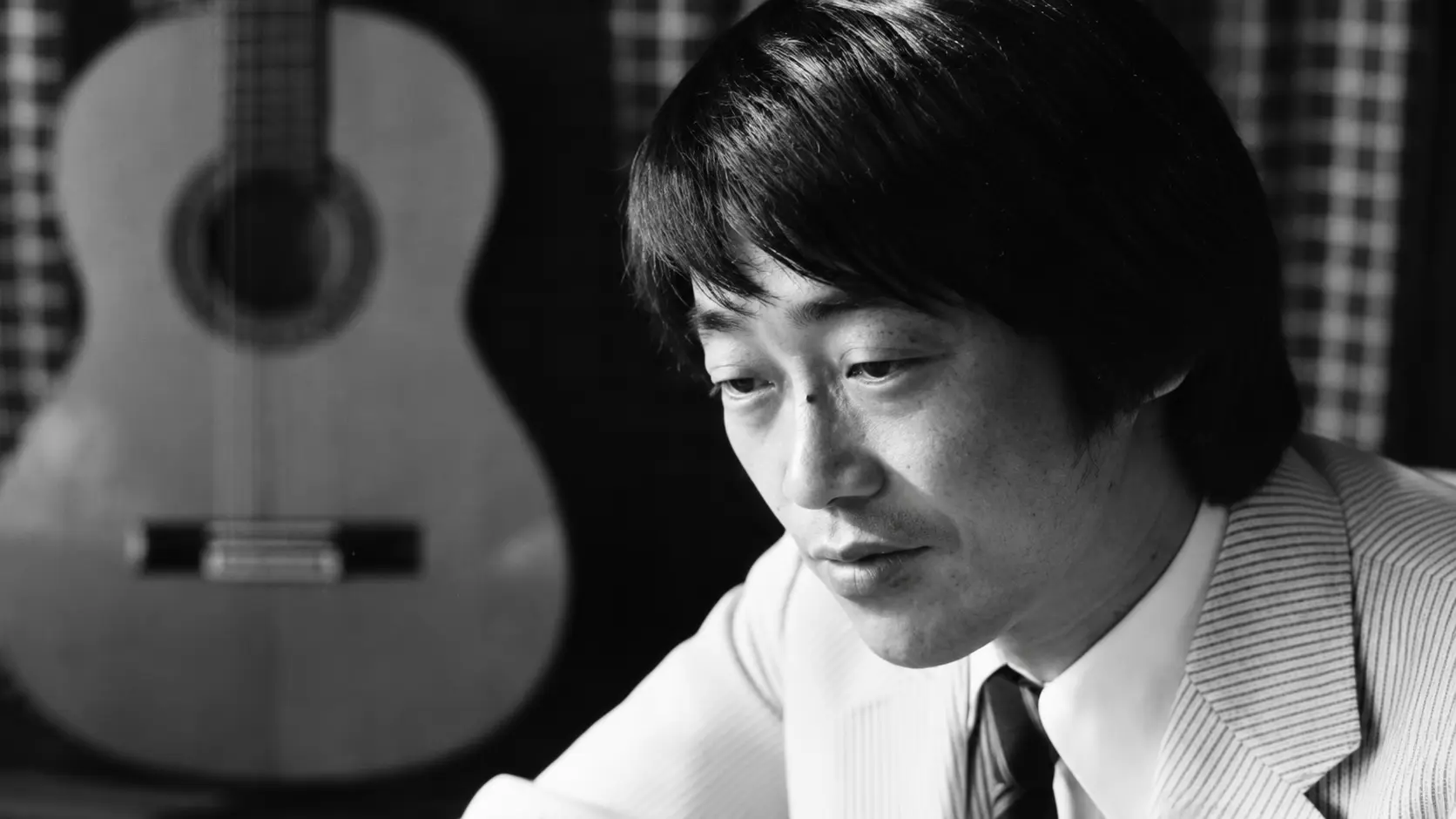
Discover the Story of Koichi Morita!
- 🎧 Listen to This Article
- No. 3 is “Geshukuya” (The Boarding House).
- First, listen to the official audio of “Geshukuya,” sung by Koichi Morita.
- The Boarding House Itself Becomes the Main Character
- White Flowers and a Note Left Behind—Two Farewells
- Youth Without Romanticizing Poverty
- A Different Kind of Youth from “Seishun Jidai”
- Koichi Morita’s Melody and Voice
- The Friend Who Disappeared
- Why “Geshukuya” Stays with Me
- In Closing
🎧 Listen to This Article
Get a quick overview of the article through narration.
Recommended before reading if you would like to get a feel for the atmosphere of “Geshukuya” and the overall flow of the article.
🎵 English Narration
Listen to an English narration introducing the content of this article.
🎶 Japanese Narration
Listen to a Japanese narration introducing the content of this article.
Listening first will help you grasp the atmosphere of “Geshukuya” and the key points of the article before you begin reading.
No. 3 is “Geshukuya” (The Boarding House).
“Geshukuya” was written by Aku Yu, composed and arranged by Koichi Morita, and released by Koichi Morita & Top Gallants on August 21, 1975. That same year, Morita received the Composition Award for the song at the 17th Japan Record Awards.
Although it was not a major hit, the song reached No. 48 on the Oricon chart.
The following year brought “Seishun Jidai” (Days of Youth), which became one of the group’s signature songs. But to me, “Geshukuya” captures the everyday lives of young people in those days in a much more vivid and unvarnished way.
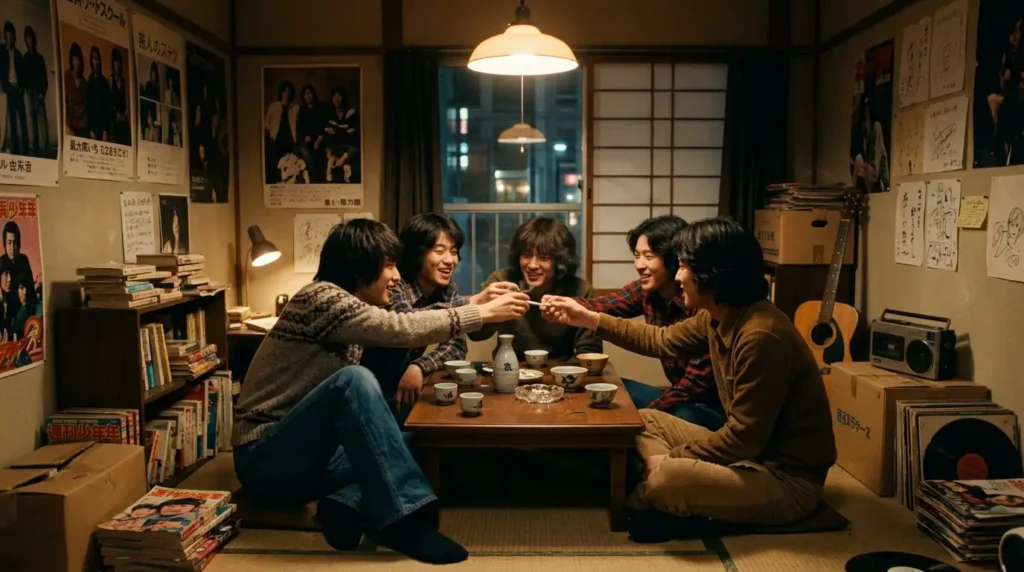
They have no money. They pass a cigarette around. They drink from chipped bowls. Yet they have friends, and someone is always falling in love. Then, one by one, people begin to disappear from those days—a person who came to say goodbye, and a friend who simply vanishes from their lives.
The song remembers not only the good times, but also the way the people who shared them gradually disappear.
That is the vision of youth that draws me to this song.
My Free Interpretation
We had little but our youth, laughing with friends and falling in love despite having no money.
At the boarding house at the top of the hill, our reckless younger days seemed to fill every room.
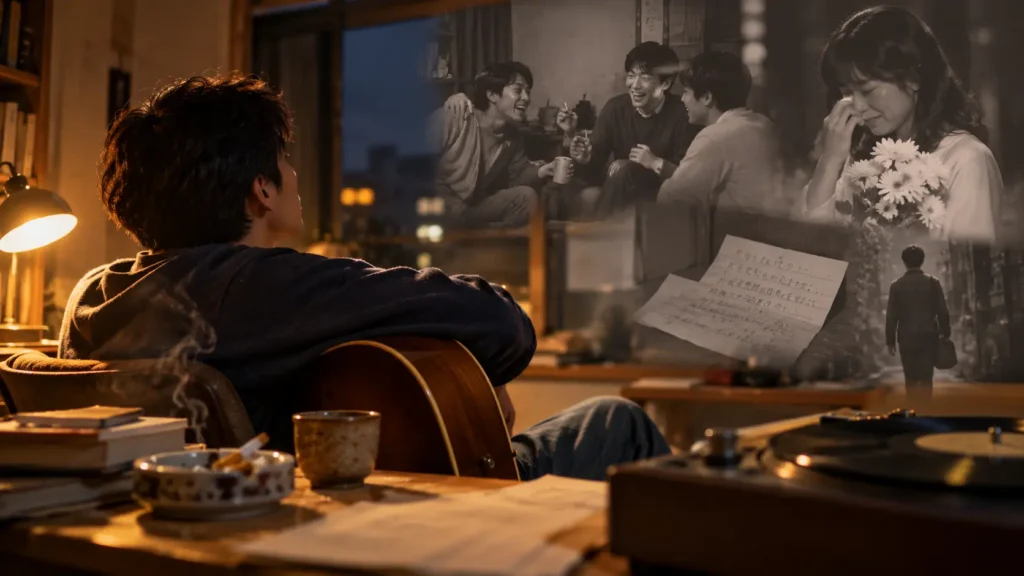
There was someone who came to say goodbye and left behind white flowers. And there was a friend who eventually disappeared from our lives.
Only the note he left behind quietly brings back those days we can never return to.
💡 You might also like: View the original Japanese lyrics (External site)
If the lyrics are available only in Japanese, you can use your browser’s translation feature or an AI translation tool to understand their general meaning.
First, listen to the official audio of “Geshukuya,” sung by Koichi Morita.
Credits
♪ “Geshukuya” / Koichi Morita & Top Gallants
Lyrics: Aku Yu Music & Arrangement: Koichi Morita
Audio provided by Sony Music Direct (Japan) Inc.
Official YouTube audio
In Two Lines
A boarding-house youth filled with friends, love, drink, and laughter despite having little money.
A person who came to say goodbye and a friend who disappeared—a song that looks back on an irretrievable youth with quiet melancholy.
The Boarding House Itself Becomes the Main Character
Two people appear in the song: “that person,” who comes to say goodbye, and a friend whose whereabouts are no longer known. Yet I do not feel that either of them is the true protagonist.
Rather, it seems to me that the boarding house itself stands at the center of the song, connecting the memories of both people.
A Boarding House at the Top of a Long, Gentle Hill
The setting is neither a stylish apartment nor a lively city district. It is an ordinary boarding house standing at the top of a long hill.
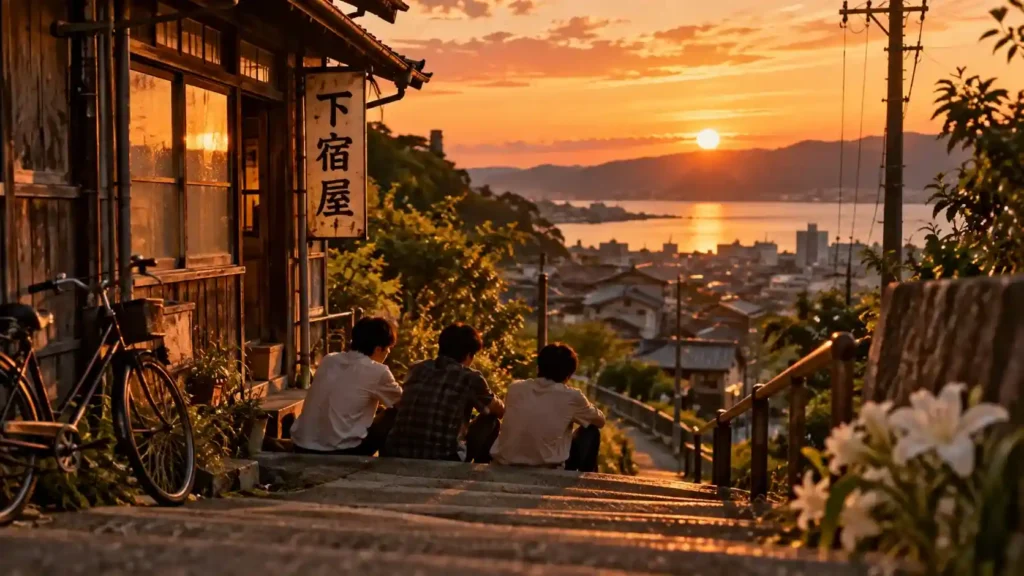
Boarding houses in 1970s Japan were quite different from the apartments we know today.
You had your own room, but entrances, hallways, baths, and toilets were often shared, and some boarding houses provided meals. Landlords and fellow boarders were physically and socially much closer, so it was not quite the same as living independently in an apartment.
I Also Began College Life in a Four-and-a-Half-Tatami Room in 1977
I actually had a brief experience of boarding-house life myself. When I entered university in 1977, my first home was a boarding house near Sengawa Station on the Keio Line.
My room was only four and a half tatami mats in size. Instead of a door, it was separated by a traditional sliding fusuma panel. Breakfast and dinner were included, but dinner had to be eaten by a set time—if I remember correctly, around 6:30 p.m. If I returned later than that, I missed it.
I had just started university, so it was hardly unusual to lose track of time while hanging out or talking with friends. As a result, I often arrived too late for dinner.
There was also a student from Meiji University, the same age as me, who moved in around the same time, and we often talked. Although each of us had our own room, you could always sense the presence of other young people living under the same roof. That was very different from living alone in an apartment.
Before long, however, I began to find the arrangement restrictive. Wanting a freer life, I moved out after about three months and into an apartment in Higashimatsubara, near Meidaimae Station on the Keio Line.
When I moved from the boarding house to an apartment, I think that was when living on my own first truly began to feel like freedom.
That is why, when I listen to “Geshukuya,” I understand the closeness among the young people in the song.
The image of passing a cigarette around and drinking from chipped bowls does not belong to some completely unfamiliar world for me.
The boarding house in the song was, of course, not the one where I lived. Even so, I recognize that peculiar feeling of having a private room while the lives of other people remain just on the other side of the wall.
White Flowers and a Note Left Behind—Two Farewells
What strikes me about Aku Yu’s lyrics is how little they explain. We are never told why “that person” decided to say goodbye, nor what eventually happened to the missing friend.
What remains instead are white flowers and a note left behind.
Drawing the Traces People Leave Behind
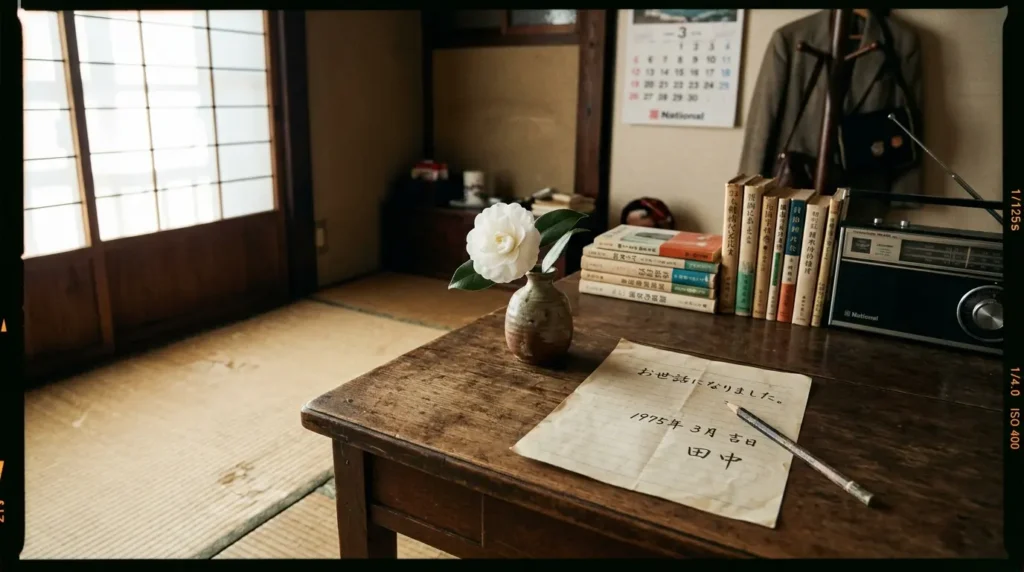
The first memory is of “that person,” who went home in tears, and the white flowers left behind. The second is of the missing friend and the note he left behind.
Aku Yu does not tell us much about the people who left. Instead, he shows us the things that remain. From the white flowers and the note, the listener is left to imagine what might have happened.
What Becomes Visible Only After Someone Is Gone
When you see someone almost every day, you stop noticing the simple fact that they are there. But once they disappear, a place that seemed completely ordinary only yesterday suddenly looks different.
The white flowers and the note are two traces telling us, “Someone really was here.” I find something distinctly Aku Yu-like in the way two small objects can make two farewells so vivid.
Youth Without Romanticizing Poverty
Another striking element is the way these young people live. They pass around stale cigarettes, drink from chipped bowls, and have little money. Materially speaking, theirs is hardly a comfortable life.
And Yet, They Were Happy
Yet the song remembers those days as happy ones. It is not praising poverty itself. Rather, the pleasure of those years seems to have come from somewhere other than material abundance.
They drink, fall for someone, and spend time with friends. What might happen years from now matters less than what is happening today. Their youth emerges through these ordinary details.
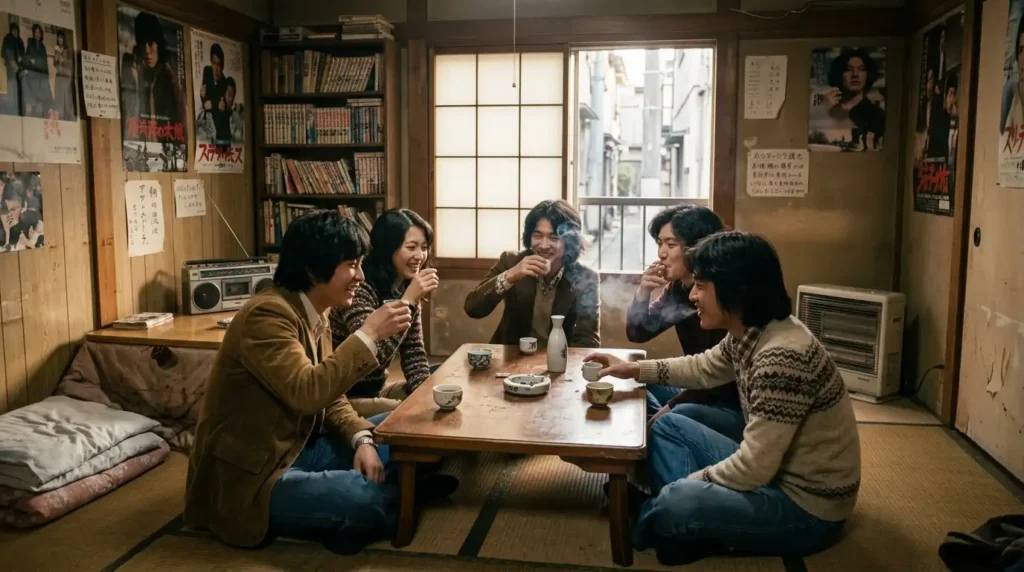
They were not affluent. But neither were they bored. That apparent contradiction gives the youth portrayed in “Geshukuya” much of its vitality.
A Different Kind of Youth from “Seishun Jidai”
Koichi Morita & Top Gallants released “Seishun Jidai” (Days of Youth) on August 21, 1976. It would go on to become one of their signature hits.
While “Seishun Jidai” places youth right in its title, the word “youth” itself never appears in “Geshukuya.” And yet, to me, “Geshukuya” makes everyday life in that era feel even closer.
Portraying Youth Without Calling It Youth
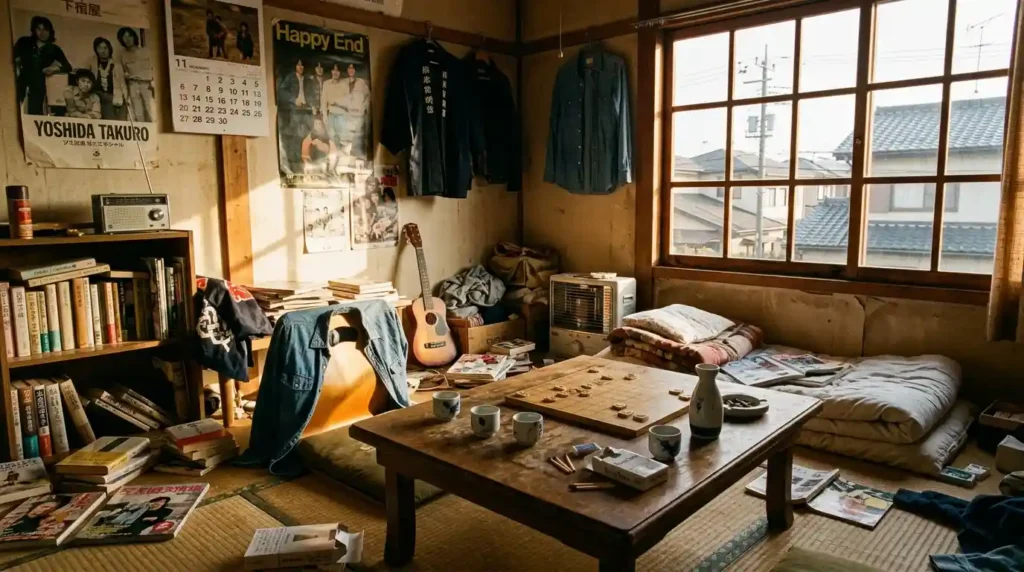
A hill, cigarettes, chipped bowls, drink, white flowers, a note left behind. Everything in the song is ordinary.
Yet as those details accumulate, the young people of 1970s Japan gradually come into view. There is no need to explain how wonderful youth is.
It portrays the untidy reality of everyday life before anyone stops to call it “youth.” To me, that is one of the most fascinating things about “Geshukuya.”
Koichi Morita’s Melody and Voice
Part of what keeps this song from becoming mere nostalgia lies in Morita’s music itself.
The melody is immediately approachable, yet it is neither bright and buoyant nor overly dramatic about the sadness of parting. Its calm, almost matter-of-fact movement perfectly suits the feeling of someone looking back and saying, “This is what happened back then.”
Why Koichi Morita’s Own Voice Fits the Song
Morita’s singing has a charm quite different from that of a polished, conventionally beautiful voice. There is a slightly dry quality to his delivery, which keeps the scenes in the song from becoming overly romanticized.
It sounds almost as if one of the men who once lived there is sitting nearby, quietly telling us what happened many years ago. That is how close his voice feels to me.
1975: Two Award-Winning Songs
At the 17th Japan Record Awards, Koichi Morita received the Composition Award for “Geshukuya.” That same year, Aku Yu received the Lyrics Award for “Ubaguruma” (Baby Carriage), sung by Yoichi Sugawara. “Ubaguruma” was also composed by Morita.
Listening to the two songs side by side reveals how differently the same partnership of Aku Yu and Koichi Morita could build a story. “Ubaguruma” uses a single baby carriage to show the passage of time, while “Geshukuya” places two farewells within the memory of a single boarding house.
The Friend Who Disappeared
What particularly stays with me in this song is the friend whose whereabouts are unknown. The farewell with “that person” has a specific scene attached to it. With the friend, however, all we know is that he disappeared and left a note behind.
People Whose Last Meeting You Cannot Even Remember
When we are students or still young, there are friends we see almost every day. At the time, we never stop to wonder whether we will still know them decades later—or whether we may never see them again.
Looking back, though, there are people who simply drifted out of our lives without any great argument or dramatic farewell. Sometimes we cannot even remember the last day we saw them.
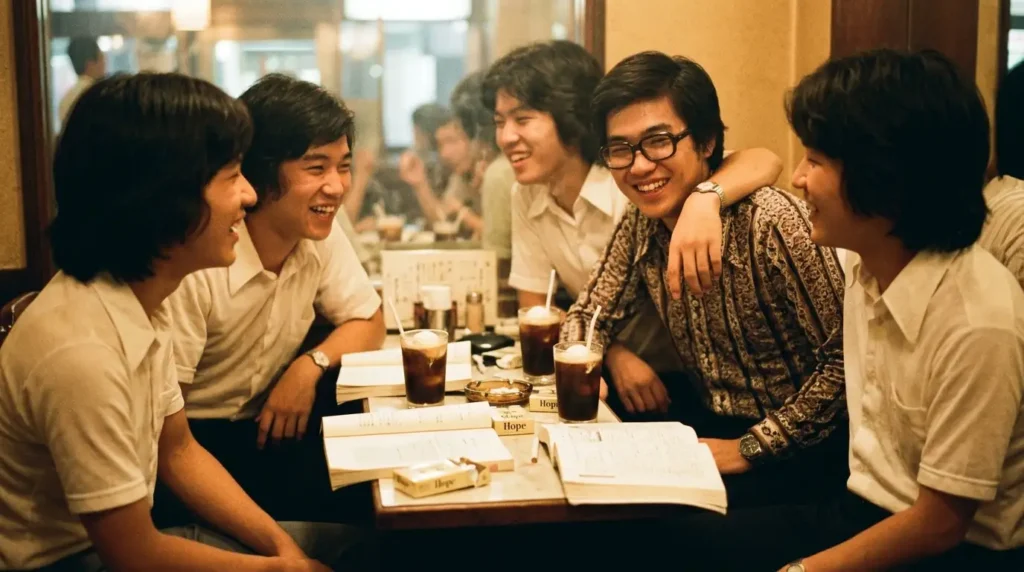
Perhaps friendship carries a particular kind of sadness precisely because its endings are not always clearly marked in the way romantic farewells often are.
“That person,” connected with the white flowers, and the friend, connected with the note left behind. Two very different kinds of farewell quietly coexist within the same song.
Why “Geshukuya” Stays with Me
For me, “Geshukuya” is not simply an old song about an era I never knew. Two years after its release, I began my own university life in a boarding house.
That does not mean I want to equate my own experience with the story in the song. What draws me to it is the way it shows the lives of young people not through explanation, but through an accumulation of ordinary scenes and details.
There is love, friendship, poverty, and parting. What binds them all together is the boarding house.
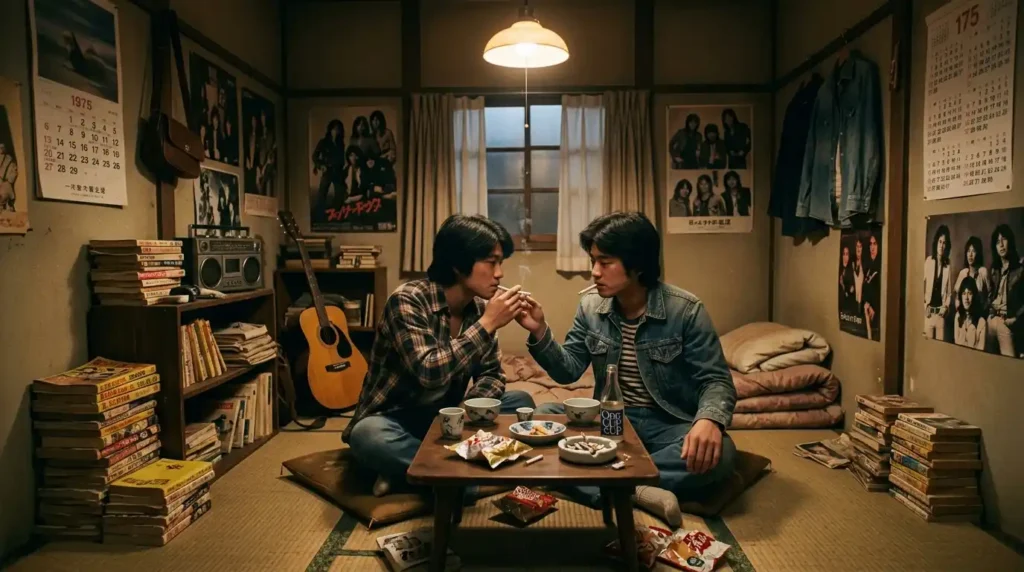
Remembering a single building can bring back, one after another, the people who once filled it. I know that feeling myself, and perhaps that is why this song feels so close to me.
In Closing
Nothing extraordinary happens in “Geshukuya.” Young people gather, fall in love, drink, and eventually go their separate ways. That is all.
In 1977, when I entered university, I too lived in a boarding house, only to choose the freedom of an apartment after about three months. At the time, I do not think I felt particularly sentimental about leaving.
And yet, nearly half a century later, listening to “Geshukuya” brings back that four-and-a-half-tatami room divided by a fusuma panel, and the students who once lived under the same roof.
Perhaps youth is a time when the ordinary days we barely notice eventually become special memories, long after they are gone.
White flowers and a note left behind. And a boarding house at the top of a long, gentle hill. The words of Aku Yu and the melody of Koichi Morita still have the power to draw those distant days quietly back toward us.
音楽ファン同士の交流・リクエストはこちら / Connect & Request Songs Here