🎵 English Narration|🌐 日本語
- 🎧 Listen to This Article
- Beyond “Michishirube Nai Tabi”: Tracing the Musical Journey of Ryūun Nagai
- Chapter 1: A Musical Calling Rooted in Fukuoka
- Chapter 2: 1978 — A Recording Debut with “Omoi”
- Chapter 3: 1979 — “Michishirube Nai Tabi” Brings National Recognition
- Chapter 4: The 1980s — Expanding His Musical Horizons
- Chapter 5: “Noren” — A Turning Point as a Songwriter and Composer
- Chapter 6: A Second Musical World Through Songs Written for Others
- Chapter 7: From His Sixtieth Birthday to the Present — A Continuing Creative Journey
- Chapter 8: Why Does Ryūun Nagai’s Music Stay with Us?
- In Closing — Looking Ahead to My Personal Mini Best 7
🎧 Listen to This Article
Discover the musical journey of Ryūun Nagai through a narrated introduction to his life, songs, and songwriting career.
Before reading, explore his journey from his 1978 debut and “Shirube Naki Tabi” to “Noren” and his more recent recordings.
🎵 English Narration
An English-language introduction to Ryūun Nagai’s musical life and career.
🎶 Japanese Narration
A Japanese-language introduction to Ryūun Nagai’s musical life and career.
The narration traces Nagai’s career from his debut and signature songs to his work as a composer and his recent albums, offering an introduction before you read the full article.
Beyond “Michishirube Nai Tabi”: Tracing the Musical Journey of Ryūun Nagai
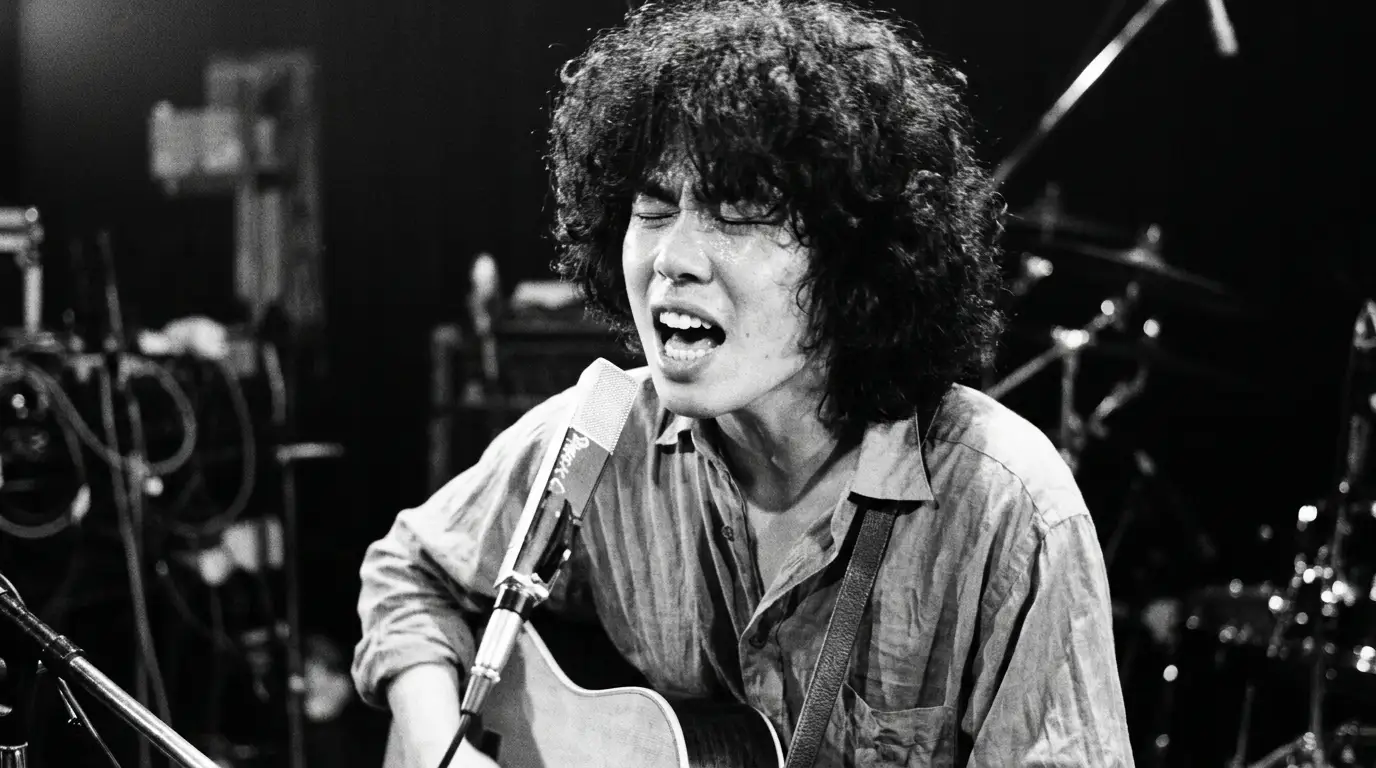
“Michishirube Nai Tabi,” “Omoi,” and “Noren.” Different songs may come to mind when people hear the name Ryūun Nagai. Yet those familiar with his voice will likely remember his wistful melodies and the unadorned honesty of his lyrics.
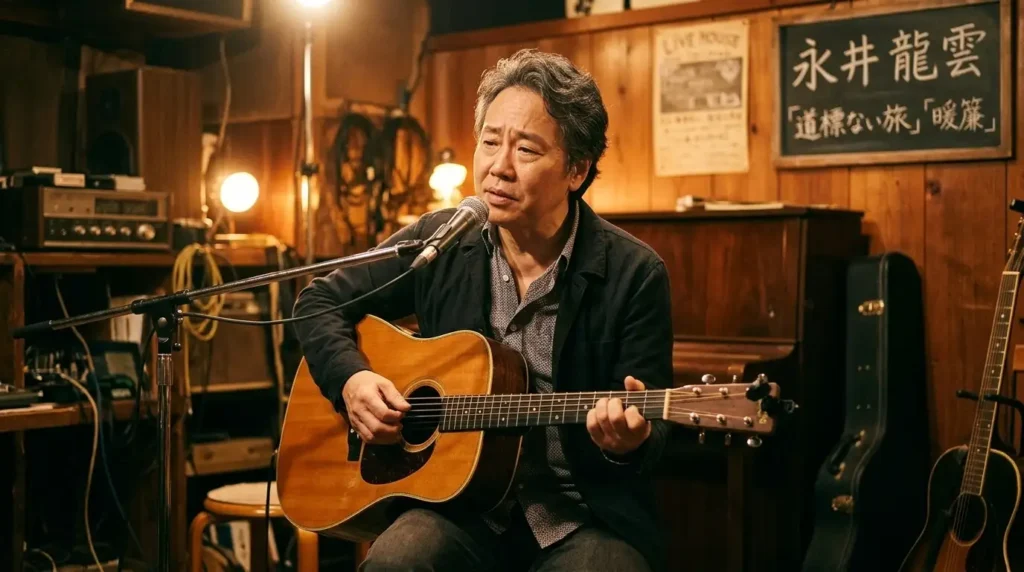
In the late 1970s, Japanese popular music was moving beyond its folk roots toward a broader style known as New Music. Singer-songwriters with distinctive voices and personal approaches to songwriting were flourishing. Ryūun Nagai was one of the artists who made his debut during this period.
Love and heartbreak, uncertainty about the future, longing for one’s hometown, and the hardships of everyday life have all found their way into his songs. Nagai has explored these subjects through accessible melodies and lyrics that respect the natural rhythms of the Japanese language.
Before beginning “My Personal Mini Best 7: Ryūun Nagai,” I would like to look back at his career, from his 1978 debut to his more recent recordings, and consider what makes his music so compelling.
Chapter 1: A Musical Calling Rooted in Fukuoka
Born in Fukuoka Prefecture in 1957
Ryūun Nagai was born on November 4, 1957, in Miyako District, Fukuoka Prefecture. He grew up in the former town of Toyotsu, now part of Miyako Town, and attended Fukuoka Prefectural Toyotsu High School, now known as Ikutokukan High School. He is one year older than I am.
During the 1970s, artists such as Takuro Yoshida and Yosui Inoue helped popularize a style in which singers wrote their own lyrics and melodies, expressing their experiences in their own words.
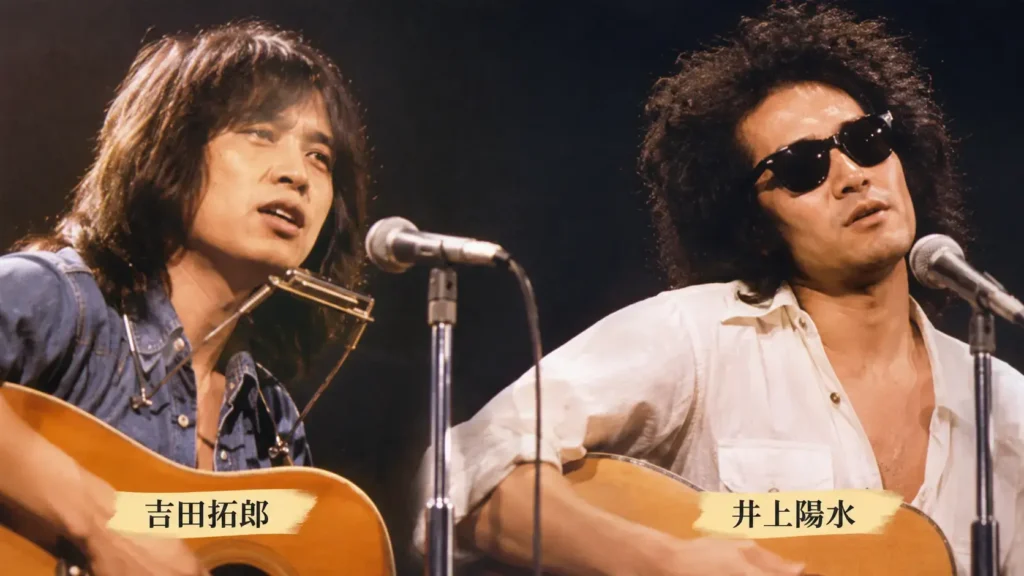
Nagai pursued music in this environment. Nevertheless, his artistic identity cannot be fully explained by the label of folk music. His songs also carry the emotional sensibility of traditional Japanese popular ballads, known as kayōkyoku, while his singing often has the intimacy of someone telling a story.
Turning Everyday Language into Song
Rather than relying on elaborate or obscure expressions, Nagai frequently draws upon familiar words. His ability to convey complicated emotions through ordinary language would later become equally valuable when he began writing songs for enka and kayōkyoku performers.
Chapter 2: 1978 — A Recording Debut with “Omoi”
Taking His First Step at Twenty
On March 25, 1978, Ryūun Nagai made his recording debut with the single “Omoi” (Feelings). He was twenty years old. On May 25 of the same year, he released his first album, “Ryūun First,” establishing himself as a professional singer-songwriter.
In 1978, Japanese audiences were embracing artists with markedly different musical personalities, including Chiharu Matsuyama, Masashi Sada, Alice, and Off Course.
Against this backdrop, Nagai distinguished himself through lyrical melodies and a voice that rarely exaggerated emotion. His singing possessed the directness of youth, yet there was often a hint of melancholy beneath the surface.
Songs About More Than the Brightness of Youth
Although many of his early compositions explore romance and hopes for the future, they seldom settle for uncomplicated optimism or youthful enthusiasm.
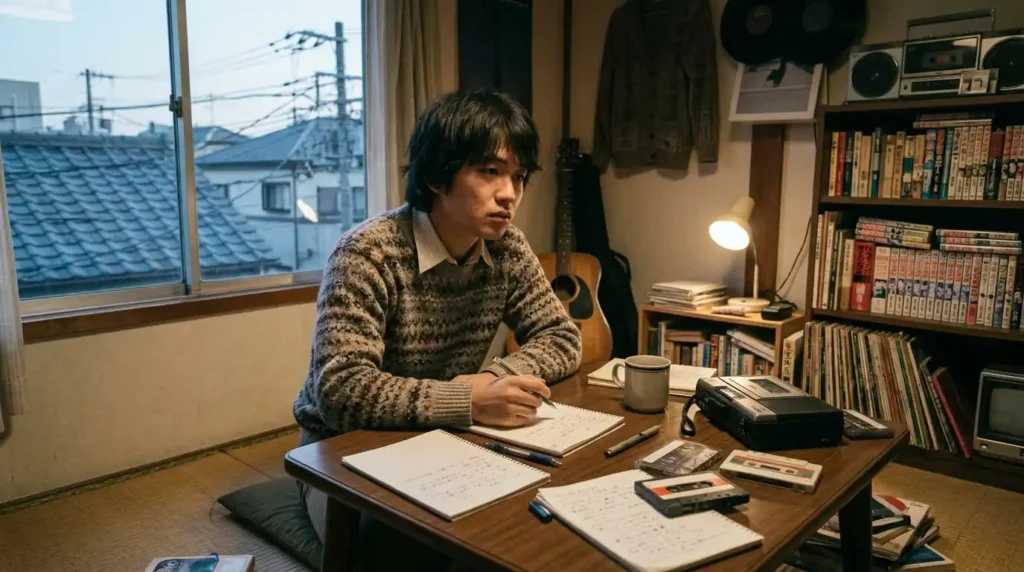
Sometimes we want to tell someone how we feel but cannot find the right words. Sometimes we try to move forward while uncertainty remains in our hearts. Nagai gives such emotions a voice through an understated, conversational style.
Chapter 3: 1979 — “Michishirube Nai Tabi” Brings National Recognition
A Television Commercial Introduces His Music to a Wider Audience
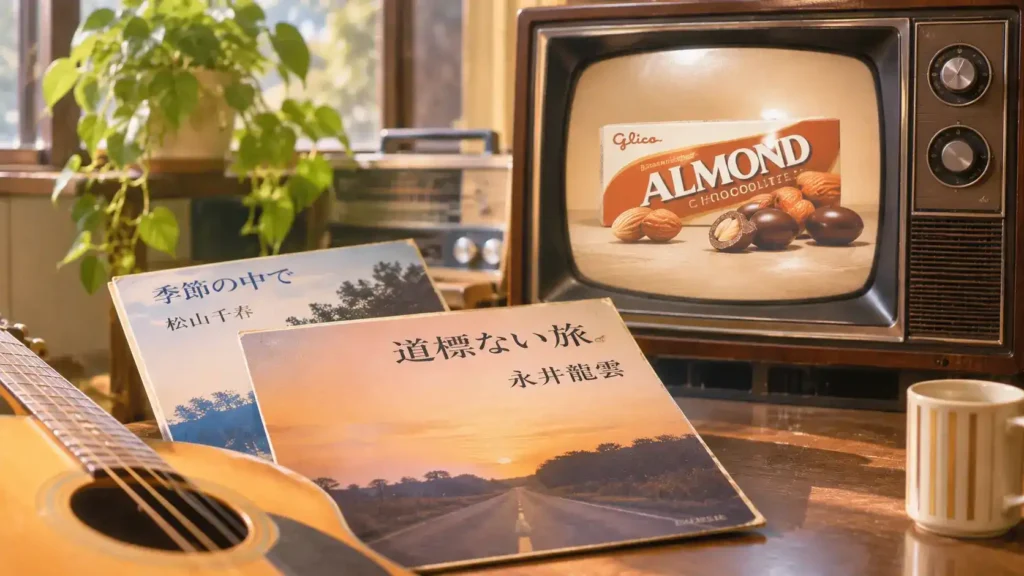
On August 21, 1979, Nagai released the single “Michishirube Nai Tabi” (A Journey Without Signposts).
Selected for a television commercial promoting Glico almond chocolate, the song became one of his signature recordings.
The previous year, Chiharu Matsuyama’s “Kisetsu no Naka de” (Amid the Seasons) had also been used in a commercial for the same product. At the time, television advertising was an important way for music to reach a nationwide audience.
Finding a Way Through Life Without Signposts
Life does not always provide clear directions. We sometimes make decisions without knowing what lies ahead, uncertain whether the paths we have chosen are the right ones.
“Michishirube Nai Tabi” conveys the determination to keep walking despite that uncertainty. Rather than promising a bright future without difficulty, the song acknowledges doubt and suggests that moving forward is still possible.
A song that once sounded like an anthem of youthful encouragement may take on another meaning later in life, inviting listeners to reflect on the choices they have made.
The Early Albums Behind the Hit Single
In 1979, Nagai also released the albums “Hatsunetsu” (Fever) and “Dankan” (Warmth and Cold). The former includes songs such as “Tsumasaki-zaka” and “Hoshizukiyo,” while the latter features “Michishirube Nai Tabi.” Together, these recordings reveal a musical world that extends well beyond his best-known single.
Chapter 4: The 1980s — Expanding His Musical Horizons
An Evolving Style Across Successive Albums
Nagai continued recording throughout the 1980s. Albums such as “Yoru, Kaze, Ame” (Night, Wind, Rain), “Fūen,” “Kaze no Cocktail” (Wind Cocktail), “STAND BY,” and “Aru Toki” (At a Certain Time) demonstrate how he broadened his musical expression while retaining his folk roots.
On March 25, 2017, a nine-CD box set titled “Ryūun Nagai 1978–1986 CANYON RECORD YEARS” was released. Bringing together eight albums from his Canyon Records period and a collection of previously non-album tracks, the set offers a chronological overview of his early career.

Another Side of Nagai on the Radio
From 1981 to 1982, Nagai also served as a host of the Thursday late-night second segment of Nippon Broadcasting System’s “All Night Nippon.”
Before the internet became widely available, radio offered listeners a rare opportunity to hear musicians speak about their personalities and ideas. For Nagai, it provided a different kind of connection with his audience beyond records and live performances.
Chapter 5: “Noren” — A Turning Point as a Songwriter and Composer
Writing for Hiroshi Itsuki
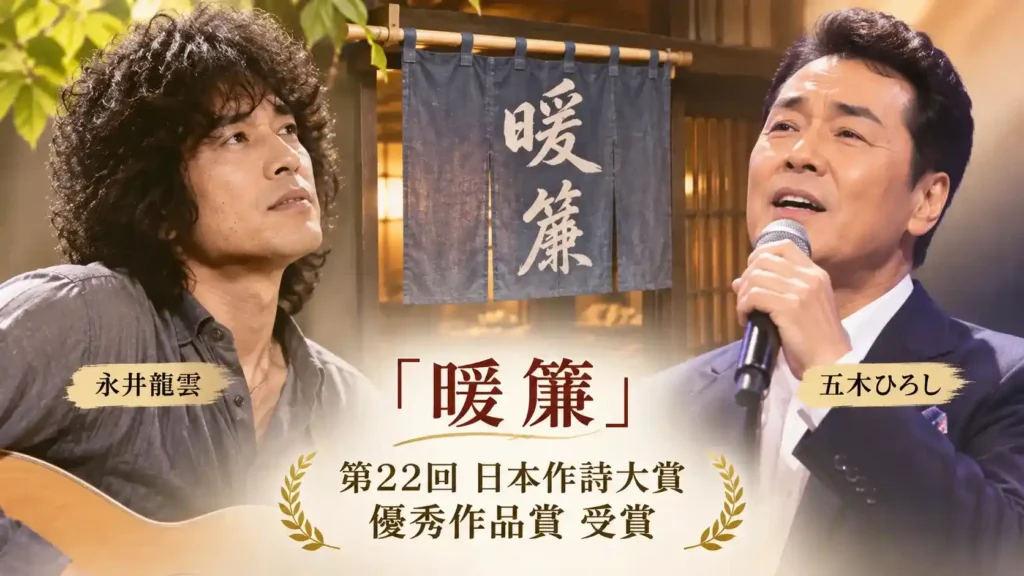
In September 1989, an important work in Nagai’s career was released: “Noren,” performed by the celebrated enka singer Hiroshi Itsuki.
Written and composed by Ryūun Nagai, “Noren” received an Outstanding Work Award at the 22nd Japan Lyricists Awards.
Already recognized as a singer-songwriter who performed his own material, Nagai now earned acclaim for a song entrusted to another artist. Its success marked an important expansion of his career as a professional songwriter.
On a personal note, “Noren” was one of my favorite karaoke songs during my years as an office worker. I often sang it at after-work gatherings and second-round parties. Those were the days! ( ;∀;)
A Song About Dignity and Perseverance
The Japanese word “noren” refers to a traditional fabric curtain hung at the entrance of a shop or restaurant. Beyond its practical function, it can symbolize a business’s reputation, traditions passed down through generations, and the pride of those who preserve them.
The song portrays a person who has experienced hardship and disappointment yet remains determined to live according to personal convictions. Itsuki’s emotionally expressive singing gives that story both warmth and strength.
Bridging Folk Music and Enka
Folk music and enka differ in musical structure and vocal technique, but both frequently explore family, separation, hometown memories, and the struggles of ordinary people.
Nagai has a gift for presenting these subjects as human stories rather than confining them to a particular genre. “Noren” demonstrates how that sensibility can reach a wider audience through another singer’s interpretation.
Chapter 6: A Second Musical World Through Songs Written for Others
Compositions Entrusted to Different Performers
Following “Noren,” Nagai continued writing for a variety of artists. Notable examples include Hiroshi Itsuki’s “Onna no Sakaba” (A Woman’s Bar), Fuyumi Sakamoto’s “Urizun no Koro” (The Season of Urizun), Aya Shimazu’s “Yumemidori” (Dream Bird), and Junko Ishihara’s “Amayadori” (Sheltering from the Rain).
For Chiyoko Shimakura’s “Kimi” (You), the lyrics were written by Tetsuro Hoshino and the music was composed by Nagai. He also wrote both the lyrics and music for Toshiyuki Nishida’s “Kondo Umarete Kuru to Shitara Nara” (If I Were Born Again).
Every singer has a different voice and approach to interpretation. Nagai’s ability to create songs that suit those individual qualities is one of his strengths as a composer.
The Distinctive Setting of “Urizun no Koro”
Fuyumi Sakamoto’s “Urizun no Koro” is a particularly interesting example of Nagai’s versatility as a songwriter. In Okinawa, “urizun” refers to the season when spring gradually gives way to early summer.
Its setting and atmosphere differ considerably from those of “Noren,” yet both songs show an interest in people’s everyday lives. The seasonal imagery associated with Okinawa reveals another dimension of Nagai’s songwriting.
The Self-Cover Album “Jiriki Hongan”
On July 7, 2010, Nagai released “Jiriki Hongan” (Self-Reliance), an album in which he performed songs originally written for other artists. Its eleven tracks include “Noren,” “Onna no Sakaba,” and “Kimi.”
Hearing the original composer perform a song made famous by another singer can change the listener’s impression of its phrasing and melody. “Jiriki Hongan” offers an opportunity to appreciate Nagai both as a vocalist and as a songwriter.
Chapter 7: From His Sixtieth Birthday to the Present — A Continuing Creative Journey
2017: The Meaning Behind “Oibito”
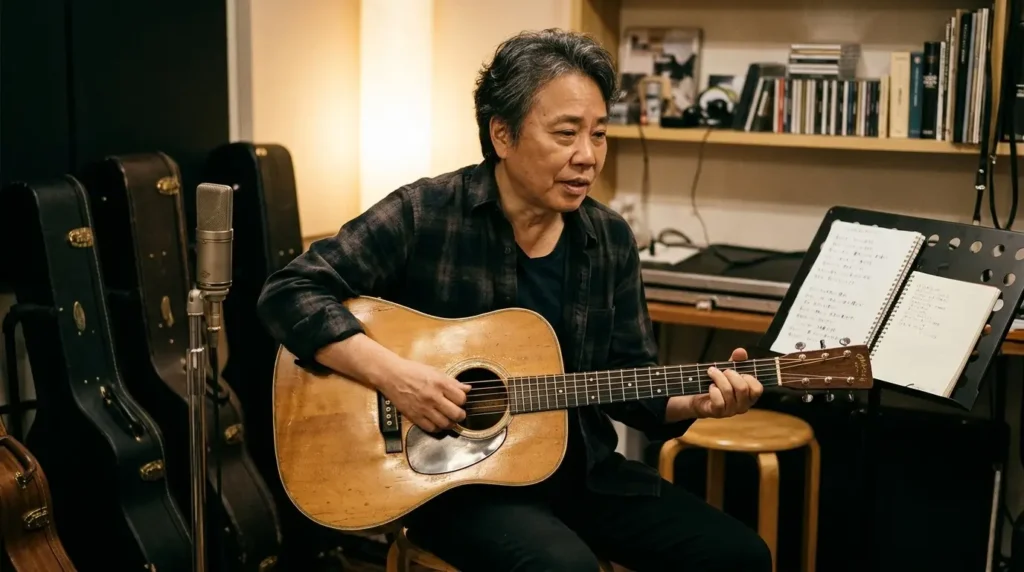
Ryūun Nagai turned sixty in 2017. On December 13 of that year, he released “Oibito,” an album commemorating both his sixtieth birthday and the fortieth-anniversary celebrations of his recording career.
“Oibito” is a word Nagai himself defined to describe someone who has grown older while pursuing dreams and continues to pursue them despite the passing years.
In youth, dreams often seem inseparable from expectations of the future. With age comes a clearer understanding of life’s limitations and difficulties. The title reflects a determination to keep setting new goals nevertheless.
An Anniversary Concert and Further Recordings
On December 16, 2017, Nagai held a fortieth-anniversary concert at Sakura Hall in the Shibuya Cultural Center Owada in Tokyo.
His recording career continued with “Shizuka na Kokoro” (A Quiet Heart) in 2020 and “Futten” (Boiling Point) in 2022. In 2023, he celebrated forty-five years since his debut and released another self-cover album, “Kan: Jiriki Hongan.”
2025: The Release of “Watashi no Isshō”
On May 21, 2025, Nagai released “Watashi no Isshō” (My Life), an album featuring ten newly written songs for which he composed both the music and lyrics.
There is something meaningful about an artist who sang “A Journey Without Signposts” in his youth releasing an album titled “My Life” decades later. The contrast between the two titles invites reflection on the many years spent creating music.
The album includes “Ajisai no Saku Koro” (When the Hydrangeas Bloom), “Goze Aika” (Lament of a Blind Itinerant Woman Musician), “Furusato Seinendan” (Hometown Youth Group), and “Ima ga Ichiban Utsukushii” (Now Is the Most Beautiful Time). Even their titles suggest subjects ranging from familiar scenery to reflections on the course of a lifetime.
Chapter 8: Why Does Ryūun Nagai’s Music Stay with Us?
Melodies Shaped by the Natural Rhythm of Japanese
One of the defining qualities of Nagai’s music is the beauty of its melodies. His compositions follow the natural flow of Japanese words, creating musical phrases that feel immediately familiar without losing their individuality.
Even when a song builds from a quiet opening toward a more emotional passage, Nagai does not depend solely on vocal power or technical display. The progression of the melody itself carries much of the feeling.
Lyrics That Acknowledge Human Vulnerability
Another important quality is his willingness to portray human weakness and uncertainty without romanticizing them.
Effort does not always lead to success. Losing someone important or regretting a decision made long ago is part of the human experience.
Nagai’s songs rarely dismiss such feelings with easy words of encouragement. Instead, they depict people living with sadness and doubt, allowing listeners to connect the music with their own experiences.
How Songs Change as We Grow Older
Returning to a song after several decades can reveal something that escaped our attention when we first heard it. The recording has not changed, but the listener has lived through experiences that give its words a different significance.
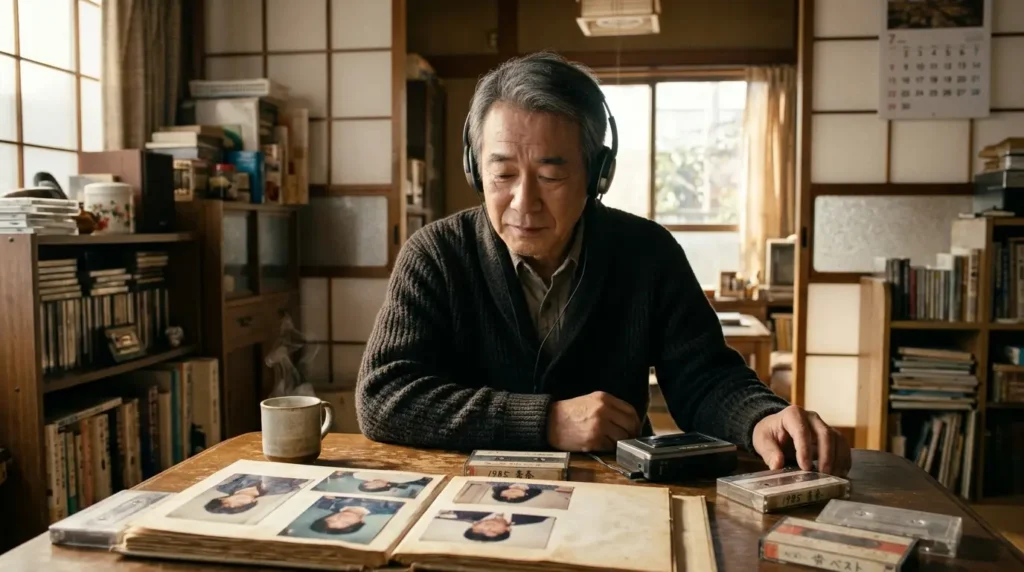
The sensitivity of Nagai the singer and the craftsmanship of Nagai the songwriter come together to form the distinctive appeal of his music.
In Closing — Looking Ahead to My Personal Mini Best 7
Nearly half a century has passed since Nagai made his debut in 1978. Throughout those years, he has continued performing his own music while composing songs for many other artists. His career encompasses far more than the recordings for which he is most widely known.
Beginning with the next article, I will present “My Personal Mini Best 7: Ryūun Nagai.”
From his extensive catalog, I have selected seven songs that have stayed with me. Each article will explore one recording, paying particular attention to its lyrics, melody, and vocal performance.

音楽ファン同士の交流・リクエストはこちら / Connect & Request Songs Here