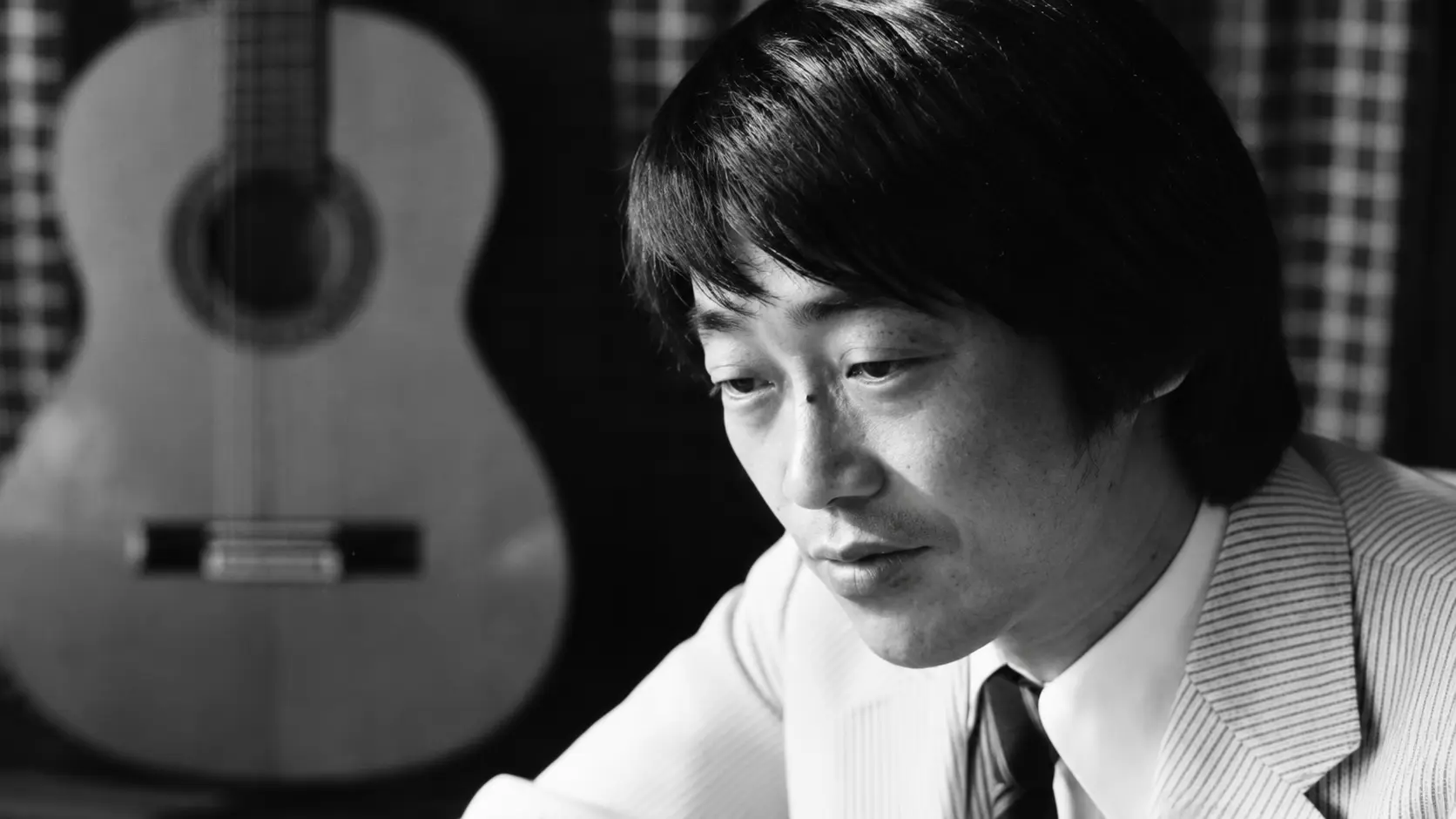
Discover the Story of Koichi Morita!
- 🎧 Listen to This Article
- No. 6: “Ubaguruma” (Baby Carriage)
- First, listen to Koichi Morita sing “Ubaguruma.”
- Three Years, Revealed by a Single Baby Carriage
- Why Three Years?
- Why the Sunny Day Matters
- A Small Child Reaches for a Pinwheel
- Koichi Morita’s Melody Sets the Story in Motion
- Turning Up the Collar of His Overcoat
- Yu Aku and Koichi Morita — Two Award-Winning Songs in 1975
- In Closing
🎧 Listen to This Article
Get a quick overview of this article through narration.
Recommended if you would like to get a feel for “Ubaguruma” and the overall flow of the article before reading.
🎶 English Narration
An English narration introducing the content of this article.
🎵 Japanese Narration
A Japanese narration introducing the content of this article.
Listening first will help you get a better sense of the world of “Ubaguruma” and the key ideas explored in the article.
No. 6: “Ubaguruma” (Baby Carriage)
“Ubaguruma” was written by Yu Aku, composed by Koichi Morita, and first released by Yoichi Sugawara on May 21, 1975. The arrangement was by Shin Kawaguchi. Morita and Top Gallants also recorded the song.
Although it never became one of the era’s biggest popular hits, “Ubaguruma” earned Yu Aku the Best Lyricist Award at the 17th Japan Record Awards that same year. Morita, meanwhile, received the Best Composer Award for “Geshukuya” (The Boarding House), which he performed with Top Gallants.
For this miniBest7, I have chosen the version of “Ubaguruma” performed by Koichi Morita and Top Gallants.
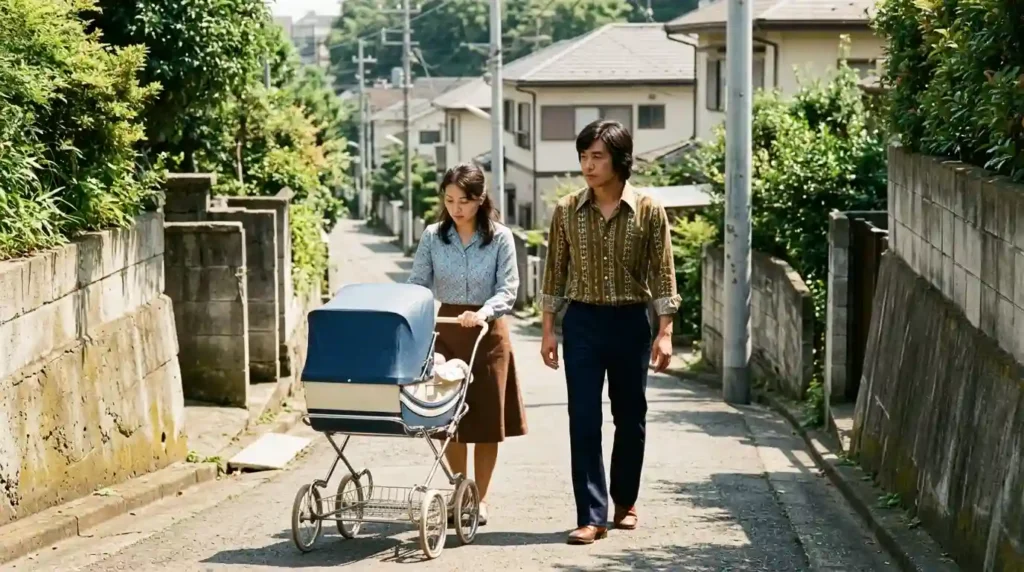
A man and a woman walk side by side up a hill on a clear day. He carries nothing; she pushes a baby carriage. That simple scene is enough to reveal the three years that now separate their lives.
A Free Interpretation
On a sunny hillside, I walk beside the woman I once knew.
I am empty-handed; she is pushing a baby carriage, with three years of life lying between us.
Her profile still looks the same, yet I know the time we lost can never be reclaimed.
I watch her leave, turn up the collar of my overcoat, and begin walking alone.
💡 You might also like: View the original Japanese lyrics (External site)
If the lyrics are available only in Japanese, you can use your browser’s translation feature or an AI translation tool to understand their general meaning.
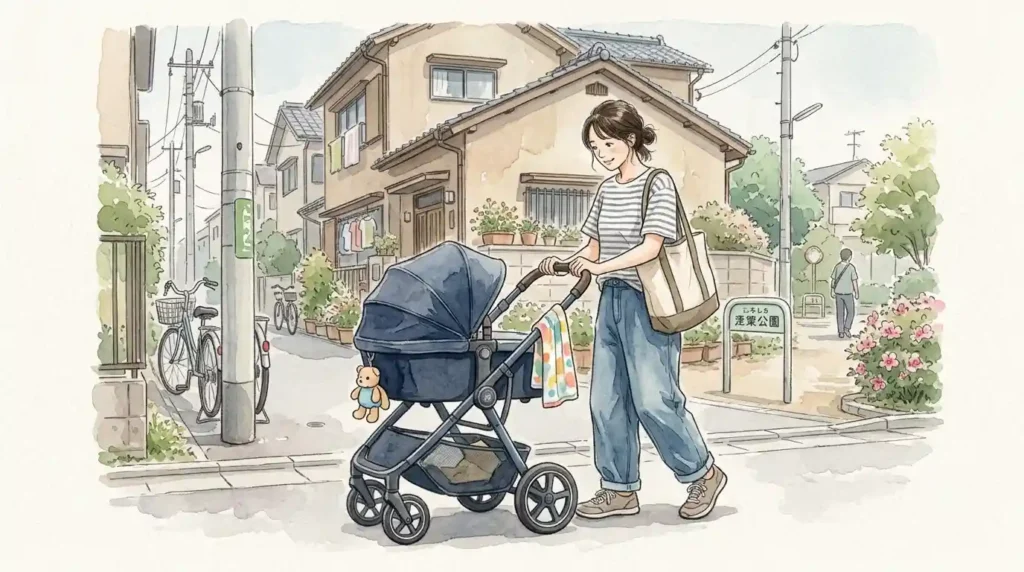
First, listen to Koichi Morita sing “Ubaguruma.”
(This is not an official video, so I have linked it through the image below. Click the image to listen.)
Credits
Lyrics: Yu Aku / Music: Koichi Morita
In Two Lines
A man and a woman, separated by three years of life, walk together on a sunny hillside as she pushes a baby carriage.
Her familiar profile remains unchanged, yet everything around her tells him how much their lives have changed.
Three Years, Revealed by a Single Baby Carriage
What first draws me to this song is its title: “Ubaguruma,” or “Baby Carriage.” Although the song looks back on the past shared by a man and a woman, Yu Aku chose not a word describing love or heartbreak, but an ordinary object standing right before them.
Nor does he explain their relationship in detail. Yet by the time the song ends, we can feel the full weight of those three years.
Three Years Left Unexplained
What exactly was their relationship? Why did they part? How did each of them spend those three years? Yu Aku tells us none of this.
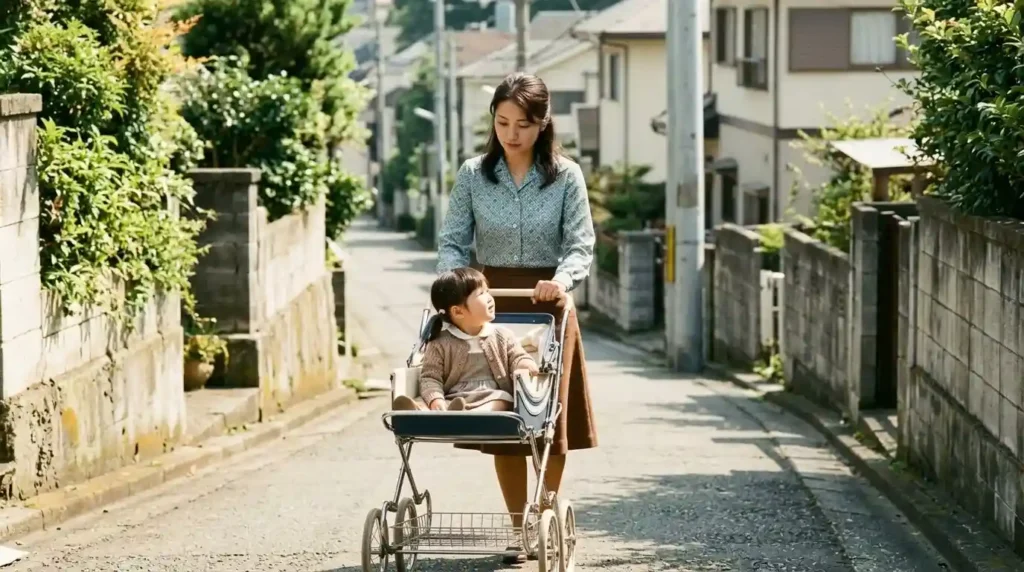
Instead, he shows us the present: the man walks empty-handed, while the woman pushes a baby carriage with a small child inside. From that alone, we know that sometime during those three years, she became a mother.
An Empty-Handed Man and a Woman Pushing a Baby Carriage
The contrast is striking.
Beside the woman is a young child. About the man, almost nothing is explained. We are simply shown that he is empty-handed.
An empty-handed man and a woman pushing a baby carriage. Without explaining what has happened in either life, this single image makes the distance of three years visible.
Why Three Years?
The more I listen to this song, the more I find myself thinking about those “three years.” Not ten years. Not five. Three.
Three years is a curious length of time. It is not long enough for memories to feel like something from a distant past. Yet it is more than enough time for a person’s life to change completely.
Perhaps that is why the woman’s profile still seems to belong to “those days.” Even after time apart, the man can immediately recognize the face he remembers. That sense of nearness makes the song all the more complicated.
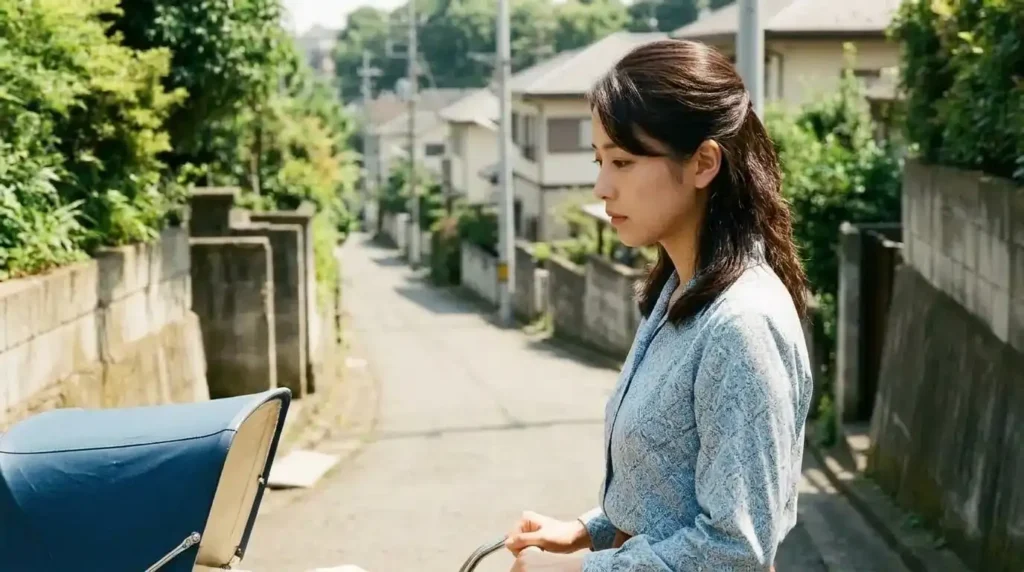
The Past Feels Close, Yet There Is No Going Back
If they were meeting again after ten years, it would hardly be surprising to find that their lives had changed. Ten years itself would be enough to explain the distance between past and present.
But three years is short enough for yesterday to feel almost within reach. In the man’s memory, his time with this woman may not yet have become something that belongs entirely to the past.
And yet the reality before him has moved far ahead. She is pushing a baby carriage, and inside it is a small child. The sight forces him to confront everything that has happened in the life of the woman he once knew while he was no longer part of it.
Not How Much Time Passed, but How Much Happened
Life does not change at a steady pace. There are years when almost nothing seems to change, and there are short periods in which an entire way of life can be transformed.
The three years in “Ubaguruma” seem to belong to the latter.
For the man, the important question is not whether three years is a long or short time. It is the realization that, somewhere beyond his sight, her life had continued moving forward without him.
Only three years have passed. And yet there is already no way back to where they once were.
That is why “Ubaguruma” does not sound to me like a song simply looking back on some distant past. It is about discovering that a past which still feels close enough to touch is, in fact, already beyond reach.
Why the Sunny Day Matters
The scene takes place neither in the rain nor at dusk. It is a rare clear day, on a hillside.
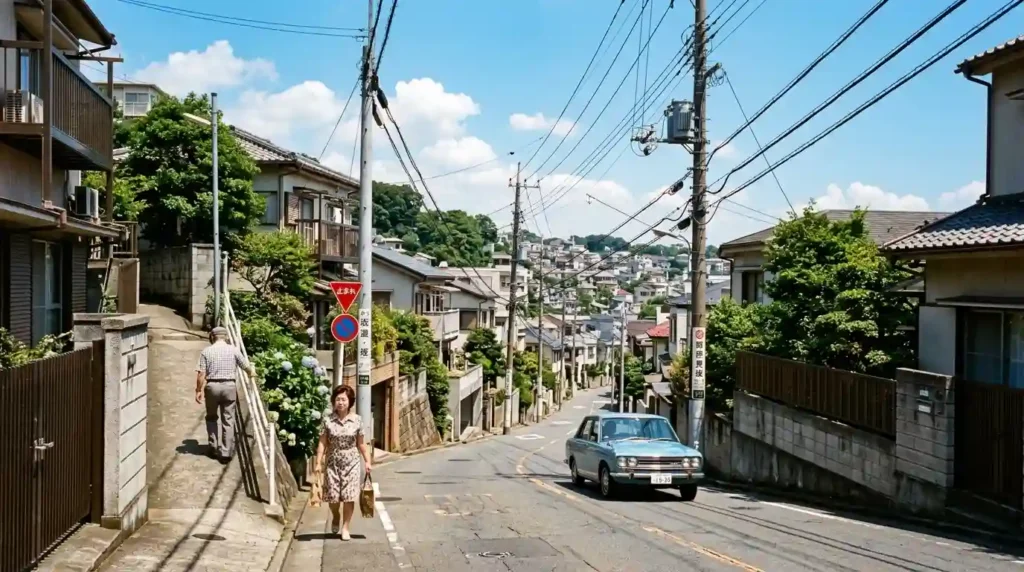
A song about separation and a lost relationship could easily have been framed by rain or darkness. Instead, “Ubaguruma” places the two of them in daylight. Perhaps precisely because the world around them is so calm, the time that can no longer be bridged becomes even more visible.
Her Profile Is Just as He Remembers It
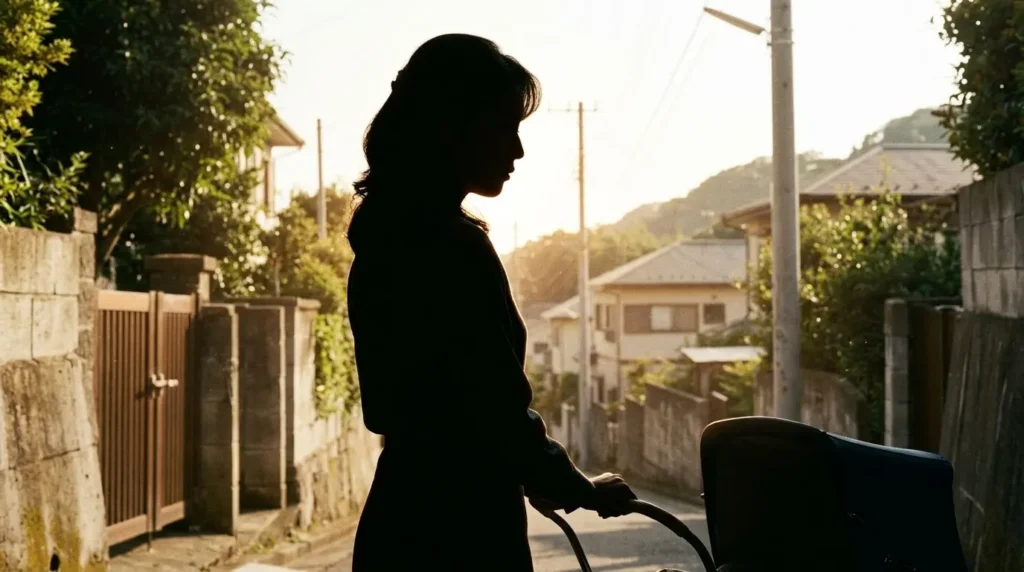
When the man steals a glance at the woman beside him, her profile seems almost unchanged from three years earlier. This is one of the song’s sharpest details.
Her appearance still carries something of “those days.” Yet beside her is the baby carriage. The more familiar her face seems, the more clearly he becomes aware of how much those three years have changed everything around it.
The same familiar profile, and a life that is no longer the same. Yu Aku places both within a single scene on the same hillside.
A Small Child Reaches for a Pinwheel
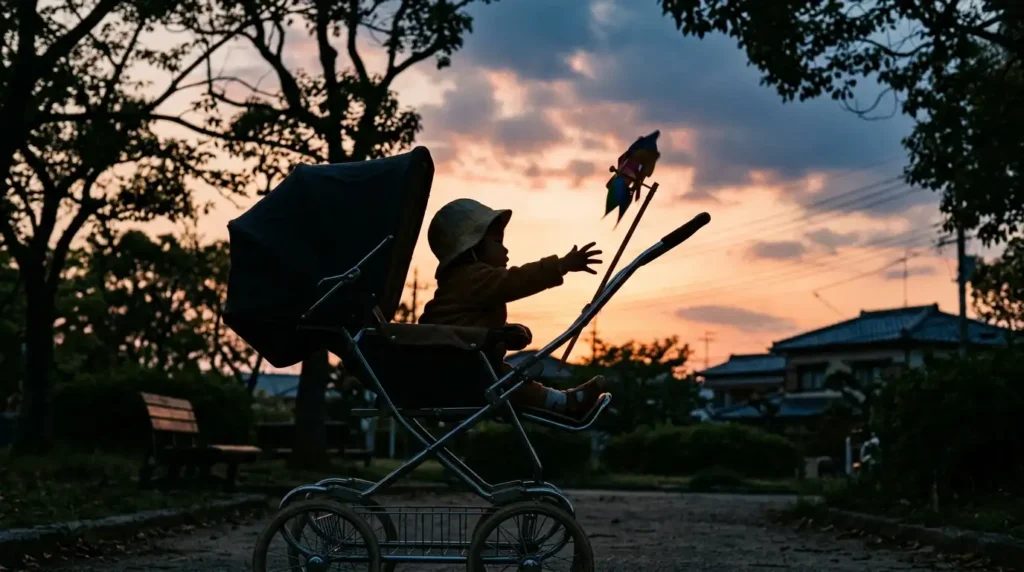
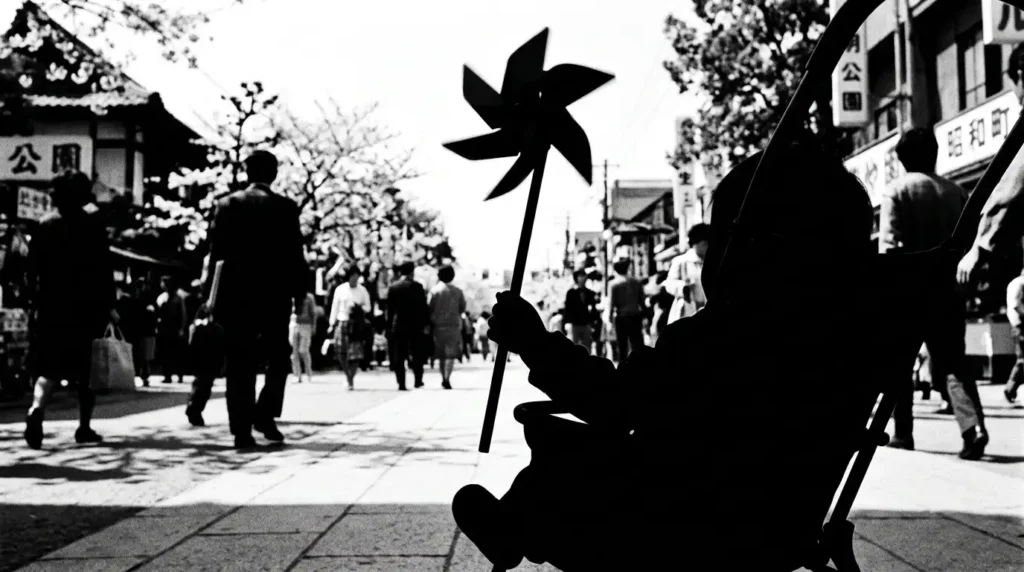
Later in the song, the child in the baby carriage reaches innocently toward a spinning pinwheel. That small gesture stays with me.
There are three years of history between the two adults. The child knows nothing of it and simply reaches toward the pinwheel turning nearby. That innocent movement suddenly makes the entire scene feel vividly alive.
Showing Emotion Through Scenery
Once again, Yu Aku does not tell us directly what the man is thinking. Instead, he gives us the pinwheel and the child’s reaching hand.
Rather than explaining the emotion, he places visible details before us one by one. The listener is left to imagine what is happening inside the man.
I think this is one reason “Ubaguruma” feels like something more than a conventional song about lost love.
Koichi Morita’s Melody Sets the Story in Motion
Read on the page, Yu Aku’s lyrics can feel almost like a scene from a short story. Add Koichi Morita’s melody, and the scene begins to move; you can almost sense the pace of the two people walking along the hillside.
There is no dramatic musical turn designed to force an emotional response. The melody follows the natural flow of the words without making the scene larger than it needs to be. That restraint suits the song beautifully.
Hearing “Ubaguruma” in Morita’s Own Voice
The song was first released by Yoichi Sugawara, whose performance carries the polished precision of a singer who knows how to deliver every word with care.
By contrast, when I hear the song performed by Koichi Morita and Top Gallants, the same story seems to move a little closer to ordinary life.
A Voice That Never Overplays the Emotion
Morita is not a singer who magnifies sadness for dramatic effect. His slightly dry, understated delivery makes the man in the song seem equally unwilling to display everything he feels.
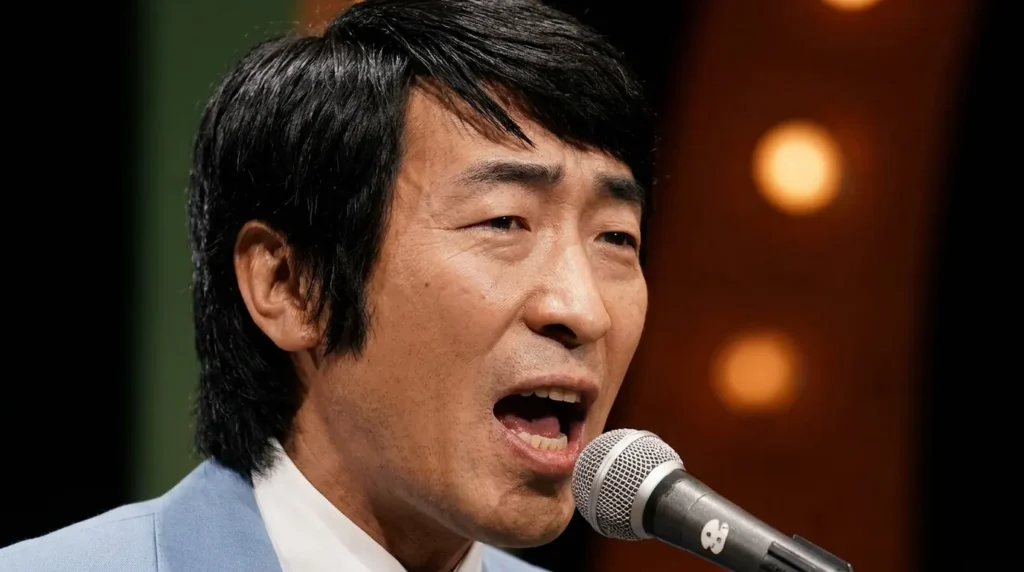
Yu Aku leaves much unexplained in the lyrics, and Morita likewise avoids overplaying the emotion. Together, they leave the listener room to imagine what cannot be put into words.
Turning Up the Collar of His Overcoat
And then comes one of the images I find most memorable: the man at the end of the song.
The woman pushes the baby carriage away. He watches her leave, turns up the collar of his overcoat against the wind, and starts walking again.
He Does Not Follow Her. He Simply Walks On.
He does not call out to her. He does not bring up the past or tell her how he feels. He watches her go, and then he begins walking himself.
Those three years cannot be recovered. Her profile may look just as he remembers it, but the reality surrounding the two of them is no longer the same.
Perhaps what this song captures is not the separation itself, but the moment when a person realizes that there is no returning to the place where the two once stood together.
Yu Aku and Koichi Morita — Two Award-Winning Songs in 1975
1975, the year “Ubaguruma” was released, was also an important year for the partnership between Yu Aku and Koichi Morita.
At the 17th Japan Record Awards, Yu Aku received the Best Lyricist Award for “Ubaguruma,” while Koichi Morita received the Best Composer Award for “Geshukuya” in the same year. “Geshukuya” was also written by Yu Aku.
That same year, Junko Sakurada’s “Jūshichi no Natsu” (Seventeen in Summer), also written by Yu Aku and composed by Koichi Morita, was among the songs honored with the Popularity Award. 1975 was a year in which the work of these two men had a particularly strong presence in Japanese popular music.
Finding Human Drama in an Ordinary Scene
“Ubaguruma” and “Geshukuya” share something important. Neither depends on a dramatic event. Instead, each finds human relationships and the passage of time within scenes that could belong to everyday life.
A Hillside, a Baby Carriage, a Pinwheel, an Overcoat
Nothing in “Ubaguruma” is extraordinary in itself: a sunny hillside, a baby carriage, a spinning pinwheel, the collar of an overcoat.
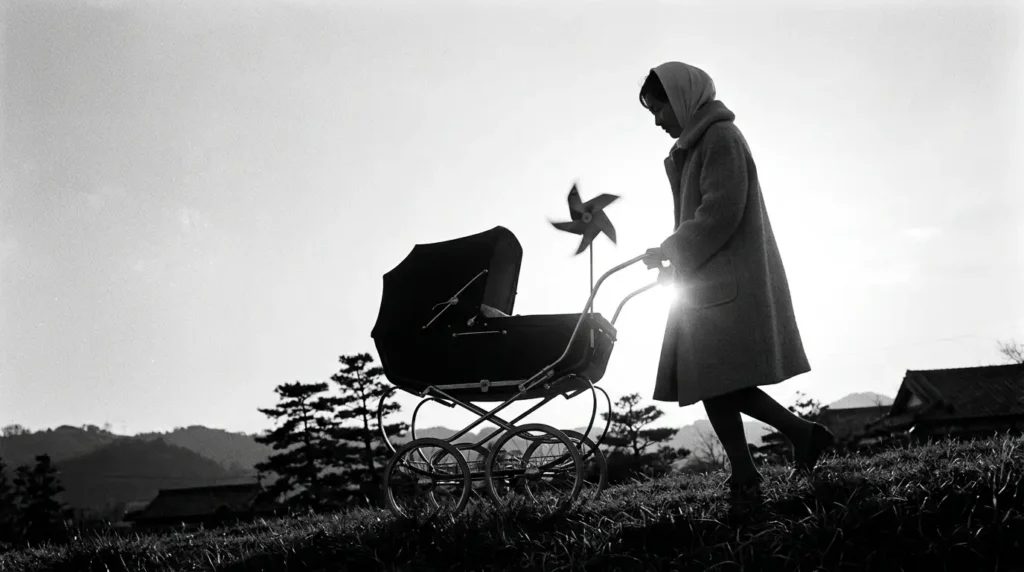
Yet when these details are brought together in a single scene, even the invisible passage of three years seems to take on a visible form. To me, “Ubaguruma” is a song that could only have emerged from the meeting of Yu Aku’s words and Koichi Morita’s melody during this particular period.
In Closing
Two people walking along a sunny hillside. A baby carriage rattling beside them. And finally, a man turning up the collar of his overcoat and walking away.
A person may look much the same as three years earlier, while the life surrounding that person has become something entirely different. Yu Aku does not explain this change. He lets a single baby carriage show it to us.
Right beside the familiar profile he remembers lies the full weight of those three missing years.
And Koichi Morita’s melody quietly keeps that scene moving forward.
There is nothing showy about “Ubaguruma.” Yet once this scene has formed in my mind, it is difficult to forget. For me, that is what makes this song so memorable.


音楽ファン同士の交流・リクエストはこちら / Connect & Request Songs Here