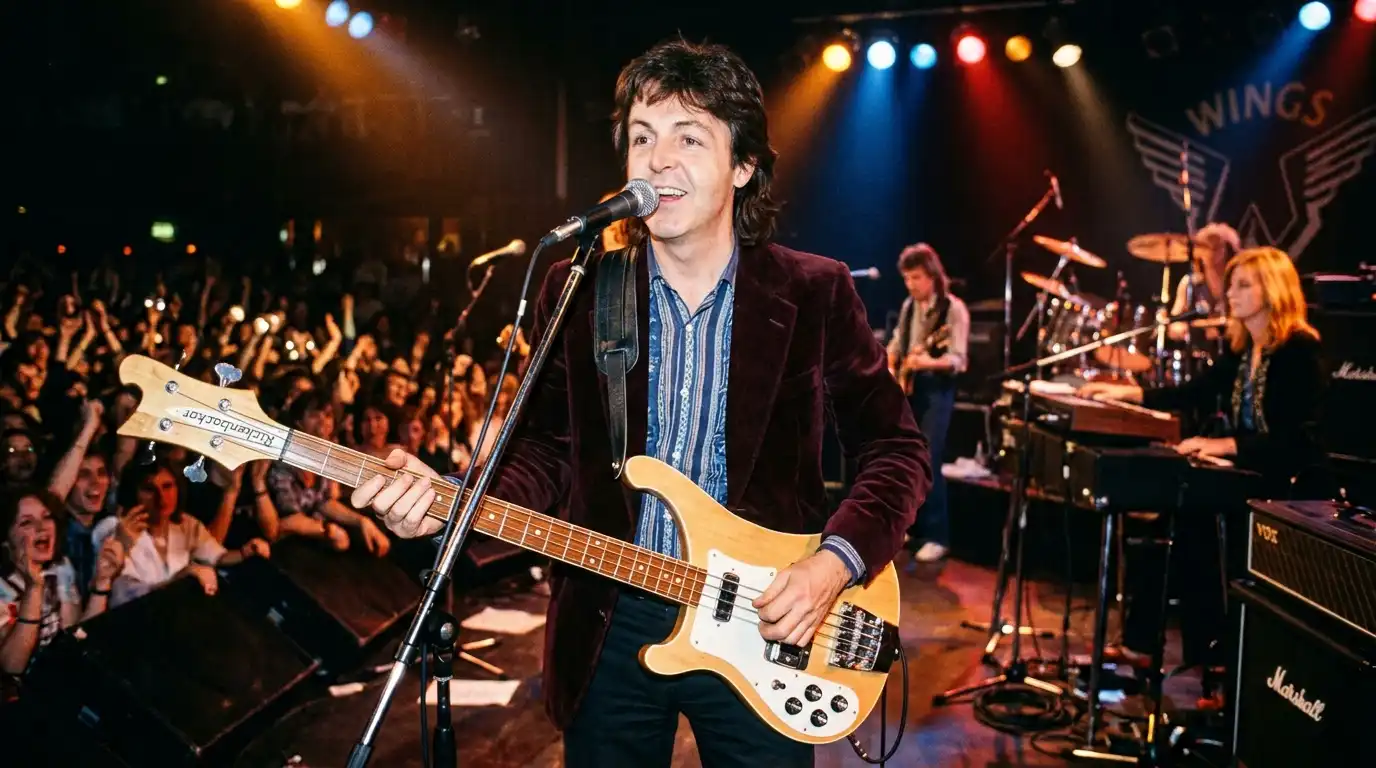
Explore Paul McCartney’s Journey Here!
- 🎧 Listen to This Article
- No. 12: “Silly Love Songs”
- First, listen to these official YouTube videos.
- The Man Accused of Writing Too Many Love Songs Answers Back
- When You Can’t Explain It, You Say “I Love You”
- That Bass Line Demands Your Attention
- Wings at the Speed of Sound — Letting the Whole Band Be Heard
- In Closing — Turning “Silly” into a No. 1 Hit
🎧 Listen to This Article
You can quickly explore the key points of this article through narration.
Recommended if you would like to get a sense of “Silly Love Songs” and the overall flow of the article before reading.
🎵 English Narration
An English narration introducing the content of this article.
🎶 Japanese Narration
A Japanese narration introducing the content of this article.
Listening first makes it easier to understand the background, musical appeal, and key points of “Silly Love Songs” before reading the full article.
No. 12: “Silly Love Songs”
No. 12 is “Silly Love Songs.” The song appeared on Wings’ album Wings at the Speed of Sound, released on March 26, 1976, and was issued as a single on April 30 of the same year.
It spent five consecutive weeks at No. 1 on the Billboard Hot 100 and earned Gold certification after selling more than one million copies. The album was also a major success in the United States, reaching No. 1 and remaining there for seven consecutive weeks.
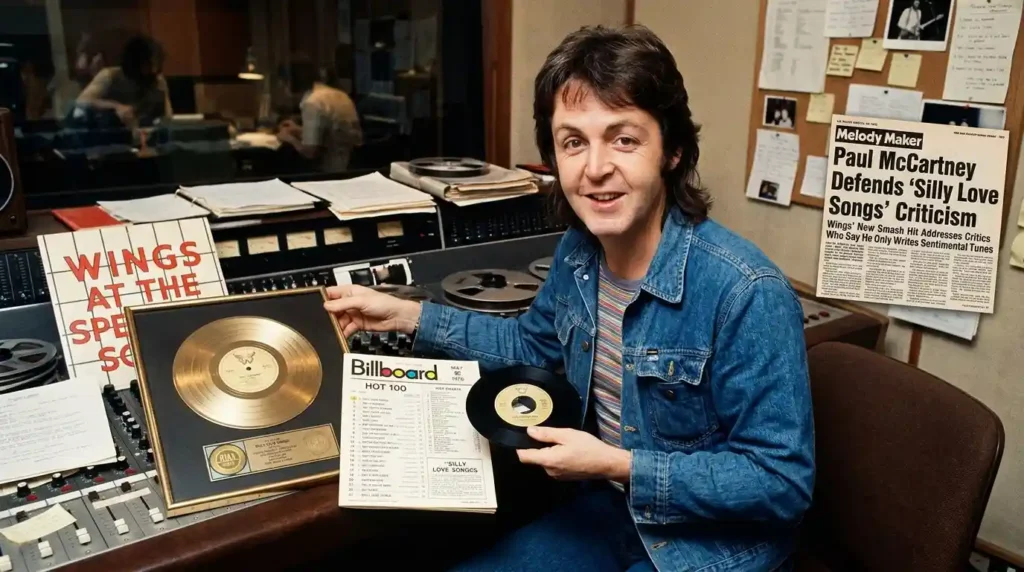
For a song that became such an enormous hit, its subject could hardly be more straightforward: a love song. Yet once you know the background, the song takes on a different character. It was written in response to critics who complained that Paul McCartney wrote too many sentimental love songs, turning the criticism itself into the subject of a song.
My Interpretation
If you think singing about love is silly, go ahead and laugh.
But when you truly love someone, sometimes “I love you” is the only thing left to say.
I may not be able to explain the feeling, but that doesn’t make it any less real.
So I’ll keep singing it again and again—because there’s nothing silly about love.
First, listen to these official YouTube videos.
Common Credits
Song: “Silly Love Songs”
Artist: Wings
Written by: Paul McCartney
Originally released on: Wings at the Speed of Sound (1976)
Published on: Paul McCartney Official YouTube Channel
① Original 1976 Music Video
Video: “Silly Love Songs” Original Music Video
Filmed: During the 1976 Wings Over the World Tour
Content: Promotional footage featuring Wings on tour
Two-Line Commentary
The original promotional video for “Silly Love Songs,” filmed during Wings’ 1976 tour.
Alongside performance footage, it captures the band on the road and offers a glimpse of Wings at the height of this period.
② “Rockshow” Live Version
Video: “Silly Love Songs” from Rockshow
Version: Live
Performance: 1976 Wings Over the World Tour / Seattle Kingdome
Featured in: Concert film Rockshow
Two-Line Commentary
A live performance from Wings’ 1976 Seattle Kingdome concert, featured in Rockshow.
Paul’s remarkably fluid bass line and the interlocking vocal parts reveal just how intricately the song was constructed.
The Man Accused of Writing Too Many Love Songs Answers Back
Behind the creation of “Silly Love Songs” was a persistent criticism directed at Paul after the breakup of The Beatles: that he wrote too many sentimental songs about love.
Paul did not respond by changing his style, nor did he offer a lengthy defense. Instead, it was almost as though he said, “Fine. Then I’ll write that love song.” He took the very subject he had been criticized for and placed it right at the center of the song.
“What’s wrong with writing love songs?”
That question lies at the heart of “Silly Love Songs.”
Yet there is no bitterness in the response. Riding on a buoyant rhythm, Paul almost smiles as he points out that people still want to hear songs about love. The ultimate irony is that his answer to the critics went on to become a No. 1 smash in America.
How the Word “Silly” Turns the Argument Around
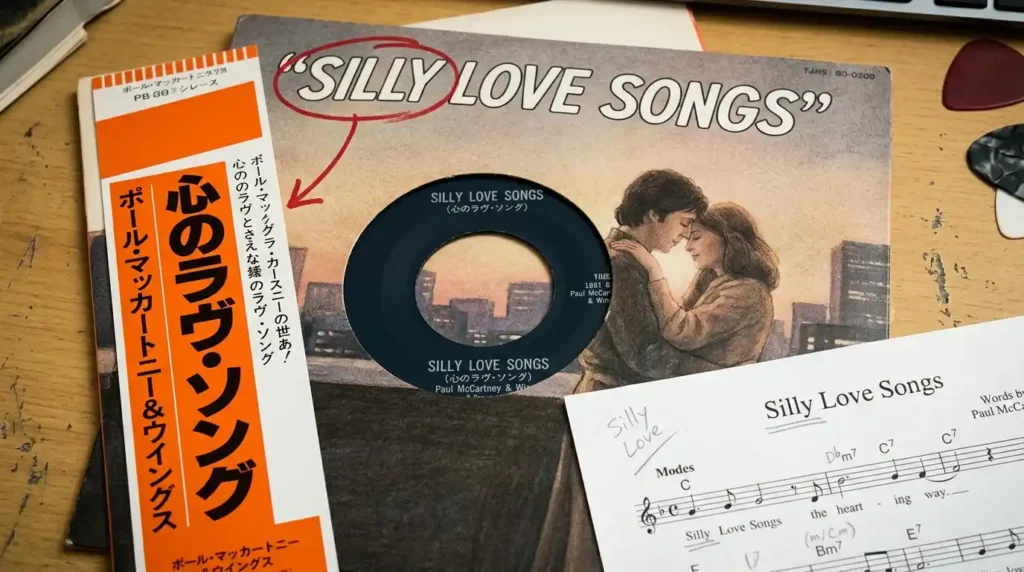
The Japanese title, “Kokoro no Love Song”—roughly “A Love Song from the Heart”—does not contain the word that gives the original title its bite: “silly,” meaning foolish or trivial. That single word is central to the song.
Paul is certainly not claiming that love itself is foolish. Instead, he borrows the language of people who dismiss love songs and gradually turns their judgment back on them.
Love does not necessarily arrive the moment we want it to. Sometimes it may never arrive at all. If love can be that difficult to find, what could possibly be foolish about singing about it? As the song unfolds, the word “silly” increasingly seems to apply not to love songs, but to the criticism of them.
When You Can’t Explain It, You Say “I Love You”
The lyrics are strikingly simple. Rather than constructing an elaborate story, the song repeatedly returns to one idea: the feeling is perfectly clear to the person experiencing it, yet almost impossible to explain.
If someone asks why you love a particular person, can you really explain everything? You can talk about personality, expressions, a voice, or memories of time spent together, but adding all those things up still does not fully explain the emotion itself.
And so what remains is the most familiar phrase of all: “I love you.” The words may be simple, but for the person saying them, there may be nothing more accurate. “Silly Love Songs” has no embarrassment about returning to that basic truth.
That Bass Line Demands Your Attention
The music, however, is far less simple than the lyrics suggest.
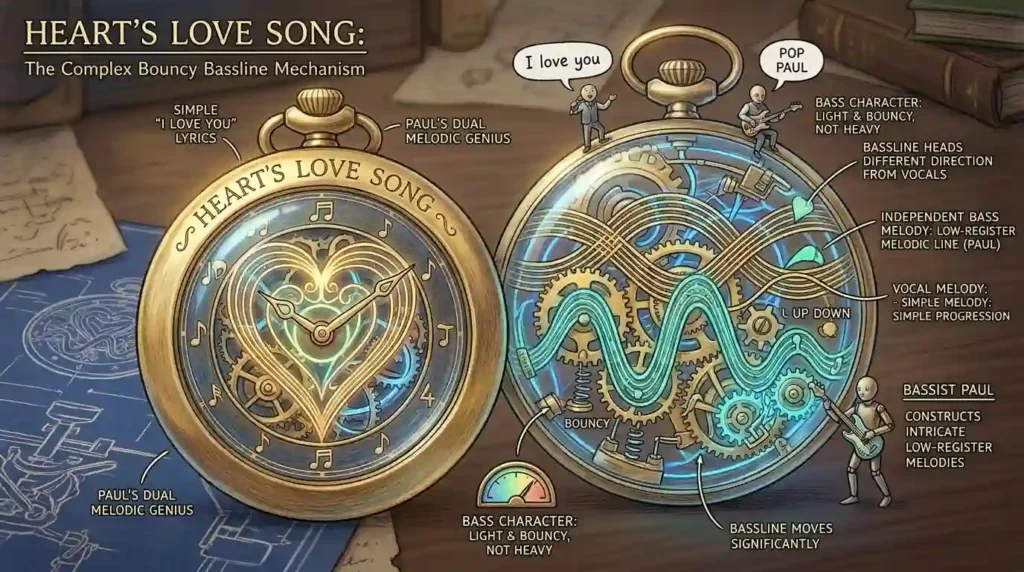
What immediately grabs the ear is Paul’s bass. Rather than merely anchoring the chords at the bottom of the arrangement, the bass line seems to move like an independent melody of its own.
Beneath the smooth vocal melody, the bass moves energetically up and down, sometimes heading in a completely different direction from the voice. Yet the arrangement never feels heavy. Instead, the movement gives the song much of its buoyancy.

Here we can hear two sides of Paul McCartney at once: the melodic craftsman who writes a tune almost anyone can hum, and the bassist constructing intricate melodic movement in the lower register.
Three Vocal Melodies Moving at the Same Time
As the song moves toward its later sections, the vocal arrangement becomes just as fascinating. Several voices carrying different words and melodies proceed simultaneously, each retaining its own identity while fitting into the larger whole.
This is not simply a lead vocal decorated with conventional backing harmonies. Independent melodic lines overlap in a contrapuntal design, increasing the musical density as the song approaches its conclusion.
The message could hardly be simpler—“I love you”—yet the musical machinery used to deliver it is remarkably intricate. That contrast is one of the major reasons “Silly Love Songs” rises above the level of an ordinary sweet pop song.
Wings at the Speed of Sound — Letting the Whole Band Be Heard
The album Wings at the Speed of Sound also reflects something distinctive about Wings at this stage of their career. Rather than placing Paul alone at the center as lead singer, every member of the band—including Linda McCartney, Denny Laine, Jimmy McCulloch and Joe English—sang lead on at least one track.
The album was made at a time when extensive touring had strengthened the bond between the established lineup. Across the record, there is a clear effort to present Wings as a genuine band rather than simply “Paul McCartney and his backing musicians.”
An Album Made in the Middle of a World Tour
Wings at the Speed of Sound was recorded during the 1975–76 Wings Over the World Tour. The fact that the album was created while the musicians were spending so much time together onstage undoubtedly reflects the cohesion the band had developed by this period.
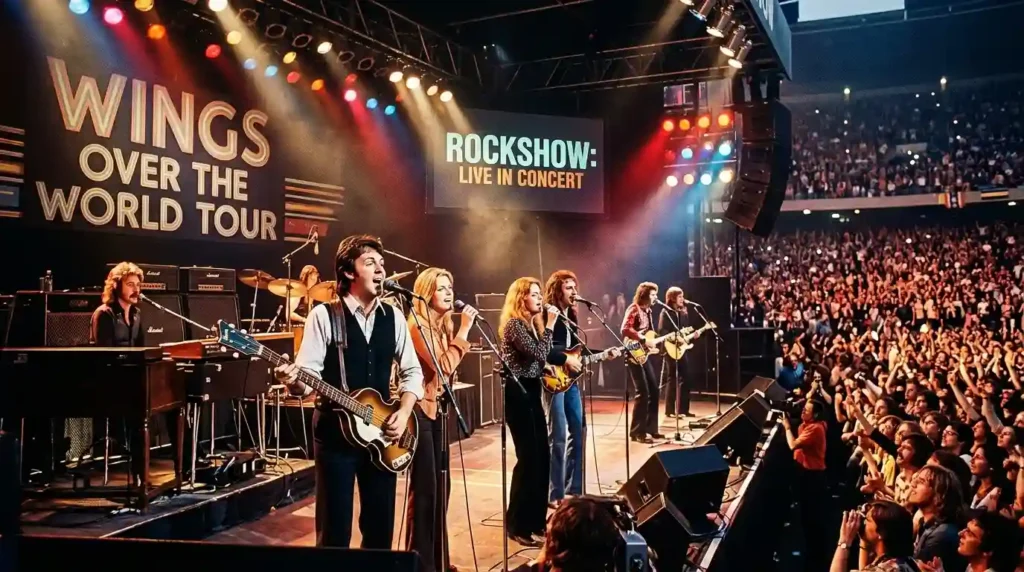
“Silly Love Songs” also became part of the tour repertoire. In the Rockshow footage above, the bass lines and overlapping vocals heard on the studio recording are recreated before a huge audience, allowing us to see how the elaborate arrangement worked onstage.
By 1976, Wings Had Enough Hits of Their Own
By 1976, Wings already had an impressive collection of signature songs, including “Band on the Run,” “Jet,” “My Love” and “Listen to What the Man Said.” Paul later recalled that by this stage Wings had accumulated enough hits of their own that he felt comfortable bringing Beatles songs into the live set.
The three-LP live album Wings Over America, released in December of that year, also included “Silly Love Songs” and reached No. 1 in the United States. It stands as a record of the era when Wings had become capable of carrying a massive international tour under their own name.
In Closing — Turning “Silly” into a No. 1 Hit
There is something quintessentially Paul McCartney about “Silly Love Songs.” Rather than avoiding the very thing critics had identified as a weakness—his love songs—he put it in the title and transformed it into a pop song anyone could understand.
Listen more closely, however, and you find a constantly moving bass line and vocal melodies crossing over one another. It sounds immediately accessible on the surface while hiding considerable sophistication underneath. That dual character gives the song much of its strength.
Most importantly, Paul never tries to turn the meaning of singing about love into an intellectual argument. People fall in love, and they try to tell someone how they feel. That is why love songs never disappear.

If love songs are everywhere, perhaps that is not because love itself is trivial, but because people in every generation continue to need it.
Are love songs really silly?
In 1976, Paul McCartney answered that question not with an essay or an argument, but with a pop song that spent five consecutive weeks at No. 1 in America.

音楽ファン同士の交流・リクエストはこちら / Connect & Request Songs Here