- 🎧 Enjoy This Article in Audio
- Prologue — The Reason “Delico” Emerged
- Formative Years (1997–1999) — From a Club to a Duo
- From Demos to Gaining Attention (1999)
- The Major Debut (2000) — The Impact of the First Single
- The Album Era (2001–2002) — A “Best Of” Styled 1st and an Expanded 2nd
- International Reception (2001–) — From US Showcases to Asia
- Maturity in the Early ’10s (2003–2015) — Self-Production and a Private Studio
- Updating the Framework (2016–2021) — Reconfiguring as a Flexible Band
- The Latest Work and Present Horizon (2022–) — Vistas Beyond “A Revolution”
- The Core of Their Sound (Summary)
🎧 Enjoy This Article in Audio
You can quickly grasp the main points of this article through narration.
Recommended for those who want to catch the vibe of the music and the flow of the article before reading.
🎶 English Narration
An English audio introduction to the contents of this article.
⌛ Duration: Approx. 4 mins
🎵 Japanese Narration
A Japanese audio introduction to the contents of this article.
⌛ Duration: Approx. 3.5 mins
* Listening to the audio before reading helps you better understand the world of the music and the main points of the article.
Prologue — The Reason “Delico” Emerged
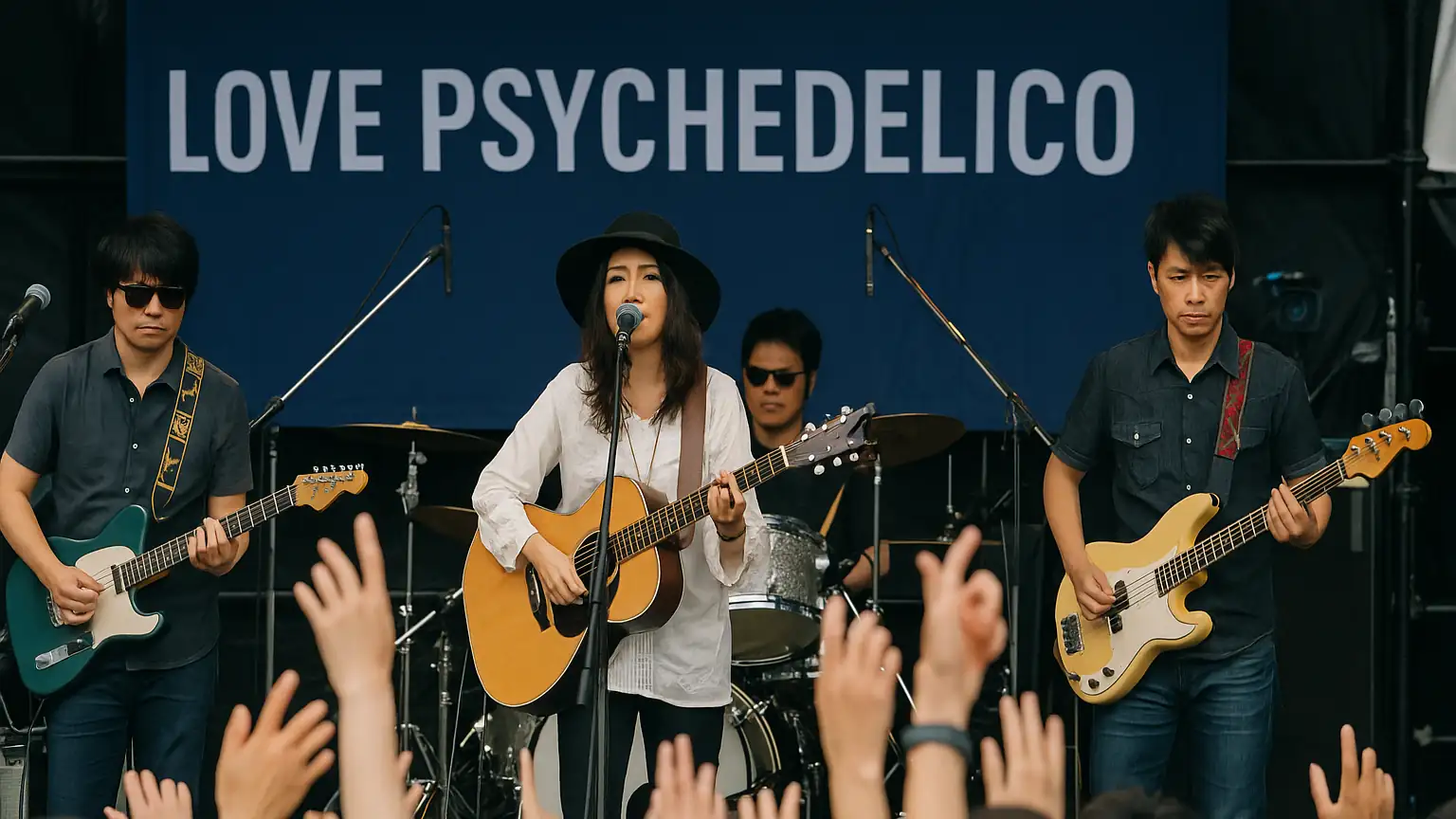
In 1997, KUMI (Vo) and NAOKI (Gt) met at Aoyama Gakuin University’s music club ACM (Aoyama Creative Music), which later led to the formation of LOVE PSYCHEDELICO.
Initially a multi-member band, they eventually settled into a duo format during the process of refining their creative direction. The demos they accumulated since their student days would evolve into official works in later years, serving as a vessel that perfectly carried the core of their vocabulary and sensibilities.

Formative Years (1997–1999) — From a Club to a Duo
KUMI’s Linguistic Background and Foundation of Expression
KUMI, originally from Chiba Prefecture, spent her early childhood in San Francisco, USA.
Her vocal style was uniquely shaped by a natural speech pattern where the rhythm of English and the intonation of Japanese coexist.
Her approach allows English to surface naturally as a layer of thought instead of applying it as a mere stylistic “effect,” which decisively sets her apart from other bilingual or English-mixing vocalists. The transitions within songs are never abrupt; they connect seamlessly through the melodic flow and consonant placement, ensuring that the semantic shift feels completely effortless. (This is exactly what makes it so brilliant!!)

NAOKI’s Roots and Riff-Oriented Thinking
NAOKI possesses a deep affection for 1960s and 70s rock, blues, and R&B, making him a guitarist who generates driving force by repeating brief musical motifs.
His style is characterized by a precise crunch that maximizes overtones and a distinct sense of structure in 4-bar units. Rather than overdubbing unnecessarily, he creates vitality by utilizing the space left by the rhythm section. His songwriting often originates from riffs, and his methodology of finely tuning positions to match the vowels of KUMI’s voice has remained consistent from their early days to the present.
Duo-Driven Demo Production
During a period of continuous member changes, the two focused heavily on “improving the quality of their demos.”
Their design principle—placing the guitar and vocals as the minimal foundation and overdubbing only where absolutely necessary—would prove effective in their later official recordings. It is an approach that prioritizes clarifying the role of each part over excessively dense layering. At this stage, motifs that would lead to their future signature tracks were steadily accumulated.

From Demos to Gaining Attention (1999)
FM Airplay and the Response
In 1999, sparked by the airplay of their submitted demo tapes, inquiries began to surge, catching the ears of multiple industry insiders.
What mattered most here was the “freshness of design” rather than the “density” of the recording.
Instead of overwhelming listeners with a wall of sound, their method of emphasizing motifs and shifting landscapes through vocal nuances translated perfectly, even within a brief radio segment.
The Significance of the 100-Yen Cassette
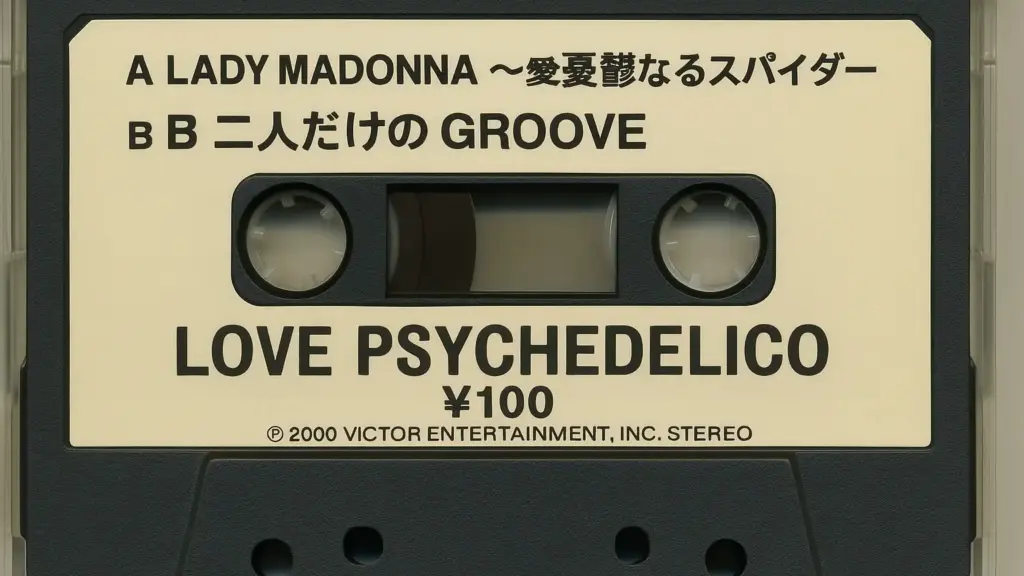
In early 2000, the 2-track “100-yen cassette tape” distributed and sold in Shimokitazawa and Tower Records stores (Shinjuku, Shibuya, Nagoya, etc.) was a brilliant tactic that highlighted their confidence in the musical content itself.
Choosing a cassette tape during the peak era of CDs was a calculated move to utilize the symbolic nature of physical media while dropping the price significantly to ensure people “just listen to it first.” While providing an easily accessible entry point for listeners, the sonic texture incorporated the latest sensibilities of the time. This paradoxical combination successfully fueled the buzz surrounding them.
The Major Debut (2000) — The Impact of the First Single
『LADY MADONNA〜憂鬱なるスパイダー〜』
Their debut single boldly announced their direction of recontextualizing Western musical vocabulary through the poetic sensibility of the Japanese language.
The juxtaposition of the English title and Japanese subtitle declared the band’s bilingual identity right from the title stage.
The arrangement infused an editing sharpness into the core structure of guitar, bass, and drums, highlighting the hooks with a tight frequency design.

The Profile of Early Signature Songs
Their signature songs at this stage share a foundational structure: building up short phrases to open up wide vistas during the chorus.
The guitar attack locks precisely with the drums, while the resonance of KUMI’s vowels expands the landscape. The back-and-forth between English and Japanese never disrupts the meaning; instead, it connects via the flow of syllables, leaving a sensation of moving forward rather than just a lingering echo.
The First Live Shows and the Habit of Self-Verification
Performing at small venues both inside and outside the university taught the duo that audiences responded more to the “clarity of design” than to the sonic texture of a recording.
They learned to avoid cramming too many words into the verse, shift perspectives in the bridge, and embolden the contours during the chorus. Setting their tempo around a mid-speed baseline, they aligned it to the exact point where the relationship between the guitar and vocals sounded clearest. This habit of self-verification built a solid musical backbone that would hold up even in massive venues later on.

Early Demo Sound Production Notes
The principle for the rhythm’s attack was always “not too aggressive.”
Even when utilizing drum loops, they avoided boosting the high frequencies of the snare or relying on continuous hi-hat hits to artificially raise the perceived BPM. Instead, they generated driving momentum through the contrast between muted and open guitar strings, leaving an appropriate gap around 2–4 kHz to allow the consonants of the vocals to stand out. These subtle adjustments made their hybrid mix of English and Japanese remarkably easy to hear.
Defining the “Delico Identity” Through Key Tracks
Many tracks from their first era feature designs where a core identity is established through brief repetitions, shifting the scenery entirely via vocal nuances. For instance, even without significant chord progressions, propulsion is generated through the positioning of the guitar attack and the phrasing at the end of vocal lines.
Moving into their second era, layers of keyboards and strings were introduced, thickening the soundscape, yet the underlying philosophy remained unchanged. In every song, the rule of “presenting the world-view within the first 8 bars” helped accelerate the listener’s comprehension.
Melody and Japanese Lyric Placement
When overlaying the continuous syllables of English onto the sharp cadences of Japanese, they subtly shifted the phrasing slightly backward to prevent consecutive consonants from sounding sluggish.
As a result, the fluency of English and the clarity of Japanese coexisted beautifully, expanding the horizon naturally toward the chorus. The lyrics balanced metaphor with concrete imagery, avoiding over-explanation while placing easily graspable, pivotal words at key milestones.
The Album Era (2001–2002) — A “Best Of” Styled 1st and an Expanded 2nd
The Position of the 1st Album “THE GREATEST HITS”
On January 11, 2001, they released their 1st album, “THE GREATEST HITS.” While the title evoked a greatest hits compilation, the content was a full-length original album composed primarily of newly recorded tracks. This bold naming was an expression of absolute confidence, and it ultimately became a massive long-term hit. While sales figures vary slightly depending on the records, multiple sources universally agree on its monumental success.
Established here were three core pillars:
① a vocal style that treated English and Japanese on equal footing,
② a direction that polished the pleasure curves of 60s and 70s rock with a 2000s editing sensibility, and
③ a production framework capable of varying the lineup around the two central members.
The Expansion of the 2nd Album “LOVE PSYCHEDELIC ORCHESTRA”
The following year’s 2nd album, “LOVE PSYCHEDELIC ORCHESTRA,” was a record that grew in scale and depth.
Their handling of strings and keyboards became more sophisticated, establishing a balance where guitar riffs never obstructed the melodic flow. Boasting impressive chart performance, it rapidly deepened their catalog of signature tracks. The songs translated exceptionally well to live performances, supplying numerous core staples for their subsequent setlists.
International Reception (2001–) — From US Showcases to Asia
The Impact of Japan Nite and the US Tour
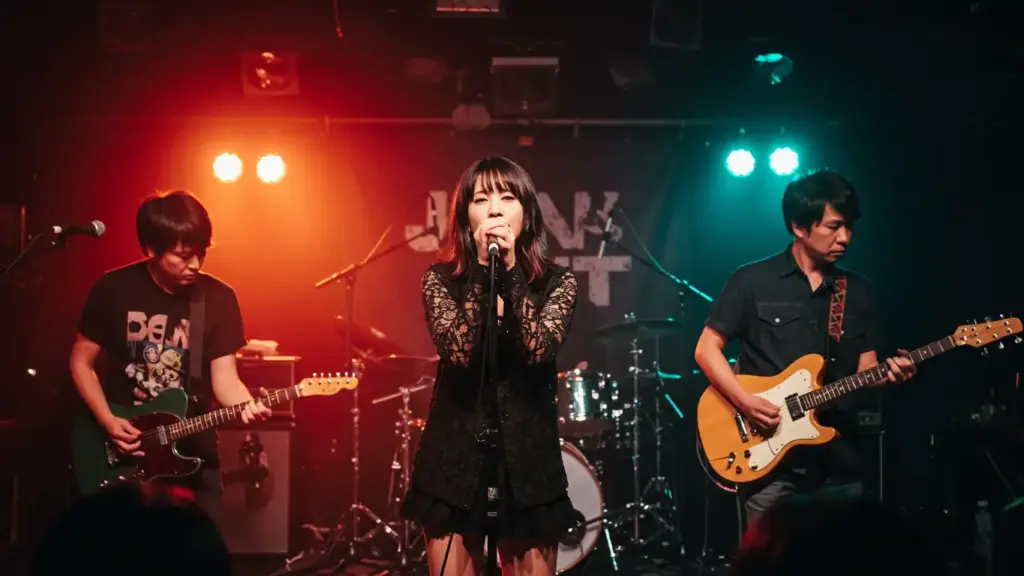
In 2001, their appearance at a US showcase-linked event opened the doors for empirical verification on the club circuit. (This means they performed at “Japan Nite” in connection with SXSW, and subsequently toured clubs across America, confirming firsthand on stage how their music resonated with local listeners.)
The English-infused vocals guaranteed accessibility for overseas audiences while maintaining a distinct originality through the crisp cadence of the Japanese phrasing. Even without a full translation of the lyrics, their appeal was conveyed directly through vocal presence and rhythm—a characteristic that would prove advantageous in the later streaming era.
Establishing a Presence in Asia
Through a combination of concerts in Taiwan and Hong Kong, festival appearances, and media exposure, their fanbase expanded sustainably across Asia.
The blend of English and Japanese presented an entry point with low barriers while simultaneously showcasing a unique flavor to listeners across the region. Their success was partly driven by diversifying entry points, strategically incorporating covers and collaborations along the way.
Maturity in the Early ’10s (2003–2015) — Self-Production and a Private Studio
Golden Grapefruit Recording Studio
From the mid-2000s onward, they transitioned to a workflow that revolved around recording and touring from their private studio, “Golden Grapefruit Recording Studio.”
By reclaiming control over studio decisions—such as microphone placement, amplifier selection, and the positioning of the rhythm section—they achieved a higher cohesion in their sonic image and accelerated their speed of experimentation. The overtone design of the guitars and the clarity of the vocal staging became pristine, bridging the distance between live performances and studio recordings. Furthermore, it allowed them the total freedom to test unusual band configurations prior to heading out on nationwide tours to strengthen the structural resilience of their compositions. This self-contained, high-speed trial-and-error environment remains the core pillar anchoring the stable brand of Delico.

The Best-Of Album Era and the 15th Anniversary Tour
The 2015 release of their best-of album “THE BEST I/II” organized the gateways to their signature catalog while sparking a widespread critical re-evaluation. Their nationwide tour juxtaposed an acoustic segment by the duo with a full-band segment, demonstrating both the structural core and the pure dynamism of their tracks. The selection of drummers and percussionists also generated significant buzz, with many critics noting that the resolution of their existing catalog had reached new heights.
Updating the Framework (2016–2021) — Reconfiguring as a Flexible Band
A New Setup and Re-Arrangement
Beginning in 2017, they embarked on nationwide tours with a refreshed lineup of support musicians. They established a routine of finely tweaking the keys, tempos, and break positions of existing songs to pinpoint where the vocals shined most brilliantly.
While maintaining a tight rhythm, their approach of tailoring the energy to each venue’s specific response brought the core identity of the duo into even sharper focus.
The 20th Anniversary and Concert Films
The year 2020 marked their 20th anniversary since debut, and the following year saw the release of concert films and a comprehensive archival showcase.
In addition to their early riff-driven songwriting, their catalog expanded with more melody-focused tracks, featuring highly refined lyric placement. Consequently, the proportion of tracks that were immediately accessible to first-time listeners increased, creating a structure that resonated effortlessly with new audiences overseas.

The US Compilation and Local Listener Reactions
Their bilingual singing style shared a natural affinity with the American indie rock context. Listeners of the alternative generation tended to be drawn to “the presence of the voice itself” and “the drive of the riffs” rather than the minutiae of the lyrics, and Delico’s tracks met those expectations perfectly. As a result, reviews consistently praised their style as “contemporary songwriting built upon a classic foundation.”
The Logistics of Asian Performances
They flexibly adjusted their backline setups to accommodate variations in venue sizes, power conditions, and local PA equipment differences. For guitars, they clarified the frequency center by switching pickups, while the vocals prioritized feedback resistance while maintaining smoothness through condenser-type microphones. This meticulous attention to logistical details consistently anchored their stable live performances.

The Symbolism of the 20th Anniversary
The anniversary project was designed not as a mere retrospective of the past, but as a statement of where they stand today. The setlist was reconfigured based not just on popularity, but on which tracks carried the most conviction with their current vocals and arrangements. The concert footage utilized close-up camera angles on their hands and expressions, visually reinforcing the precise contours of the audio. Consequently, this provided a seamless bridge for long-time fans to connect with the band’s contemporary identity.
The Latest Work and Present Horizon (2022–) — Vistas Beyond “A Revolution”
Refreshing Songs and Messages
With 2022’s “A Revolution,” they pushed sharp melodies and lucid phrasing to the forefront while preserving their core classic rock appeal.
Even in tracks containing social commentary, they maintained a distance that avoided sounding preachy, ensuring the core message resonated immediately upon listening. The division of labor between the two remained intact: NAOKI’s guitar crafted the backbone of the hooks, while KUMI’s voice simultaneously commanded both the narrative imagery and the driving momentum.
The Reciprocity Between Live Performance and Production
In recent years, the speed with which they feed live insights back into studio production has accelerated. Their lineup remains completely fluid; some nights lean entirely acoustic, while others feature rich percussion to intensify a dance-floor-like drive. This flexibility is mirrored in their recordings, where the optimal density and three-dimensionality are carefully selected for each individual track.

The Core of Their Sound (Summary)
Motifs and Riffs
The foundation rests on clearly presenting brief motifs and supporting them with the bare minimum of chords. The guitar retains a solid midrange core, utilizing overtones without drowning the sound in excessive distortion, preventing the vocal nuances from getting muddy.
Language and Melody
The shifting between English and Japanese never fractures the meaning; it flows naturally through the strategic placement of accents and beats, allowing the listener to effortlessly follow both the lyrics and the music simultaneously.
Rhythm and Texture
Propulsion is generated through the snap of the snare and the attack of the bass, occasionally layered with a streamlined feel reminiscent of programmed loops, consistently prioritizing a minimalist “subtraction” philosophy.

Contemporary Comparison and Cultural Impact
Distinction from Other Artists
Around the year 2000 in Japan, R&B, hip-hop, and electronic music heavily dominated the mainstream charts.
While intersecting with those contemporary trends, LOVE PSYCHEDELICO chose a path of modernizing the vocabulary of classic rock within the Japanese language. Consequently, they drew a line that set them apart from other boundary-crossing artists of their generation—achieving similar success but through entirely different craftsmanship—and establishing an irreplaceable individuality.
Listener Culture and the Transition to Streaming
During the transition from CD-centric to streaming-centric consumption, Delico reinforced their signature lifecycle of “presenting a world-view via albums, then reconstructing that energy live on stage.”
As video platforms and subscription services expanded, their bilingual songs traveled effortlessly across borders, multiplying their global entry points. Because their appeal is instantly captured even in short promotional clips, the pipeline from discovery to deep-diving became remarkably short, serving as a powerful tailwind.
Timeline (Key Topics – Simplified Version)

1997
Met at Aoyama Gakuin University’s ACM, transitioning into a core duo structure. Serious demo production begins.
1999
Gained significant attention via FM radio airplay; recognition spreads rapidly among industry insiders.
2000
Released major debut single. Created a direct pipeline for people to “listen first” via the strategic 100-yen cassette campaign.
2001
1st album becomes a massive, long-term smash hit. Experienced the US club circuit via international showcases.
2002
Released 2nd album. Significantly deepened their catalog of signature tracks, expanding live concert staples.
2004–2007
Established their private studio environment. The workflow of comprehensive self-production becomes fully anchored.
2008–2010
Strengthened international connections through a US compilation album and West Coast-inspired works.
2013–2015
Spurred critical re-evaluation through tour expansion and a best-of compilation. A highly flexible live setup becomes standard.
2017–2021
Reconfigured with a refreshed band setup. Pushed forward with concert film releases and archival presentations for their 20th anniversary.
2022–
Continuing to evolve post-“A Revolution,” blending explicit melodies with New social commentary.
Discography “Listening Guide”
For Those Who Wish to Dive Deeper (Album by Album)
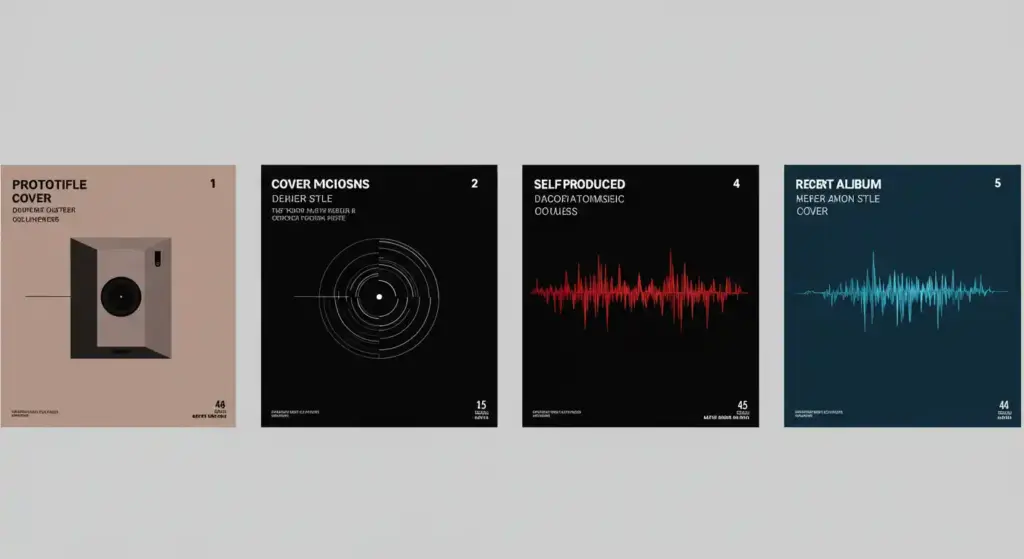
Listening through their catalog reveals a clear continuity of philosophy: the 1st album establishes the prototype of design, the 2nd achieves sonic depth, the 3rd and 4th solidify self-production, and recent works clarify a melody-oriented focus. Even if listener favorites are scattered across individual tracks, listening in album units unveils exactly which elements they chose to amplify in each era.
The Creative Philosophy
The duo has always prioritized “the craftsmanship of modernization” over “the accuracy of replication.” They never conceal their vintage reference points, yet they ensure that citations never end as mere imitation.
The continuous dialogue between Japanese and English, between electronic precision and raw analog feel, between past vocabulary and contemporary texture—their legacy can be summarized as optimizing these three intersections with every single release.
Future Outlook (An Overview Including Conjecture)
The hybrid approach of blending intimate acoustic configurations with full-band sets will undoubtedly remain a core strength.
In alignment with modern digital streaming habits, they are highly likely to continue crafting songs that instantly establish their world-view within a brief introduction. Simultaneously, they are expected to maintain their commitment to album-length architecture and continue reconfiguring those works dynamically on stage. In upcoming material, the balance between forward-moving melodies and dense rhythmic architecture will surely be polished to an even finer sheen.
Summary — The Continuous “Old Yet New”
LOVE PSYCHEDELICO is a rare unit that satisfies both vintage musical pleasures and modern editing sensibilities simultaneously. While maintaining their three foundational pillars—vocals that treat English and Japanese equally, riff-driven songwriting, and fluid live configurations—they have consistently updated fine details to achieve the optimal solution of the moment.
A quarter-century since their initial meeting at a university music club, their instincts remain as sharp as ever, stepping steadily forward toward the next record and the next stage.


音楽ファン同士の交流・リクエストはこちら / Connect & Request Songs Here