
Read the Story of Mayumi Itsuwa Here!
- 🎧 Listen to This Article
- No. 3: “Koibito yo”
- First, listen to the official YouTube video.
- The Sudden Death That Gave Birth to the Song
- 48 Seconds — The Drama Begins Before the Voice
- Fallen Leaves, a Bench, a Gravel Road — Turning Emotion Into Scenery
- Who Can Hear the Cry of “Koibito yo”?
- From No. 4 to No. 3 — Two Songs, Two Different Moments of Farewell
- From a Japanese Hit to a Song That Crossed Borders
- In Closing
🎧 Listen to This Article
Get a quick overview of the article through narration.
Listen before reading to get a sense of the world of “Koibito yo” and the overall flow of the article.
🎵 English Narration
This audio introduces the article in English.
🎶 日本語
This audio introduces the article in Japanese.
Listening first will help you better understand the world of “Koibito yo” and the key points of the article.
No. 3: “Koibito yo”
“Koibito yo” was released on August 21, 1980, as Mayumi Itsuwa’s 18th single. Written and composed by Itsuwa herself and arranged by Motoki Funayama, the song was also included on her album Koibito yo, released on September 6 of the same year.
The song became a long-running hit and won the Gold Award at the 22nd Japan Record Awards. At the end of 1980, Itsuwa made her first appearance on NHK’s prestigious year-end music program Kohaku Uta Gassen with this song. In Japan, it was later covered by numerous singers, including Noriko Awaya and Hibari Misora, while its reach extended overseas to countries such as China, South Korea, Indonesia, and Malaysia.
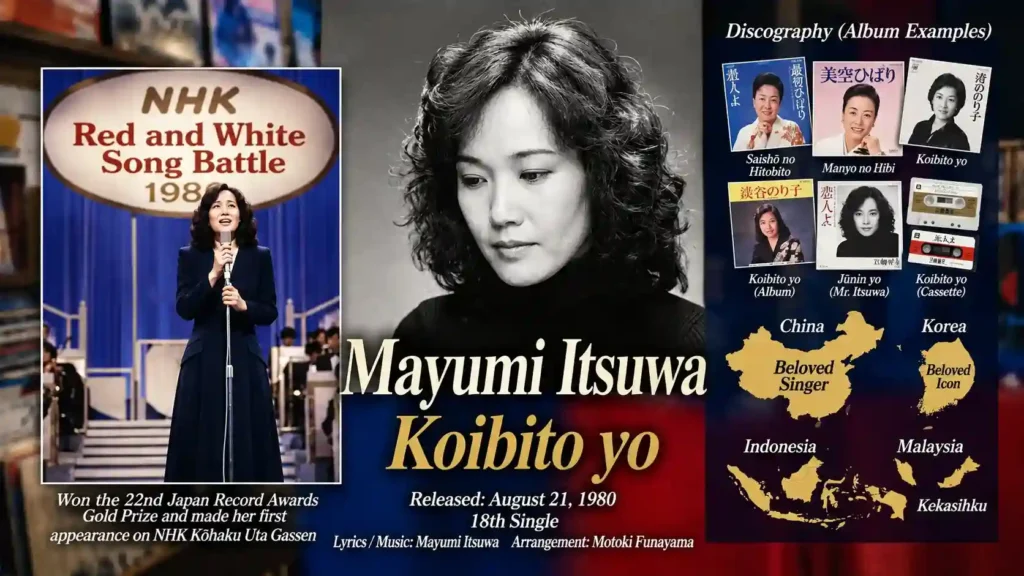
Mayumi Itsuwa has many musical faces: the folk-influenced sound of her early years, songs that make distinctive use of the Japanese language, and works that found a life of their own beyond Japan.
Among them, I see “Koibito yo” as the defining song in which Mayumi Itsuwa the songwriter and Mayumi Itsuwa the singer come together within one sweeping work.
My Poetic Interpretation
Beyond the fallen leaves, I can still see you standing there.
The seasons turn, yet my heart remains on the day we parted.
I long to rekindle the time we shared, vanished like a shooting star.
My love, just once more, smile and tell me our goodbye was only a joke.
💡 You might also like: View the original Japanese lyrics (External site)
If the lyrics are available only in Japanese, you can use your browser’s translation feature or an AI translation tool to understand their general meaning.
First, listen to the official YouTube video.
Credits
Video: Mayumi Itsuwa “Koibito yo” Official Video
Footage: From “Mayumi Itsuwa Concert Tour '92–'93”
Courtesy of: MUSIC Liverary
About the Video
This official live performance was recorded during “Mayumi Itsuwa Concert Tour '92–'93.”
Itsuwa sings with a restrained intensity that brings out the profound sorrow of “Koibito yo,” offering a sense of immediacy distinct from the studio recording.
The Sudden Death That Gave Birth to the Song
A Farewell With No Way Back
To understand “Koibito yo,” its origin is essential. In 1980, Mayumi Itsuwa was confronted with the sudden death of Kosuke Kida, a producer who had been closely involved with her career since her debut.
Kida died in a traffic accident in May of that year at the age of just 31. His death deeply shocked Itsuwa, and at his funeral she witnessed the profound grief of his wife. It is said that this experience led her to transform the pain of parting from someone she could never see again into song.
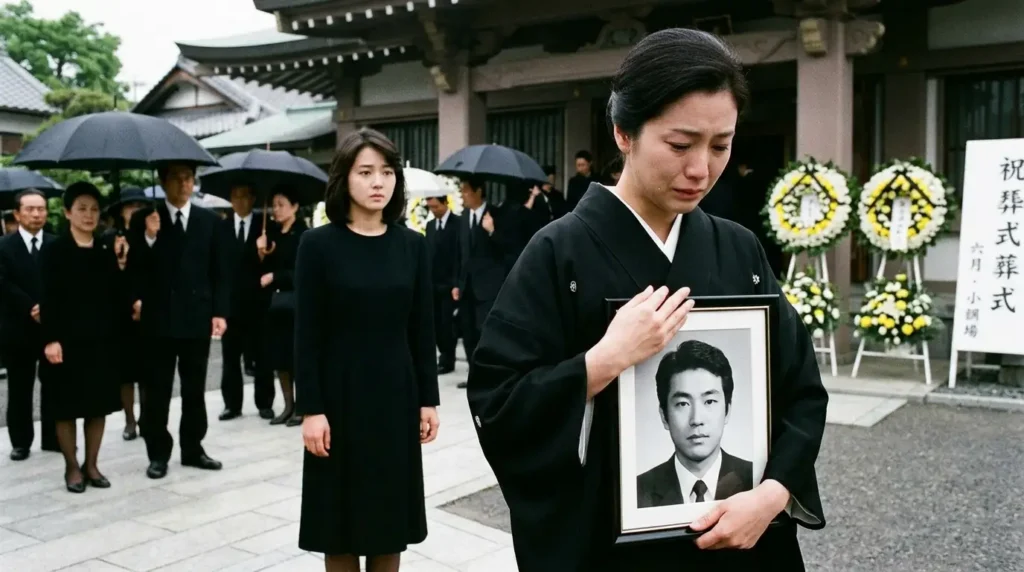
Knowing this background changes the way we hear “Koibito yo.” It is no longer simply a song about the end of a romantic relationship. After an ordinary breakup, we can still imagine a chance encounter or even reconciliation. Death leaves no such possibility.
At the heart of the song is a collision between the longing to see someone once more and the knowledge that such a reunion can never happen. That is why the protagonist’s call feels so desperate, yet no answer ever seems possible. The one-sided nature of that appeal gives “Koibito yo” much of its emotional weight.
48 Seconds — The Drama Begins Before the Voice
Originally Intended as a B-Side
“Koibito yo” also has an intriguing production history. The song was originally intended not as the A-side of the single, but as its B-side.
At that stage, an intro of approximately 48 seconds was created — unusually long for a Japanese single of the period. Yet after the song was completed, it was ultimately promoted to the A-side, with its extended opening left intact.
As a result, those 48 seconds became one of the song’s defining characteristics. A conventional hit single might hurry toward the vocal entrance. “Koibito yo” does not.

Those 48 Seconds Are Not “Waiting Time”
The piano begins, the strings enter, and the melody gradually forms a broad musical current. During those opening seconds, we are not yet told whom the protagonist is thinking about or what she has lost.
Even so, before a single word is sung, the music suggests a solitary figure standing in the aftermath of something momentous. Only after the tension has fully gathered does Mayumi Itsuwa’s voice appear.
In “Koibito yo,” the story does not begin with the first lyric. The intro creates the scene first, and only then does the protagonist enter it. That sequence is fundamental to the song’s dramatic structure.
Fallen Leaves, a Bench, a Gravel Road — Turning Emotion Into Scenery
The Song Does Not Explain Their Past
The song presents a succession of images: an evening of falling leaves, a cold town, a weathered bench, someone running along a gravel road, the turning seasons, and a shooting star. Yet it tells us very little about how the protagonist and her loved one met or what kind of life they shared.
What Itsuwa shows us is not the sequence of events that led to the separation, but the world as it appears to the protagonist after losing someone precious.

A World in Motion, a Heart That Cannot Move
These images share something important. Leaves fall, people pass by, seasons turn, and shooting stars disappear. Everything around the protagonist continues to move, regardless of what she wants.
Her heart, however, remains with the person she has lost. The more the world keeps moving, the more clearly we see the heart that has been left standing still. Through this contrast, the magnitude of loss is conveyed without the need for direct explanation.
That is why “Koibito yo” never becomes a song that simply insists on its own sadness. By placing these passing scenes before us, it allows listeners to experience the protagonist’s loneliness for themselves.
Who Can Hear the Cry of “Koibito yo”?
Words Addressed to Someone Who Cannot Answer
Perhaps the most powerful words in the song are the title itself. “Koibito yo” — roughly, “My love” or “O my beloved” — is a direct address that assumes the presence of another person. Yet within the song, no answering voice ever comes.
The protagonist continues to remember and speak alone. Her words are sent outward, but no reply returns and no conversation can take place. The title calls out to someone she loves, yet at the same time reminds us that this person is no longer there.
Longing and Reality Within a Single Phrase
The protagonist’s desire is unmistakable: she wants the person she loves beside her once more. But behind the song lies a separation that cannot simply be undone.

That is why the cry of “Koibito yo” contains more than affection. It carries the desperation of someone who knows the words cannot reach their destination and yet cannot stop calling. That contradiction gives the title its extraordinary power.
The long intro prepares the place where the protagonist will stand; the scenes of the town reveal the time that continues after loss; and what finally remains is the call to the absent loved one. That brief invocation — “Koibito yo” — holds the entire song together.
From No. 4 to No. 3 — Two Songs, Two Different Moments of Farewell
How It Differs From “Sayonara dake wa Iwanaide”
The previous entry in this Top 10, my No. 4 choice, was the 1978 song “Sayonara dake wa Iwanaide.” Like “Koibito yo,” it was written and composed by Mayumi Itsuwa and arranged by Motoki Funayama.
Yet the two songs stand at different points in the experience of parting. In “Sayonara dake wa Iwanaide,” the focus is on a relationship approaching its end and on what words should — or should not — be spoken at that final moment.
In “Koibito yo,” by contrast, the protagonist is already standing on the other side of loss. The question is no longer whether the separation will happen. The story is about the time spent continuing to think of someone who will never return.
Placed side by side, the two songs also show that “Koibito yo” did not appear out of nowhere. The songwriting, vocal expression, and ability to build stories in Japanese that Itsuwa had developed throughout the 1970s came together in a particularly powerful form in 1980.
From a Japanese Hit to a Song That Crossed Borders
A Song That Continued to Grow Through Other Voices
In Japan, “Koibito yo” has been performed by many singers, including Noriko Awaya and Hibari Misora. Its reach also extended across Asia, with artists in China, South Korea, Indonesia, Malaysia, and elsewhere taking up the song.
Itsuwa’s own activities also expanded overseas, and in 1982 she held a solo concert in Hong Kong. Born in Japan, “Koibito yo” gradually became a song heard across national and linguistic boundaries.
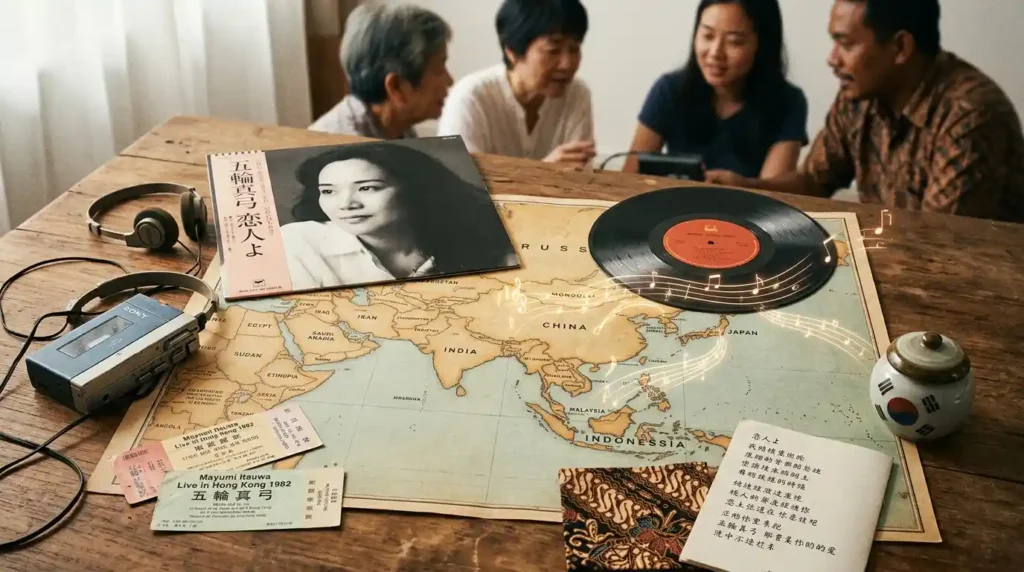
What is especially striking is that the song has reached listeners who do not necessarily share every nuance of the Japanese lyrics. The emotion carried by the melody and the voice has a power that does not depend entirely on understanding every word.
“Koibito yo” is regarded as one of Mayumi Itsuwa’s defining songs for reasons that go beyond its original sales and awards. Decades after its release, the song continues to live through different singers and different listeners. That continuing reach is part of what makes “Koibito yo” such an important work in Itsuwa’s career.
In Closing
The protagonist of “Koibito yo” has no way to erase the separation or turn time backward. Yet the impulse to call out to the person she loves does not disappear. That is where the song’s deepest ache lies.
What strikes me most when I listen to this song is not simply its sadness, but the cruelty of time. The town, the seasons, and the people all continue forward, while somewhere inside the heart there remains a place that cannot move on. Mayumi Itsuwa shaped that feeling into a complete musical story.
“Koibito yo” cannot be contained by the simple label of “a sad classic.” It turns one of the most human emotions into a ballad: knowing that your words cannot reach the person you have lost, yet continuing to call out to them all the same.
Decades have passed since the song became a major hit in 1980, but that call has not grown old. That, I believe, is why “Koibito yo” continues to be heard today as one of Mayumi Itsuwa’s defining works.

音楽ファン同士の交流・リクエストはこちら / Connect & Request Songs Here