
- 🎧 Enjoy This Article in Audio
- Beyond “Koibito yo” — The Musical Path Mayumi Itsuwa Forged
- An Awakening to Music — Discovering the Joy of Singing Before an Audience
- 1972 — An Extraordinary Debut Recorded in Los Angeles
- The Early 1970s — Building a Distinctive Musical World
- Her Work in France — A Turning Point in Reconsidering Her Music
- A Change of Direction — A Deliberate Approach to Kayokyoku
- “Koibito yo” — The Masterpiece That Brought Her Earlier Journey Together
- Mayumi Itsuwa’s Music Spreads Across Asia
- Refusing to Be Confined by One Great Hit
- The 50th Anniversary of Her Debut — Songs That Continue Across Generations
- Conclusion — A Singer Who Reached the World Through Her Own Words
🎧 Enjoy This Article in Audio
You can quickly explore the main points of this article through narration.
Recommended for readers who want to understand Mayumi Itsuwa’s musical journey and the overall flow of the article before reading.
🎶 English Narration
This narration introduces the content of the article in English.
🎵 Japanese Narration
This narration introduces the content of the article in Japanese.
Listening first will make Mayumi Itsuwa’s musical journey and the key points of the article easier to understand.
Beyond “Koibito yo” — The Musical Path Mayumi Itsuwa Forged
We are beginning My Personal Top 10: Mayumi Itsuwa Edition.
When people hear the name Mayumi Itsuwa, the first song that comes to mind for many is probably “Koibito yo.”
Beginning with an extended piano introduction, the song quietly yet powerfully expresses the pain of losing someone dear. Released in 1980, it became Mayumi Itsuwa’s first song to reach No. 1 on the charts. It sold more than 900,000 copies, earned a Gold Award at the Japan Record Awards, and led to her first appearance on NHK’s annual Kohaku Uta Gassen.
However, Mayumi Itsuwa’s musical career cannot be explained by “Koibito yo” alone.
She was writing her own lyrics and melodies and completing each work through her own voice at a time when the term “female singer-songwriter” had yet to become widely established in Japan.

She made her debut with an album recorded in the United States and later produced music in France as well. Her songs subsequently spread to Hong Kong, Indonesia, Vietnam, and other parts of Asia, where some continue to be sung in Japanese.
Mayumi Itsuwa’s history is the story of half a century spent studying music from abroad, reassessing her own Japanese sensibility, and creating a distinctive form of expression across folk, pop, and kayokyoku.
An Awakening to Music — Discovering the Joy of Singing Before an Audience
Her First Performance Before the Entire School
Mayumi Itsuwa was born on January 24, 1951, in Nakano, Tokyo.
In 1967, during her first year of high school, she sang before the entire student body at a farewell event for the graduating third-year students. The following year, she formed the female folk duo Fancy Free Singers with a classmate and appeared on the TBS morning television program “Seven Two O.”
At the time, American folk music was spreading among young people in Japan, and a culture of singing one’s own thoughts while playing the guitar was beginning to take root.
Mayumi Itsuwa also admired Joni Mitchell and included songs such as “Both Sides, Now” and “Woodstock” in her repertoire. Female artists who wrote both their own lyrics and music must have provided important inspiration as she considered her future direction.

Building Experience in Small Venues
After graduating from high school, Mayumi Itsuwa enrolled at the YMCA English school in Kanda. She left after approximately six months and began pursuing music in earnest.
From 1970 to 1971, she performed guitar-based solo sets in Ginza and appeared at the small Shibuya theater Jean-Jean. She also briefly toured American military camps, where her performance of “Tennessee Waltz” was well received, according to her official profile.
Performing in venues where she could sense the audience’s reactions directly gave her a practical setting in which to develop her placement of words and control of vocal intensity. The accomplished singing style she later established cannot be separated from the experience she gained before her professional debut.
1972 — An Extraordinary Debut Recorded in Los Angeles
Writing Her Own Songs and the Creation of the UMI Label
In the latter half of 1971, Mayumi Itsuwa began composing songs in earnest. I was in my first year of junior high school at the time.
Recognizing her talent, CBS/Sony established UMI, a label created exclusively for her, in September 1972. In October of that year, the company simultaneously released the single “Shojo” and the album Shojo, formally launching her recording career.
The album was recorded at Crystal Sound Studios in Los Angeles.
John Fischbach handled the production, and Itsuwa met David Campbell through the recording sessions. In addition, Carole King, whom Mayumi Itsuwa greatly admired, provided her own band for the recording and personally participated on piano.
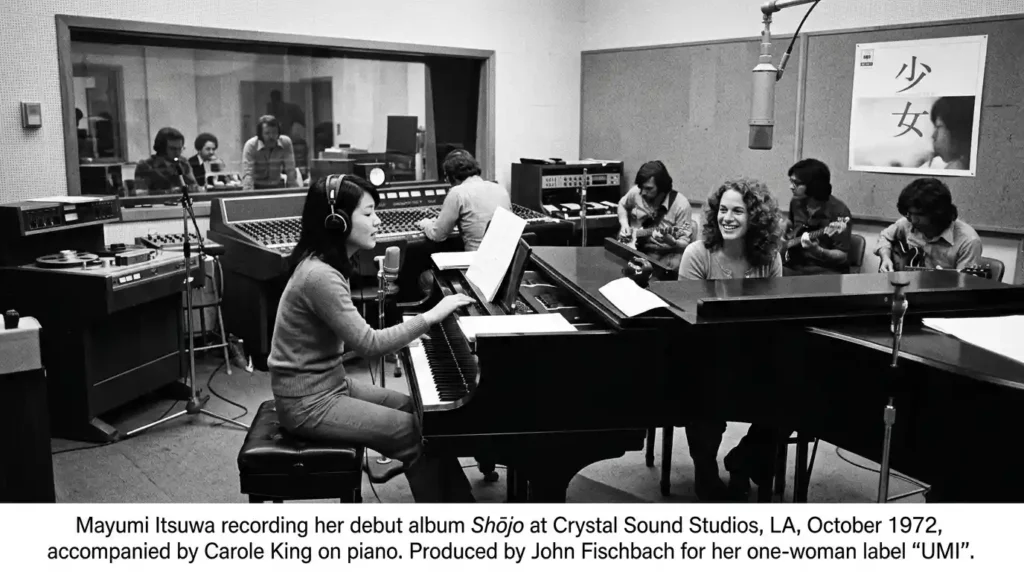
For a newly debuting Japanese singer to make an album with leading international musicians was highly unusual at the time.
How the Overseas Recording Revealed Itsuwa’s Individuality
Shojo was not simply an attempt to bring an American sound back to Japan.
Within arrangements built primarily around acoustic guitar and piano, the Japanese lyrics and Mayumi Itsuwa’s voice remain at the center. Although American musicians participated in the sessions, the essential core of the work lies in her own words and melodies.
At the time of her debut, her piano-based singer-songwriter style sometimes earned her the description “Japan’s Carole King.”
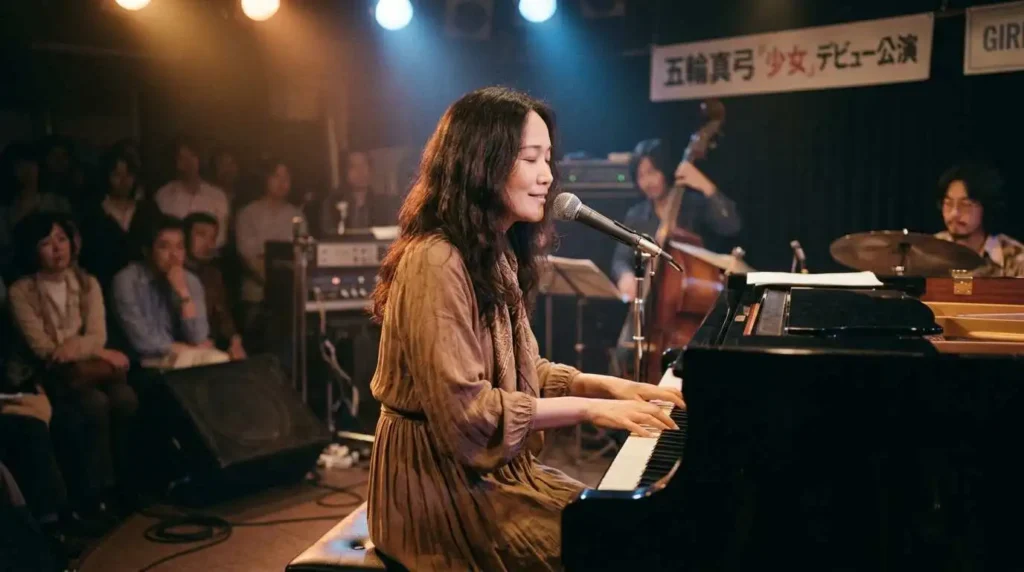
However, “Shojo” already reveals Itsuwa’s distinctive perspective: an inward gaze that observes personal emotions without overstating or decorating them. Her approach of using international production techniques while creating introspective songs in Japanese was already evident in her debut album.
The Early 1970s — Building a Distinctive Musical World
Everyday Scenes in “Tabako no Kemuri” and “Ame”
After her debut, Mayumi Itsuwa released the album Kaze no Nai Sekai in 1973. One of its tracks, “Tabako no Kemuri,” was later issued as a single after being used in a commercial. She continued releasing original songs, including “Ame.”
Her early works depicted familiar images such as cigarette smoke, rain, wind, city streets, and the changing seasons.
Rather than explaining emotions directly, she used visible scenery to communicate human loneliness and changes in personal relationships. This songwriting method would later be carried into “Koibito yo.”
Creating Music Between the United States and Japan
In 1973, she returned to the United States to record Kaze no Nai Sekai. She also produced Toki o Mitsumete in America in 1974.
Meanwhile, her Japanese concerts and recording sessions featured musicians such as Jun Fukamachi, Kenji Omura, Kenji Takamizu, Shuichi Murakami, Haruomi Hosono, and Shigeru Suzuki, all of whom would play important roles in the development of Japanese popular music.
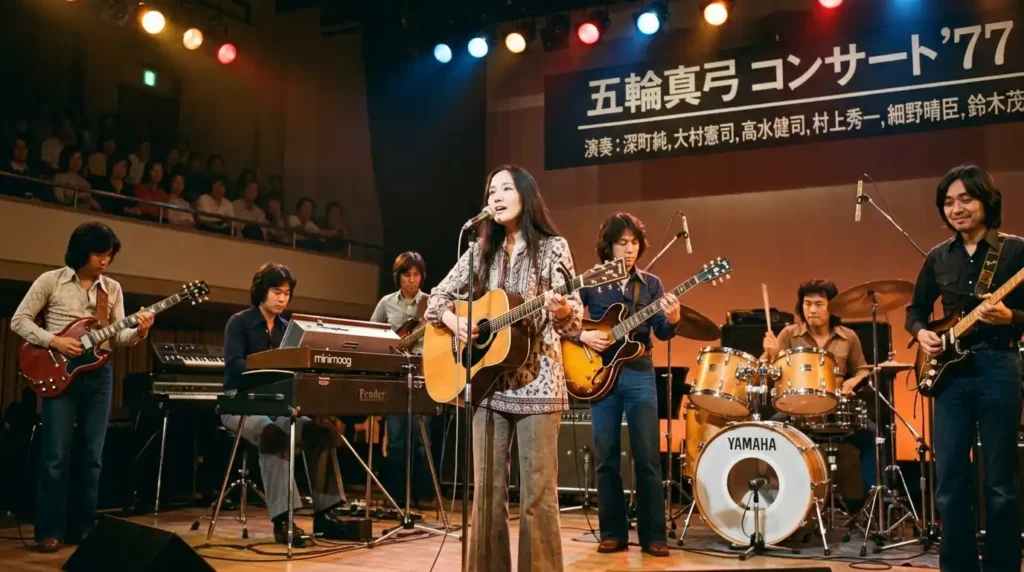
By experiencing both American production methods and the musical sensibilities of Japanese performers, Itsuwa developed a sound that could not be confined to a single genre.
Her Work in France — A Turning Point in Reconsidering Her Music
A French-Language Album and the Olympia in Paris
In 1976, CBS Records France highly praised the album MAYUMITY and encouraged Mayumi Itsuwa to pursue activities in France.
In December of that year, she traveled to France for recording sessions. In April 1977, she released MAYUMI, an album sung entirely in French, in France and several other European countries. She also made a guest appearance at Salvatore Adamo’s concert at the Olympia in Paris.

She subsequently released Etranger, an album containing songs in both Japanese and French.
Rediscovering a Japanese Emotional Sensibility Abroad
Years later, Mayumi Itsuwa explained that her activities in France had led her to realize that her true individuality could be found in the music and emotional sensibility of her own country.
Simply following music from abroad could leave an artist appearing derivative from an international perspective. She therefore decided to reintroduce into her work the Japanese emotional sensibility she had absorbed while growing up.
Her experiences outside Japan did not transform her into a Western-style singer. Instead, they gave her an opportunity to place the Japanese language and her own Japanese sensibility at the center of her music.
A Change of Direction — A Deliberate Approach to Kayokyoku
A Choice Made to Overcome a Creative Slump
During the latter half of the 1970s, Mayumi Itsuwa experienced a period of creative stagnation.
In a statement marking the 50th anniversary of her debut, she recalled that she deliberately began incorporating elements of kayokyoku into her songwriting in an effort to overcome the slump.
This movement toward kayokyoku did not mean abandoning the musical identity of her early career. While preserving her approach of examining an individual’s inner life, she introduced clearer dramatic development and melodies that listeners could remember more easily.
The 1978 song “Sayonara Dake wa Iwanaide” was an important example of this change. It communicated the emotions of separation through a clear melody and a more dramatic structure.
This experimentation led directly to “Koibito yo” in 1980.
“Koibito yo” — The Masterpiece That Brought Her Earlier Journey Together
The Death of Her Debut-Era Producer
“Koibito yo” was written following the death of the producer who had worked with Mayumi Itsuwa at the time of her debut.
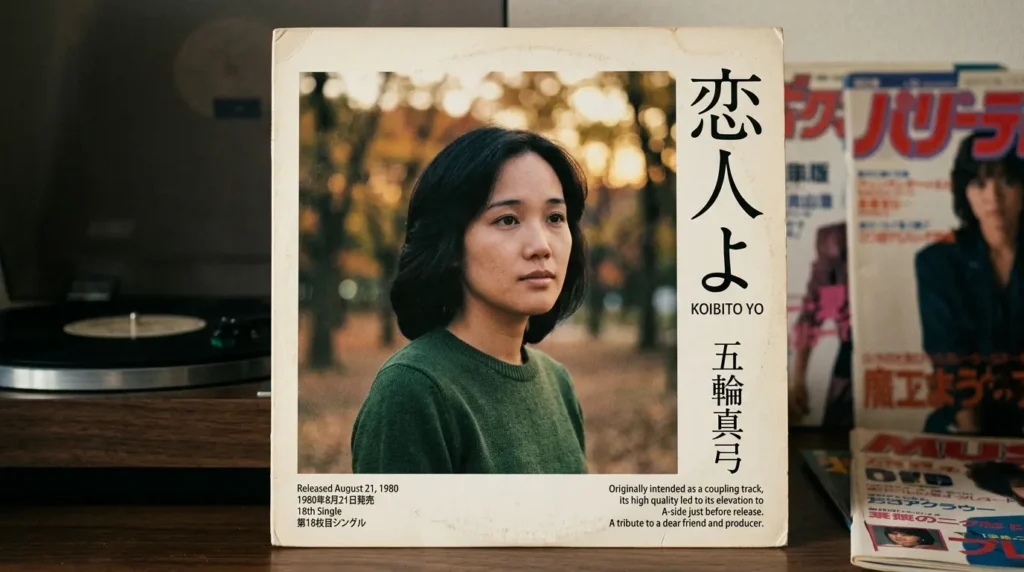
It was released as her 18th single on August 21, 1980, followed by an album of the same name in September. I was in my fourth and final year of university at the time.
The song was originally intended to appear as a B-side. As a result, its introduction runs for 48 seconds, an unusually long duration for a single of that period. However, the quality of the completed work was judged so highly that it was promoted to the A-side shortly before release.
Transforming Grief into Scenery
“Koibito yo” does not explain the lost person in detail.
Instead, images such as an old bench, fallen leaves, rain, and the cold season convey the depth of loss and the impossibility of recovering the past.
The song restrains its emotions in the opening section, then raises both melody and vocal intensity as it approaches the chorus. Through this structure, a song born from a personal loss became a work upon which many listeners could project their own experiences.
Mayumi Itsuwa herself has described “Koibito yo” as a fully realized story with a clear dramatic progression, and as a song so complete that singing it once could leave her feeling entirely satisfied.
The visual songwriting of her early works, the structural awareness gained through overseas recording, the Japanese emotional sensibility she rediscovered in France, and her experimentation with kayokyoku all came together in “Koibito yo.”
Mayumi Itsuwa’s Music Spreads Across Asia
A Historic Solo Concert in Hong Kong
Following the success of “Koibito yo,” Mayumi Itsuwa’s music spread throughout Asia.
In February 1982, she held a solo concert in Hong Kong that attracted an audience of 8,000. Her official 50th-anniversary website describes it as the first large-scale solo concert of its kind by a Japanese artist.
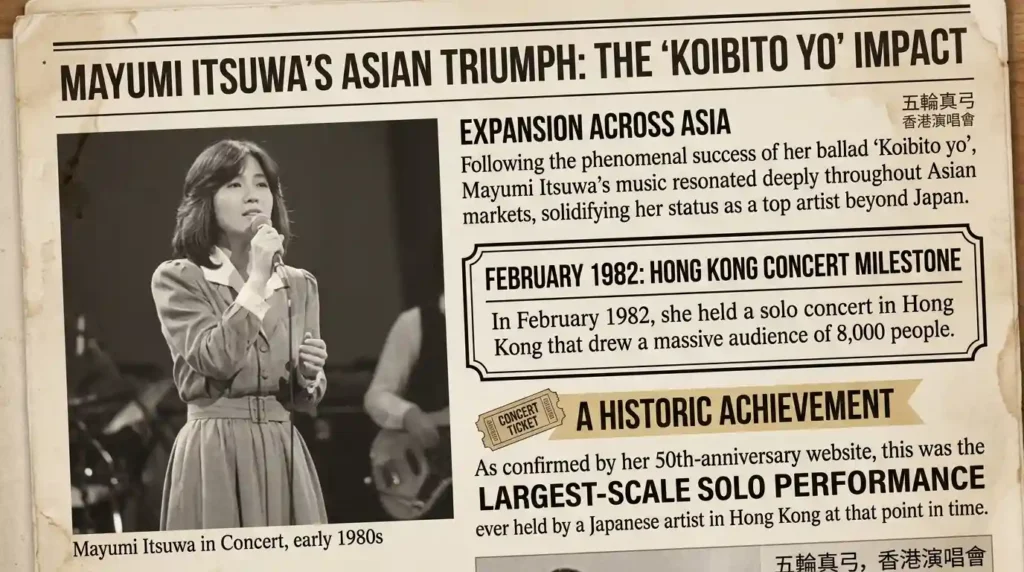
Her songs were subsequently covered by numerous singers in China, South Korea, Vietnam, Indonesia, Malaysia, and other countries.
The clarity of her melodies and the emotional direction of her songs allowed them to cross linguistic boundaries.
“Kokoro no Tomo” — A Song Passed Down in Indonesia
The album Shiosai, released in October 1982, included the song “Kokoro no Tomo.”
The song was not released as a heavily promoted single in Japan. However, after it was introduced on Indonesian radio, it developed widespread popularity there through a largely organic process.
Today, it is sometimes described as “Indonesia’s second national anthem” and continues to be sung in Japanese across generations. In 2015, Mayumi Itsuwa received the Japanese Ambassador’s Commendation from the Embassy of Japan in Indonesia in recognition of her contribution to cultural exchange through the song.

In addition, “Ai no Shinkiro,” from the album Koibito yo, has been covered by many singers in Vietnam.
Mayumi Itsuwa’s reputation outside Japan was not built on “Koibito yo” alone. Different works found their own audiences and developed distinct histories in different countries.
Refusing to Be Confined by One Great Hit
From Romantic Love to the Human Experience
Singers with a major signature song often face pressure to repeat the same successful formula.
Mayumi Itsuwa, however, did not devote herself solely to recreating “Koibito yo.”
Alongside love and separation, she expanded her subjects to include friendship, family, the passage of life, and the bonds between people. Musically, she drew from the folk style of her early years, the pop sound of her overseas recordings, and the dramatic structures of kayokyoku according to the needs of each work.
In 2013, she released “BORN AGAIN,” her first original single in nine years. The compilation album Lovers & Friends, released in the same year, separated songs about romantic love from works dealing with friendship and broader human affection, demonstrating the range of themes she had explored throughout her career.
A Singer Recognizable from a Single Line
Mayumi Itsuwa’s singing combines clarity and projection with a rich lower-middle register and precise articulation of each word.
Rather than presenting the strongest emotions from the outset, she adjusts the intensity of her voice according to the development of the song. As a result, the emotional rise of the chorus becomes especially powerful.
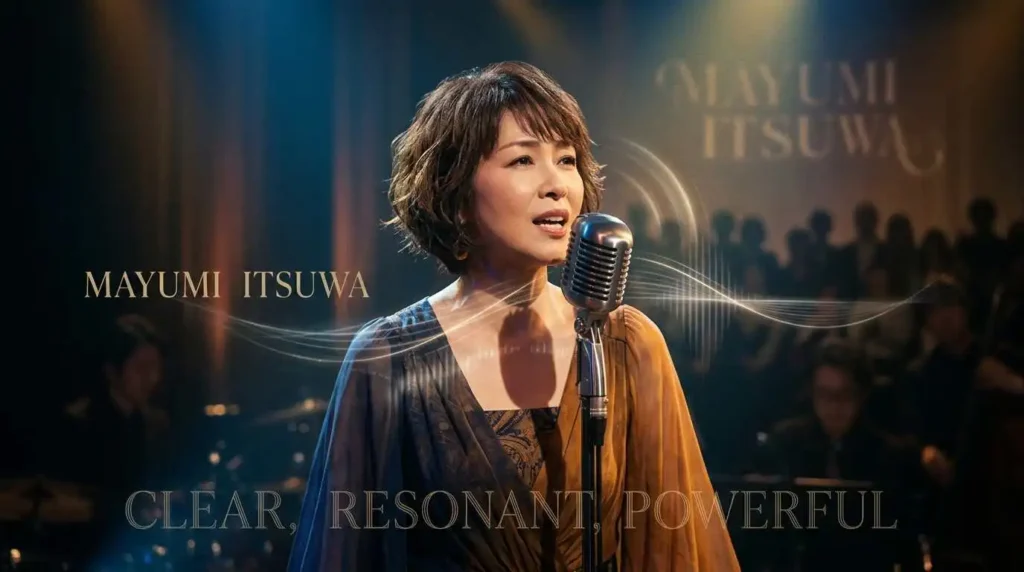
Another defining feature is that she writes the lyrics, composes the music, and performs the songs herself. She decides which words receive long notes, where the melody rises, and where the voice should be restrained. Because the composition and performance are inseparable, the finished work possesses a strong internal unity.
The distinctiveness that makes Mayumi Itsuwa recognizable from a single line has supported her career for more than half a century.
The 50th Anniversary of Her Debut — Songs That Continue Across Generations
On October 21, 2022, Mayumi Itsuwa marked the 50th anniversary of her recording debut.
Anniversary projects traced her career from the debut album Shojo, while earlier recordings and footage were introduced to listeners once again. In 2023, three live albums from the 1970s were reissued on high-quality CDs and as high-resolution digital recordings.
On January 24, 2025, the first official lyric video for “Koibito yo” was released to commemorate the song’s 45th anniversary.
The way people listen to music has changed from records to CDs, and from CDs to streaming services and online video. Even so, songs such as “Shojo,” “Tabako no Kemuri,” “Sayonara Dake wa Iwanaide,” “Koibito yo,” and “Kokoro no Tomo” continue to be heard across generations and national borders.
Conclusion — A Singer Who Reached the World Through Her Own Words
Mayumi Itsuwa’s history is not defined by the success of “Koibito yo” alone.
Her journey includes a high-school folk duo, guitar-based performances in Ginza and Shibuya, a Los Angeles debut album featuring Carole King and other leading musicians, the production of a French-language album, a deliberate engagement with kayokyoku, and recognition throughout Asia.
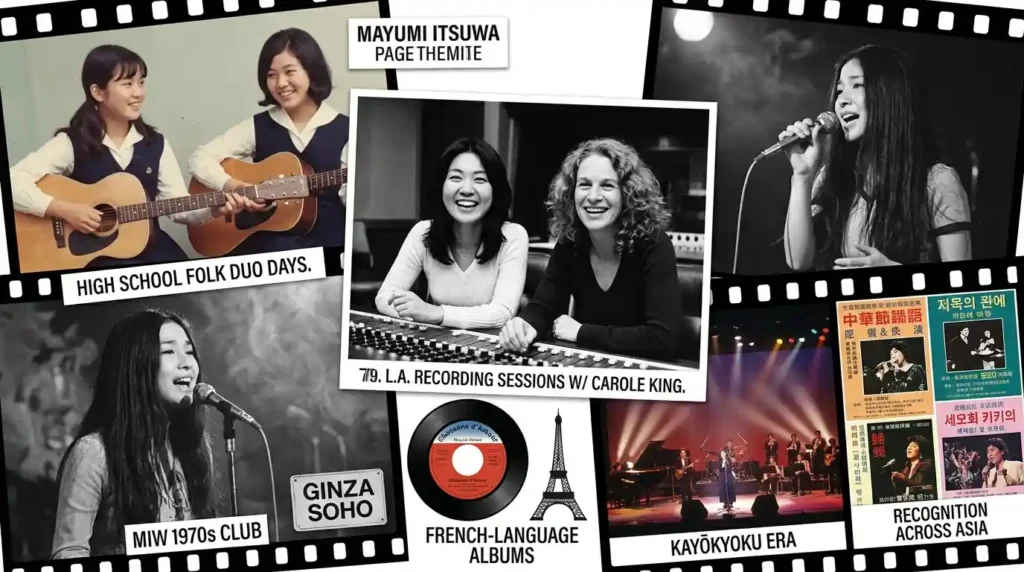
By going abroad, she discovered that her own individuality lay in a Japanese emotional sensibility. She added the accessible dramatic structures of kayokyoku to her inward-looking songwriting. She also demonstrated that songs in Japanese could cross cultural and linguistic boundaries.
“Koibito yo” remains the most prominent entrance into Mayumi Itsuwa’s music.
Beyond that entrance stands a young woman who wrote her own lyrics and melodies, a pioneer who recorded with leading international musicians, an artist who rediscovered her Japanese sensibility, and a singer who carried Japanese-language songs throughout Asia.
To follow Mayumi Itsuwa’s career is also to follow the history of a Japanese female singer-songwriter who helped open a path toward the wider world through her own words and voice.

音楽ファン同士の交流・リクエストはこちら / Connect & Request Songs Here