
Click here for Yosui Inoue’s History!
🎧 Enjoy This Article in Audio
You can quickly grasp the main points of this article through narration.
Recommended for those who want to catch the vibe of the music and the flow of the article before reading.
🎶 English Narration
An English audio introduction to the contents of this article.
⌛ Duration: Approx. 3 mins
🎵 Japanese Narration
A Japanese audio introduction to the contents of this article.
⌛ Duration: Approx. 3 mins
Listening to the audio before reading helps you better understand the world of the music and the main points of the article.
Click here for the history of Yosui Inoue!
🎧 Enjoy This Article via Audio
You can quickly grasp the key points of this article through the narration.
Recommended for those who want to catch the vibe of the music and the overall flow before reading the article.
🎵 Japanese Narration
Listen to the content of this article in Japanese audio.
⌛ Playback Time: Approx. 3 mins 40 secs
🎶 English Narration
Listen to the content of this article in English audio.
⌛ Playback Time: Approx. 3 mins
Note: Listening to the audio before reading will help you more deeply understand the world of the song and the key points of the article.
No. 10 is “Fun”
Wait, did you notice there are two songs ranked at number 10? You are exactly right. Unbelievably, I made a blunder. I accidentally left out “Fun,” a song I absolutely love and cannot omit, from the preliminary list.
As I was writing the articles, there was a phrase that kept repeating in my head:
“Is what’s written in the diary a sad thing after all?
Or does it say she is stopping her diary starting today?”
This is a part of the lyrics from “Fun.” It is a somewhat endearing and heartwarming line.
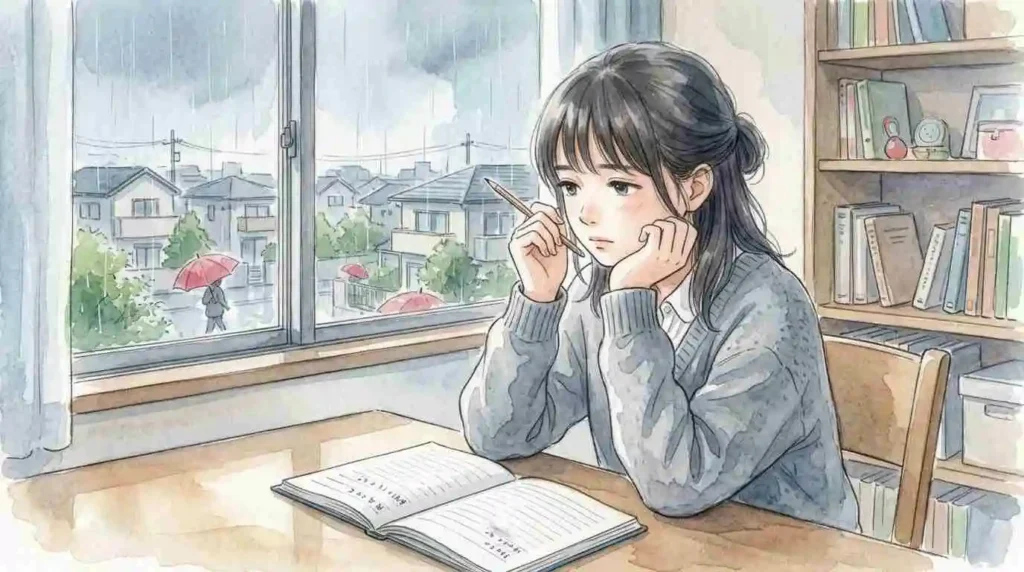
After finishing the previous 10th place song, “Ai wa Kimi” (Love is You), and starting to watch a drama on Netflix, I found myself humming these lyrics again. I thought I had already introduced it, but when I glanced back at the ranking chart, I discovered it was missing from the list and am now hurriedly writing this. In terms of position, around 10th place feels just right.
I thought about adding it at the end after introducing all 30 songs, but since it fit so perfectly right here, I decided to add it as a tie for 10th place.
This time, the spotlight is on “Fun,” a hidden masterpiece included in the timeless album “Kori no Sekai” (Ice World), released in 1973, which recorded Japan’s first million-seller.
I will guide you through this early masterpiece of Yosui’s, which stands apart from the damp gloom and excessive self-pity found in Japanese folk songs of that era, offering a somewhat objective yet strangely warm human touch.
Creative Interpretation
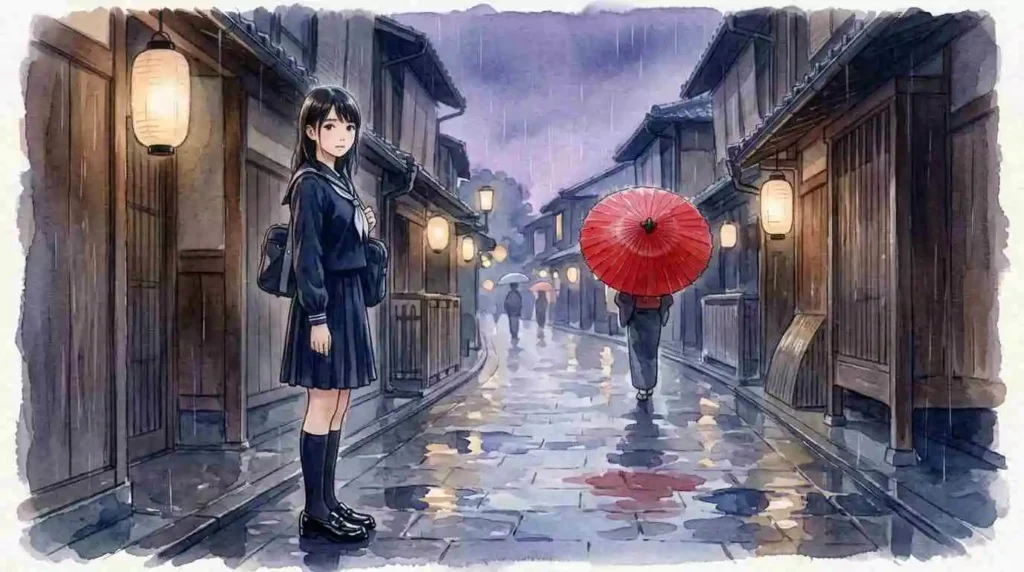
The girl in the rain has just learned what love is, wrapped more in anxiety than joy.
The red umbrella, the wet shoes, and the words written in her diary—everything looks a bit sad.
Blaming herself for being a crybaby and a coward, she has fallen in love with someone anyway.
If it clears up tomorrow, today's tears will eventually turn into a small memory.
First, Please Listen to the YouTube Videos
This is the studio version. Please click the image below.
Credits
Song Title: FUN
Lyrics, Composition, Vocals: Yosui Inoue
Arrangement: Katsu Hoshi
Album: "Kori no Sekai" (Ice World)
Two-Line Commentary
"FUN" is an early work by Yosui Inoue that depicts an unstable heart having just learned love, seen through a girl getting wet in the rain.
Props like the red parasol, enamel shoes, a diary, and early summer rain vividly bring to life the image of a girl swaying between childhood and love.
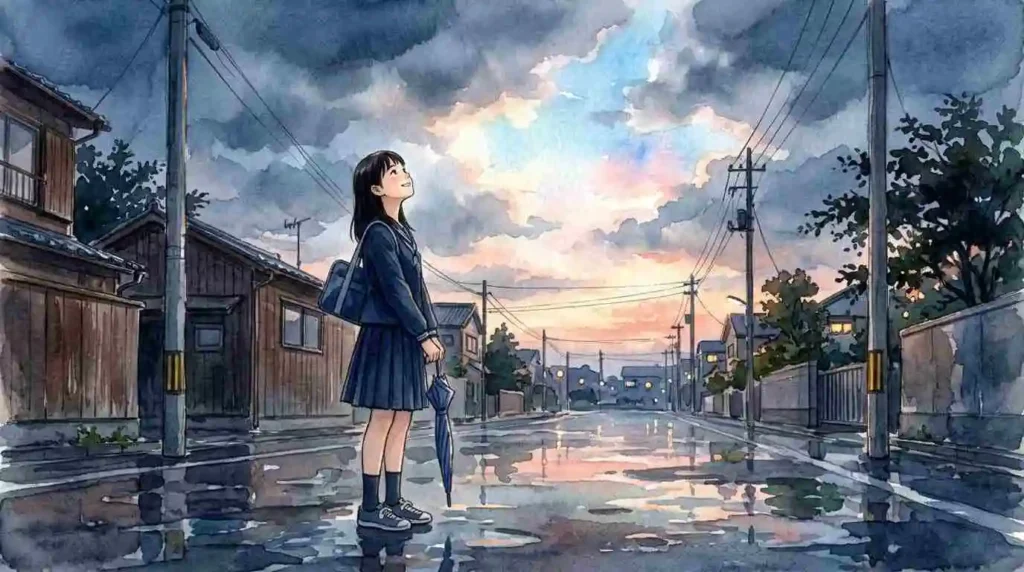
Next is the live version. Please click the image below.
Credits
Song Title: FUN
Lyrics, Composition, Vocals: Yosui Inoue
Video Type: Live Audio
Two-Line Commentary
In this live version, the contours of the vocals become more raw than in the studio recording, bringing the girl's solitude and hope for the rain to stop much closer.
(Note: Most of the audio sources of Yosui Inoue available on the internet are not official distributions. Therefore, out of consideration for copyright, this blog adopts a format where we link to external sites using uniquely prepared images instead of directly embedding videos.)
The True Identity of the Slightly Mischievous and Endearing “Inversion” Hidden in the Title
Yosui sketches the melancholy of a rainy day and the frustration of unrequited love using a truly painterly approach. The reason it doesn’t feel heavily dark is probably due to the exquisite balance maintained between the sullen charm of the protagonist girl and a camera-like gaze watching her from a distance.
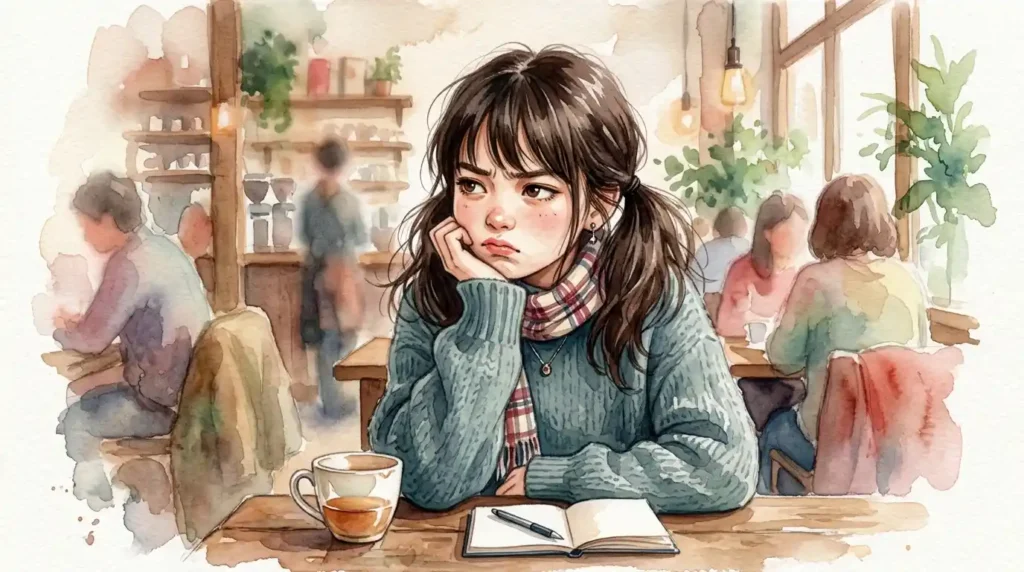
Every time I listen to “Fun,” I feel a strange comfort, wondering, “Why is it so lighthearted despite the sad situation?”
Following the lyrics closely, what isดีepicted is a somewhat painful scene of heartbreak, with a girl left waiting in the rain.
Despite this, Yosui deliberately titled this slightly sentimental story “Fun” (meaning enjoyment or mischief).
Instead of turning the painful memories of youth into damp sentimentality, he looks back with a smile as if it were a “little prank of life.” I feel Yosui is trying to convey such a mature, composed perspective to us through this lighthearted pop music.
Red Parasol and Enamel Shoes: A “Rain Portrait” Spun by Vivid Colors
Looking down at the lyrics, you notice a row of words that evoke remarkably fresh imagery.
- A single “red parasol” standing out vividly against the rainy sky
- “Enamel shoes” gleaming wet in the twilight
- A “puddle on the way home” that she doesn’t even bother to step around
These are not merely descriptive words; they function as a perfect color design to instantly project “a quiet, rainy street corner at dusk” into the listener’s mind. It resembles a screen filled with dry poetry, as if watching a film from the early 1970s.
Even after becoming a working adult, I sometimes found myself humming the melody of this song on my way home in the rain.
Yosui does not dress up the girl’s “crybaby, coward, and lonely” time with easy sympathy. He simply fixes that scene quietly like a camera and gently presents it to us.
Yosui’s Dry Humor in Seeing Through Your “Pretense”
The question posed at the beginning of the lyrics, “Are you looking at the rain? / Or are you just pretending to look at the rain?” symbolizes the unique sense of distance this song maintains.
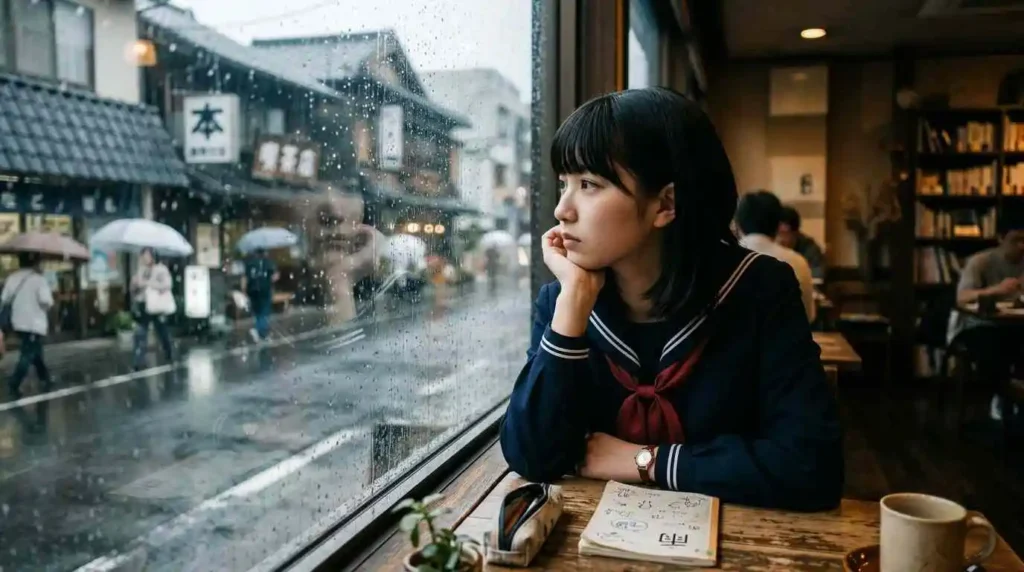
Toward the downcast girl, instead of just shedding tears together, there is a mature humor that gently sees through her small show of strength, as if saying, “You’re actually checking on me, aren’t you?”
Because of this gaze, the often heavy theme of heartbreak transforms into an airy texture, much like a high-quality short film.
Amidst the folk songs of that era, which tended to get dragged down by sticky passions, this one-step-removed, smart stance radiated a highly distinctive brilliance.
An Onlooker’s Gentle Gaze Entrusted to the Words “Stopping the Diary”
The phrase that resonates most memorably in this song is, “I wonder if she’s writing that she’s stopping her diary starting today.“
This does not directly depict the girl’s inner thoughts, but is a warm gaze softly watching her as she stands looking a bit sullen in the rain. The onlooker is gently wondering about her situation, thinking, “Since something a bit sad happened today, I wonder if she is going to stop writing in her diary.”
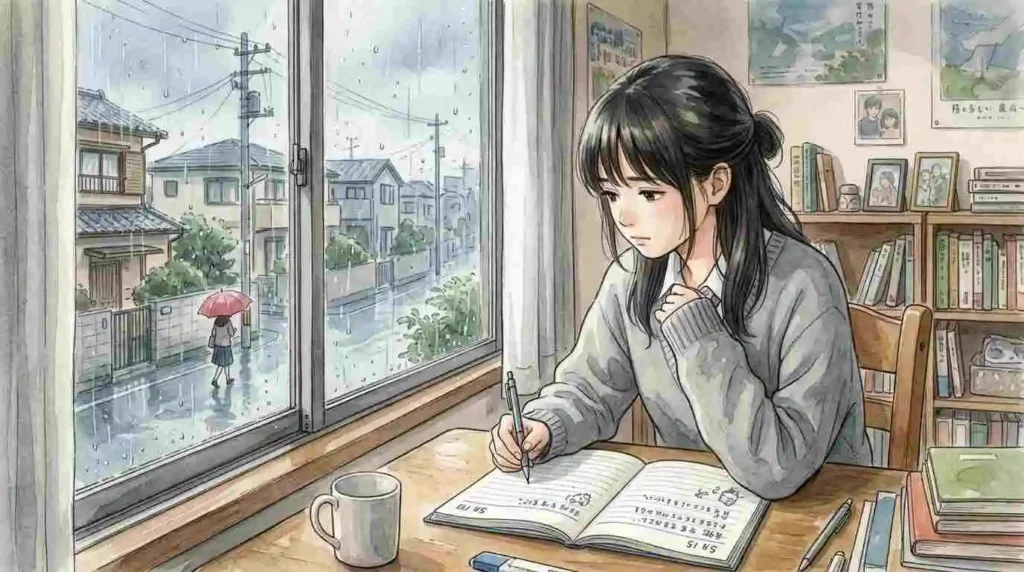
Instead of explaining the protagonist’s emotions directly, Yosui elevates the poignant scene into something more three-dimensional by filtering it through this surrounding gaze and the private prop of a diary. Precisely because of this distance—where one considers her feelings through her every move rather than forcing comfort upon her—the song carries a pleasant resonance free of intrusiveness.
Listener Memories Expanding Precisely Due to the Unconfined Scenery
Looking across the entire lyrics, the full details of a concrete story—who did what to whom—are deliberately left unrevealed in this song.
What is depicted are only fragmentary situations and props, such as the rain, a red parasol, wet shoes, or a diary. Because explanations are kept to a minimum, the world of the song is left to the listener’s imagination. Thanks to this structure, listeners can naturally project their own distant memories or a bitter piece of their past youth onto it.
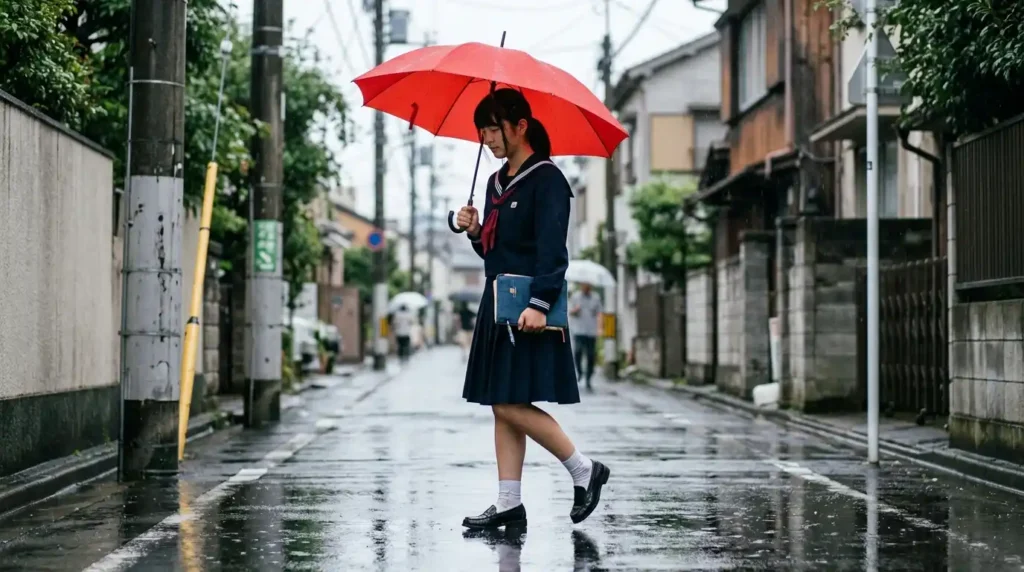
Yosui’s style of not telling everything possesses a mysterious capacity that allows anyone, across eras and generations, to receive this song as their own story.
Conclusion
If I had failed to notice the omission from the list tonight and finished the ranking while passing right by “Fun,” this “Yosui Inoue Edition” would undoubtedly have lacked its finishing touch. To that extent, this song is an extremely crucial milestone proving that Yosui was beginning to establish his own unique pop sensibility.
When I get a little tired of songs that overly agitate emotions, I still often play this track. When I do, the light acoustic tone flowing from the speakers instantly repaints the air of the room into “that slightly painful yet endearing street corner on that rainy day.”
The comfort of being free from the weight of words, simply surrendering to the swelling sound and casual gentleness. Why not immerse yourself once again tonight in this exquisite “grown-up prank” crafted by Yosui?

音楽ファン同士の交流・リクエストはこちら / Connect & Request Songs Here