
- 🎧 Listen to This Article
- October 3 Is Yoshiyuki Ohsawa’s Birthday
- First, Listen to the Official YouTube Audio
- A Breakup Song That Never Explains the Breakup
- Why Doesn’t He Run After Her?
- Its Restraint Is Exactly What Makes It Unforgettable
- 1984: A Time When Japanese Pop Was Expanding in New Directions
- From “Itetsuita Rally” to Ohsawa’s Signature Song
- Why It Still Feels Timeless More Than 40 Years Later
- And I Remember 1984
🎧 Listen to This Article
Get a quick overview of the article through narration.
Recommended if you’d like to get a feel for “Soshite Boku wa Tohou ni Kureru” and the overall flow of the article before reading.
🎵 English Narration
Listen to an English narration introducing the key points of this article.
🎶 Japanese Narration
Listen to a Japanese narration introducing the key points of this article.
Listening first will help you get a better sense of “Soshite Boku wa Tohou ni Kureru” and the key points explored in this article.
October 3 Is Yoshiyuki Ohsawa’s Birthday
Yoshiyuki Ohsawa was born on October 3, 1957, in Koenji, Tokyo. He is one year older than I am, but we belong to the same generation.
He made his debut in 1981 as the vocalist and guitarist of the rock band Cloudy Sky. After the band broke up, he launched his solo career with EPIC/Sony in June 1983.
I feel it would be a shame to describe Yoshiyuki Ohsawa simply as “the singer of Soshite Boku wa Tohou ni Kureru.”
Along with being a distinctive singer, he is also an accomplished songwriter who has composed songs for Kenji Sawada, Akina Nakamori, Kumiko Yamashita, Koji Kikkawa, and others. His name can be found behind some of the songs that defined Japanese pop in the 1980s, including Akina Nakamori’s “1/2 no Shinwa” and Koji Kikkawa’s “La Vie en Rose.”

His music draws on soul and R&B, his voice has a distinctive slightly rough texture, and his sophisticated urban sound stood apart from much of the mainstream Japanese pop of the time. The song that brought those qualities to a much wider audience was his 1984 hit “Soshite Boku wa Tohou ni Kureru.”
The song first appeared on his third album, CONFUSION, released on July 10, 1984, and was released as his fifth single on September 21 of the same year. It was featured in a Nissin Cup Noodles commercial and became a major hit, reaching No. 6 on the Oricon chart.
Lyrics by Giniro Natsuo, music by Yoshiyuki Ohsawa, arrangement by Masaaki Omura.
1984 produced one colorful hit after another in Japan. Yet this song neither exaggerates its emotions nor turns a breakup into a grand drama. Even so, more than four decades later, many people probably need only see the title for that melody to begin playing in their heads.
Interpretive Translation
If leaving is the choice you have made, all I can do is accept your decision.
Even so, the time we shared and your smile remain in this room and in my heart.
The seasons may change and you may move farther away, but those feelings will not simply disappear.
And so I walk alone into the evening, carrying my loneliness with me.
💡 You might also like: View the original Japanese lyrics (External site)
If the lyrics are available only in Japanese, you can use your browser’s translation feature or an AI translation tool to understand their general meaning.
First, Listen to the Official YouTube Audio
Credits
Yoshiyuki Ohsawa — “Soshite Boku wa Tohou ni Kureru”
Lyrics: Giniro Natsuo / Music: Yoshiyuki Ohsawa
Audio provided by TEICHIKU ENTERTAINMENT
In Two Lines
A defining 1984 song that captures a man's sense of loss after a breakup within a cool, sophisticated urban sound.
Each return of the title phrase deepens the feeling of a man left with nowhere to go, suspended in quiet loneliness.
When I First Heard This Song…♫
| My Age | Elementary School | Junior High | High School | University | 20s | 30s | 40s | 50s | 60+ |
| Year Released | 1984 | ||||||||
| When I Heard It | ● |
I think I first heard this song when it was released in 1984. I was in my fourth year of working life. Every day was hectic, and I threw myself into both work and fun. It was an enjoyable time in my life.
I seem to have always preferred voices with a slightly rough edge to perfectly clear, polished ones. GAO’s “Sayonara,” which I introduced recently, is a perfect example.
I can no longer recall a specific scene from when I heard this song back then. I was 26 years old, and I suppose I simply let myself be carried along by a busy life, with one day passing into the next almost before I noticed.
A Breakup Song That Never Explains the Breakup
Looking closely at the lyrics again reveals what makes this song so interesting.
What we see is a woman, apparently the narrator’s lover, preparing to leave the room. Yet we are never told why they are breaking up, when their relationship began to fall apart, or what happened between them.
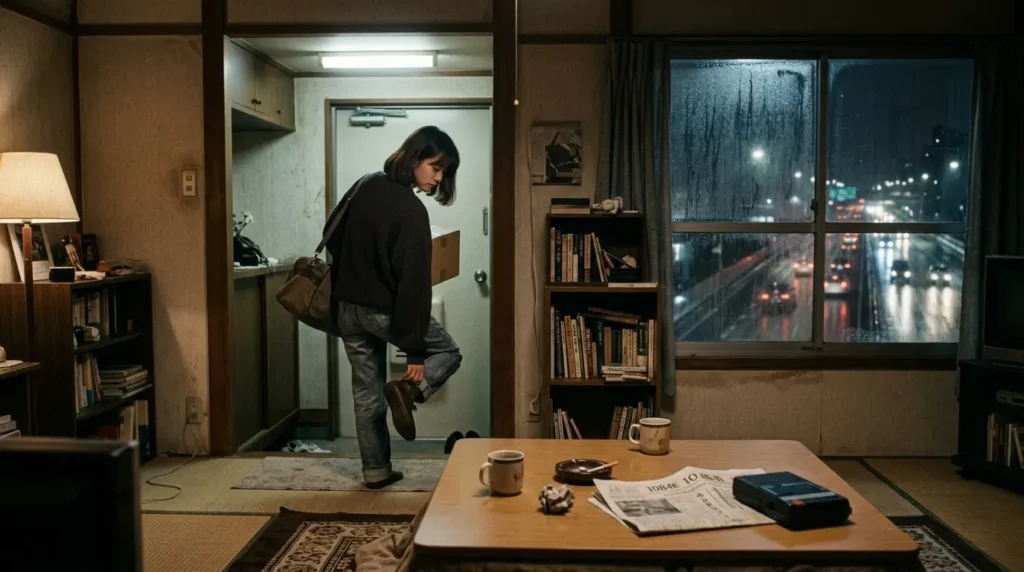
Instead, the lyrics give us ordinary objects and scenes: clothes, a hairstyle, a table, a rain-soaked highway, a room, a window. Rather than directly telling us that the narrator is sad or lonely, Giniro Natsuo lets us imagine his state of mind through what he sees around him.
What the “Unfamiliar Clothes” Suggest
One of the first things that catches my attention is the phrase “unfamiliar clothes” at the very beginning.
Someone who was close to him until yesterday is wearing clothes he does not recognize, fixing her hair, and preparing to leave. It is a small detail, but it suggests that she is already moving toward a world the narrator no longer knows.
Meanwhile, the table has been left untouched. It almost looks as if their life together has simply been cut off halfway through.
If this were a movie, the camera would not need a close-up of the narrator collapsing in tears. Instead, after the door closes, it might linger on a table with a half-finished cup and a magazine left open.

Nothing dramatic needs to happen for us to understand that the everyday life they shared until yesterday has ended. That is one of the great strengths of these lyrics.
Why Doesn’t He Run After Her?
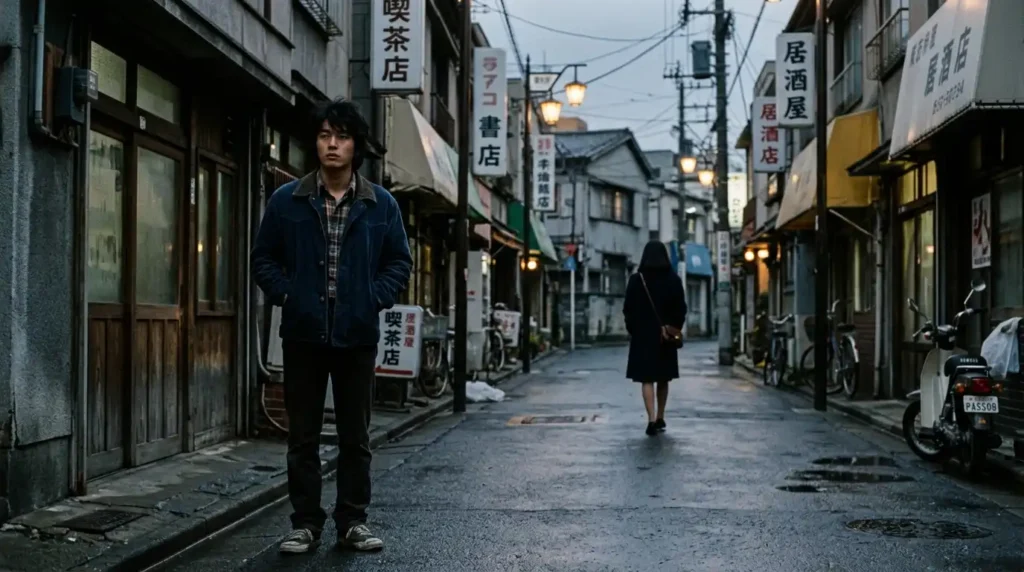
Another thing that strikes me is that the narrator does not run after her.
He does not stop her. He does not blame her. He does not ask her to come back. Instead, he tries to convince himself that she will be all right because this is the choice she has made.
Yet the more he tries to accept her decision, the more he seems to lose his own sense of direction.
And that is where the title, “Soshite Boku wa Tohou ni Kureru,” becomes so powerful.
It is not anger, nor is it theatrical despair. He simply does not know what to do or where to go from here. The fact that this state of helpless bewilderment becomes the title itself is one of the song’s greatest strengths.
Its Restraint Is Exactly What Makes It Unforgettable
The melody has much the same character as the lyrics.
This is not the kind of song that builds through a series of dramatic peaks before exploding into a huge chorus. The melody moves forward over a steady rhythm, creating something like the sensation of walking through the same place again and again.
That repetition suits the narrator’s state of mind. Something important has happened, but his mind has not yet caught up with reality, so the same thoughts keep circling back. The music captures that very human experience remarkably well.
Masaaki Omura and the Sound of 1984
Another essential figure in this song is arranger Masaaki Omura.
Omura worked with numerous Japanese artists, including Seiko Matsuda, and became one of the defining arrangers of Japanese pop in the 1980s.
“Soshite Boku wa Tohou ni Kureru” contains the electronic textures associated with the era, but the arrangement never tries to make everything sound spectacular at once. Ohsawa’s husky voice sits over a restrained, steady rhythm, and that combination gives the song its distinctive emotional temperature.

1984: A Time When Japanese Pop Was Expanding in New Directions
When this song was released in 1984, the Japanese music scene was remarkably vibrant.
Seiko Matsuda, Akina Nakamori, The Checkers, Southern All Stars, Anzen Chitai, and many others were filling the charts, while synthesizers and other electronic instruments were rapidly becoming part of mainstream record production.
At the same time, Japanese pop was absorbing influences from overseas genres such as new wave, AOR, soul, and funk.
I think Yoshiyuki Ohsawa occupied a rather unusual position within that movement.

He was a performer in his own right, but also a gifted melody writer who supplied hit songs to other singers, with R&B and soul forming an important part of his musical background. “Soshite Boku wa Tohou ni Kureru” brings those different elements together without ever sounding forced.
It does not fit neatly into the category of traditional Showa-era kayokyoku, yet neither does it simply import a Western pop style wholesale. In that sense, it can be heard as one of the songs that captures a period when Japanese pop was rapidly absorbing new sounds and turning them into something of its own.
From “Itetsuita Rally” to Ohsawa’s Signature Song
There is also an interesting story surrounding the song’s creation.
The composition is said to have originally carried the working title “Itetsuita Rally” and to have been intended as a song for another singer. In the end, Ohsawa recorded it himself, and with Giniro Natsuo’s lyrics it became “Soshite Boku wa Tohou ni Kureru.”
Knowing the finished version today, it is strange to imagine that the song might have gone to someone else. The melody and Ohsawa’s slightly rough voice sound so naturally connected that they seem almost inseparable.
Why It Still Feels Timeless More Than 40 Years Later
This is a recording from 1984, so if you listen closely to its textures, you can certainly hear the era in which it was made. Yet it does not fit comfortably into the box of “an old hit song.”
One reason is that very little in the lyrics ties the story to a particular period.
There are no smartphones, of course, but there are no telephone calls or letters either. What we have instead is a room, clothes, a window, rain, a highway, and someone walking away. It is a scene that could exist in 1984 or in 2026.
Another reason is that the story offers no clear resolution.

The narrator finds no answer, and we are never shown him recovering from the breakup. He simply faces the reality that someone important has gone, without knowing what he should do next.
Human emotions are rarely organized as neatly as stories sometimes make them appear. That sense of emotional reality may be one reason this song continues to connect across generations.
And I Remember 1984
Sometimes all it takes is the opening of a song from decades ago, and suddenly I remember the streets I walked, the work I was doing, the car I drove, and even the people I used to see.
For me, “Soshite Boku wa Tohou ni Kureru” is deeply connected with 1984. I was in my fourth year of working life, and at the end of that year, I got married.
More than 40 years have passed since then.
How much did I really understand this song at the time? Probably not nearly as much as I do now. I suspect I simply listened to it thinking, “This is a really cool song.”
Perhaps a great song is not one that sounds exactly the same decades later, but one that reveals something different as the listener grows older.
October 3 is Yoshiyuki Ohsawa’s birthday.
Today, I think I’ll listen to “Soshite Boku wa Tohou ni Kureru” again, while remembering a little of the person I was back in 1984.


音楽ファン同士の交流・リクエストはこちら / Connect & Request Songs Here