Explore Paul McCartney’s Journey Here!
- 🎧 Listen to This Article
- No. 9 is “With a Little Luck.”
- First, listen to the official YouTube video.
- What “a little luck” really means
- The sound of the synthesizer captures 1978
- When a Caribbean yacht became a recording studio
- London Town — when Wings became a trio again
- After “Mull of Kintyre,” a No. 1 hit in America
- From 5:45 to 3:13 — another version of “With a Little Luck”
- In Closing — a little luck is enough
🎧 Listen to This Article
Get a quick overview of the key points in this article through narration.
Recommended if you would like to get a feel for “With a Little Luck” and the overall flow of the article before reading.
🎵 English Narration
An English narration introducing the content of this article.
🎶 Japanese Narration
A Japanese narration introducing the content of this article.
Listening first will help you grasp the background, musical appeal, and key points of “With a Little Luck” before reading the full article.
No. 9 is “With a Little Luck.”
On March 23, 1978, Wings released “With a Little Luck” as a single. Eight days later, on March 31, it appeared as the ninth track on the album London Town.
In the United States, the song reached No. 1 on the Billboard Hot 100 dated May 20, 1978 and remained at the top for a second week. The previous year, “Mull of Kintyre” had become a historic success in the UK, selling more than two million copies, while “With a Little Luck” brought Wings another major triumph in the American market.
Chart success alone, however, is not why I placed this song at No. 9. Beneath its bright and instantly accessible melody lies a surprisingly active way of thinking that goes beyond simply leaving things to luck.
My Take on the Lyrics
If a little luck is on our side, we can surely make it through.
With just a little love, the two of us can change even the hardest situation.
Like a willow turning away from the storm, we can bend without losing our way.
There is no limit to what you and I can do together.
All we need now is for a little luck to blow our way.
First, listen to the official YouTube video.
Video Credits
Song: “With A Little Luck”
Artist: Wings
Written by: Paul McCartney
Album: London Town
Source: Official Paul McCartney YouTube Channel
YouTube release: February 27, 2013
Two-Line Commentary
A signature late-period Wings track from the 1978 album London Town that reached No. 1 in the United States.
Its warm blend of synthesizers and vocal harmonies is carried by one of Paul McCartney’s effortlessly memorable melodies.
What “a little luck” really means
The Japanese title, “Shiawase no Yokan,” roughly meaning “A Premonition of Happiness,” beautifully captures the song’s brightness. The original title, however, places the emphasis somewhere slightly different. “With a Little Luck” is not about happiness simply arriving; it is about the idea that just a little good fortune might be enough to help things work out.
The two people in the song are not sitting around waiting for luck to fall into their laps. They believe that problems can be sorted out and situations can change if they work together. Behind the lightness of the title lies a surprisingly strong sense of determination.
We do not have to leave everything to chance.
We only need a little luck to give us the final push as we move forward ourselves.
Another kind of strength, taught by a willow
One of the most interesting images in the lyrics is the willow turning away from bad weather. Instead of choosing a heroic figure standing defiantly against the storm, Paul uses a willow tree. That choice says a great deal about the character of the song.

A willow does not stand rigidly against a powerful wind. Its branches bend, but the tree remains. Paul turns that image into something larger: strength does not always mean forcing your way through resistance.
That is why “With a Little Luck” is not simply an encouragement song saying that hard work guarantees success. It also embraces flexibility—the ability to adjust to circumstances and still move forward together. That quality is one of the things I find most appealing about the song.
The sound of the synthesizer captures 1978
Musically, the first things that stand out are the electric piano and synthesizer.
Along with lead vocals and bass, Paul plays electric piano and synthesizer, while Linda McCartney and Denny Laine add backing vocals.

Paul’s official website also highlights the combination of synthesizers and vocal harmonies as one of the song’s defining features. Unlike “Jet” or “Band on the Run,” which draw much of their impact from the force of a rock band, “With a Little Luck” lets keyboards and electronic textures define the shape of the music.
Electronic sounds, but plenty of warmth
Even with the synthesizer placed so prominently in the arrangement, “With a Little Luck” never feels mechanical. The electronic sounds do not cover Paul’s melody; they drift around it, gradually opening up the song’s bright atmosphere.
What I especially like is that the melody remains something you can sing even as the palette of sounds becomes more modern. Paul does not use the new technology merely to show off the equipment. He absorbs those sounds into his own language of pop songwriting.
In the album version, the synthesizers become even more prominent from the middle of the track onward. A song that begins with the voice at its center slowly moves into a flowing passage of keyboards and electronic textures before returning to the vocals. The transition is remarkably smooth.
Why 5 minutes and 46 seconds never feels long
The album version on London Town runs for 5 minutes and 46 seconds. By the standards of a 1970s hit single, that is quite a long track.
Yet it rarely feels like an extended piece. Rather than relying on dramatic key changes or abrupt shifts of scene, the song remains within one musical environment while gradually changing the balance between keyboards, voices, and synthesizers.
This is not a song that races toward the finish line. It changes its scenery little by little as it moves forward. That unhurried pace is a large part of the song’s appeal.
When a Caribbean yacht became a recording studio
The song also has a production story almost as intriguing as the music itself. During the recording of London Town, Wings travelled to the U.S. Virgin Islands.
There they used a yacht called Fair Carol. A 24-track recording setup was installed aboard the vessel, allowing the band to work in an environment completely different from a conventional studio.

The basic tracks for “With a Little Luck” were recorded aboard Fair Carol on May 10 and 12, 1977, with overdubs added later that November at Abbey Road Studios in London.
Music made on the water
Of course, we cannot explain the song’s relaxed atmosphere simply by pointing to the fact that it was recorded on a boat. Still, once you know the setting, it is difficult not to hear something almost water-like in the gentle movement of the keyboards and synthesizers.
Working outside the confines of a conventional studio, Paul and the band were also incorporating electronic sounds that still felt relatively new at the time. The openness of the Caribbean setting and the machine-made quality of the synthesizer might seem like opposites, yet they coexist naturally in the finished recording.
London Town — when Wings became a trio again
At the same time, major changes were taking place within the band. During the making of the album, guitarist Jimmy McCulloch and drummer Joe English both left, leaving Wings centered once again around Paul, Linda, and Denny Laine.
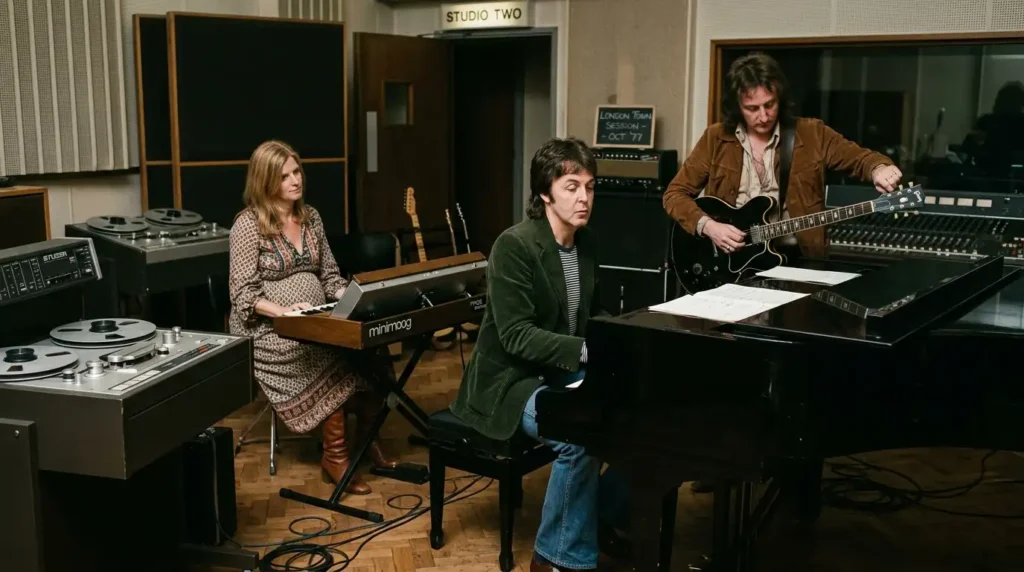
Linda’s pregnancy also forced changes to the band’s plans for 1977.
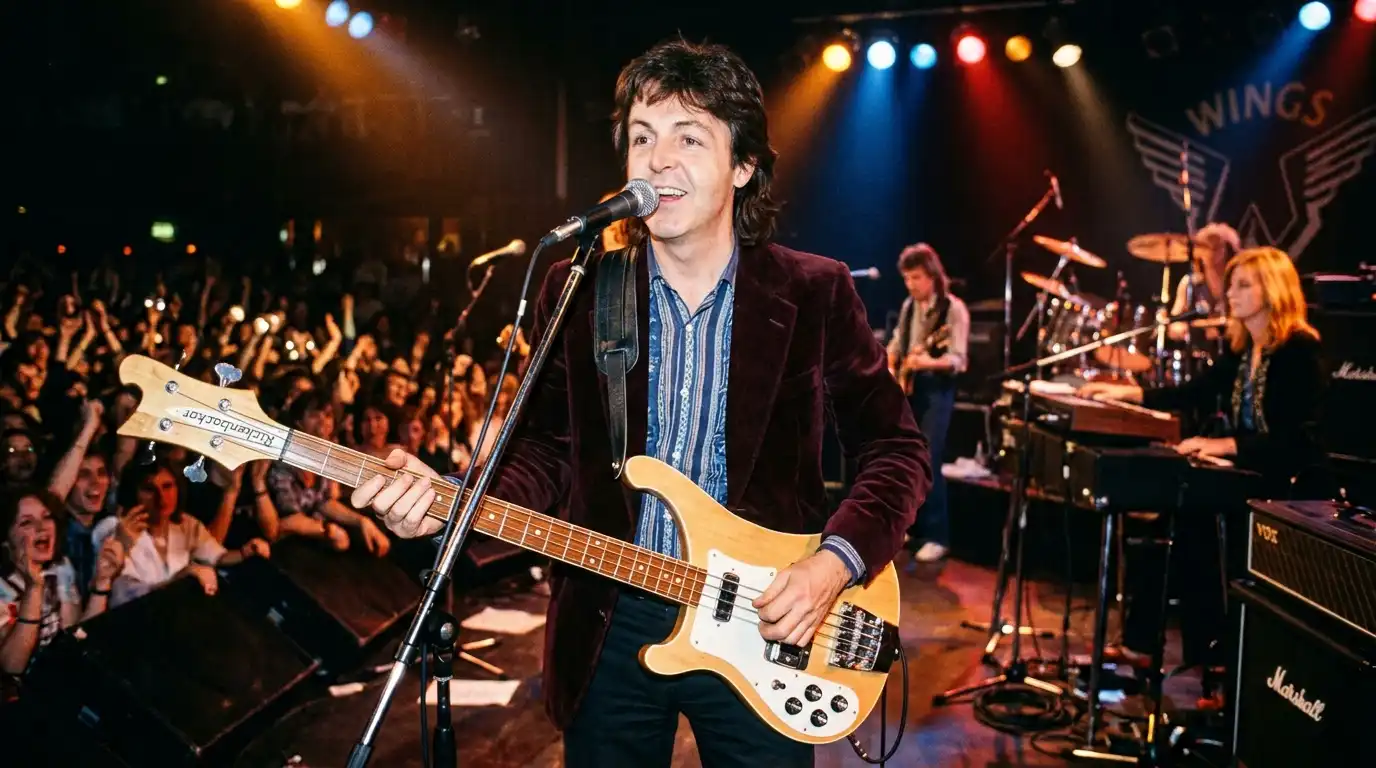
Only a year earlier, Wings had been playing huge venues on the Wings Over the World Tour. Now the lineup that had carried the band through that peak period was beginning to change once more.
A calm affirmation born from an unsettled band
What I find interesting is that “With a Little Luck,” despite being created during such a transitional period, contains very little sense of anxiety or tension.
Of course, it would be wrong to connect the band’s internal circumstances directly to the lyrics. Even so, there is something compelling about the contrast: a song written while the group itself was changing speaks so confidently about moving forward together in the face of difficulty.
After “Mull of Kintyre,” a No. 1 hit in America
At the end of 1977, “Mull of Kintyre” had sold more than two million copies in the UK, becoming one of the landmark hits in British music history. Its greatest success, however, was concentrated in Britain.
The following year, “With a Little Luck” achieved success in a very different way, spending two consecutive weeks at No. 1 on the Billboard Hot 100 beginning with the chart dated May 20, 1978. Without a crushing guitar riff or large-scale orchestration, a pop song built around melody and synthesizers reached the top of the American chart.

Paul rarely repeats the same formula for success
Even within this Best 15 series, Paul’s major songs refuse to fit into a single pattern.
“Live and Let Die” unfolds with the scale and drama of film music; “Band on the Run” joins three distinct musical sections into a single track; “Silly Love Songs” intertwines bass and multiple vocal parts. With “With a Little Luck,” Paul instead makes synthesizers a central feature of a gentle, flowing pop song.
It would have been safer to reuse the formula of an earlier hit, but Paul moved toward a different sound instead. That is one of the reasons I keep wanting to hear what he does next.
From 5:45 to 3:13 — another version of “With a Little Luck”
Alongside the full album version, which runs for roughly 5 minutes and 45 seconds, “With a Little Luck” also exists as a much shorter radio-oriented DJ Edit. That version runs for approximately 3 minutes and 13 seconds and has been officially preserved as a separate version.
The biggest difference is the substantial removal of the instrumental section that gives the full version so much of its character. As a result, the DJ Edit focuses more directly on the melody and vocals, turning the track into a tighter and more conventional pop single.
Listening to the two versions side by side makes the strength of the full recording especially clear. The song still works perfectly well in just over three minutes, but the longer version allows the synthesizers to expand at their own pace, creating the unhurried flow that makes “With a Little Luck” so distinctive.
The DJ Edit reveals the basic structure of a hit song. But if I want to experience the atmosphere that truly belongs to “With a Little Luck,” I still prefer to hear the album version from beginning to end.

In Closing — a little luck is enough
The Japanese title suggests the bright feeling that something good may be about to happen. But when we follow the original title and the meaning of the lyrics more closely, the song reveals itself as something more than a simple wish for good fortune.
Two people work together. If things go wrong, they try to put them right. If a strong wind blows, they bend like a willow rather than break. And after all that, perhaps they only need a little luck on their side.
“With a Little Luck” — sometimes, a little luck is all you need.

Paul McCartney turned that modest idea into an irresistibly melodic song colored by the synthesizer sound of 1978. More than its No. 1 chart position, I think it is the combination of lightness and quiet strength that continues to make “With a Little Luck” sound fresh today.

音楽ファン同士の交流・リクエストはこちら / Connect & Request Songs Here