🎧 Listen to this article
You can first check the key points of this article via audio.
Recommended for those who want to grasp the essentials quickly before reading.
🎶 English Narration
The content of this article is explained in English audio.
⌛ Duration: approx. 3 min
🎵 Japanese Narration
You can also listen to the narration in Japanese.
⌛ Duration: approx. 3 min
* Listening to the audio before reading will help you gain a deeper understanding of the song’s background and message.
No. 1 is “Hungry Heart”
My personal ranking of Bruce Springsteen, which I have been writing for a long time, has finally reached its peak. The glorious No. 1 spot goes to “Hungry Heart,” from the 1980 double album *The River*.
Why place this song at the top instead of grand rock anthems like “Born to Run” or “Thunder Road“? It’s because within this short three-minute pop song, the “inevitable contradictions and karma” of being human are packaged in the most beautiful, yet haunting way.
Now that I am older and have observed countless human dramas within the framework of society, the true depth and weight of this song resonate more deeply in my heart than ever before.
Core Meaning
One day, on a whim, he leaves his wife and kids in Baltimore and just drives away.
Wandering with no destination, unable to turn back, just playing his part.
Everyone carries an inescapable "hunger" and "emptiness" deep inside.
First, please listen to the official YouTube audio
Credits
Bruce Springsteen "Hungry Heart"
Official Audio / Bruce Springsteen Official YouTube Channel
Quick Commentary
A song about a man who has a family and a place to belong, yet is driven by an unfulfilled heart to leave it all behind.
Behind the upbeat melody lies a masterpiece that captures the universal loneliness and longing for a "place to go home to."
Credits
Bruce Springsteen "Hungry Heart"
Berlin ’95 Version / Bruce Springsteen Official YouTube Channel
Quick Commentary
A live version where the universal loneliness of "everyone having an unfulfilled heart" is sung amidst a massive crowd singalong. The human desperation for a home seeps through the energetic rock 'n' roll heat.
Credits
Bruce Springsteen & E Street Band "Hungry Heart"
The River Tour: Tempe 1980 / Bruce Springsteen Official YouTube Channel
Quick Commentary
Live footage from the 1980 tour, bursting with the raw energy of the young Springsteen and the E Street Band. The loneliness of the song vividly emerges behind the bright, audience-engaging atmosphere.
The Intense Gap Between “Sound” and “Story”
The greatest strength of this song lies in the contrast between its bright sound and the darkness of its theme.

Upbeat Rhythm and Brutal “Irresponsibility”
The opening lyrics describe a man who leaves his wife and kids in Baltimore, goes for a drive, and never comes back. It is an incredibly selfish, irreversible act of escapism. If this had been sung as a heavy minor-key ballad, it would have been a mere tragic confession.
However, Springsteen chose a highly cheerful, bouncing 60s-style pop approach, reminiscent of Phil Spector’s “Wall of Sound.” This lightness actually highlights the “lack of reason” behind the man’s actions. He didn’t abandon his family out of malice. Like a river flowing wherever it goes, he just took a sudden turn and kept moving forward.
The “Magic Veil” Cast by the E Street Band
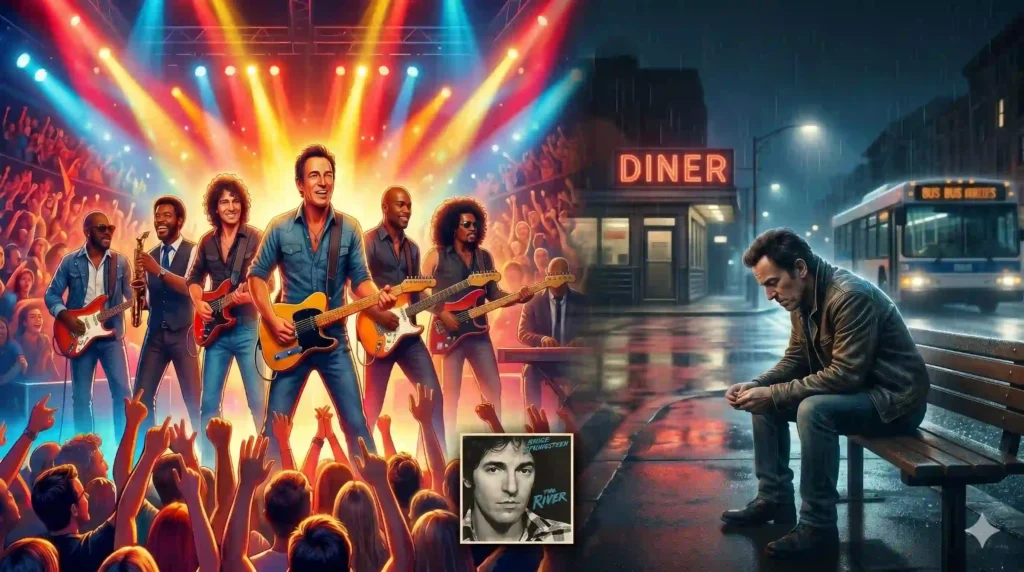
This almost cruel level of “poppiness” is undoubtedly defined by the brilliant ensemble of the E Street Band. From the beginning, the light keyboard sounds pull the song along like a merry-go-round. Clarence Clemons’ soaring saxophone in the bridge is somewhat humorous, yet carries an undeniable human sorrow.

It is precisely because of their cheerful sound production that the protagonist’s “hopelessness” and “irresponsibility” are elevated to top-tier entertainment. The exquisite balance of singing away a tragedy over a thoroughly upbeat rhythm is an artistic pinnacle.
The True Nature of the “Hungry Heart” We All Carry
How the Song Changes as We Age
The Perspective Shift: Then vs. Now
The phrase “**Hungry Heart**.” When I listened to this song in my younger days, perhaps back as a student, I thought this “hunger” was simply ambition—a desire to achieve something great or a youthful burst of energy.
But listening to it again now, after going out into the world and accumulating various life experiences, my impression has gradually shifted. The “hunger” sung here seems a bit different from mere motivation or aspiration. No matter how well work is going or how happy a home life you have, it’s that inexplicable loneliness or sense of unfulfillment—the feeling that “something is missing” or “I want to go somewhere”—that hits you in a sudden moment.
To Live with Contradiction is to be Human
Toward the end of the song, the protagonist reveals his true feelings: “Everybody needs a place to rest / Everybody wants to have a home / Don’t make no difference what nobody says / Ain’t nobody like to be alone.” Despite having left his family, deep down he still longs to be connected to someone. This is a deep contradiction, but I feel that is exactly what makes us human.

“I want to be free,” but “I don’t want to be lonely.” We all carry that selfish yet earnest “hunger” somewhere hidden in our hearts. That is likely why this song continues to resonate with so many people, even after more than 40 years.
Rock ‘n’ Roll and the “Dead End” Landscape
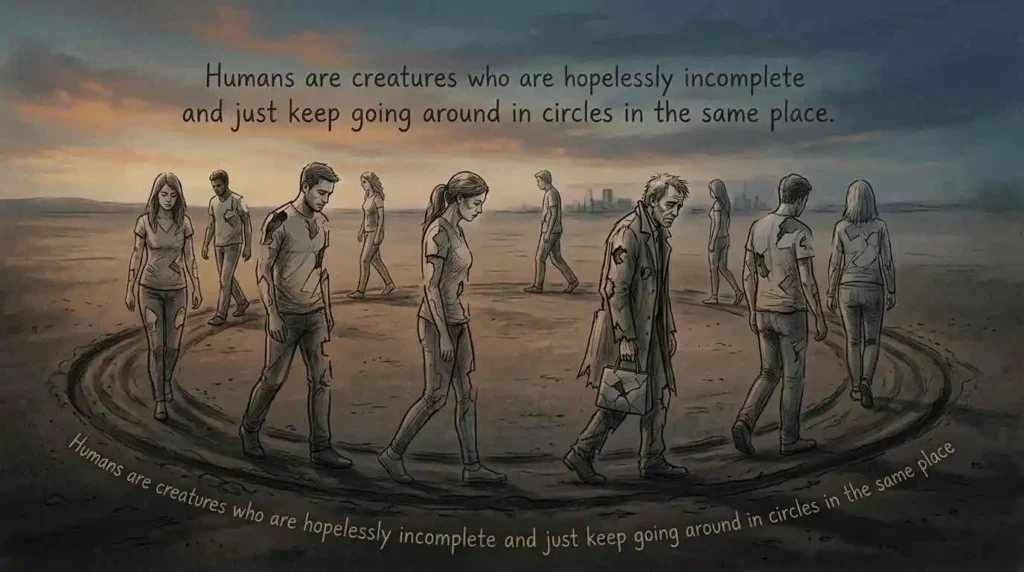
Springsteen’s earlier masterpieces were filled with the romanticism of youth trying to escape to some distant “Promised Land.” However, the protagonist of “Hungry Heart” has no clear destination. He is just going in circles in the same place, moving like a piece on a predetermined game board, simply “playing his part” in society.
Why I Rate “Hungry Heart” as His Greatest Work
A Cold Universality That Offers No Easy “Answer”
Why did I choose this short pop song as No. 1 in my ranking? Because it offers no easy “answer” or “hope.”
There is no fiery message of “let’s run away together,” nor a powerful determination to face adversity. It simply presents the cold fact that “humans are creatures who carry inescapable gaps and wander in circles.” The strength of not looking away from that stark truth is what ensures its universality, remaining unfaded by time.
The Catharsis of the Stadium Singalong
The true final form of this song can only be seen in live performance. Springsteen often leaves the opening verse to the audience. Then, tens of thousands of people, young and old, men and women, joyfully sing along to this “selfish man’s escape drama.”
It is a grand ritual in which the “desire for escape” and “unavoidable emptiness” hidden in everyone’s heart is shared and affirmed in the vast space of a stadium. The moment a personal darkness turns into a lovable, shared human weakness.
Closing: Living with the Unfilled Gap
The day the “hungry heart” is completely satisfied will probably never come. We all carry that gaping hole while silently playing our respective parts on the game board of the life we have left.
But that is precisely why we can lean on one another through music and sing together with others who carry the same emptiness. What Bruce Springsteen taught us through “Hungry Heart” might be such a cruel, yet ultimately gentle, celebration of humanity.
This concludes my “Personal Best 15: Bruce Springsteen Edition.” Thank you so much for following along for so long. I look forward to seeing you again on our next musical journey.


音楽ファン同士の交流・リクエストはこちら / Connect & Request Songs Here