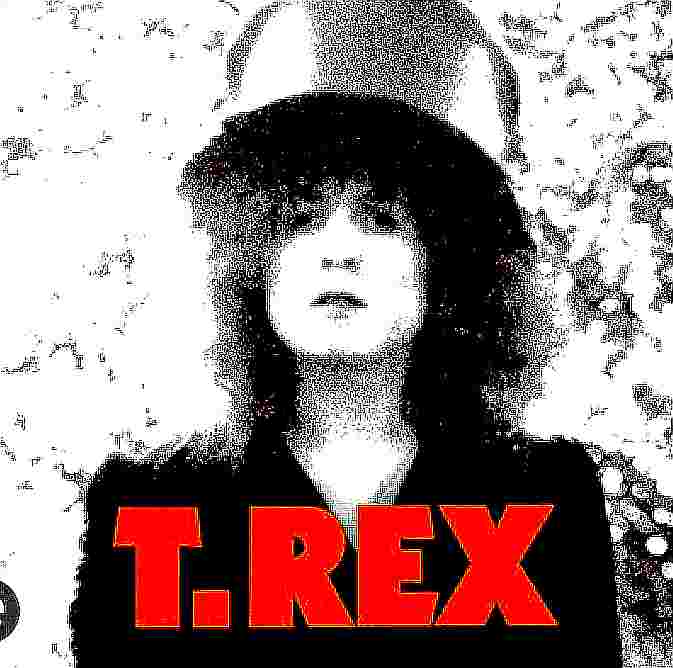
For the history of T. Rex and Marc Bolan’s journey, click here!
- 🎧 Listen to This Article
- No. 1: “Children of the Revolution”
- First, Watch T. Rex Perform “Children of the Revolution”
- September 1972 — A Standalone Single That Spent Three Weeks at No. 2 in the UK
- There Are Actually Several Different Versions
- Why Does Something So Simple Sound So Powerful?
- What Does “Children of the Revolution” Mean?
- Ringo Starr Captures T. Rex at Their Peak
- A Song Strong Enough to Survive a Hard Rock Makeover
- Why I Chose It as No. 1
🎧 Listen to This Article
Get the key points of this article quickly through narration.
Recommended if you want to get a feel for “Children of the Revolution” and understand the overall flow of the article before reading.
🎵 English Narration
An English narration introducing the content of this article.
🎶 Japanese Narration
A Japanese narration introducing the content of this article.
Listening first makes it easier to grasp the appeal of “Children of the Revolution” and the key points of the article.
No. 1: “Children of the Revolution”
At last, we have reached No. 1 in my T. Rex Top 10. My choice is “Children of the Revolution,” released in 1972.
If I had to give just one reason, it would be simple: it is incredibly cool.
The heavy guitar, the solid rhythm, the powerful chorus, and Marc Bolan’s unmistakable voice at the center of it all.
Along with “20th Century Boy” and “Solid Gold Easy Action,” this is one of the T. Rex songs I have listened to most often. But if I had to leave just one song at the very top of this Top 10, this would still be the one.
My Free Interpretation
Dance any way you want.
Make some noise and set yourself free.
No matter how they dress up their words,
we, the children of a new age, will not be fooled anymore.
First, Watch T. Rex Perform “Children of the Revolution”
Credits
T. Rex — “Children of the Revolution”
Written by: Marc Bolan
Performed by: Marc Bolan, Mickey Finn, Steve Currie, Bill Legend
Filmed: London, October 1972
Published by: T. Rex Official Artist Channel
Published: November 6, 2020
Video: Official HD promotional video
About the Video
This official promotional video was filmed in London in October 1972. Marc Bolan can be seen playing his newly acquired custom Veleno aluminum guitar.
Scorpions Cover “Children of the Revolution”
Here is another version worth hearing: German hard rock band Scorpions performing “Children of the Revolution.”
With a much heavier arrangement than the T. Rex original, the cover makes the underlying strength of the song’s structure even more obvious.
Credits
Scorpions — “Children of the Revolution”
Written by: Marc Bolan
Original artist: T. Rex (1972)
Album: Comeblack (2011)
Produced by: Mikael Nord Andersson and Martin Hansen
Video: Official music video
Published by: Scorpions Official Artist Channel
About the Video
Scorpions reinterpret the T. Rex classic with a heavier hard rock sound.
The original riff and anthem-like character remain intact, while Klaus Meine’s powerful vocal adds a new level of intensity.
September 1972 — A Standalone Single That Spent Three Weeks at No. 2 in the UK
“Children of the Revolution” was released as a single in the UK in September 1972.
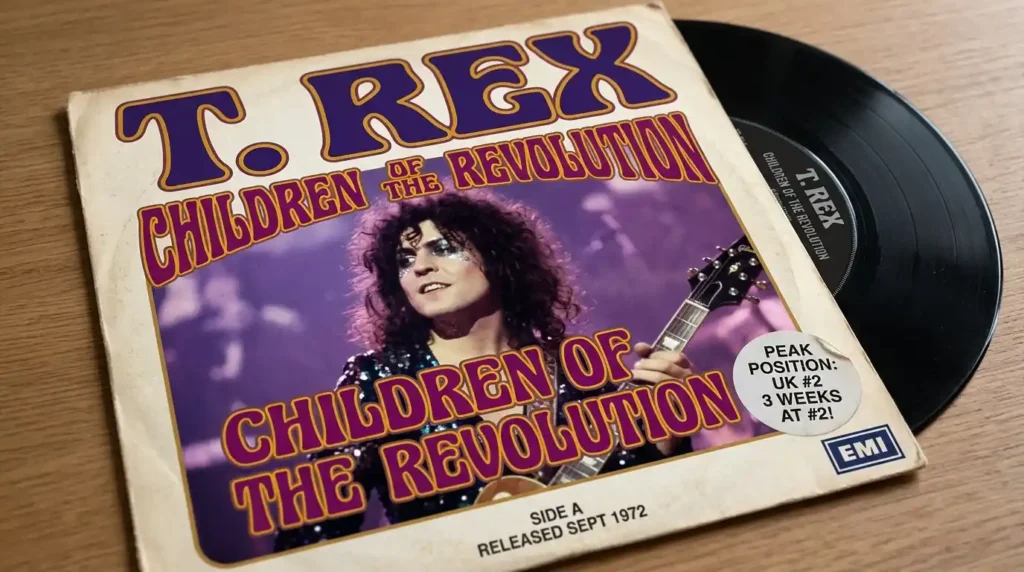
It reached No. 2 on the UK Singles Chart and remained in that position for three weeks.
At the time, T. Rex were at the very center of the phenomenon known as “T. Rextasy.” “Telegram Sam” and “Metal Guru” had both reached No. 1 in the UK earlier that year.
“Children of the Revolution” arrived right in the middle of that extraordinary peak.
It Was Not Included on a Contemporary Studio Album
One particularly interesting point is that the song was not included on any of T. Rex’s original studio albums at the time.
It appeared on neither The Slider, released in July 1972, nor Tanx, which followed in March 1973.
During this period, T. Rex regularly released major singles independently of their albums, and “Children of the Revolution” is one of the clearest examples.
Rather than treating a single merely as a promotional tool for an album, T. Rex could make the single itself a complete work in its own right. That is an important point when looking back at the British pop scene of the early 1970s.
There Are Actually Several Different Versions
Several recordings of “Children of the Revolution” survive from different stages of its development.
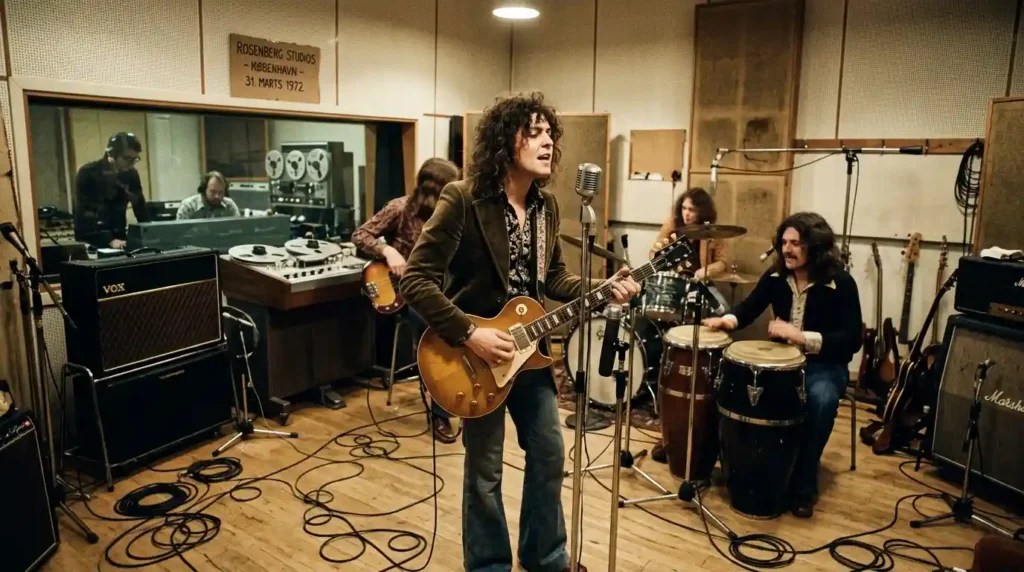
On March 31, 1972, a rehearsal version lasting more than 12 minutes was recorded at Rosenberg Studios in Copenhagen, Denmark.
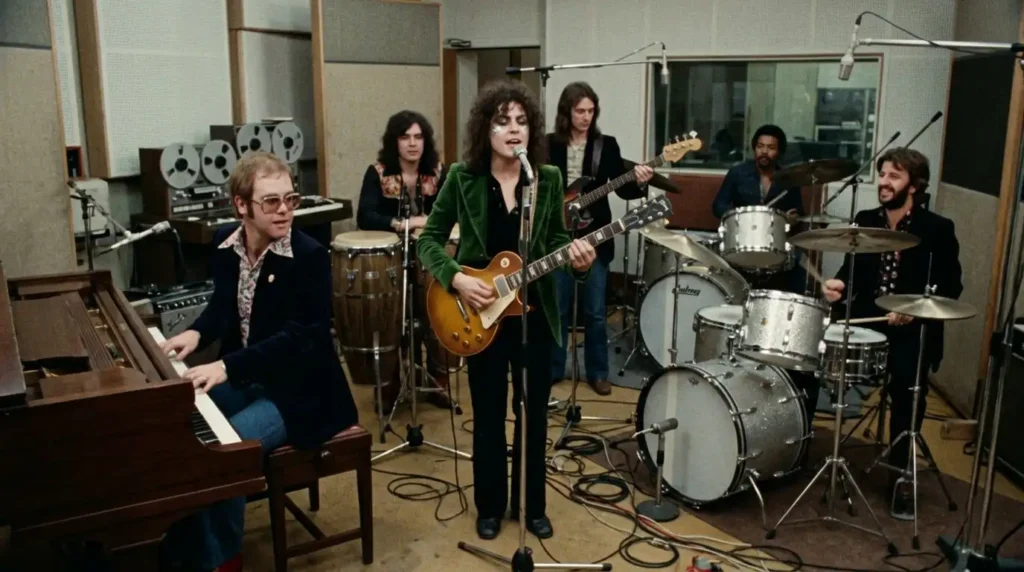
Then, on April 6 of the same year, a special session was held at Apple Studios in London for the film Born to Boogie.
Elton John and Ringo Starr Join the Session
Elton John played piano on the film version, while Ringo Starr, who also directed the movie, played drums.
T. Rex, Elton John, and Ringo Starr.
Even looking back today, it is an astonishing combination of musicians.
There is, however, an important distinction to make.
The version featuring Elton John and Ringo Starr heard in Born to Boogie is a different recording from the single released in September 1972.
The single version was recorded in August 1972, during the early sessions that would lead toward the next album, Tanx, and was later mixed at AIR Studios.
Why Does Something So Simple Sound So Powerful?
The first thing that strikes me about this song is the sheer strength of its sound. There is no complicated chord progression and no lengthy guitar solo.
Yet when Bolan’s voice and the massive backing vocals are placed over the thick foundation created by the guitar and rhythm section, the song takes on a scale far greater than its short running time might suggest.
An Anthemic Quality Within the T. Rex Sound
“Get It On” has its seductive groove, while “Telegram Sam” has a slightly darker, hypnotic repetition.
“Children of the Revolution,” by contrast, has the kind of anthemic power that makes you want to sing along with a crowd.
The title itself feels enormous, and the chorus has tremendous force. Yet underneath it all, the simple rock and roll character that defines T. Rex remains completely intact.
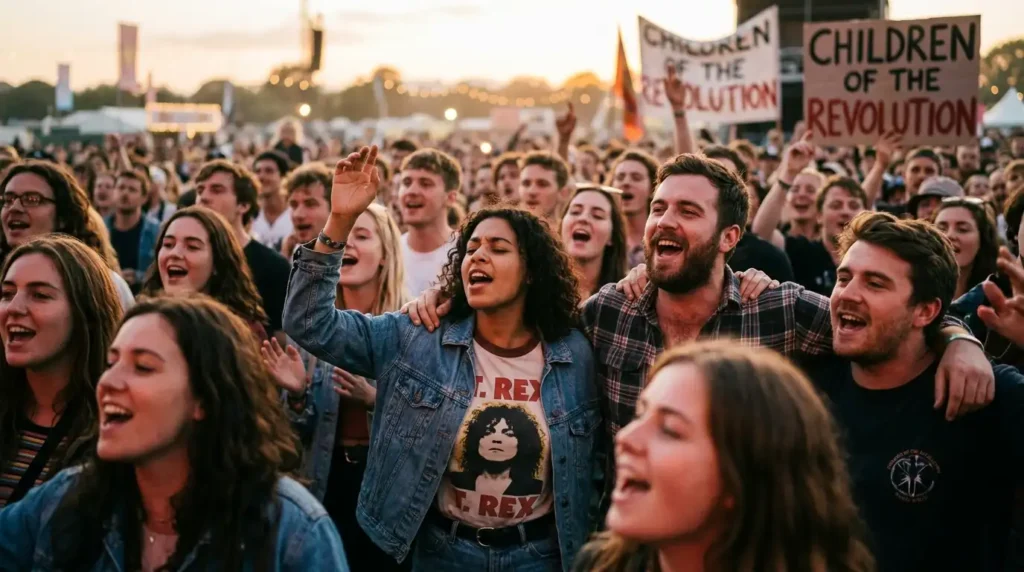
That balance is one of the reasons I never grow tired of hearing it.
What Does “Children of the Revolution” Mean?
Taken literally, the title means exactly what it says: “Children of the Revolution.” But I do not think it is quite right to assume from the title alone that Bolan was singing about a specific political revolution.
The lyrics are extremely concise and do not spell out a particular political ideology or social program.
Instead, the central feeling is something much simpler and more powerful: a new generation will not be so easily fooled.
There are references to dancing, making noise, and letting yourself go. After those distinctly rock-and-roll images, the title phrase returns again and again.
For that reason, rather than forcing a detailed political interpretation onto the song, it seems more natural to hear the phrase as an expression of the confidence and rebellious spirit of a younger generation entering a new era.
Ringo Starr Captures T. Rex at Their Peak
No discussion of “Children of the Revolution” would be complete without Born to Boogie.
Directed by Ringo Starr, the film includes footage from T. Rex’s concerts at London’s Empire Pool on March 18, 1972, as well as special studio performances.
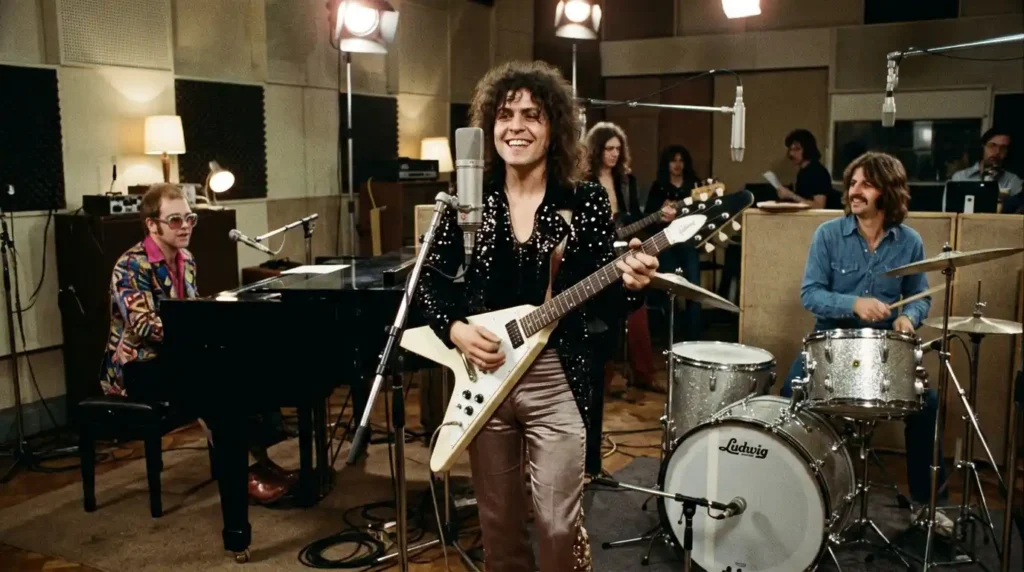
The version of “Children of the Revolution” featured there has a very different character from the standard single recording.
Elton John on piano, Ringo Starr on drums, and Marc Bolan at the center.
Rather than viewing it simply as a guest appearance, it is worth seeing the performance as a moment when several major figures in early-1970s British rock came together in the same studio.
And above all, Bolan looks as though he is having a wonderful time.
The atmosphere of the period when T. Rex were driving Britain wild survives not only in the music, but on film. That alone makes Born to Boogie an invaluable record of the era.
A Song Strong Enough to Survive a Hard Rock Makeover
The Scorpions cover featured earlier reveals another side of the song’s appeal.
The T. Rex original has the flamboyance and distinctive lightness of glam rock. In the hands of Scorpions, however, it becomes heavier and unmistakably more hard-rock-oriented.
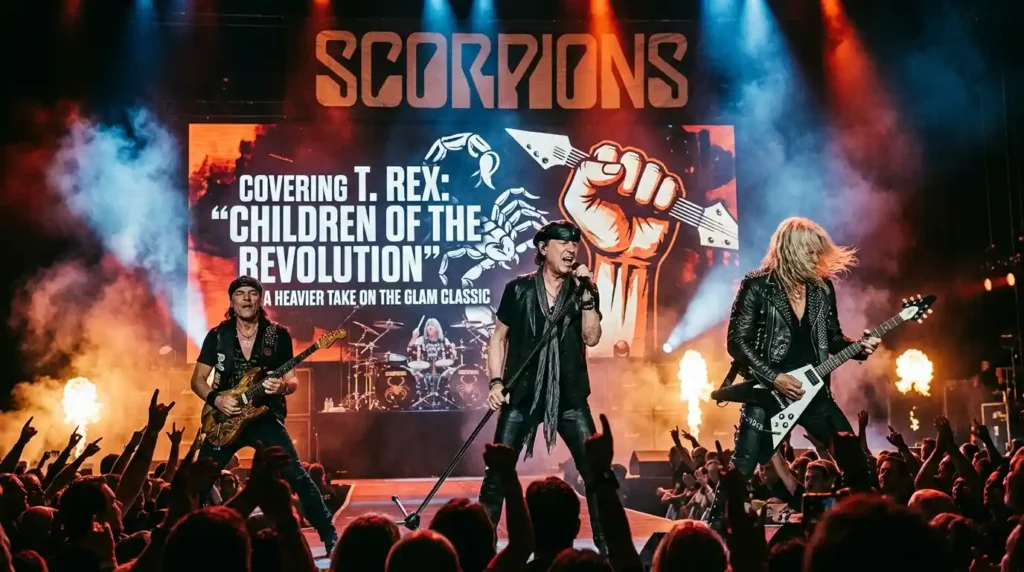
And yet, within seconds, there is no mistaking it for anything other than “Children of the Revolution.”
Change the arrangement, and the core of the song still remains. That says a great deal about the strength of the original composition.
Over the years, the song has continued to be covered by a variety of artists, crossing both generations and musical genres.
Why I Chose It as No. 1
When I put together this T. Rex Top 10, choosing the No. 1 song was not exactly something I agonized over until the very end.
I love “20th Century Boy.” And the moment the intro to “Solid Gold Easy Action” begins, I still feel an immediate physical reaction.
Then there are songs such as “Telegram Sam,” “Metal Guru,” and “Get It On” — tracks that sound unmistakably like T. Rex within seconds.
But in the end, the song that remains at the top for me is “Children of the Revolution.”
The rush the moment the guitar kicks in. Bolan’s voice. And that enormous chorus.
You do not need a complicated explanation. You only have to hear it.
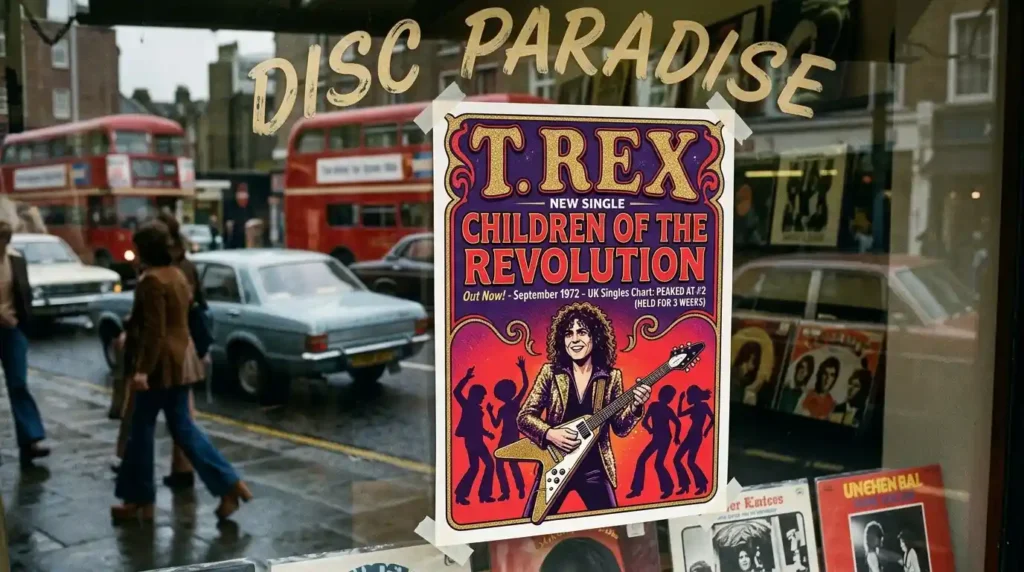
“It’s just incredibly cool. That’s all there is to it.”
I wrote those words in the original version of this article, and even after revisiting and rewriting the entire piece, I still see no reason to change them.
My Personal Top 10: T. Rex — No. 1 is “Children of the Revolution.”
T. Rex’s simple rock and roll, Marc Bolan’s flamboyant presence, and the power of an anthem capable of pulling an entire crowd with it — all of those elements come together here. For me, this is the ultimate T. Rex song.
音楽ファン同士の交流・リクエストはこちら / Connect & Request Songs Here