Explore Paul McCartney’s Journey Here!
- 🎧 Enjoy This Article in Audio
- No. 10 is “Hope of Deliverance”
- First, listen to the official YouTube videos.
- “Hope of Deliverance” Was Born in an Attic
- What the Japanese Title Adds to “Hope of Deliverance”
- Latin Rhythm Propels the Acoustic Guitar
- The Touring Band Behind Off the Ground
- What the Studio and Live Versions Reveal
- No. 18 in Britain, No. 3 in Germany — A Striking Difference in Reception
- In Closing — Hope for Those Who Do Not Know the Answer
🎧 Enjoy This Article in Audio
Listen to a concise narration of the key points from this article.
Recommended if you would like to get a sense of “Hope of Deliverance” and the overall flow of the article before reading.
🎵 English Narration
An English audio introduction to the content of this article.
🎶 Japanese Narration
A Japanese audio introduction to the content of this article.
Listening first will help you grasp the background, musical appeal, and key points of “Hope of Deliverance” before reading the full article.
No. 10 is “Hope of Deliverance”
No. 10 is “Hope of Deliverance.”
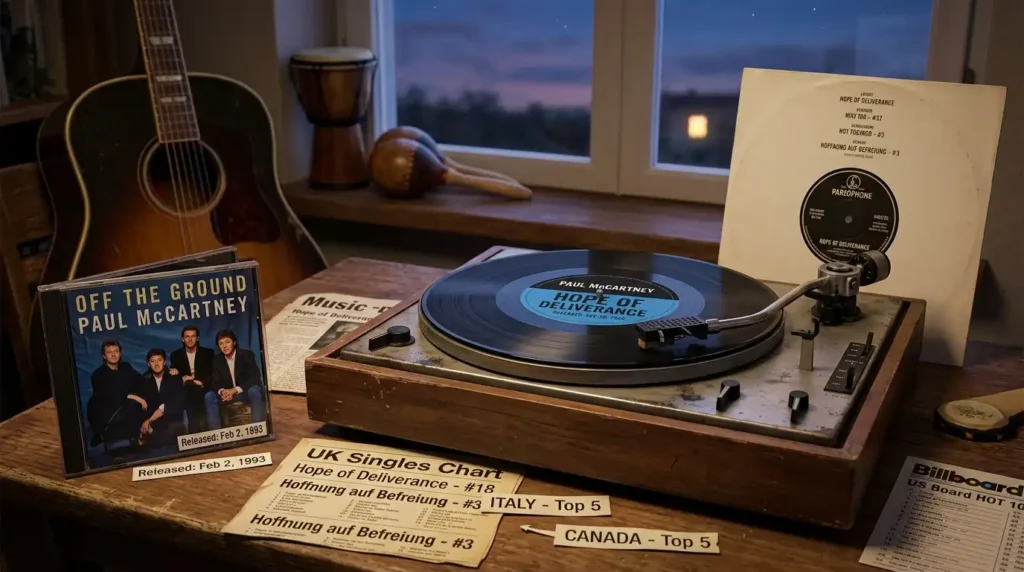
The song was released as a single on December 28, 1992, ahead of Paul McCartney’s album Off the Ground, released on February 2, 1993.
It reached No. 18 on the UK Singles Chart and climbed to No. 3 in Germany. It also entered the Top 5 in Austria, Canada, Italy, Norway, and Switzerland, earning particularly strong support across Europe.
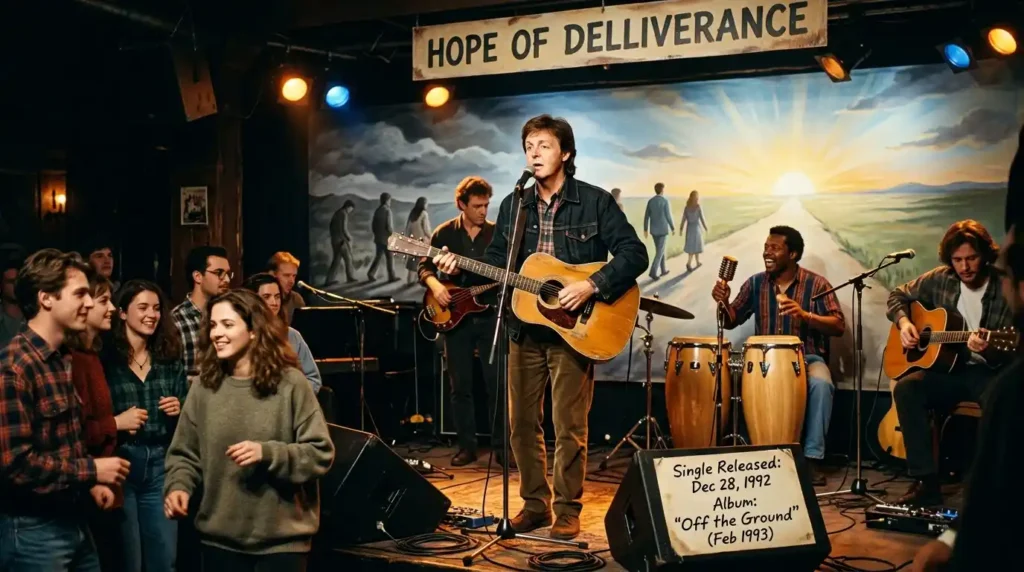
In the United States, however, the song peaked at No. 83 on the Billboard Hot 100. The considerable difference in its reception from country to country is one of the more interesting aspects of its history.
The brisk acoustic-guitar rhythm and Latin-flavored percussion give the song an immediately bright character. Yet the words describe a situation in which no one really knows what lies ahead.
Even so, people continue to live in the belief that something exists beyond the darkness. The song does not erase uncertainty; it chooses to move forward while uncertainty remains. That gives “Hope of Deliverance” a depth that contrasts intriguingly with its light, buoyant sound.
Interpretive Translation
Even when darkness surrounds us and tomorrow remains unknown,
I want to believe that one day the light will break through.
If you are beside me, I will not let go of that hope.
Today, we keep living with faith in the tomorrow that lies beyond the darkness.
First, listen to the official YouTube videos.
Common Credits
Paul McCartney – “Hope of Deliverance”
Written and composed by: Paul McCartney
Vocals: Paul McCartney
Album: Off the Ground (1993)
Original single release: December 28, 1992
① Paul McCartney – Hope Of Deliverance【Official Music Video】
Individual Credits
Director: Andy Morahan
Featuring: Paul McCartney, Linda McCartney, Robbie McIntosh, Hamish Stuart, Paul Wickens, Blair Cunningham
Filmed: November 1992, Ashdown Forest / Black Island Studios, North London
Two-Line Commentary
A warmly accessible song driven by acoustic guitar and a lively Latin-inflected rhythm, yet carrying a strong sense of hope beneath its brightness.
The woodland setting and gathering of people visually expand the song’s movement from darkness toward light.
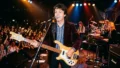
② Paul McCartney – Hope Of Deliverance【Live In New York】
Individual Credits
Recorded: June 11, 1993, Giants Stadium / East Rutherford, New Jersey
Tour: The New World Tour
Performers: Paul McCartney, Linda McCartney, Robbie McIntosh, Hamish Stuart, Paul Wickens, Blair Cunningham
Produced by: Paul McCartney
Engineer: Geoff Emerick
Album: Paul Is Live (1993)
Two-Line Commentary
This 1993 live version preserves the buoyant rhythm of the studio recording while giving the full band a more immediate presence.
The stronger choruses and rhythmic drive reveal just how naturally the song comes alive onstage.
“Hope of Deliverance” Was Born in an Attic
The song began with an episode that feels characteristically McCartney. Looking for a quiet place at home, Paul went up to his attic with a Martin 12-string guitar.
He placed a capo partway up the neck, pushing the naturally shimmering sound of the 12-string guitar into an even higher register. The resulting tone made him think of churches and Christmas, and those associations eventually led him toward the words “hope” and “deliverance,” as McCartney later explained.
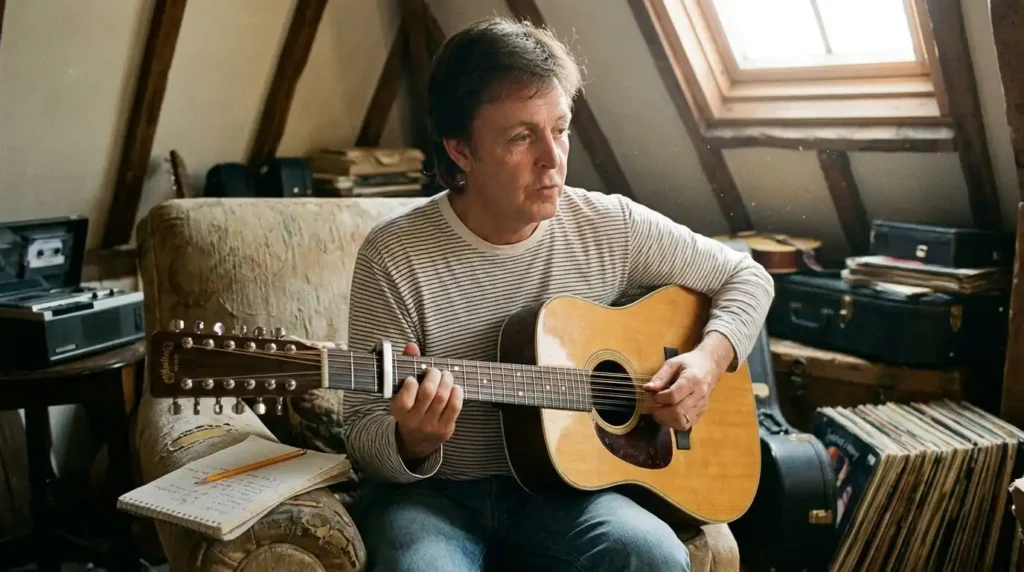
In other words, McCartney did not begin by setting out to write a song around some grand theme. The sound of the guitar and the words gradually came together while he was alone playing. Knowing that sequence makes the song’s unforced brightness easier to understand.
A Song That Refuses to Point to Only One Meaning
McCartney has connected the idea of “deliverance” with escaping many kinds of hardship, including poverty, illness, and homelessness. At the same time, he did not restrict the meaning of the song, allowing it to be heard as something addressed to a lover or even to a greater presence beyond the individual.
That matters. “Hope of Deliverance” does not present a clearly defined protagonist or a specific dramatic event. Because of that openness, listeners can place their own struggles inside the song.
What each person hopes to be delivered from is different.
That is why the word “hope” is never confined to a single meaning.
What the Japanese Title Adds to “Hope of Deliverance”
The Japanese title, “Ashita e no Chikai”, literally suggests something close to “A Promise for Tomorrow.” It is not a direct translation of “Hope of Deliverance,” which carries the sense of hoping for rescue or release from difficulty.
The original English title suggests the hardship of the present situation. The Japanese title, by contrast, introduces the word “tomorrow” and turns the listener’s gaze toward the future.
I find that difference especially interesting. The English title shows us where the song is standing now; the Japanese title points toward where it wants to go. Taken together, the two titles make the song’s direction even clearer.
Latin Rhythm Propels the Acoustic Guitar
The first defining element of “Hope of Deliverance” is its acoustic guitar. Rather than relying on a heavy rock riff, the song moves on a series of fine, steady strums that keep it flowing forward.
But the guitar alone would not have created such a distinctive feel. The other element that continually catches the ear is the percussion, which moves busily through the arrangement.
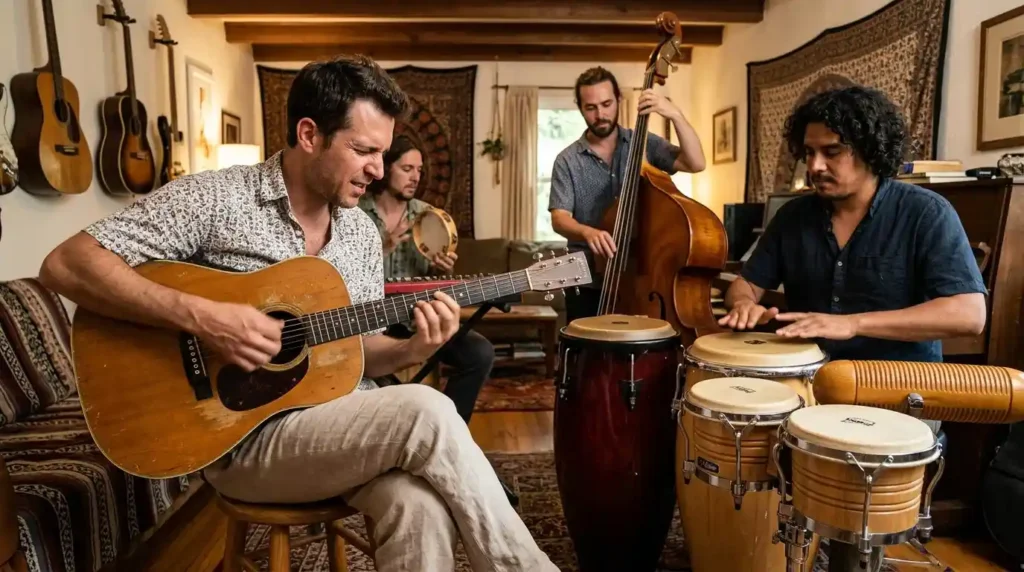
Three Percussionists Joined the Session on July 17, 1992
On July 17, 1992, overdubbing for the song took place at McCartney’s Hog Hill Studio in Rye, England. Three percussionists took part: Davide Giovanni, Dave Pattman, and Maurizio Ravalico.
By that point, the song was already close to completion, but the production team wanted to add a distinctly Latin feel. The three musicians brought a variety of percussion instruments and added finely detailed rhythmic patterns throughout the track.
The overdubs did much more than simply increase the number of sounds. The guitar establishes a steady flow while the percussion adds shifting accents around it. That interaction helps the track retain its buoyancy from beginning to end.
Spanish Guitar Adds Another Shade to the Sound
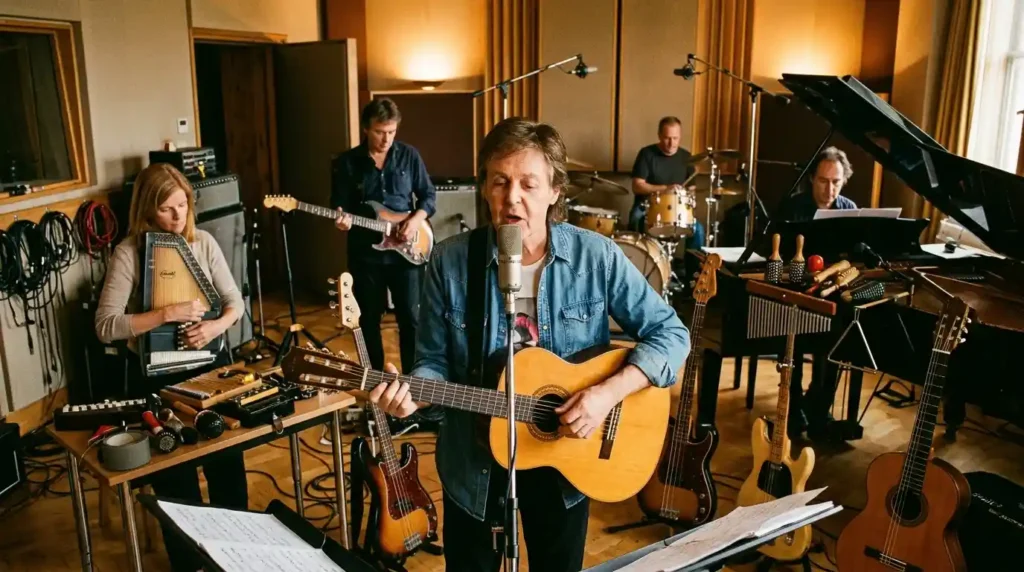
In addition to vocals and bass, McCartney played acoustic guitar, electric guitar, and Spanish guitar. Robbie McIntosh also contributed several guitar parts.
Linda McCartney added autoharp, Paul Wickens contributed piano and percussion, and Blair Cunningham played drums. On the surface, the song feels like an immediately accessible pop tune, but underneath that simplicity lies a carefully layered combination of many different instrumental colors.
The Touring Band Behind Off the Ground
Off the Ground was McCartney’s first studio album of the 1990s, arriving roughly four years after Flowers in the Dirt.
One of its defining features is that the musicians who had toured with McCartney in 1989 and 1990 also formed the core of the studio band. Robbie McIntosh, Hamish Stuart, Paul “Wix” Wickens, Blair Cunningham, and Linda McCartney had already accumulated extensive experience playing together onstage, and that familiarity carried directly into the new recordings.
Drum programming was also used on “Hope of Deliverance,” but it never dominates the track with a mechanical feel. Live drums, guitars, percussion, and layered backing vocals combine to give this early-1990s recording a sound that is not dependent on the electronic textures of its era.
What the Studio and Live Versions Reveal
Listening to the two versions above one after the other makes the construction of the song especially clear. In the studio recording used for the official music video, the intricate interplay between acoustic guitar and percussion comes through with particular clarity.
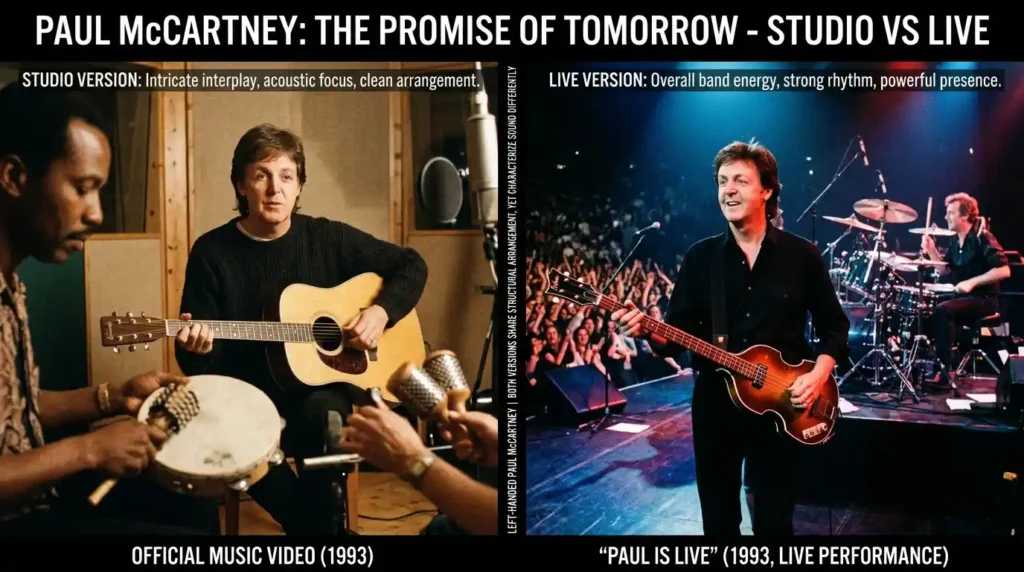
The backing vocals are carefully organized as well, allowing each instrument to occupy a clearly defined place. By contrast, the June 11, 1993 performance later included on Paul Is Live gives greater weight to the drums and the band as a whole, making the rhythm feel more immediate.
The basic arrangement remains the same, yet the listener’s focus changes. In the studio version, the ear is drawn toward fine detail; onstage, attention shifts toward the momentum of the entire band. That difference is precisely what makes the two versions worth hearing side by side.
The Repeated Title Comes Alive on Stage
In the latter part of the song, the phrase “Hope of Deliverance” is repeated several times. On the printed page, the words are extremely simple, but within the music they gain force each time the chorus and rhythm return.
That effect is particularly clear in concert. A phrase that begins as McCartney’s own statement gradually becomes something shared by the entire band and audience. The song does not need a complicated explanation; the repetition of one short phrase communicates its center.
No. 18 in Britain, No. 3 in Germany — A Striking Difference in Reception
The chart history reveals a remarkable geographical divide. “Hope of Deliverance” reached No. 18 in Britain and No. 83 on the US Billboard Hot 100, while climbing all the way to No. 3 in Germany.
It also entered the Top 5 in Austria, Canada, Italy, Norway, and Switzerland. The song was therefore embraced especially strongly across Europe, in some cases more enthusiastically than in McCartney’s home country or the United States.
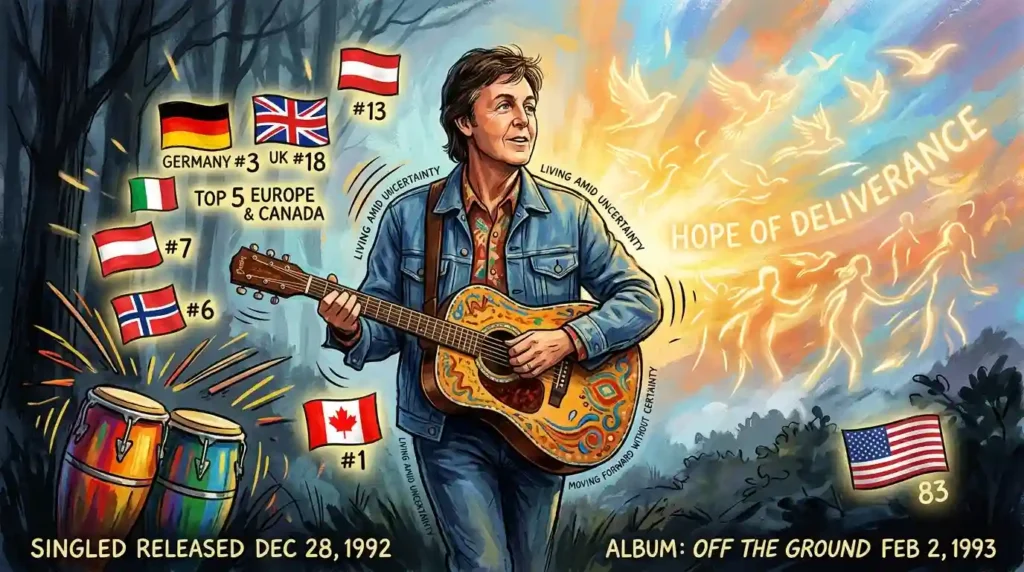
Chart positions, of course, do not determine the value of a song. Still, the fact that the same recording can provoke such different reactions from one country to another is part of what makes pop music fascinating. “Hope of Deliverance” is a particularly clear example of that phenomenon.
In Closing — Hope for Those Who Do Not Know the Answer
“Hope of Deliverance” never tells us that everything will be fine if we simply follow a particular path. We do not know when circumstances will change, or what tomorrow will look like.
Yet McCartney never allows that uncertainty to turn into despair. A melody born from the bright sound of a 12-string guitar is joined by Spanish guitar and Latin percussion, transforming uncertainty into a pop song that almost instinctively makes the body move.
Hope is not knowing the answer in advance. It is being able to believe that something still lies ahead, even when the answer cannot yet be seen.
That is what I find myself thinking whenever I hear “Hope of Deliverance.” Sometimes a person can begin to look forward without grand declarations or heavy words — sometimes the sound of an acoustic guitar is enough. Paul McCartney turned that feeling into a pop song lasting just over three minutes.
音楽ファン同士の交流・リクエストはこちら / Connect & Request Songs Here