- 🎧 Listen to This Article
- October 22: Celebrating Yukihide Takekawa’s Birthday
- When I First Heard This Song
- 1979: A Turning Point in Japanese Popular Music
- What Makes “Galaxy Express 999” So Irresistibly Cool?
- The Pain of Farewell Beneath an Uplifting Melody
- Leiji Matsumoto’s Universe and GODIEGO’s Music
- Why “Galaxy Express 999” Continues to Reach New Generations
🎧 Listen to This Article
Enjoy a quick audio introduction to the highlights of this article.
Before reading, discover the appeal of GODIEGO’s classic hit “Galaxy Express 999” and the distinctive vocals of Yukihide Takekawa.
🎵 English Narration
An audio introduction to this article in English.
🎶 日本語
Listen to the Japanese narration of this article.
Listening first will help you appreciate the musical appeal of “Galaxy Express 999” and get a feel for the article before reading.
October 22: Celebrating Yukihide Takekawa’s Birthday
Yukihide Takekawa was born on October 22, 1952, in Saitama Prefecture, Japan. Today marks the 74th birthday of the singer-songwriter behind some of Japan’s most memorable pop hits.
Influenced by his father, a professor at a music college, Takekawa began studying the violin at the age of five and composing music when he was ten.
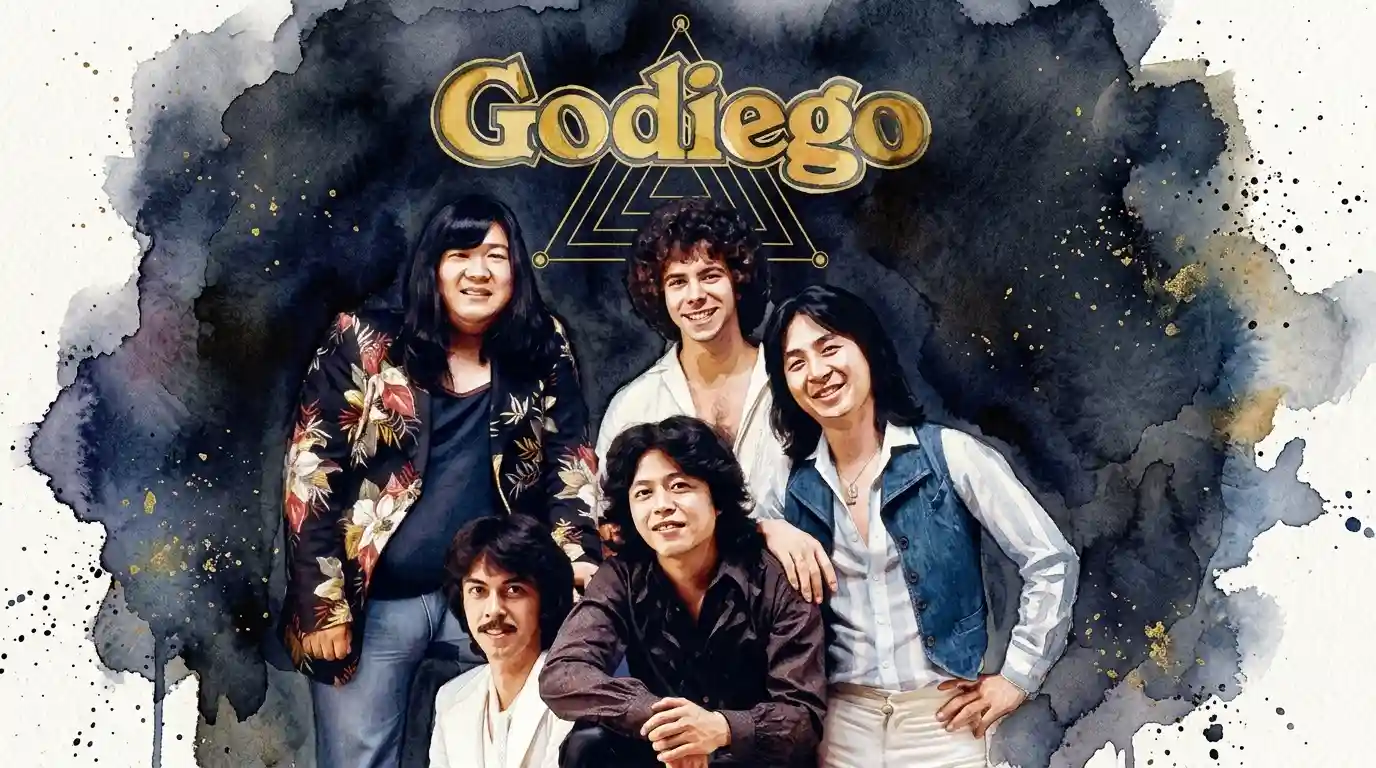
While studying at Tokyo University of Foreign Studies, he made his solo debut in 1975 with Running Away with the Romance, an album featuring songs written entirely in English. The following year, he formed GODIEGO, becoming the band’s lead vocalist and principal composer.
In 1978, GODIEGO achieved a major breakthrough with “Gandhara,” the theme song for the Japanese television drama Journey to the West. The success continued with “Monkey Magic,” followed by “Beautiful Name” and “Galaxy Express 999” in 1979.
What makes Takekawa distinctive is his ability to sing Western-influenced melodies naturally in both Japanese and English. His clear, gentle voice and effortless sense of rhythm give his performances a special elegance. He never needs to overpower a song to make it memorable.
From the 1980s onward, he continued working in songwriting, film music, and other musical projects. GODIEGO resumed regular activities in 2006, and Takekawa celebrated the 50th anniversary of his solo debut in 2025.
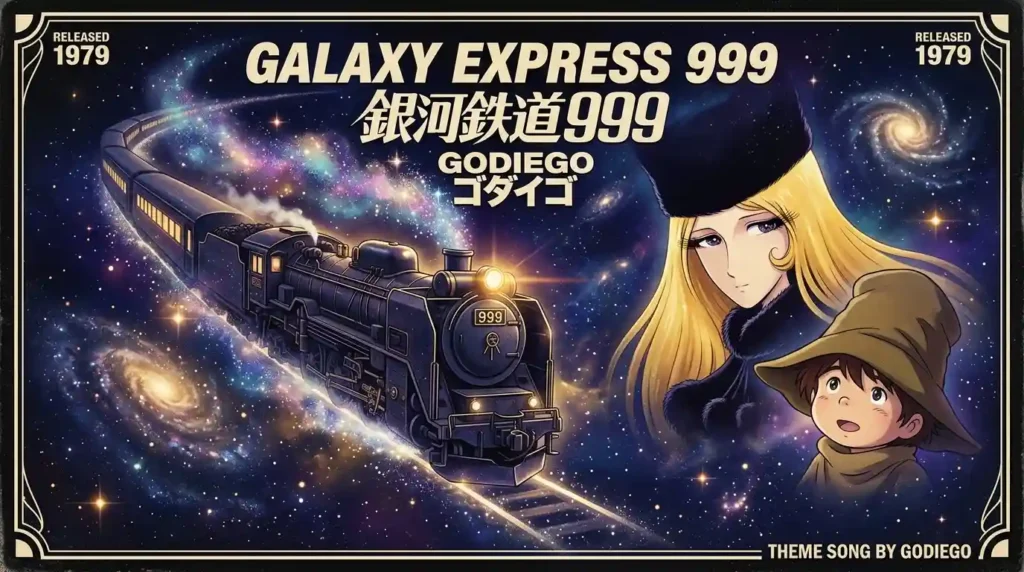
Today’s featured song is “Galaxy Express 999,” released on July 1, 1979. Written as the theme for the animated feature film released that August, it became one of GODIEGO’s signature hits, reaching No. 2 on Japan’s Oricon chart and selling approximately 666,000 copies.
My Interpretation of the Lyrics
Lift your head and step into a new breeze, carrying the dreams of yesterday.
The faces of those we've left behind, and the tears we once shed, may someday become cherished memories.
Even the love we discovered through loss can make us stronger.
Galaxy Express 999 keeps carrying us toward a future we have yet to see.
And somewhere beyond this endless journey, new hope is surely waiting.
First, Listen to the Official Audio on YouTube
Official Audio Credits
GODIEGO – "Galaxy Express 999 (The Galaxy Express 999)"
Performed by: GODIEGO
Lyrics: Yoko Narahashi and Keisuke Yamakawa
Music: Yukihide Takekawa
Arrangement: Mickie Yoshino
Audio provided by: Nippon Columbia
About the Song
One of GODIEGO's signature hits, released as the theme song for the 1979 animated film Galaxy Express 999.
Its driving melody and hopeful lyrics capture the excitement of setting off into the unknown and the courage to embrace the future.
English Version
Official Audio Credits
GODIEGO – "Galaxy Express 999 (English Version)"
Performed by: GODIEGO
Lyrics: Yoko Narahashi
Music: Yukihide Takekawa
Arrangement: Mickie Yoshino
Album: GODIEGO GREAT BEST VOL.2 – English Version
Audio provided by: Nippon Columbia
YouTube release date: July 11, 2018
About the Song
Unlike the familiar hit version, which combines Japanese and English lyrics, this recording features English vocals throughout.
The natural rhythm of the words and Takekawa's smooth, expressive singing give the song a distinctly international pop sound.
Japanese vs. English: Two Ways to Experience the Same Song
I’ve included both the Japanese and English versions of “Galaxy Express 999” because listening to them back-to-back reveals some fascinating differences.
In the Japanese version, the emotions surrounding departure come through clearly. Memories of someone left behind, the sadness of separation, and the determination to begin a new chapter all form part of the story. Understanding the words makes it easier to imagine the person preparing for that journey.
The English version creates a somewhat different impression. English word stress fits naturally into the melody, giving the vocal lines a particularly fluid quality. It also brings out the Western pop influences in Takekawa’s singing.
What I’d especially recommend is comparing the opening verse in Japanese with the corresponding section in English. The notes may be familiar, but changing the language can alter the way the melody feels.
Personally, I enjoy the Japanese version when I want to concentrate on the story, and the English version when I want to appreciate Takekawa’s vocal delivery. Neither is necessarily better. It’s simply a pleasure to discover two different sides of the same song.
When I First Heard This Song
| My Age | Elementary | Junior High | High School | University | 20s | 30s | 40s | 50s | 60+ |
| Release Year | 1979 | ||||||||
| When I Heard It | ● |
I believe I first heard “Galaxy Express 999” around the time of its release in 1979, when I was a university student.
Rather than actively searching for the record, I probably came across it through a television commercial promoting the film.
At the time, I wasn’t particularly interested in television dramas or animated movies. GODIEGO, however, was a band that had already caught my attention.
What impressed me most was Yukihide Takekawa’s English singing. Hearing a Japanese vocalist deliver English lyrics with such fluency and rhythmic ease was genuinely refreshing. Since I listened to a great deal of Western music, his style appealed to me immediately.
I had also enjoyed “Gandhara,” which had become a major hit the previous year. That was probably another reason I was naturally drawn to “Galaxy Express 999.”
The contrast between the two songs was striking. “Gandhara” had an almost mystical atmosphere, while “Galaxy Express 999” was bright, energetic, and full of movement.
It’s remarkable that the same band could create such different musical worlds within roughly a year.
Perhaps that versatility was what attracted me to GODIEGO in the first place.
1979: A Turning Point in Japanese Popular Music
When Kayokyoku Met New Music
In 1979, established Japanese pop idols such as Hideki Saijo and Hiromi Go remained hugely popular. At the same time, bands and singer-songwriters were gaining an increasingly prominent place in the music scene.
Artists such as Southern All Stars, Off Course, and Tulip were helping reshape Japanese popular music.
Internationally, disco, rock, and adult-oriented rock, commonly known as AOR, were attracting considerable attention. Japanese musicians were also incorporating more elements of Western pop and rock into their recordings.
GODIEGO stood out by combining Japanese and English lyrics with a sophisticated blend of rock, pop, and funk influences.

Five Musicians, Five Distinct Personalities
Takekawa provided the memorable melodies, while keyboardist and arranger Mickie Yoshino transformed them into polished, sophisticated band arrangements.
Steve Fox’s bass, Takami Asano’s guitar, and Tommy Snyder’s drums were equally essential to the group’s distinctive sound.
The combination of their individual musical skills and international backgrounds allowed GODIEGO to appeal to both Western music enthusiasts and fans of mainstream Japanese pop.
What Makes “Galaxy Express 999” So Irresistibly Cool?
A Rhythm That Feels Like a Train Setting Off
One of the first things that strikes me about this song is its remarkable sense of momentum.
From the opening, the crisp rhythm immediately grabs your attention. It almost feels as though a train is gathering speed and beginning its journey.
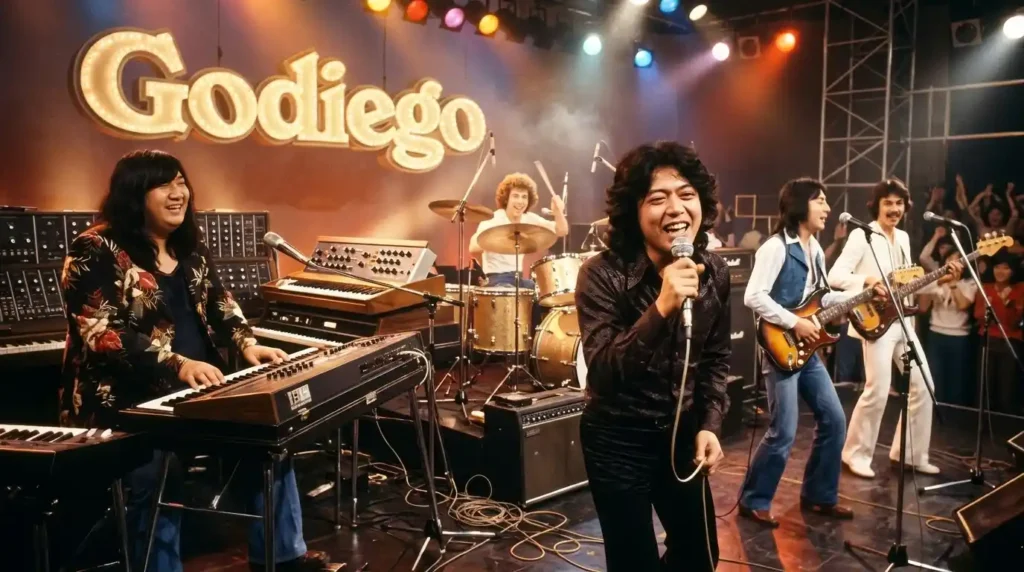
The bass establishes a solid foundation, while the drums maintain a steady beat. Guitar and keyboards then add brightness and excitement to the arrangement.
Despite the energetic instrumentation, the sound never becomes unnecessarily heavy. Each instrument has a clearly defined role, allowing Takekawa’s voice to remain at the center.
From Japanese to English: The Musical Landscape Expands
Another defining feature of the familiar hit version is the transition from Japanese verses to an English chorus.
The Japanese lyrics describe memories of the past and the pain of leaving someone important behind. When the English chorus arrives, the perspective suddenly expands toward the vastness of space.
A song rooted in personal emotion becomes an anthem for a grand adventure. The transformation is wonderfully effective.
The English phrases are short, with repetition used to great effect. Even listeners who aren’t fluent in English can easily sing along.
That accessibility says a great deal about the skill behind both the composition and arrangement.
The Pain of Farewell Beneath an Uplifting Melody
More Than Just a Song About Setting Off
“Galaxy Express 999” is often remembered as an uplifting song about departure and new beginnings. But a closer look at the lyrics reveals a more bittersweet story.
The person at the center of the song is preparing for a new journey while remembering someone who once meant a great deal to them.
Those feelings cannot simply be erased. Yet the traveler is determined to move forward, carrying those experiences into the future.
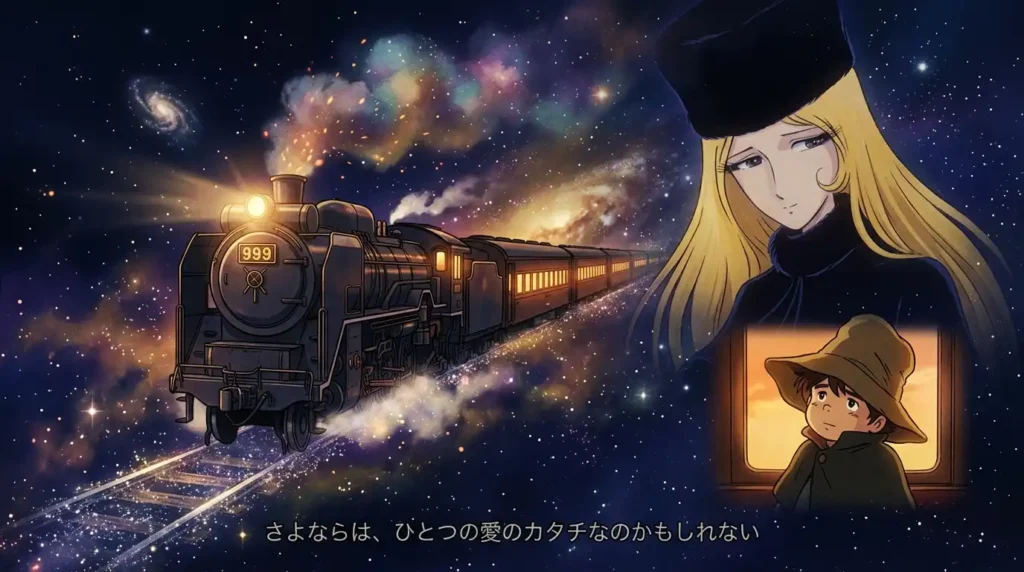
What particularly interests me is the idea that saying goodbye can itself be an expression of love.
When a relationship ends, the time two people spent together doesn’t suddenly become meaningless. Happy memories and painful experiences alike can continue to shape the lives they lead afterward.
Turning Sadness into the Strength to Move Forward
What’s fascinating is that these bittersweet emotions are carried by such a bright, powerful melody.
Instead of expressing sadness through a melancholy tune, the song transforms it into the determination to begin something new.
There’s no need to forget the past. But there’s no reason to remain in the same place forever, either.
That forward-looking spirit is beautifully matched by the music’s energetic rhythm.

Leiji Matsumoto’s Universe and GODIEGO’s Music
Something More Important Than a Mechanical Body
Released on August 4, 1979, the animated feature film Galaxy Express 999 was based on the manga created by Leiji Matsumoto.
The story follows a young boy named Tetsuro Hoshino, who boards a mysterious space train with a woman named Maetel. His destination is a distant planet where he hopes to obtain a mechanical body free of charge.
Along the way, Tetsuro encounters a remarkable variety of people and confronts difficult questions about immortality and a society increasingly dependent on machinery.
Through these experiences, he begins to reconsider what it truly means to live as a human being.
Beneath its science-fiction adventure, the film explores the limits of life, the meaning of freedom, and the value of human existence.
A Major Success for Both the Film and Its Theme Song
The theatrical release of Galaxy Express 999 earned approximately 1.65 billion yen in distributor rentals, making it Japan’s highest-ranking domestic film of 1979 by that measure.
Following the success of titles such as Space Battleship Yamato, animated films were attracting increasing attention from teenagers and adults, not just children.
Galaxy Express 999 became one of the defining works of that movement.

Incidentally, the television anime adaptation featured a different theme song performed by Isao Sasaki.
The television theme has a majestic quality that reflects the scale of the story. GODIEGO’s film theme, by contrast, works equally well as a standalone pop song.
It’s interesting that the same fictional universe inspired two such different musical approaches.
Why “Galaxy Express 999” Continues to Reach New Generations
How a 1979 Hit Found New Listeners
Over the years, “Galaxy Express 999” has been performed and reinterpreted by numerous artists.
In 2008, the Japanese pop group EXILE released a cover version, introducing the song to younger listeners who may not have been familiar with GODIEGO’s original recording.
The melody can also be heard at school events and sporting occasions in Japan.
Its appeal goes beyond nostalgia. The instantly recognizable tune and optimistic message make it accessible to listeners who weren’t even born when the original record came out.
Galaxy Express 999: Is the Real Star the Train or the Music?
When you think about it, this is quite a bold song.
It’s the theme for a story about a train traveling through space. Yet instead of choosing grand, dramatic music reminiscent of a powerful steam locomotive, GODIEGO went with a lively pop song.
And that’s not all.
One moment, the Japanese lyrics are dealing with the sadness of parting. The next, the English chorus sends us racing across the galaxy.
On paper, that combination might seem a little awkward. But when GODIEGO performs it, everything fits together beautifully.
I think that’s ultimately why I love this song.
You can enjoy it without knowing anything about the movie, and you don’t have to analyze the lyrics to feel excited by the music. But listen more closely, and you’ll discover just how cleverly the melody and arrangement have been put together.
And then there’s that English chorus.
No matter how many times I hear it, I can’t resist singing along. Whether my English sounds anything like Yukihide Takekawa’s wonderfully smooth delivery, of course, is an entirely different question! (LOL)

音楽ファン同士の交流・リクエストはこちら / Connect & Request Songs Here