
◆Click here for Yosui Inoue’s History!
- 🎧 Enjoy This Article via Audio
- No. 25: “Akazu no Fumikiri” (The Never-Opening Railroad Crossing)
- First, Please Listen to the Tracks on YouTube
- A Defiant Opener Engineered by a Cultural Icon
- The Unyielding Barrier and the Internal Distance
- A Sharp Soundscape Reviving a Cold Era
- Deciphering the “Quiet Madness” of Everyday Life
- The Significance of the Track on the Masterpiece Album
🎧 Enjoy This Article via Audio
You can quickly grasp the key points of this article through our narration.
Recommended for those who want to catch the vibe of the music and the overall flow before reading.
🎶 English Narration
Listen to the content of this article in English.
⌛ Runtime: Approx. 3 min
🎵 Japanese Narration
Listen to the content of this article in Japanese.
⌛ Runtime: Approx. 3 min
* Tuning in before reading helps you dive deeper into the song’s world and the article’s core insights.
No. 25: “Akazu no Fumikiri” (The Never-Opening Railroad Crossing)
Released in December 1973, “Koori no Sekai” (Ice World) achieved an unprecedented milestone in the Japanese music scene as the first-ever million-selling album. It is this uniquely textured track that the needle of the turntable picks up first, kicking off a monumental record.
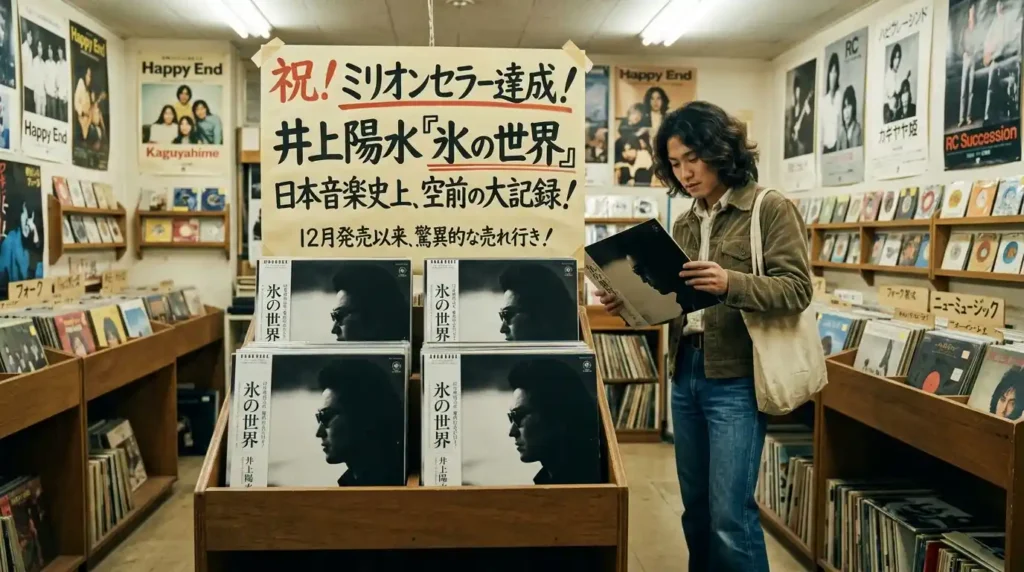
Behind the relentless blare of the metallic alarm, the petty convenience of the crowd and their cold indifference toward others are gradually laid bare. What Yosui crafted here was no mere sketch of a cityscape, but the opening of a psychological suspense where ordinary life suddenly bares its fangs when least expected.
Poetic Interpretation: The World of the Lyrics
In a town where no one lends a hand, I am the only one frozen in place.
Everyone crosses the tracks with practiced faces, moving forward as if noticing nothing.
At this crossing flooded in kaleidoscopic colors, I continue to wait,
clinging to the feeling that you might step back over to my side once more.
First, Please Listen to the Tracks on YouTube
(*Please note that most of the audio tracks for Yosui Inoue currently available on the internet are unofficial uploads. In compliance with copyright considerations, this blog provides custom image links to external sites instead of embedding the videos directly.)
Click the image below. (Studio Recording)
のイメージ画像_1975年あたりの光景_20-1024x572.webp)
Credits
Yosui Inoue - "Akazu no Fumikiri"
Lyrics: Yosui Inoue
Composition: Yosui Inoue, Hitoshi Komuro
Arrangement: Masaru Hoshi
Track from the album "Koori no Sekai"
Two-Line Commentary
Standing before a crossing that refuses to open, the protagonist experiences a profound sense of isolation while watching his lover, the townspeople, and children. Through the imagery of endless passing trains, the song captures the invisible walls of daily life, the ache of waiting, and a heart unable to move forward.
Click the image below. (Live Recording)
のイメージ画像_1975年あたりの光景_20-1-1024x572.webp)
Credits
Yosui Inoue - "Akazu no Fumikiri"
Lyrics & Composition: Yosui Inoue
From the live album "Koori no Sekai Tour 2014 Live the Best"
Recorded on June 13, 2014, at Sagami Women's University Green Hall
Two-Line Commentary
The narrator, stranded on this side of the gate, observes his lover and the warmth of a life just out of reach across an uncrossable distance. In this 2014 live cut, the raw urgency of the original gives way to a reflective, spoken-word resonance that lingers long after the music stops.
A Defiant Opener Engineered by a Cultural Icon
In an era when the Japanese youth were deeply immersed in the sweet lyricism of folk music and the insular, deeply personal themes of “yo-johan” (four-and-a-half mat room) confessions, Yosui deliberately chose the stance of a detached, dry “observer.” The melody, co-written with Hitoshi Komuro, centers on a relentless, circular refrain that refuses to rise or fall, instantly stirring a subtle unease in the listener’s chest.
The string arrangement by Masaru Hoshi discards any trace of typical ballad elegance, lurking in the background like an alarm designed to unhinge your pulse. Positioned as the gateway to the album, this track served as an absolute declaration that the journey into “Koori no Sekai” would be anything but a comfortable ride.
The Unyielding Barrier and the Internal Distance
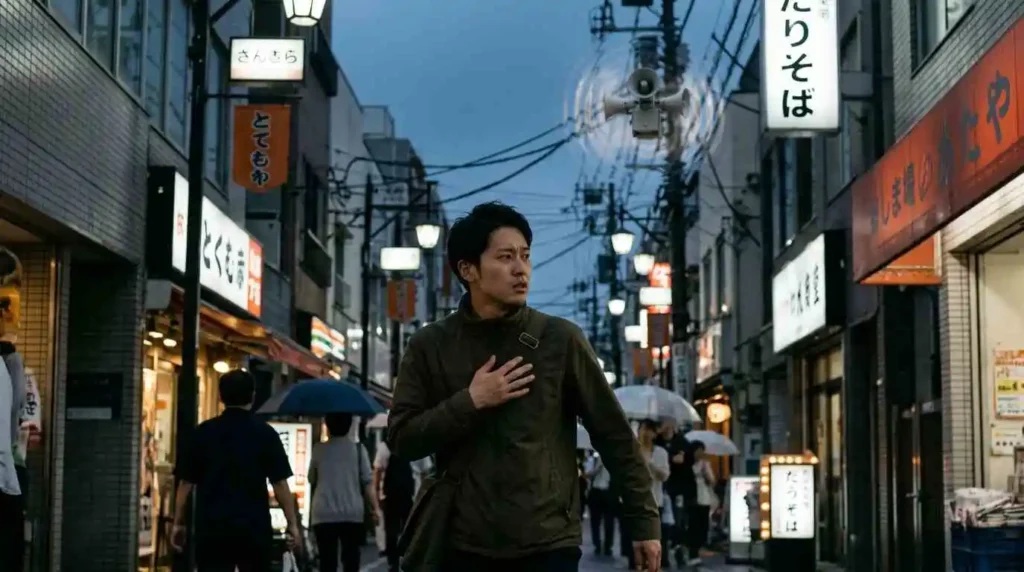
The railroad crossing depicted here is no mere physical obstacle to traffic; it serves as a metaphor for the stark distance that stretches between human beings.
This side of the alarm versus the other side. When a space that should naturally be continuous is violently ruptured by a massive iron machine, what shifts occur within the human psyche? Yosui captures this transformation with a remarkably flat, yet breathtaking precision.
- The glimpses of others’ lives across the tracks, tantalizingly close yet utterly unreachable.
- A growing numbness toward the overwhelming force passing right before one’s eyes.
- Losing sight of the purpose of waiting, left simply standing frozen in place.
While many contemporary artists romanticized the “virtue of waiting” or the “poignancy of passing paths,” Yosui’s protagonist neither resists the situation nor raises his voice. He merely observes the fragmentation of daily life with a cool gaze. It is precisely this low emotional temperature that cuts straight into the listener’s subconscious.
A Sharp Soundscape Reviving a Cold Era
Metallic Strumming That Shattered the Folk Formula
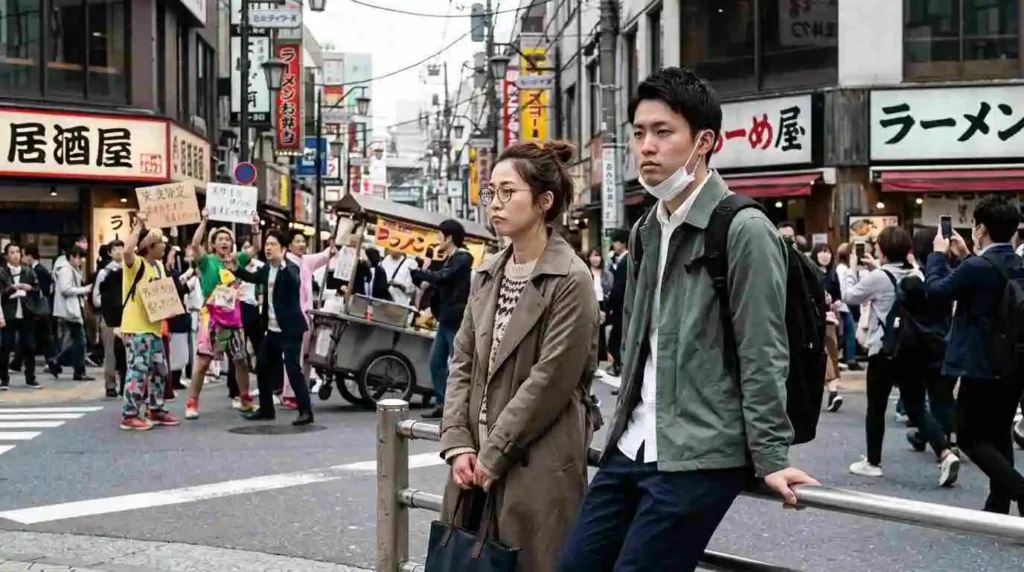
Dropping the needle on this track, what immediately strikes the eardrum is the literal sharpness of the sound. Entirely bypassing the gentle, acoustic warmth that blanketed the early ’70s folk scene, the acoustic guitar delivers a metallic, frantic strumming. It actively rejects any soothing resonance, cutting sharply to keep the listener on edge.
Back then, these endless crossings loomed heavily across almost every neighborhood we walked through. Yet, the audio texture Yosui captured never settles for a simple, nostalgic portrait of Showa-era Japan.
The Impact of Masaru Hoshi’s Unsettling Strings
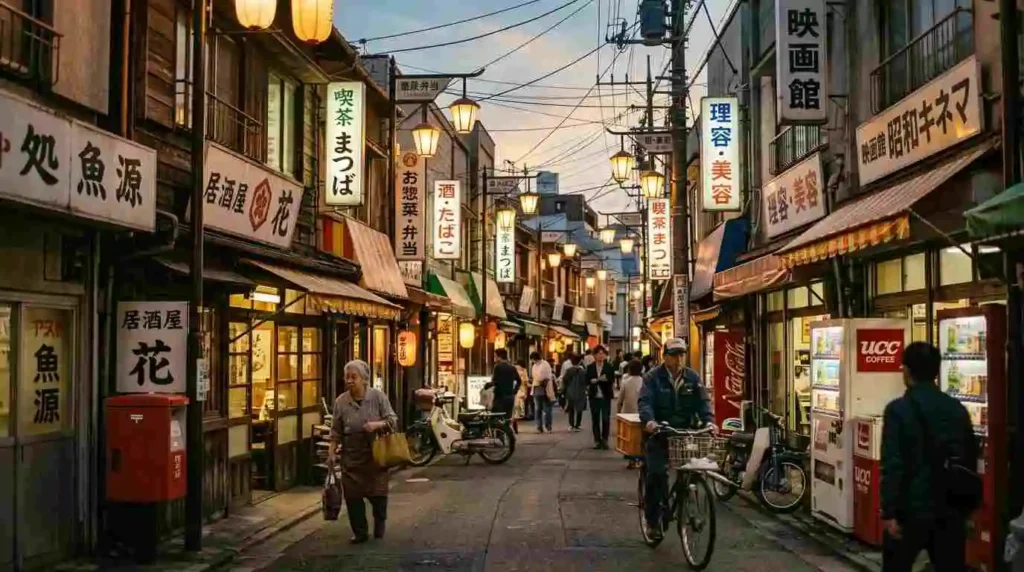
Layered over the dry acoustic strumming is Masaru Hoshi’s brilliant string arrangement. Its entry thoroughly deconstructs the traditional boundaries of the folk genre from the inside out.
The Essence of the Sonic Tension Rather than providing comfort or framing a conventional melancholy, the violins twist and surge unpredictably from low to high registers, mirroring the anxious hum of an overcrowded city. The effect infuses the track with the cinematic dread of an avant-garde thriller score.
This dry, unyielding sonic landscape closely mirrored the internal reality of the youth of that era—individuals caught in the slipstream of rapid economic growth who nevertheless viewed society with a detached, solitary perspective.
Deciphering the “Quiet Madness” of Everyday Life
The Eerie Silhouette of Children Playing Catch Across the Tracks
Peeling back the layers of the track reveals something far deeper than the superficial frustration of being held up by a train; it uncovers a chilling disconnect in human communication.
Most notable is the surreal imagery of children playing catch across the open gap of the crossing. Playing catch inherently demands a baseline of mutual trust, shared rhythm, and sustained eye contact. Here, however, that connection is continuously severed by a roaring, blind mass of iron and a piercing alarm.
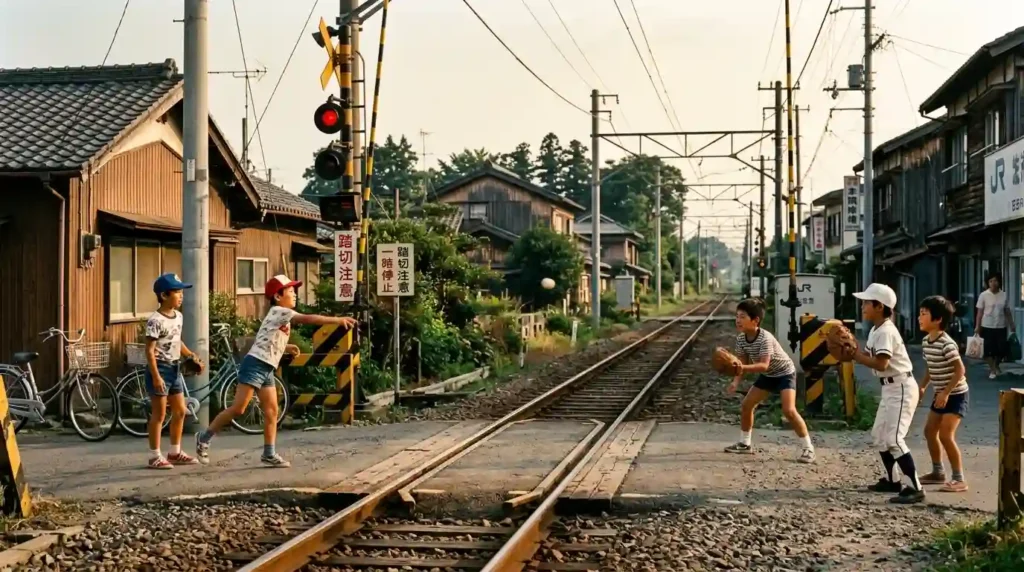
- The ball sails through space while their field of vision is repeatedly blacked out by iron.
- How do they manage to exchange throws when they cannot even look at each other’s faces?
- Could this be less about genuine connection and more about a hollowed-out routine?
Viewed in this light, the scene turns remarkably ominous. The narrator possesses no spare energy to question the absurdity; he simply stands there, allowing his mind to go completely numb.
An Analytical Eye Stripped of Romanticism
This clinical gaze, completely stripped of sentimentality, represents the sharpest edge of Yosui Inoue’s artistry—a defining element that separated him completely from the contemporary singer-songwriter collective of his time.
The Significance of the Track on the Masterpiece Album
The Singular Gravity of a Curtain-Raiser
The enduring presence of this piece stems directly from its vital role as the curtain-raiser for “Koori no Sekai.”
Stepping out from early acoustic lyricism toward the sophisticated, mercurial pop territories of his later career, the cool perspective introduced here became a vital undercurrent running through his entire discography.
A rock-tinged ensemble breaking traditional molds, an objective lens that maps the scene with absolute detachment, and a striking ability to transform a mundane metropolitan fixture into a theater of subtle unease—these elements collectively define the song’s brilliance.
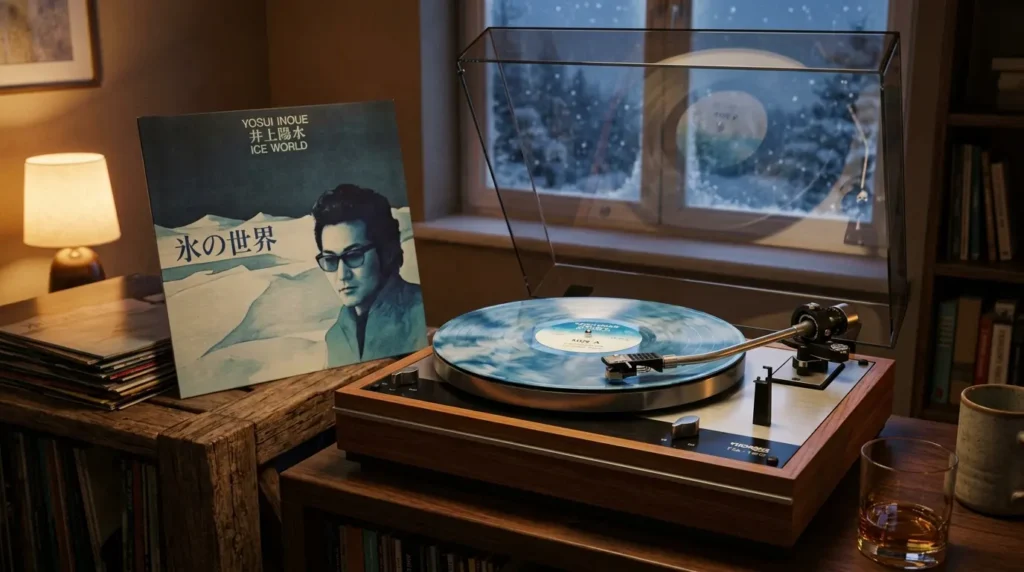
Revisiting this opening track that defines the entire tone of the album offers a beautiful opportunity to re-examine the sharp edge of his lyricism and the multi-dimensional musical brilliance that continues to defy simple categorization.

音楽ファン同士の交流・リクエストはこちら / Connect & Request Songs Here