
◆Click here for Yosui Inoue’s History!
🎧 Enjoy This Article via Audio
You can quickly grasp the main points of this article through the narration.
Recommended for those who want to catch the musical atmosphere and overall flow before reading.
🎶 English Narration
Listen to the content of this article in English.
⌛ Duration: Approx. 5 mins
🎵 Japanese Narration
Listen to the content of this article in Japanese.
⌛ Duration: Approx. 4 mins
* Listening to the audio beforehand will help you dive deeper into the song’s universe and the key insights of the article.
Ranked 19th: “Koharu Obasan” (Aunt Koharu)
When listening back to the early works of Yosui Inoue, there are moments when you feel an almost ominous chill that cannot be contained within the simple vessel of folk music. “Koharu Obasan,” which I have selected as the 19th track in this series, is the quintessential example of this, and it is a song that has held my heart captive for a very long time.
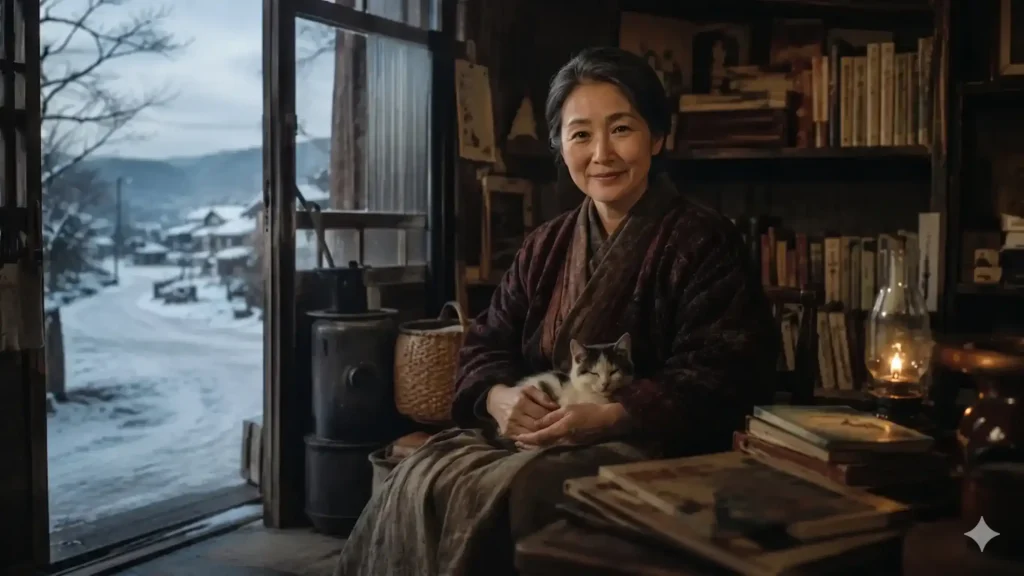
Released in December 1973, “Koharu Obasan” is quietly tucked away as the fifth track on Side B of the masterpiece album Korori no Sekai (Ice World), a record that established an immortal landmark in Japanese music history. At first glance, the song presents itself as a heartwarming homecoming tune about longing to see a gentle aunt who always welcomed you with open arms. In fact, back when I first encountered this song in my youth, I was simply enchanted by the beauty of the nostalgic imagery sung over the gentle plucking of the acoustic guitar.
However, after hearing this melody countless times and living through the years while traveling to various places myself, an extraordinary sense of desolation underlying the song has come into sharp focus.
This is not a mere memoir longing for the “good old days.” It is a story of an unyielding sense of distance, where the harder you reach out for warm memories, the more the cold wind of reality seems to push them away.
_20260526172-1024x572.webp)
In this article, I would like to unravel from my own perspective the “beautiful yet heartbreaking mechanism of the world” that Yosui masterfully wove into the increasingly tense atmosphere toward the album’s end.
Interpreting the Worldview of “Koharu Obasan” (My Interpretation)
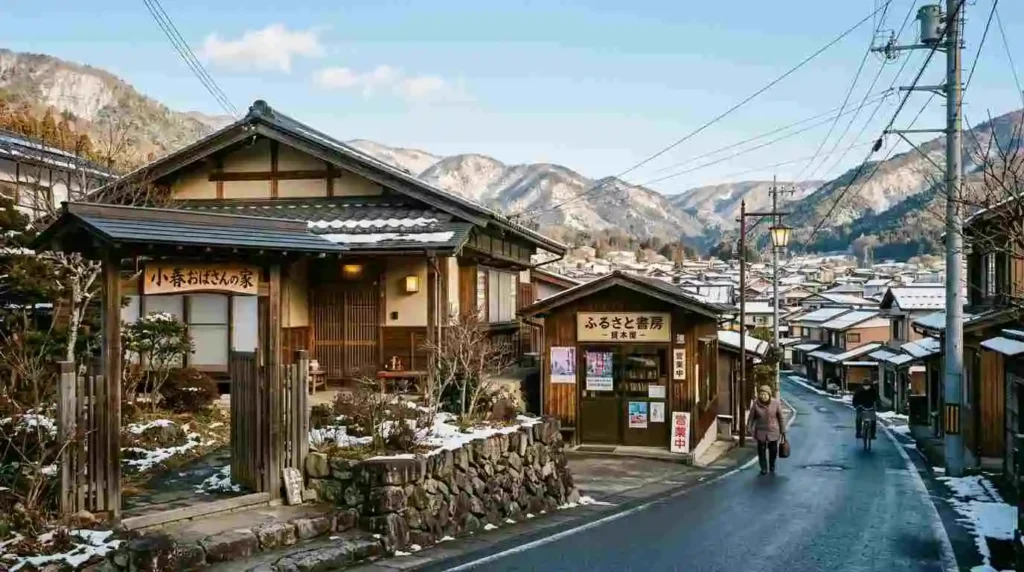
While being buffeted by a freezing north wind in a city far away, I find myself remembering that nostalgic country town with my favorite book-rental shop.
I vow to myself, "Tomorrow, I will surely go visit my aunt's house," dreaming of a peaceful time listening to old stories with a kitten resting on my lap.
Yet, the winter wind blowing past me is cold without end, making me feel as if even the landscapes of my childhood are fading away into the distant sky.
First, Please Listen to the YouTube Videos
Please start with the studio recording version. Click the image below to play.
Credits
Lyrics & Composition: Yosui Inoue
Arrangement: Masaru Hoshi
Featured on the album "Korori no Sekai" (Ice World), released in December 1973.
Two-Line Overview
A hidden masterpiece where the lyrical melodies of Yosui's early career and his somewhat melancholic vocals strike a deep chord.
Experience the unique atmosphere woven by the fresh voice of a young Yosui and the delicate acoustic ensemble.
“Koharu Obasan” (Live Version) – Click the image below to play.
Credits
Yosui Inoue - "Koharu Obasan"
Lyrics & Composition: Yosui Inoue / Arrangement: Masaru Hoshi
Album: "Korori no Sekai" (Ice World)
Footage: Ice World Tour Concert 2014
Two-Line Overview
Yosui stands on stage, singing intensely while strumming a single acoustic guitar.
Amidst the imagery of a biting north wind, this song evokes a profound nostalgia unique to Yosui, conjuring up affection for a small country town and Aunt Koharu. Intimate memories of childhood, the book-rental shop, and old tales resonate as a heartbreaking longing for lost time.
(*Note: Most of the audio files of Yosui Inoue currently available on the internet are not official distributions. Therefore, out of respect for copyright, this blog uses custom images linked to external sites rather than direct video embedding.)
The Landscape of a Country Town: A “Primal Scenery of the Heart” Shared by All
The Book-Rental Shop as a Narrative Device of the Showa Era
Every time I listen to this song, the landscape of a country town in the Showa era, washed in sepia tones, vividly appears in my mind. The phrase that leaves an especially strong impression in the lyrics is “the country town with a book-rental shop.”
Unlike today, when any text or story is accessible at the tip of a finger, for the boys of that era, a book-rental shop was likely a modest wonderland that connected them to unknown stories slightly removed from their everyday lives. Tracing my own memories, the old bookstore on the corner of the town or the dusty school library I frequented after hours possessed a distinct scent of ink and a quietude that allowed one to forget the passage of time. (By the time I was old enough to remember things, the “book-rental shops” had already disappeared.)
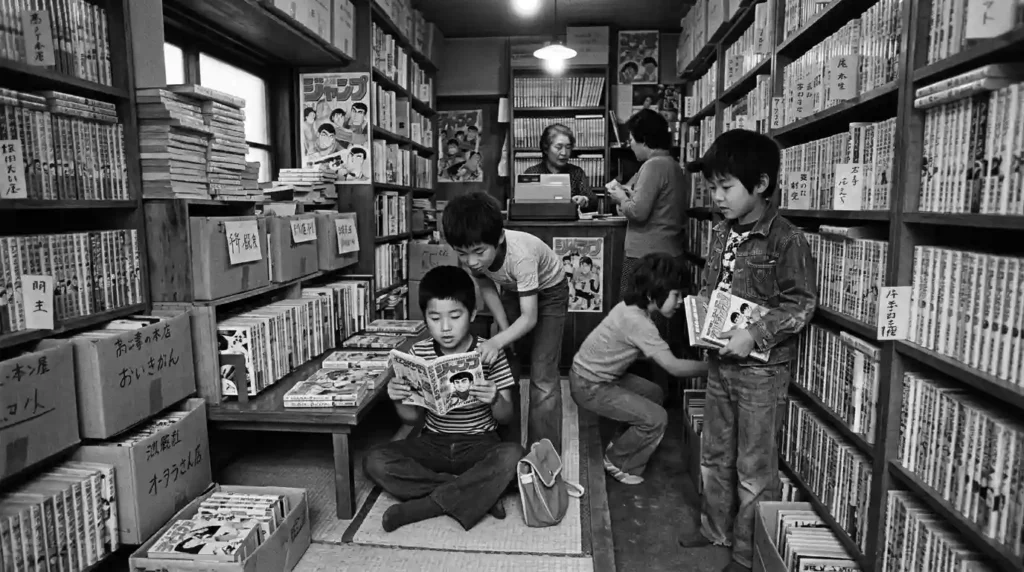
The “book-rental shop” drawn by Yosui is not just a geographical landmark. It functions beautifully as a narrative device symbolizing the protagonist’s cultural longing and the intellectual curiosity of an age when one wishes to stretch a bit beyond childhood. A beloved place like that, paired with a house where Aunt Koharu unconditionally welcomes you—for the protagonist, that home must have been a sanctuary from the trivialities of daily life.
The Seasonal Ambivalence Hidden in the Name “Koharu”
Another element where I find a breathtaking, chilling brilliance in the song’s structure is the contrast between the name “Koharu” and the meteorological descriptions of the “north wind and winter wind” dominating the entire piece.
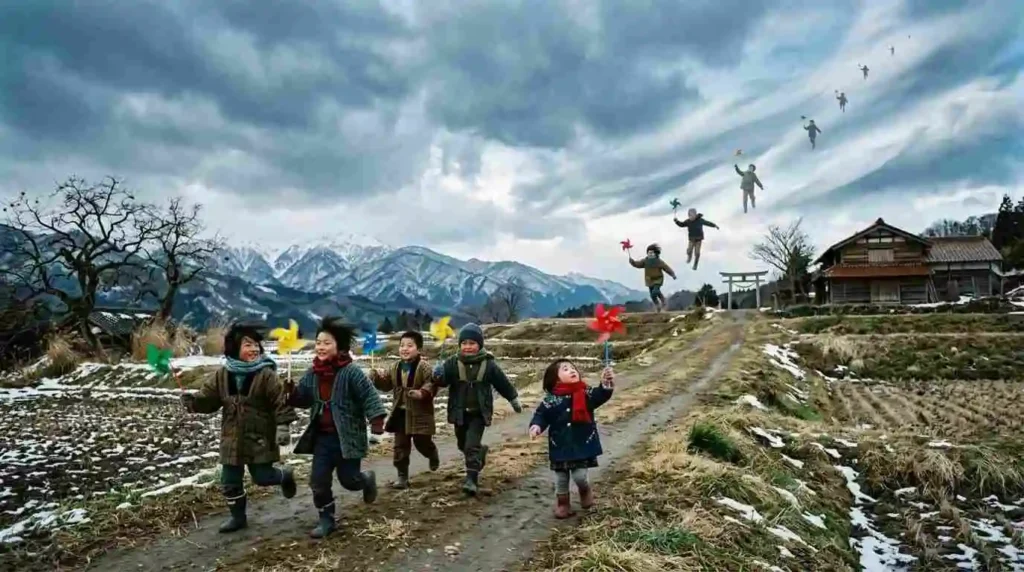
The word “Koharu” (Indian summer) originally refers to the calm, warm, spring-like weather that occurs from late autumn to early winter. In this song, however, what rages is literally a piercing “cold north wind,” bringing an ominous and dreamlike, chilly scene where “children are like pinwheels, spun and being spun around, disappearing into the distant sky.”
_202605261744-1024x572.webp)
The aunt’s presence should be a emotional anchor offering the protagonist warmth akin to a balmy “Koharu-biyori” (Indian summer day). Yet, the environment surrounding her and the reality facing the protagonist as he tries to head there are layered with the severity of a howling winter. This vivid contrast between warmth and coldness generates the unique dynamism of Yosui Inoue, elevating it far beyond a simple, heartwarming folk song.
The “Severance” Lurking Beneath the Lyrics, and the Unattainable Nostalgia
The Sorrowful Distance Enfolded in the Words “Tomorrow, I Will Surely Go See You”
Toward the end of this track, the protagonist repeatedly chants the phrase, “Tomorrow, I will surely go see you.” At first glance, this might sound like a fresh declaration of intent on the eve of a reunion. However, as the music approaches its close, that refrain begins to take on a desperate, almost obsessive, sorrowful tone.
This is because if there were absolute certainty that one could visit tomorrow, there would be no need to repeat the words so many times as if to convince oneself. What is depicted here is surely the figure of a young man confronting a reality where he longs to return but cannot easily do so.
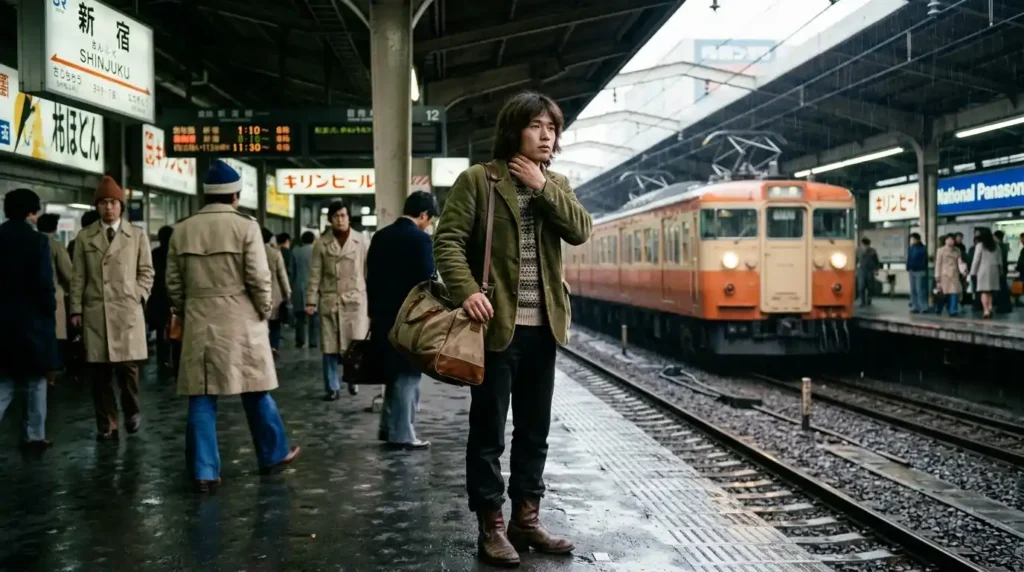
Amidst the daily rush and days worn thin by city life, a winter wind suddenly blows across the sky. It awakens the memory of that quiet country town where Aunt Koharu, who once validated him unconditionally, still resides. Yet, the steps attempting to return to that sanctuary of memory are somehow blocked by the weight of the reality he lives in now.
The Uncontrollable Flow of Time Symbolized by the Pinwheel
The line near the beginning of the lyrics, “Children are like pinwheels, spun and being spun around, disappearing into the distant sky,” captures the unique sense of impermanence inherent in Yosui’s literature with unparalleled clarity.
A pinwheel does not spin on its own; it is a passive entity forced to rotate by the power of the wind blowing from the outside. The children described here—or perhaps the protagonist himself who was once a child—have been buffeted by the “wind” of changing times and the irresistible flow of time, carried away helplessly to a place far removed from where they truly belonged.
- The pinwheel buffeted by the wind ➡ The vulnerability of human beings driven by environment and time, independent of their own will.
- Disappearing into the distant sky ➡ A permanent parting from an innocent childhood that can never be reclaimed.
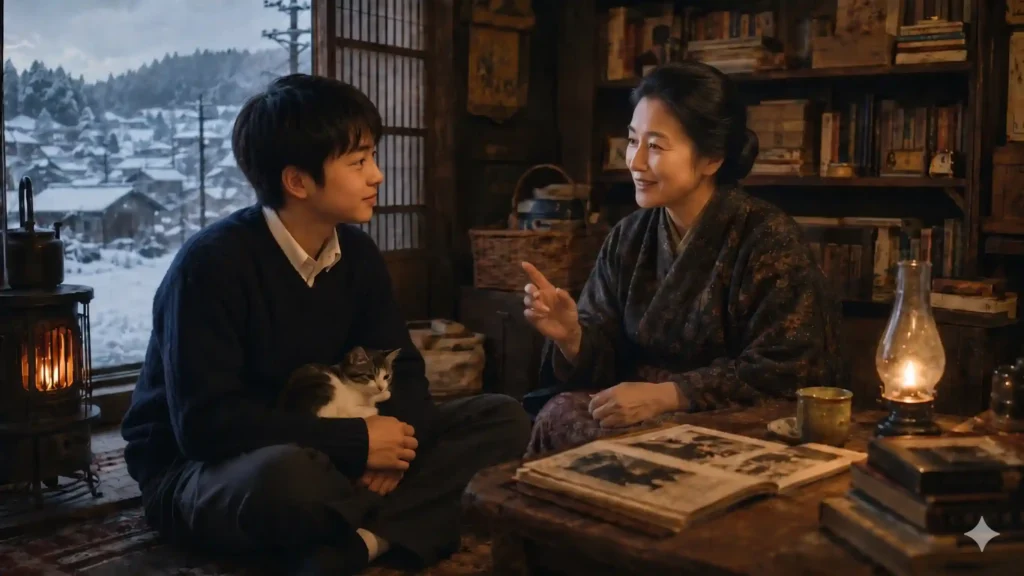
The highly concrete, warm, everyday depiction of listening to old tales with a kitten on one’s lap at the aunt’s house stands alongside the abstract, absurd worldview symbolized by the “pinwheel.” Because these two elements are sung on the very same horizon, the listener is struck by an existential loneliness that goes far beyond simple nostalgia.
The Unique Thermal Sensation Emitted by This Song Amidst the Album’s Energy
The greatest charm of the album Korori no Sekai lies in its kaleidoscope of shifting sounds that violently sway the listener’s emotions. Within this massive work, packed tightly with everything from ominous funk to dense ballads with weeping strings and dry folk-rock, the atmosphere emitted by “Koharu Obasan” on track five of Side B is exceptionally distinct.
Turning away from the album’s uproar of flashy horn sections and edgy beats, here we are met closely only with the plucking of an acoustic guitar and Yosui’s voice laden with humidity. Yet, this is by no means an easy “resting place” meant to slacken the taut tension.
Rather, while other tracks depict the cold human relationships of the city and the anxiety of the times, this song alone offers us “an absolute warmth that certainly existed at one time.” Consequently, the sound of the north wind howling behind that warmth pierces our skin more realistically and sorrowfully than any other moment on the album.

Borrowing the form of a gentle recollection, it actually confronts us with the “loneliness” that forms the undercurrent of the entire album in its purest state. Hidden within this quiet placement is the compelling mastery of direction that deepens the overall gradation of the work to its absolute limit.
Conclusion
The song “Koharu Obasan” teaches us the importance of the place we ought to return to, while simultaneously softly presenting an adult’s resignation: “You may no longer be able to return there in the same form as before.”
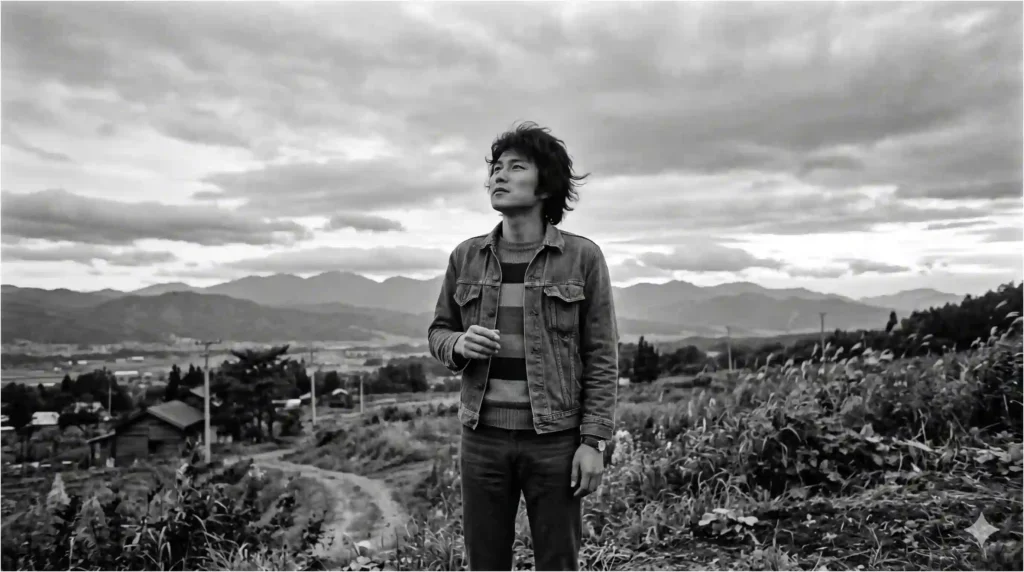
In everyone’s life, there must be one or two sanctuaries of memory, much like that “country town with a book-rental shop.” When you feel buffeted by the winds of daily life and on the verge of losing your way, listen closely to this quiet melody. There, resisting the unsettling winter wind, the image of a young Yosui looking up at the distant sky in anticipation of tomorrow—and indeed, our own reflection—is undeniably alive.

音楽ファン同士の交流・リクエストはこちら / Connect & Request Songs Here