
◆Click here for Yosui Inoue’s History!
- 🎧 Enjoy This Article in Audio
- No. 18 is “Chie-chan”
- First, Please Listen to the YouTube Videos
- The True Nature of the Disconnection Surrounding “Chie-chan”
- A Double Exposure of Departure: “Overseas” and “Heaven”
- The “Distortion” and “Desire” Seen from the Protagonist’s Perspective
- The Role “Chie-chan” Plays in the Album “Ice World”
- In Conclusion
🎧 Enjoy This Article in Audio
You can quickly grasp the main points of this article through narration.
Recommended for those who want to catch the vibe of the music and the flow of the article before reading.
🎶 English Narration
An English audio introduction to the contents of this article.
⌛ Duration: Approx. 3 mins 30 secs
🎵 Japanese Narration
A Japanese audio introduction to the contents of this article.
⌛ Duration: Approx. 3 mins 30 secs
* Listening to the audio before reading helps you better understand the world of the music and the main points of the article.
No. 18 is “Chie-chan”
The world drawn by the exceptional artist Yosui Inoue often resembles a beautiful labyrinth. This song, placed as the fourth track on Side A of his historic 1973 masterpiece album “Ice World (Kori no Sekai),” holds a special place in my heart—one that I absolutely could not leave out from his vast discography.
Set against a light, upbeat, and somewhat country-style refreshing sound, what is actually sung is a sudden and deeply profound shadow of “parting.” There is an undeniable and unique presence drifting through this piece.

In this article, I would like to unravel from my own perspective the deep layers of these lyrics, where the brightness coexists with a back-to-back loneliness, and where “departure for a foreign land” and “eternal farewell from this world” are layered over each other like a double exposure.
The World of “Chie-chan” (Poetic Translation)
Like a memory of sunflower fields, that girl went far away on a summer day.
Without a chance to say goodbye, and with no one to see her off, she vanished into the sky.
In times of sadness, become the sea, the wind, or words, and gently heal someone's heart.
Did you go to an unfamiliar town, or did you settle down somewhere, intending never to return?
Why did you vanish all alone into that brilliant, dazzling sky.
First, Please Listen to the YouTube Videos
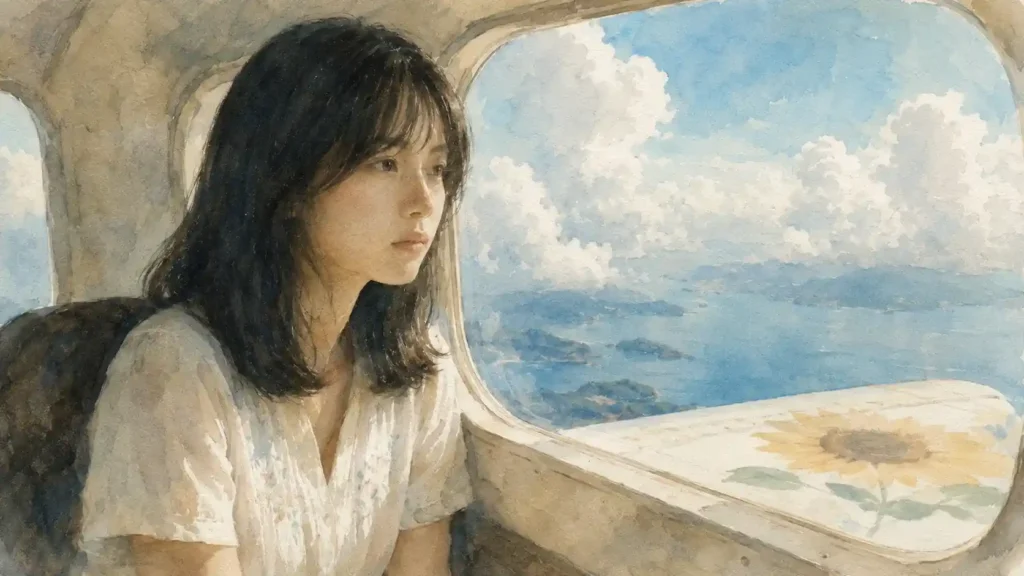
This is the studio recording. Please click the image below.
Credits
Yosui Inoue "Chie-chan"
Lyrics & Composition: Yosui Inoue / Arrangement: Katashi Mashi, Nick Harrison
Track from the 1973 album "Ice World (Kori no Sekai)."
Two-Line Review
A piece that seals the sense of loss for "that girl" who flew away on a summer day within a bright, dazzling landscape.
With a gentle tone reminiscent of a nursery rhyme, it leaves a lingering resonance that can be read as a parting, a journey, or a bereavement.
This is the live version. Please click the image below.

Credits
Yosui Inoue "Chie-chan"
Lyrics & Composition: Yosui Inoue
Live Video: Ice World Tour 2014
Two-Line Review
While retaining the simplicity of the album version, this live rendition allows his aged voice to resonate the absence of "that girl" even more deeply. Beneath the cheerful melody, a gentle gaze toward the summer parting and the unreturning time remains.
(*The majority of Yosui Inoue’s audio files available on the internet are not official releases. Therefore, out of consideration for copyright, this blog adopts a format where we link to external sites via our own custom images rather than embedding the videos directly.)
The True Nature of the Disconnection Surrounding “Chie-chan”
A Pop Sound Image and an Alarming Narrative
When hearing this song for the first time, many people will likely be drawn to its approachable melody. The nimble acoustic guitar strokes evoke a clear, sun-drenched summer landscape. Katashi Mashi’s arrangement carries a briskness akin to American folk-rock.
Yet, as you surrender yourself to that comfortable rhythm and follow the words, a sudden stirring of unrest begins to take hold in your chest. The actual content being sung is the sudden vanishing of a young girl, hiding just beneath the surface of that cheerful soundscape.

Without telling anyone, and without being seen off by a soul, Chie-chan boards an airplane decorated with sunflowers and disappears into the sky. The gap between this strikingly contrasting “brightness of sound” and “the boundless loneliness implicit in the poetry” is precisely what drives an unforgettable thorn into the listener’s heart.
The Cipher of the “Sunflower-Patterned Airplane”
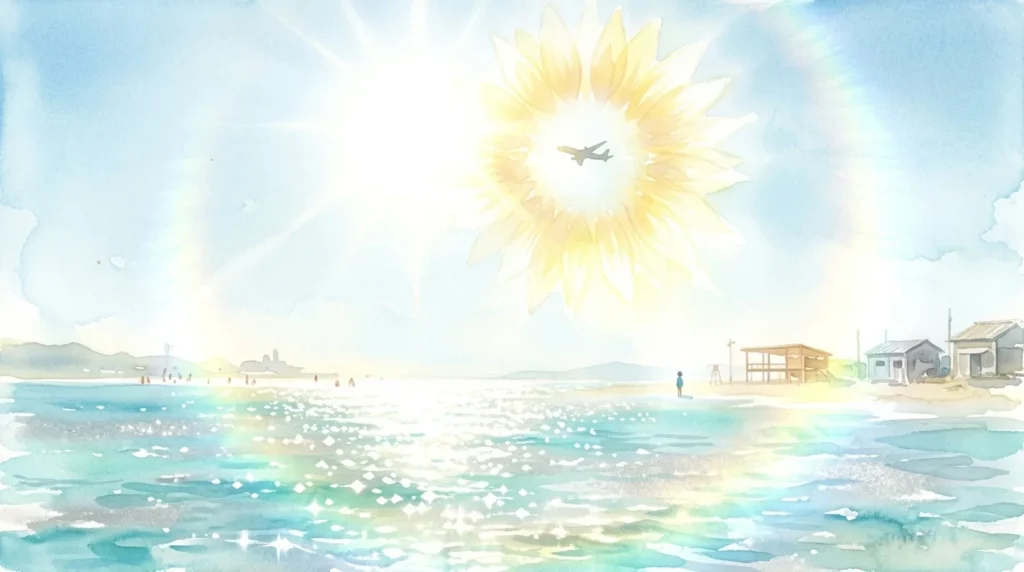
The phrase “sunflower-patterned airplane” appearing at the beginning possesses, at first glance, a whimsical charm like a fairy tale. However, depending on whether this refers to something real or a complete fantasy, the scenery of the song changes entirely.
Even when considering the historical context of the era, it is difficult to imagine a commercial aircraft adorned with such flamboyant paint flying on a regular basis. If that is the case, this might be a sorrowful filter within the protagonist’s mind, used to romanticize her departure.
Alternatively, one can interpret that the intense summer sunlight itself projected the illusion of sunflowers onto the aircraft. In any case, behind this catchy choice of words, one cannot help but feel a subjective distortion at play—as if refusing to look reality straight in the eye.
A Double Exposure of Departure: “Overseas” and “Heaven”
A Journey to a Foreign Land as a Road Movie
If we follow the lyrics plainly, we see a line-up of highly physical and realistic keywords such as an airplane, a seashore, swimwear, and crossing the sea.
A free-spirited girl who left for an unfamiliar town, then to a further distant town, flying abroad without telling anyone just to find something. An interpretation like a road movie easily holds ground at first—where the left-behind protagonist sends her an encouragement, thinking, “The sea over there isn’t just cold, so give it your all even if words don’t come through.”
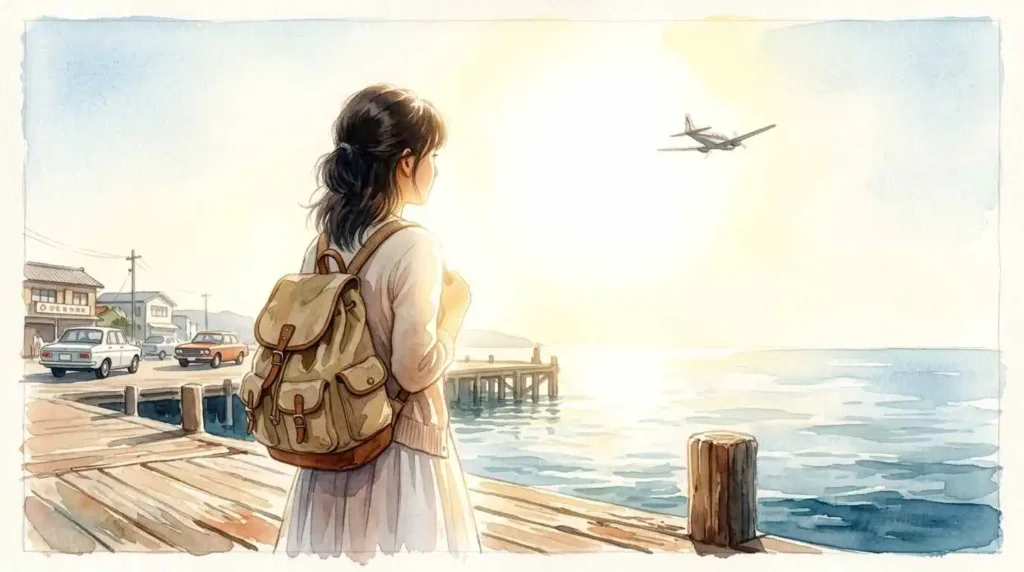
However, the true genius of Yosui begins here. Every single word beautifully flips into another interpretation—her absolute disappearance from this world (death).
A Heartrending Cry to Her Who Vanished into the “Dazzling Sky”
The phrase “Without being seen off by a soul, she vanished all alone into the sky, into the dazzling sky” is exquisitely beautiful, yet at the same time, its sense of reality is faint.
If her departure signifies passing away to heaven, the sunflower-patterned airplane starts to look like a radiant illusion seen by the protagonist through the depths of grief, unable to accept a farewell that came far too soon.

When viewed this way, the radical phrase in the middle, “show off your body to the sun,” completely alters its meaning. It begins to sound like a tearful prayer directed toward her who has become a transparent spirit, crying out, “Please live once more with that vivid physical presence.”
The question, “Do you intend to never return, staying settled down somewhere?” also reveals the painful reluctance of the one left behind, unable to accept her death and wishing to believe she is alive and well somewhere.
While playing a pop melody beneath a clear summer sky, Yosui heavily diffuses a vaguely blurred yet definitive sorrow of absence, blurring the boundary line between life and death at the “shore on the other side.”
The “Distortion” and “Desire” Seen from the Protagonist’s Perspective
The Soliloquy Hidden Within “Will You Find Something and Return?”
Toward the end of the narrative, the lyrics strongly take the form of questions from the protagonist to her. The line “From an unfamiliar town to a distant town, will you find something and return?” resonates on the surface like a pure question caring for a traveler.
However, it feels as though a powerful attachment from the one left behind and a denial of the reality before his eyes are coexisting here. The stark fact remains that she left of her own accord without telling a soul. Yet, facing this, the figure of the protagonist stands there, unable to stop himself from asking if she will return.
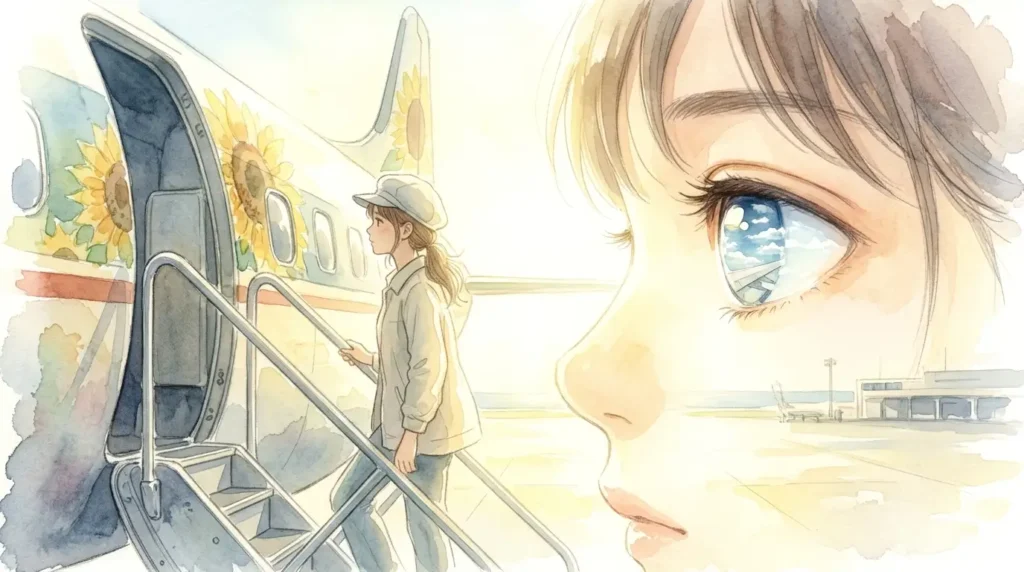
Here lies a glimpse of a sorrowful struggle, trying somehow to reshape an unresolvable reality into a narrative he can come to terms with. If her departure means an eternal farewell from this world, the poignancy of this question deepens even further.
A soliloquy as if telling himself that she has merely gone out to a slightly distant town, spoken to an interlocutor who can never return. It tightly constricts the listener’s chest.
The Silent Acceptance within “Do You Intend to Never Return?”
The words thrown out next—”Or do you intend to never return, staying settled down somewhere?”—shift from the previous faint hope into a sense of quiet acceptance.
A premonition that her absence is no longer temporary, and a helplessness that she has gone to a place beyond his reach, drift through the air. At the same time, one feels that even the complex emotion of turning into a blaming tone toward her somewhere is entirely enveloped within this brief inquiry.
Contained here is a raw human regret that cannot be settled by a simple expression of loneliness. Riding on a beautiful country-style rhythm, Yosui calmly yet vividly portrays this unrenounceable human fate.
The Role “Chie-chan” Plays in the Album “Ice World”
An Exquisite Placement as Track 4 on Side A
Let us broaden our perspective slightly and look at the placement of this song within the album “Ice World.” This work holds an incredibly dense flow, starting from the opening track “The Railroad Crossing That Never Opens (Akazu no Fumikiri),” moving into the tense “The Beginning (Hajimari),” and leading into the massive hit “Two Who Cannot Return (Kaerenai Futari).”
Sliding in right after that sequence is this very track, “Chie-chan.” The deftness with which it repaints the heavy, dramatic atmosphere of the previous tracks in an instant with a refreshing acoustic tone plays a vital role in creating the dynamism of the entire album.

Yet, the depth of Yosui Inoue as an artist ensures it does not end as a mere light interlude. While disarming the listener’s guard with an easy-listening sound, he is actually letting a story of the most profound and unresolvable loss slip quietly into the listener’s heart.
The Catharsis Brought by the Sound
Katashi Mashi’s magnificent arrangement skillfully neutralizes the weight of the lyrics, elevating it instead into a sort of exhilarating clarity.
If these lyrics had been sung as a dark folk song in a minor key, we might not have wanted to listen to this track over and over as many times as we do. It is precisely because of the soundscape resembling a clear, cloudless sky that we are able to receive the underlying loneliness and pain of parting as something containing a touch of salvation.
In Conclusion
The song “Chie-chan” is a mysterious work that reveals a different face every time you listen to it. At times, it approaches our hearts like a bright road movie remembering a friend who left for a distant foreign land; at other times, like an elegiac poem tracing an unseverable bond to someone we can never meet again.
This labyrinth of double exposure set up by Yosui does not present us with a clear answer. It merely burns a striking visual into our minds—the crisp summer sky and the sunflower-patterned airplane.

When facing the music of “Chie-chan” after moving through the natural gradations of time in life, we find ourselves pleasantly mystified once again by the unfinished question left behind by Yosui.
Katashi Mashi’s bursting arrangement and Yosui’s listless yet brilliant voice. Every time I hear that thoroughly crisp summer sound image, my thoughts quietly begin to chase the whereabouts of her who vanished into that sunflower-patterned sky, holding onto the unresolved blank space as freshly as ever.

音楽ファン同士の交流・リクエストはこちら / Connect & Request Songs Here