Click here for Yosui Inoue’s History!
- 🎧 Enjoy This Article in Audio
- Number 13 is “Jiko Keno” (Self-Loathing)
- First, Please Listen to the YouTube Videos
- Analysis of Disquiet: Why Does This Song Stir Our Hearts?
- A Quiet Full Stop in the Masterpiece “Koori no Sekai”
- Sound Portrait: The “Arrangement that Robs the Body Warmth” by Katsuru Hoshi
- In Conclusion: Our “Karma” of Continuing to Stare into the Dark
🎧 Enjoy This Article in Audio
You can quickly grasp the main points of this article through narration.
Recommended for those who want to catch the vibe of the music and the flow of the article before reading.
🎶 English Narration
An English audio introduction to the contents of this article.
⌛ Duration: Approx. 3 mins
🎵 Japanese Narration
A Japanese audio introduction to the contents of this article.
⌛ Duration: Approx. 3 mins
* Listening to the audio before reading helps you better understand the world of the music and the main points of the article.
Number 13 is “Jiko Keno” (Self-Loathing)
Once again, we have a track from the 1973 monumental masterpiece album, “Koori no Sekai” (Ice World).
When discussing the musical history of Yosui Inoue, the songs born during the folk boom of the early 1970s are often talked about in the context of fresh lyricism or sharp social satire.
I have already introduced many songs from that era in this Best 30 series.
However, behind the tracks that stand under the bright spotlight, there are a few pieces hidden away that evoke a bottomless sense of dread and fascination within me. Standing quietly, one step removed from the craze of the era, this song “Jiko Keno” is precisely one of them.
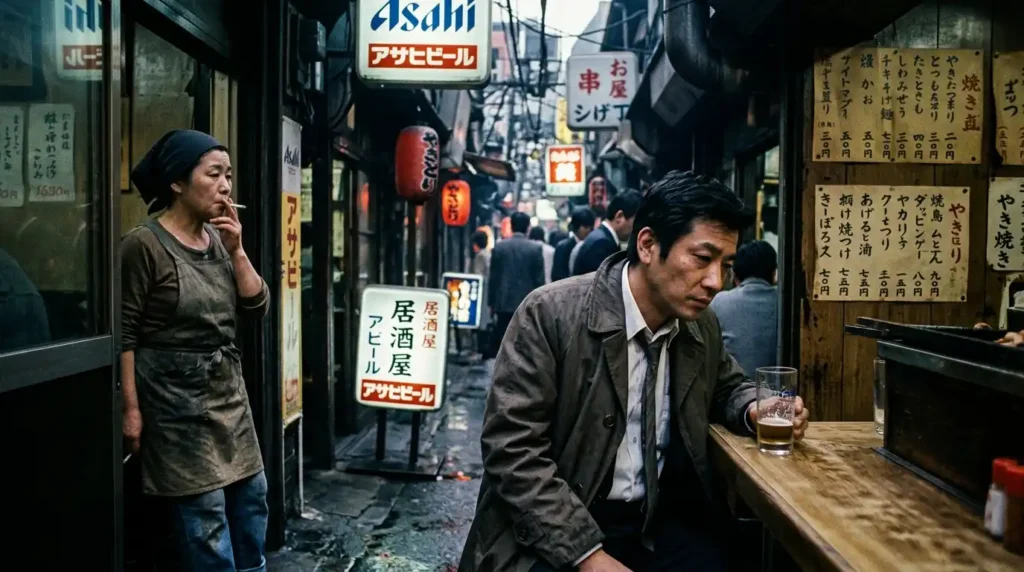
This piece has an extremely introspective, heavy texture, entirely removed from mainstream hit charts or flashy publicity.
The “raw karma of humanity” and “helpless loneliness” that we unconsciously keep a lid on in our daily lives are captured by Yosui with an icy cold, yet somehow sweetly lingering touch.
In this article, I want to dissect deeply from my own perspective the unique, magnetic pull of this hidden masterpiece called “Jiko Keno,” which stirs the listener’s heart and drags them into its depths.
Poetic Translation: The Landscape Beyond the Words
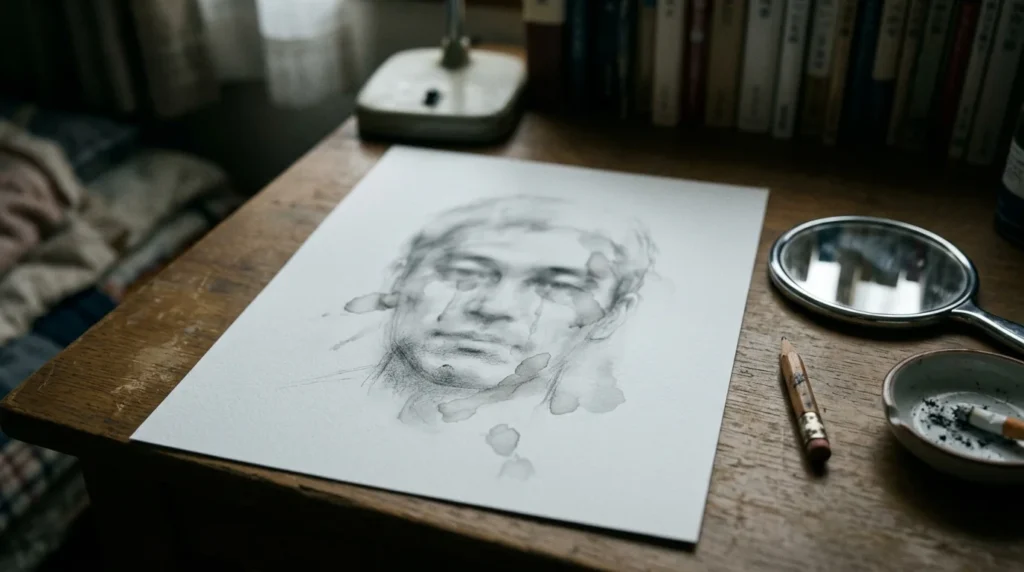
Even if I stare into myself, the person standing there is not someone to be proud of—only a weak, ill, and sleepless man.
Like a sketch blurred by tears, even my own contours remain uncertain.
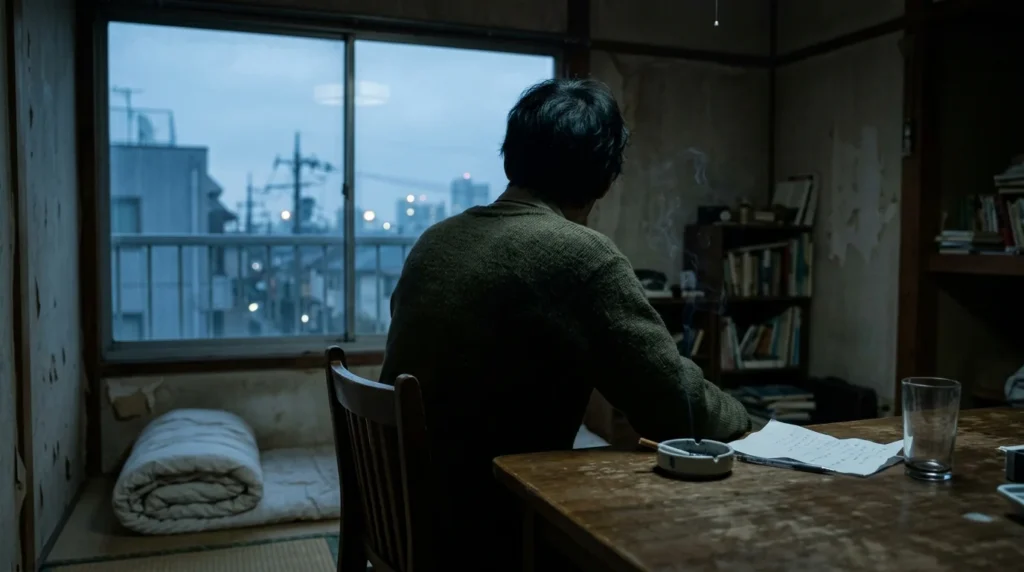
With no faith left to believe in tomorrow, I merely trace the path of the drifting smoke blankly.
Yet, I have no choice but to keep singing, though I do not even know how far this voice will reach.
First, Please Listen to the YouTube Videos
First is the original studio track. Please click on the image below.
Credits
Yosui Inoue - "Jiko Keno" (Self-Loathing)
From the album "Koori no Sekai"
Released on December 1, 1973
Lyrics & Composition: Yosui Inoue
Arrangement: Katsuru Hoshi
Two-Line Commentary
One of the most deeply introspective tracks on "Koori no Sekai," where a young Yosui Inoue stares at himself with complete detachment.
The restrained vocals and chilling arrangement make the feeling of self-loathing resonate not as mere sentimentality, but as an inescapable reality.
Next is the live version. Please click on the image below.
Credits
Yosui Inoue - "Jiko Keno" (Self-Loathing)
From "Koori no Sekai Tour 2014 Live the Best"
Live recording on May 16, 2014, at Aichi Arts Center Main Hall
Lyrics & Composition: Yosui Inoue
Two-Line Commentary
A live recording from the 2014 tour, where Yosui revisits "Jiko Keno" with a detached yet deeply shadowed delivery. The poignant self-awareness of his youth rises back to life through the vocals of his mature years, manifesting as a calmer, heavier sense of isolation.
(*Note: Most of the audio files of Yosui Inoue available on the internet are unofficial uploads. Therefore, out of respect for copyright regulations, this blog adopts the format of linking to external sites via custom images rather than embedding the videos directly.)
Analysis of Disquiet: Why Does This Song Stir Our Hearts?
The Cold Detachment Beyond the Borders of a Confessional Novel, Drawn by the “Folk Standard-Bearer”
The image most people associate with the term “folk song” is likely a scene of young romance in a small room, naive anger toward the times, or the bittersweet joys and sorrows of daily life.
However, the world Yosui presents in “Jiko Keno” completely rejects such personal sentimentality or the “easy-to-understand stories” designed to win sympathy.
What is sung here is a sketch of four men placed in seemingly hopeless situations. With each transition of the lyrics, the men who appear carry their own physical or mental dark sides, merely staring at a single point somewhere in the world.
- The First Man: Muts a confession to his drawn self-portrait with sightless eyes
- The Second Man: Quietly watches his dwindling days from a sickbed
- The Third Man: Stares at the hazy boundary of morning and purple smoke on a sleepless night
- The Fourth Man: Trembles in fear with nowhere to go, having lost his means of expression
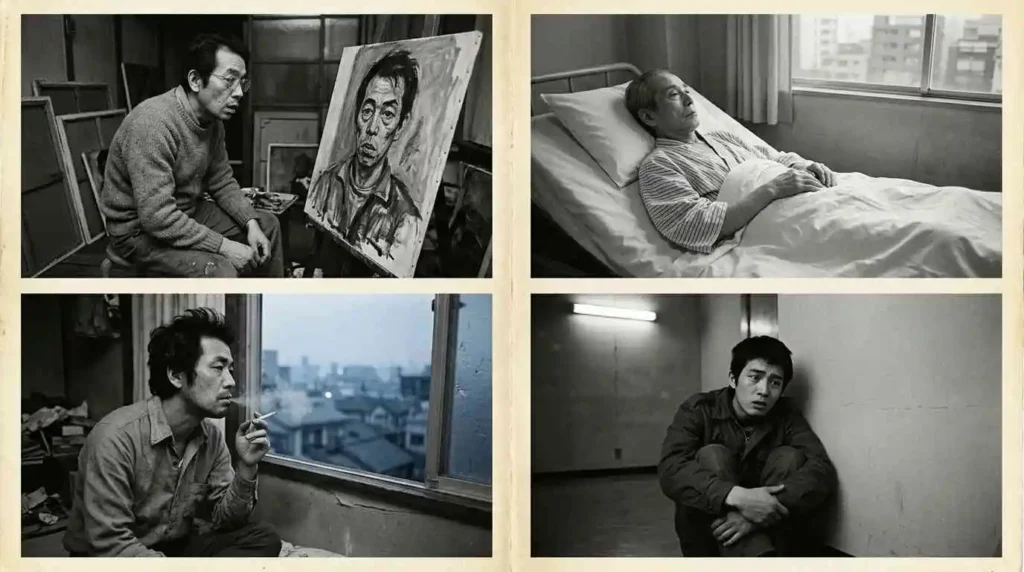
The initial sense of disquiet I felt upon listening to this song lay in the fact that while lining up such harrowing motifs, Yosui’s gaze as a singer shows absolutely no sympathy, pity, or desire for solidarity toward them.
In standard pop music, when portraying the weak or those in agony, there is usually some saving grace like “even so, life goes on,” or an emotional production meant to draw tears from the listener.
Yosui, however, captures their presence onto the record exactly as they are, as if zooming in on a subject with a high-performance camera without emotion.
This “detached gaze” is precisely what inflicts an uncanny discomfort upon the listener, while simultaneously creating a deep, inescapable addiction once you are caught in its grip.
The Conflict of Era and Expression Told by the Alteration of the Opening Four Characters
When discussing the disquiet carried by this song and its journey through time, we must address the definitive difference between the two recordings introduced here. That difference is concentrated in the very first four characters that open the song.
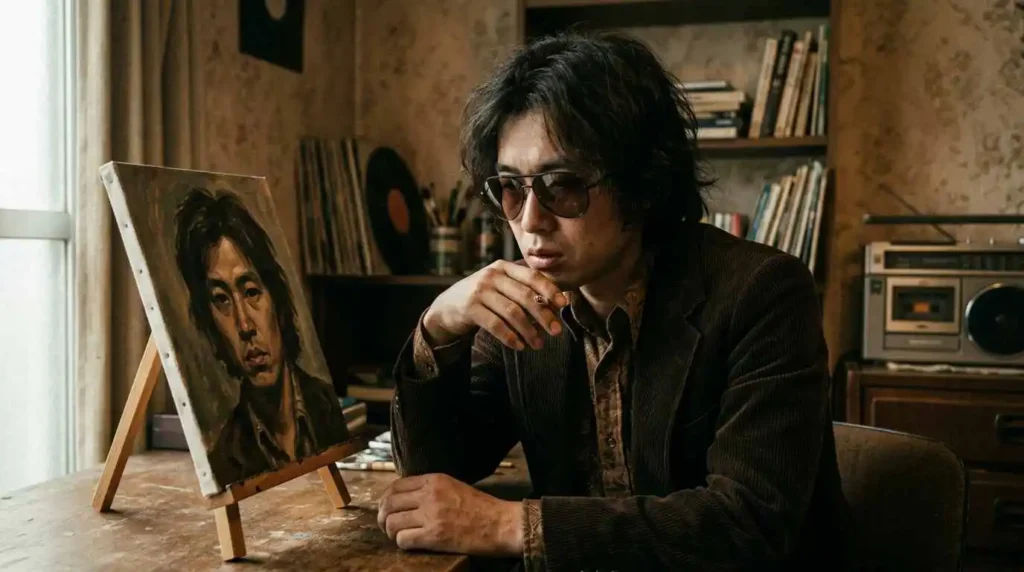
In the original 1973 studio recording, Yosui describes the first man by singing the words “Mekura no…” (The blind man…). However, in later live versions, this opening is explicitly changed to “Mienai…” (The sightless…).
Needless to say, the background of this change lies in the considerations regarding broadcast-restricted words (derogatory terms) and the tightening of media compliance over the years. As time flowed from Showa to Heisei, and then to Reiwa, the historical circumstances of the music industry as a whole surface here, where direct expressions once permitted were forced to be revised as unsuitable for public performance.
Yet, what we should marvel at here is that despite the wording being softened into a milder phrasing, the inherent dread and icy atmosphere of the track have not wavered in the slightest.
By changing the raw vividness of “Mekura” into the quiet description of “Mienai,” the depth of the darkness enveloping the man and the fracture of his world become more abstracted, striking the listener’s heart as a universal isolation. The fact that he could absorb an external demand like a lyrical change and turn it into the flesh and blood of his art inversely proves Yosui Inoue’s bottomless magnetic pull as a vocalist.
The Misdirection of the Title “Self-Loathing”
Delving deeper into the analysis, we realize that the ultimate mystery of this song lies in the title “Jiko Keno” (Self-Loathing) itself. No matter where you read the lyrics, or how closely you listen to the audio, there is no direct depiction of the protagonist (or the singer himself) blaming himself or writhing in self-disgust.
What is drawn is strictly a cold sketch of others. Why, then, is the title “Self-Loathing”?
Herein lies the highly advanced mental realm of Yosui Inoue as a creator. Could it be that he harbors a quiet disgust toward his own “karma”—the self that observes the despair and isolation of others so cold-bloodedly, or uses it as material for entertainment to sing over a beautiful melody?
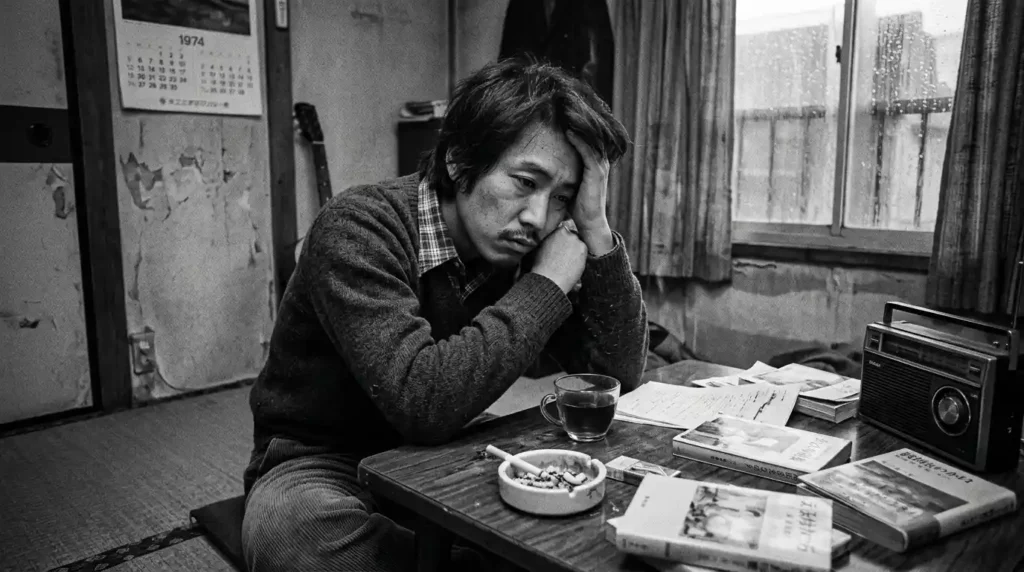
The cruelty of an artist who steps back into a safe place to watch the misfortune of others and the absurdity of the world, sublimating it into art. I believe that the absolute rejection of the self reflected in that mirror is the true theme flowing beneath this song. That is exactly why we, the listeners, are dragged into a sense of complicity, as if voyeuristically peeking into someone else’s pain, leaving a sharp ache deep in our chests.
A Quiet Full Stop in the Masterpiece “Koori no Sekai”
The Significance of the Placement at the Very End of SIDE A
When listening through Yosui Inoue’s album “Koori no Sekai” in the LP vinyl format, one cannot help but sense a calculated design on the part of the artist in the specific spot where “Jiko Keno” is placed.
SIDE A opens with the up-tempo, eerie “Akazu no Fumikiri” (The Unopened Railroad Crossing), moves into the beautiful lyricism of “Kaerenai Futari” (The Two Who Can’t Go Home)—a co-write with Kiyoshiro Imawano—and proceeds into the funky, fantastic impact of the title track “Koori no Sekai.” It is a dazzling sequence packed with cutting-edge sounds and Yosui’s overwhelming pop sensibility.
Yet, immediately following that flashy and intense excitement, sliding into the 7th track—the final spot of SIDE A—is this chilly acoustic number, “Jiko Keno.”
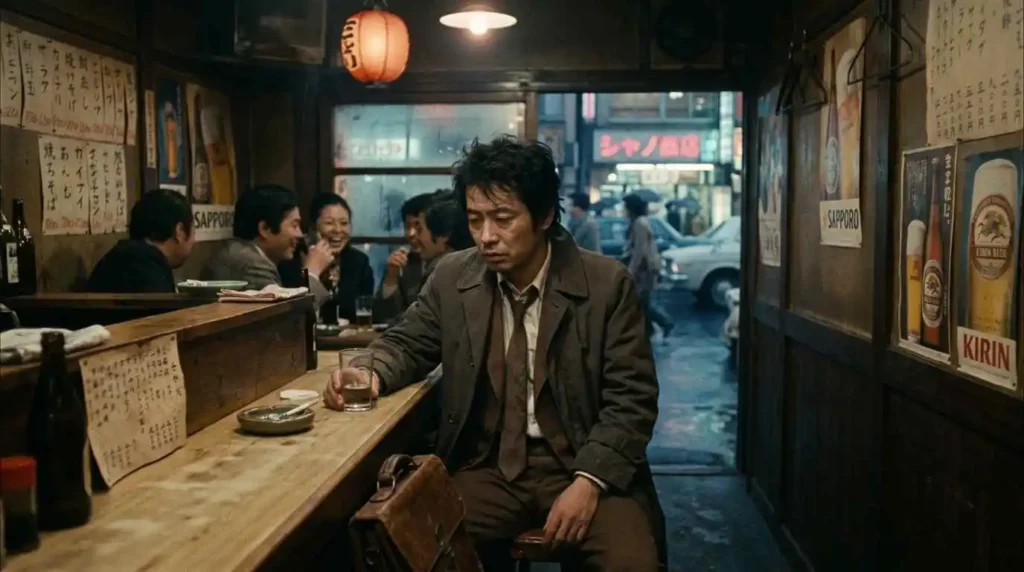
It is not a gentle lull after the festival.
It functions to drop the listener into an abyss, showing us that all the urban fantasies and madness of the era we just witnessed are completely continuous with the “raw reality” in which these four men live. Precisely because this song sits at the end of SIDE A, staring silently, the nobility of the entire album and its depth of peering into the human abyss are firmly established.
Sound Portrait: The “Arrangement that Robs the Body Warmth” by Katsuru Hoshi
Restrained Strings and the Hard Resonance of the Acoustic
The element finalizing the icy world of this track is the stripped-back, tight arrangement by Katsuru Hoshi.
The core of the sound consists of dry acoustic guitar strumming and a minimalist, tight rhythm section. From the middle of the track, weaving through the gaps of the words, strings with an unsettling semi-tone movement crawl low like a serpent.

When Yosui’s low-register, deadpan vocals blend with these ominous string movements, the space beyond the speakers is dominated by a quiet sense of detachment, resembling an empty room in the dead of winter.
Creating such a heavy atmosphere purely through the combination of acoustic instruments, without relying on electronic processing, is a realm that could only be reached by this specific duo during this exact golden era.
In Conclusion: Our “Karma” of Continuing to Stare into the Dark
Yosui Inoue’s “Jiko Keno” is by no means a song for everyone. It is not something you play on a bright, sunny weekend morning, nor is it a tune to hum along to while driving with someone.
Even so, the reason I place this track at the relatively high rank of number 13 in my series and find myself wanting to drop the needle on the record periodically is that I believe an unmistakable “human truth” is mirrored here.
To be completely honest, while writing this series, this melody kept looping ominously in my head. This is not a piece that can be written off with a simple phrase like “a song I love,” as if fondling an old favorite record.
Rather, guided by a strange, separate gravity that stirs my senses, I find myself always turning my ear back to this sound.
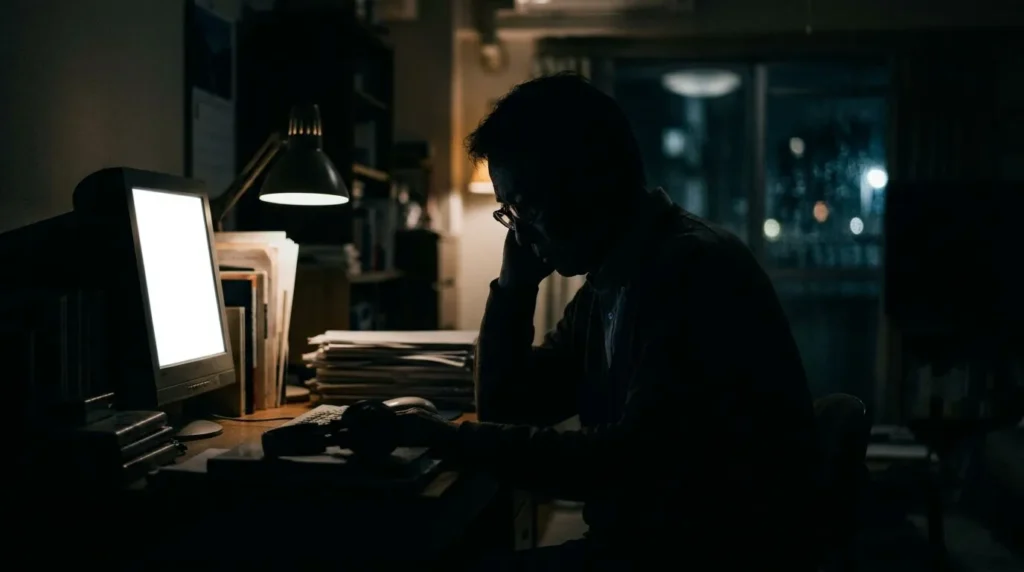
Every single one of us, in a sudden passing moment, can be crushed by the absurdity of the world or our own powerlessness, raising a silent cry from the depths of our souls. The four men Yosui drew so dispassionately might be extreme sketches, but they are, in fact, fragments of our very own minds.
The young Yosui Inoue bound the dark side of humanity, from which we want to avert our eyes, into a single piece of work with absolute beauty and chill.
When standing before that bottomless expression, though we tremble at the helpless isolation, we somehow willingly choose to submerge ourselves into that cold, quiet stillness.

音楽ファン同士の交流・リクエストはこちら / Connect & Request Songs Here