
Click here for Yosui Inoue’s History!
🎧 Enjoy This Article in Audio
You can quickly grasp the main points of this article through narration.
Recommended for those who want to catch the vibe of the music and the flow of the article before reading.
🎶 English Narration
An English audio introduction to the contents of this article.
⌛ Duration: Approx. 2 mins 15 secs
🎵 Japanese Narration
A Japanese audio introduction to the contents of this article.
⌛ Duration: Approx. 2 mins 45 secs
* Listening to the audio before reading helps you better understand the world of the music and the main points of the article.
No. 10 is “Ai wa Kimi” (Love is You)
With this song, we finally enter the Top 10. Every single track from here on out is an absolute masterpiece, so I truly hope you will read through and listen to every bit of it.
As I go through the process of selecting my favorite Yosui Inoue songs like this, I find myself completely overwhelmed, simply as a fan, by the sheer depth and variety of the musical repertoire he has built over the years.

At times, he captures human nature in the corners of a city with a touch of irony, and at other times, he paints mysterious landscapes purely through the resonance of his words. He is an incredibly elusive artist, and that is precisely why it is impossible to take your eyes off him.
Released in 1972 on his debut album “Danzetsu” (Disconnection), “Ai wa Kimi” holds a somewhat mysterious presence among his countless masterpieces and remains one of my personal favorites.
The Pinnacle of Unadorned Pop
When I listen to this track closely after a long time, as if gently dropping a needle onto a vinyl record, I feel a quiet, yet incredibly fresh breeze blowing through my heart.
Born at the very dawn of his career—just as he changed his stage name from “Andre Candre” to “Yosui Inoue” and set out to forge his own distinct musical universe—this song, in my mind, already beautifully condenses the very essence of Yosui-style pop.
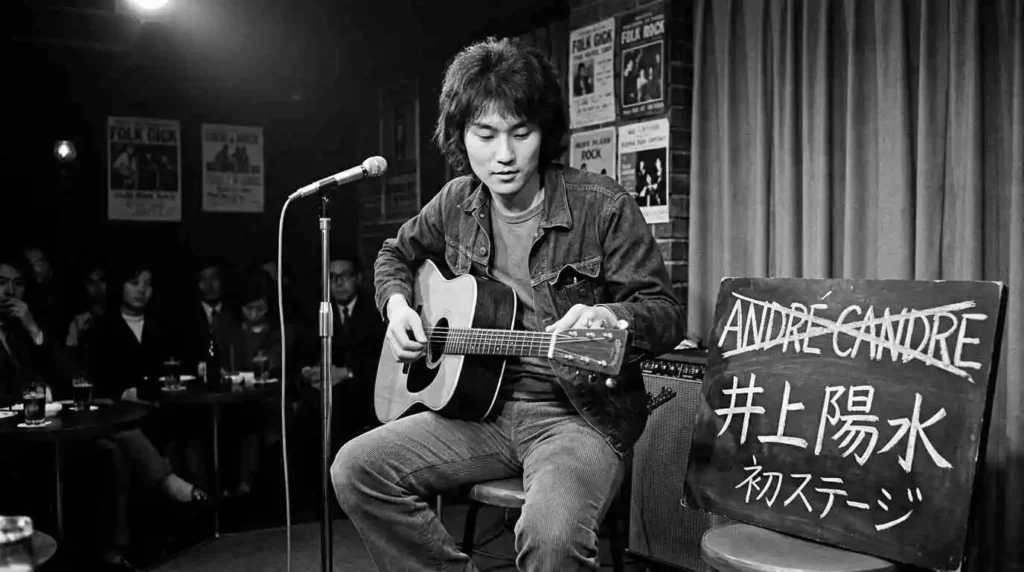
The texture of the sound is infinitely gentle, carrying a sweet melody that flows like sunlight filtering through trees. Yet, if you surrender yourself to its comfort and follow the lyrics, you are enveloped by a strange sensation, as if the familiar, everyday scenery around you is slowly shifting its shape.
The way this song quietly presents “love”—where everything in your field of vision becomes filled with the presence of someone precious—seems to harbor something that simply cannot be contained within the conventional frameworks of the words we overuse daily.
In a way, it reminds me of Masayoshi Yamazaki’s “Zenbu, Kimi Datta.” (It Was All You), which I previously shared on this blog. It offers that same blissful sense of floating, where the entire world melts away into a single existence.
Poetic Translation: The World of the Lyrics
Love exists everywhere in this world, just like the sky, the sea, the birds, and the flowers.
Yet for me, the entirety of that love is directed solely toward you.
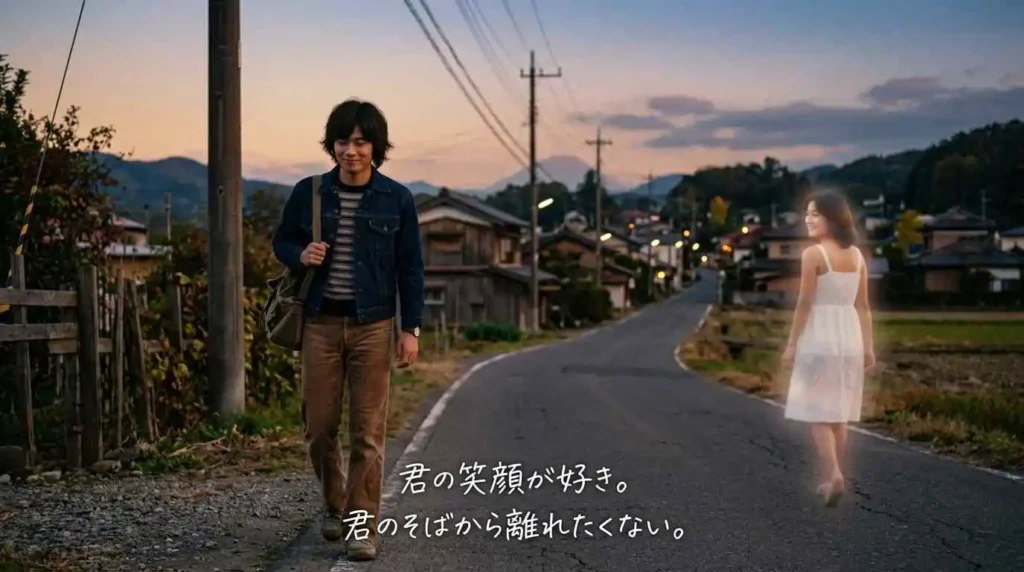
I love your smile, and I never want to leave your side.
I love you so truly that I want to give you all of myself.
First, Please Listen to These Three YouTube Videos
Below, you can compare different versions of “Ai wa Kimi” across various eras, ranging from the official studio recording to rare live tracks. Please experience for yourself the undeniable persuasiveness carried by Yosui’s vocal style.
All tracks are titled “Ai wa Kimi,” written and composed by Yosui Inoue, with original arrangement by Katsushi Shishi.
This is the original studio recording. Please click the image below.

Credits
Song Title: Ai wa Kimi
Artist: Yosui Inoue
Lyrics & Composition: Yosui Inoue
Arrangement: Katsushi Shishi
Album: "Danzetsu"
Related Info: Registered as the theme song for the 1994 drama "Stewardess no Koibito" (The Stewardess's Lover).
Two-Line Commentary
A remarkably straightforward love song that expands the concept of love to all elements of nature with lines like "Love is the sky, love is the sea," before ultimately converging into "Love is you." Typical of early Yosui Inoue, its simple repetition of words coexists with an unpretentious, slightly mysterious sense of floating.
Next up is the official audio track.
Credits
Audio Source: Live at Shinjuku Koseinenkin Kaikan / April 14, 1973
Live Album: "Yosui Live Modorimichi"
Remastered: 2018
Album Info: Released on July 1, 1973; currently distributed as a 14-track, 56-minute live album.
Two-Line Commentary
A live recording of the "Danzetsu" track "Ai wa Kimi," performed at Shinjuku Koseinenkin Kaikan on April 14, 1973. Compared to the studio version, its conversational simplicity shines through, allowing the direct conclusion of "Love is you" to resonate with the distinct intimacy of a live venue.
This is the acoustic guitar version. Please click the image below.
Credits
Format: Acoustic Live Recording
Year: 2007
Notes: Audio track associated with "Hikigatari Passion"
Two-Line Commentary
A later acoustic performance of the 1972 track "Ai wa Kimi" by Yosui Inoue. Moving away from the raw confession of his youth, this 2007 version utilizes vocal restraint and deliberate pacing to let the words of love resonate with greater depth and serenity.
(Note: The vast majority of Yosui Inoue tracks available online are not official uploads. For this reason, out of respect for copyright compliance, this blog utilizes custom-made images that link to external sites rather than directly embedding non-official videos.)
A Mysterious Labyrinth Named Simplicity
The Melting of Words Through the Juxtaposition of Nouns
Anyone who listens to this song will likely be struck first by the relentless listing of nouns during the chorus.
Here, we find basic, universal elements of nature—“sky,” “sea,” “bird,” “flower,” “star,” and “wind”—words so simple they could appear in an elementary school textbook. Yet, they are all bound together on the exact same plane as the subject “love.”
_202606081-1-1024x572.webp)
In standard songwriting, natural elements are usually employed as metaphors to describe feelings, such as “my feelings for you are vast like the sea.” Yosui, however, strips away all such embellishments. Instead, he writes as if gathering the surrounding landscape and our very existence, placing them raw into one massive container.
- A perspective showing that sky, sea, bird, and flower are all part of the same single life force.
- A realization that, at the core, both “I” and “you” are merely pieces of this massive cycle.
- A sensation where the literal meanings of the words dissolve, leaving only beautiful sound to fill the chest.
This space, entirely filled with the word “love,” appears at first glance to be a blissful paradise, yet it simultaneously carries a peculiar stillness that washes away the minor anxieties and noises of daily life.
The Subtle Force of Straightforward Words
Even looking across Yosui’s entire career, it is rare to find expressions of affection as unadulterated and direct as “I love your smile” or “I love you so much.” He is an artist who typically excels at angling his perspectives or concealing his true sentiments beneath layered metaphors.

Because of this, the confession of “I truly love you” ringing between the lines hits the listener’s heart with surprising weight and directness. It possesses a strange, singular devotion, as if he has cast aside all deep analysis and structural reasoning.
When I first heard this song back in junior high school, I remember feeling a touch of embarrassment at its completely unpretentious delivery. However, as the years passed and I grew older, the meaning held by this song began to unfold step by step. Listening to it again now, I find myself deeply captivated by the absolute lack of hesitation underlying this simplicity.
The world depicted in “Ai wa Kimi” contains not a single drop of social maneuvering or adult compromises. The simple truth of “I love you” is simply placed right there—quietly, yet with an undeniable presence.
The Sonic Mechanics of “Ai wa Kimi”
Solid Musicianship Within a Comfortable Tempo
The arrangement of this track was handled by Katsushi Shishi, who shaped Yosui’s signature sound during his early years.
At first listen, the track plays out as a pleasant mid-tempo pop song that makes you want to clap along. Yet, if you listen closely, you notice that the rhythm section—led by the bassline—anchors the bottom with remarkable weight.

This steady rhythm keeps the sweet melody and lyricism grounded, ensuring they settle gently into the listener’s heart without becoming overly lightweight.
Layered over this rhythm section, the detailed strumming of the acoustic guitar and the electric guitar’s perfectly placed obligatos (supporting lines) play an exceptionally memorable role. They never interfere with the vocals; instead, they slide in exquisite phrases during the brief moments when Yosui’s voice pauses.
Thanks to this sparse instrumentation, completely free of unnecessary noise, every single word Yosui sings reaches the ear with crystal clarity.
A Vocal Conviction Resonating Across Eras
This time, we compared three distinct versions from different eras: the 1972 studio track, the 1973 live version from “Modorimichi,” and the 2007 acoustic rendition.
What struck me anew was the astonishing evolution of Yosui Inoue’s “voice” over time, paired with the enduring strength of a composition that refuses to fade.
From the somewhat fragile, earnest delivery of a young folk singer to the mature, deeply resonant tone of an experienced artist displaying complete control. Though his vocal approach adapted with the times, the “unpretentious world” inside “Ai wa Kimi” remained entirely unshaken.
In fact, the more one looks back at his long career filled with highly intricate compositions, the clearer it becomes how pure—and how miraculously balanced—this initial simplicity truly was.

Conclusion: What “Ai wa Kimi” Means to Me
The allure of Yosui Inoue’s music is frequently attributed to his complex, unpredictable structures and his seductive wordplay. That is undoubtedly his trademark style.
Yet, every time I listen to “Ai wa Kimi,” which I proudly place at No. 10, I am forced to return to his other core brilliance—his genius as a melody maker who can construct flawless, high-purity pop using words that absolutely everyone knows.
“Ai wa Kimi”

The steady, direct resonance carried within these words will surely continue to echo clearly in my heart, without ever losing its color.


音楽ファン同士の交流・リクエストはこちら / Connect & Request Songs Here