
Click here for Yosui Inoue’s History!
- 🎧 Enjoy This Article in Audio
- Number 1 is “Kaerenai Futari” (The Two Who Can’t Go Home)
- First, Please Listen to the YouTube Videos
- Memories Hidden Below: The Landscapes of Youth and the Soccer Club Locker Room
- The B-Side of “Kokoro Moyou”: An Absolute Masterpiece Hidden in Plain Sight
- Cold Night Debris and Blinking Lamps: A Terrifyingly Beautiful Scenery
- Two Geniuses Sharing Creative Sparks in a Dark Corner
- What Yosui’s Music Has Given Me on an Endless Journey
- Digression: Was Choosing “Kokoro Moyou” as the A-Side Truly the Right Answer?
🎧 Enjoy This Article in Audio
You can quickly grasp the main points of this article through narration.
Recommended for those who want to catch the vibe of the music and the flow of the article before reading.
🎶 English Narration
An English audio introduction to the contents of this article.
⌛ Duration: Approx. 3 mins
🎵 Japanese Narration
A Japanese audio introduction to the contents of this article.
⌛ Duration: Approx. 3 mins 30 secs
* Listening to the audio before reading helps you better understand the world of the music and the main points of the article.
Number 1 is “Kaerenai Futari” (The Two Who Can’t Go Home)
At last, we have reached the final song.
While I have listened to countless tracks by Yosui and found my heart trembling at each masterpiece, “Kaerenai Futari” alone holds a completely distinct and special resonance within me.
Just hearing that quiet guitar strumming brings back the chill of the night air on my skin and an indescribable heartache, vividly resurrecting the exact texture of those days.
Of course, the masterpieces left behind by the unparalleled singer-songwriter Yosui Inoue are all so magnificent that it is nearly impossible to rank one above another. I believe that the entire collection of songs introduced so far could easily shift in evaluation or order depending on the listener’s preference and the disposition of their heart at any given moment.
Every single ranking presented this time is merely “My Personal Best 30.”

Therefore, if there are those who think, “Why is that song at this rank?” or “Shouldn’t this song be higher?” I kindly ask for your understanding. This is nothing more than a deeply personal record of how my own individual life has intertwined with Yosui’s music.
Even within that vast, expansive trajectory, “Kaerenai Futari” exists for me as an unalterable, essential origin that I could never leave out.
Poetic Translation: The Landscape Beyond the Words
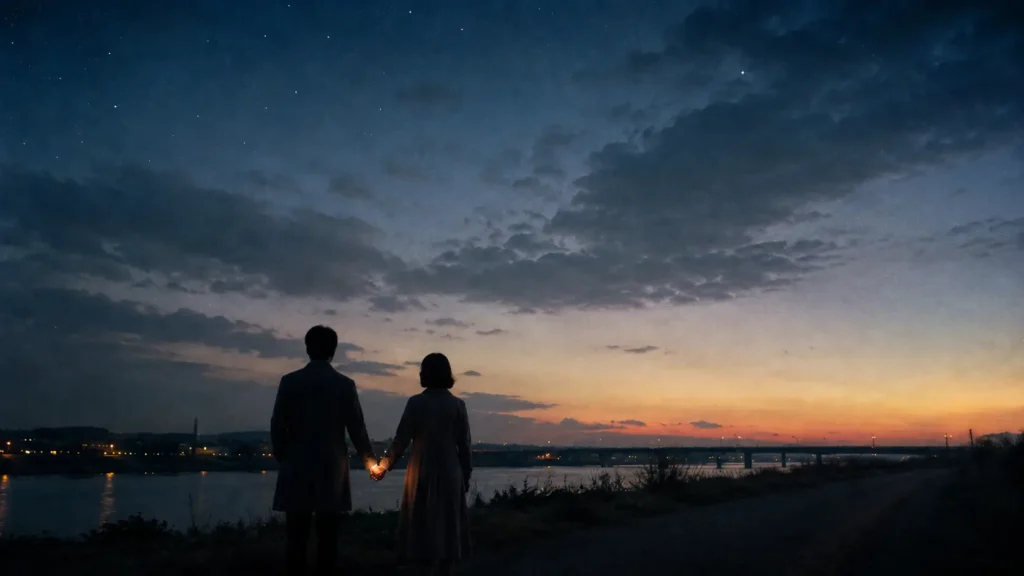
In the piercing cold where the night fog stings the skin, the voices of the two huddled close together tremble faintly.
At the exact moment he tries to confess his love, the city lights suddenly vanish, plunging the world into deep darkness.
As if abandoning the two who have lost their way home, even the stars are about to retreat beyond the night sky.
While the warmth of their clasped hands is the only certain reality, the freezing night hours relentlessly close in on them.
💡 You might also like: View the lyrics(External site)
If the lyrics are displayed only in Japanese, you can use your browser’s translation feature or an AI translation tool to understand the general meaning.
First, Please Listen to the YouTube Videos
Track Information
Song Title: Kaerenai Futari (帰れない二人)
Vocal: Yosui Inoue (井上陽水)
Lyrics & Composition: Yosui Inoue, Kiyoshiro Imawano (忌野清志郎)
Arrangement: Katsuru Hoshi (星勝)
Original Release: September 21, 1973, as the B-side to the hit single "Kokoro Moyou" (心もよう)
Album Release: Included in the album "Koori no Sekai" (氷の世界) released on December 1, 1973
This is the original studio version from the album “Koori no Sekai.” Please click the image below.
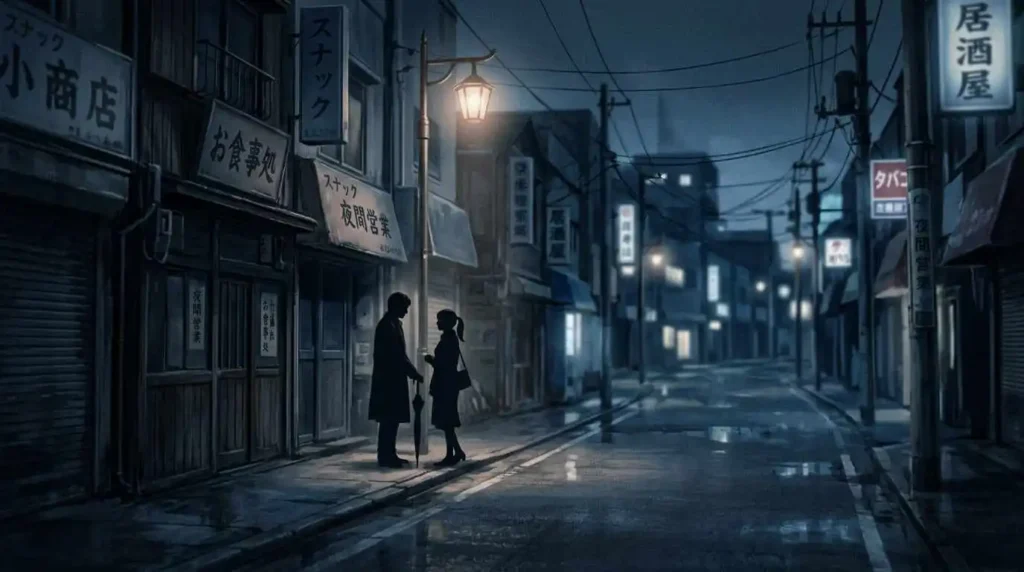
Steeped in the atmosphere of 1973, "Kaerenai Futari" locks the night's chill and the couple's helplessness inside a quiet vocal performance.
Rather than building to a flashy climax, it fades like the disappearing city lights, leaving a long-lasting resonance after the music stops.
Next is a live recording from the NHK Hall on March 7, 1982.
Please click the image below.

Live audio from NHK Hall on March 7, 1982.
In contrast to the delicate stillness of the studio recording, the tremors in Yosui's voice and the palpable energy of the venue bring the night of "Kaerenai Futari" to life with raw intensity.
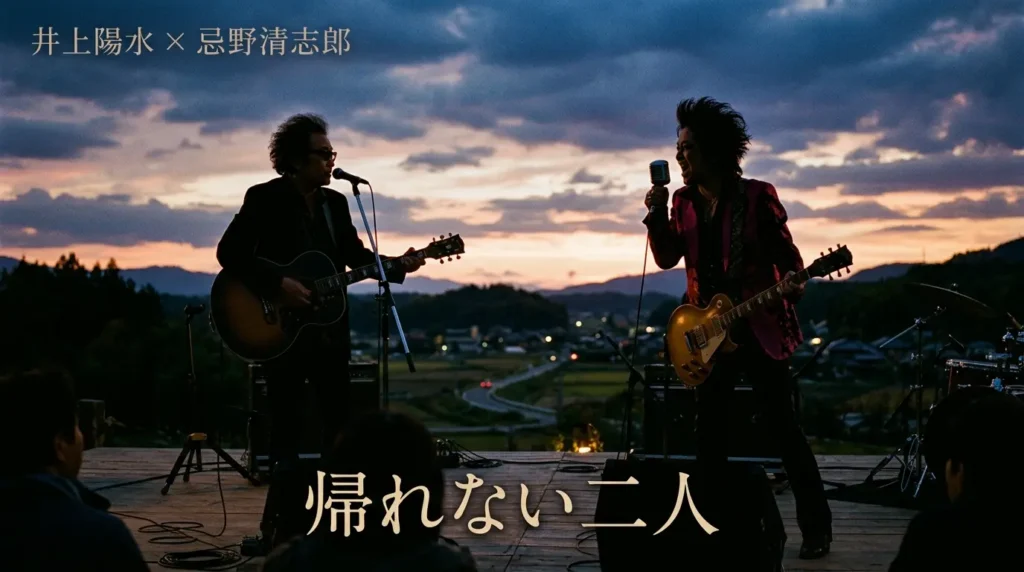
A live video of Yosui Inoue & Kiyoshiro Imawano performing together at the Uminonakamichi Seaside Park Outdoor Theater on August 25, 1991.
Please click the image below.
Seeing Yosui Inoue and Kiyoshiro Imawano share the same stage lets the underlying friendship and creative warmth ooze from the piece.
Unlike the quiet isolation of the original audio, the blending of their two voices adds a warm sense of life to the song's sorrow.
(*To respect copyright guidelines, this blog does not directly embed non-official video streams. Instead, we use custom-made images that link to external sites.)
Memories Hidden Below: The Landscapes of Youth and the Soccer Club Locker Room
It is a strange thing, but the moment the intro to this song begins, a specific scene invariably flashes vividly across my mind.
It is not the cityscape or the social climate of the era when the song was released, but rather the memories of my own junior high school club activities (the soccer club) and the sight of that mud-stained locker room.
_日本-1024x572.webp)
Back then, I knew nothing of real romance, yet right in the thick of adolescence, everyone was going through a season of “being in love with love itself.” At dusk, after practice ended, we would linger in the corner of the locker room, harboring vague yearnings for an ideal woman we hadn’t met yet or a love that would someday come—that slightly bittersweet atmosphere of the past.
The reason these images overlap in my memory is likely because our club practices spanned that transition from late afternoon into night. I believe that slightly sentimental feeling of the fading sunset vibrates deeply with the night-mist scenery of this song and its elusive, fluttering romantic longings, blending together into a single memory.
Katsuru Hoshi’s masterful arrangement and Yosui’s meticulous vocals possess the power to awaken these faint seasonal memories sleeping deep within a listener’s heart. Music truly has a way of outgrowing the creator’s initial intent, quietly leaning into the unique personal landscapes of everyone who listens.
The B-Side of “Kokoro Moyou”: An Absolute Masterpiece Hidden in Plain Sight
Here, we must touch upon a symbolic episode from when this song was first introduced to the world.
As you may know, “Kaerenai Futari” made its debut as the B-side (coupling track) to Yosui’s massive hit single, “Kokoro Moyou.” However, surrounding this selection, a heated debate unfolded between Yasuo Kawase—Yosui’s director at Polydor Records at the time—and Yosui himself regarding which track deserved to be the A-side.
Yosui felt a profound attachment to the progressive sound and sheer craftsmanship of “Kaerenai Futari” and strongly insisted on making it the lead track.
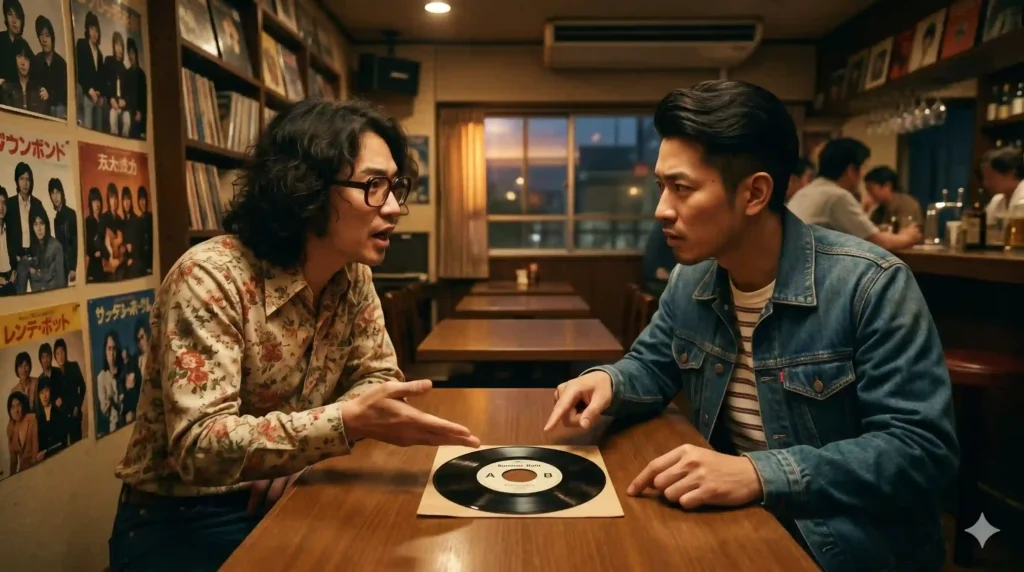
However, Director Kawase stood firm, refusing to yield because he believed that “Kokoro Moyou” held all the necessary elements for a commercial hit, and he carried out his executive decision.
Ultimately, Kawase’s foresight proved correct from a commercial standpoint; “Kokoro Moyou” became the A-side and went on to record a historic success that defined the era. Yet, the very fact that the artist himself pushed so hard to release this song as his main “showdown piece” stands as ultimate proof of its superb quality.
Even considering the historical irony that placed such an exceptional song on the reverse side, one cannot help but marvel at the bottomless depth of talent Yosui possessed during this era.
Cold Night Debris and Blinking Lamps: A Terrifyingly Beautiful Scenery
The true genius of this track lies in its stunning realism, dragging the listener instantly into the “freezing confines of a nocturnal room.”
Right from the opening, the setting of an unexpected chill from the night mist and the faintly trembling voices of the couple tells us everything we need to know about their physical proximity and, paradoxically, the fragile state of their hearts.
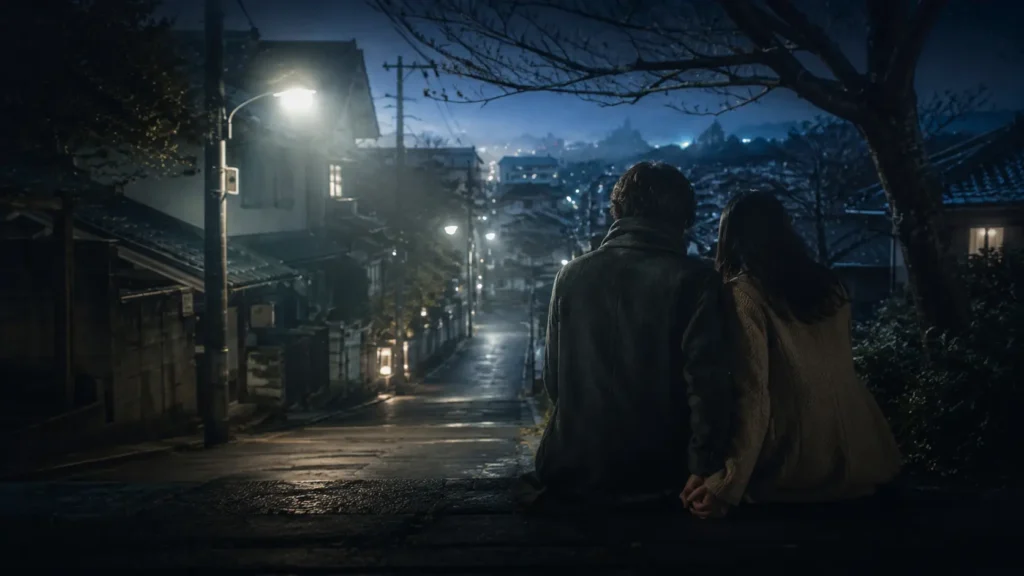
What is exceptionally breathtaking is the dramatic turn of the line: “Just as I was about to say to you… the streetlights went out.”
The ordinary world that had barely illuminated them is suddenly stripped away, leaving nothing but the two of them and the sound of their overlapping breaths. This cinematic, high-contrast shift drops a powerful visual imprint into our minds through the poetic translation.
Furthermore, as if cornered by their surroundings, even the stars in the heavens quietly slip away (“The stars are already trying to head home…”).
While the city remains asleep, dreaming as though none of this matters, the warmth of their clasped hands surfaces as the only trustworthy reality left in the universe.
This tender yet mournful tension is precisely what elevates this piece into a truly peerless masterpiece.
Two Geniuses Sharing Creative Sparks in a Dark Corner
In discussing “Kaerenai Futari,” one cannot omit the collaborative drama between Yosui Inoue and Kiyoshiro Imawano, two giant figures who shine brilliantly in Japanese music history.
At the time, these two young artists were just beginning to assert their prominence in the folk scene. The way they crossed paths during the same era and sat together in a single room, side by side, to forge this song possesses an almost miraculous beauty.
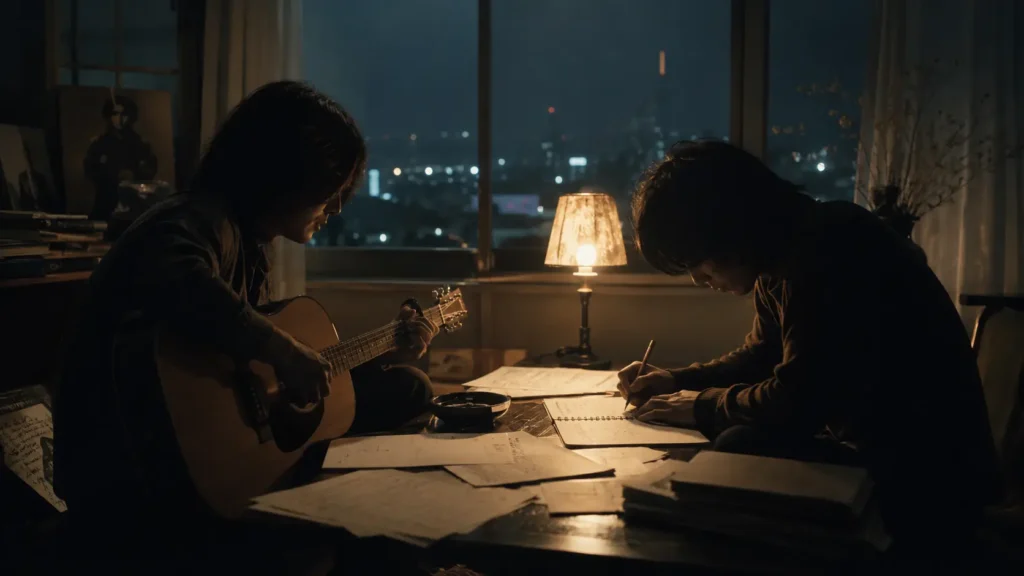
It all began because Yosui frequently visited the office of RC Succession, the band to which Kiyoshiro belonged.
Recognizing each other’s gifts, they sat together one night, plucking acoustic guitars and weaving words as if sharing heat and melody.
With Kiyoshiro handling the lyrical melody of the first half and Yosui taking over the dramatic progression that followed, their distinct personalities melted together like two people sharing a single blanket.
Before they became icons, they faced the music purely in a dark corner of the evening, feeling their way forward to complete a masterpiece. That intimate atmosphere is surely what birthed the fragile yet warm emotional current flowing through the track. In later years, when they performed this song as a duet on stage, the smiles on their faces carried the undeniable, vivid pulse of those youthful creative nights (as seen in that third video above!).
A Quiet Sonic Stamp That Defined an Era
I would also like to briefly mention Katsuru Hoshi’s musical arrangement. The sound design discards excessive ornamentation, layering the delicate resonance of acoustic guitars with gentle waves of strings to beautifully trace that mist-laden night landscape.
During the turbulent early 1970s, when the musical landscape was shifting drastically from raw folk to polished New Music, this intimate and dignified sonic architecture stood completely apart. By allowing the spaces to speak and letting the vocalist’s subtle inflections lead the way, this arrangement gives the song a timeless quality that feels entirely fresh even half a century later.
What Yosui’s Music Has Given Me on an Endless Journey
With this, I have introduced all thirty selections in “My Personal Yosui Inoue Best 30.”
Looking back at the entire list from number thirty to number one, it became clear that this was not a clinical task of judging musical superiority. Rather, it felt like an endless journey through time, pulling back the curtain on my own path and the landscapes I witnessed across different eras.
The musical world Yosui creates can be as deep as a labyrinth or as reflective as a mirror showing the listener’s own inner self. At times, it sharply carves out urban isolation; at others, it gently calls forth primeval landscapes tucked inside our hearts, much like that sentimental twilight I felt on the school grounds back in my junior high days.
During the moments I spent immersed in his singing voice, I could step away from the daily rush and quietly connect with my most fundamental emotions.
Though it takes the form of a ranking, as I noted at the very beginning, the numbers themselves hold little significance. Every single song was there with me through the various seasons of my life, giving me a tangible sense of warmth.
I am certain that within your hearts, too, there lies a personal “Number 1,” along with precious memories that flood back every time that particular song plays.
Thank you so much for accompanying me to the very end of this series, which often felt like a long, personal monologue. The wonderful music left behind by Yosui will undoubtedly continue to shift shapes, quietly and gracefully lighting our paths forward. The journey to seek new musical vistas beyond the cleared night fog continues onward.
Digression: Was Choosing “Kokoro Moyou” as the A-Side Truly the Right Answer?
To conclude this article, I want to leave you with an intriguing historical “what-if” to ponder regarding music history.
That question is: What would have happened if “Kaerenai Futari” had been released as the A-side, just as Yosui had insisted, overriding the objections around him?
In mainstream music history, the decision by Director Yasuo Kawase, who spotted the hit potential in “Kokoro Moyou” and pushed it forward, resulted in a million-selling hit. Consequently, with the benefit of hindsight, that choice is almost always heralded as the “correct answer.”
Yet, considering the immense cultural gravity Yosui commanded at the time, it stands to reason that if that quiet acoustic intro and the vivid lyric “Just as I was about to say to you…” had hit the radio waves as the face of the single, the youth of the era would have been just as deeply spellbound.
Perhaps it might have even accelerated the entire tectonic shift toward Japanese New Music.
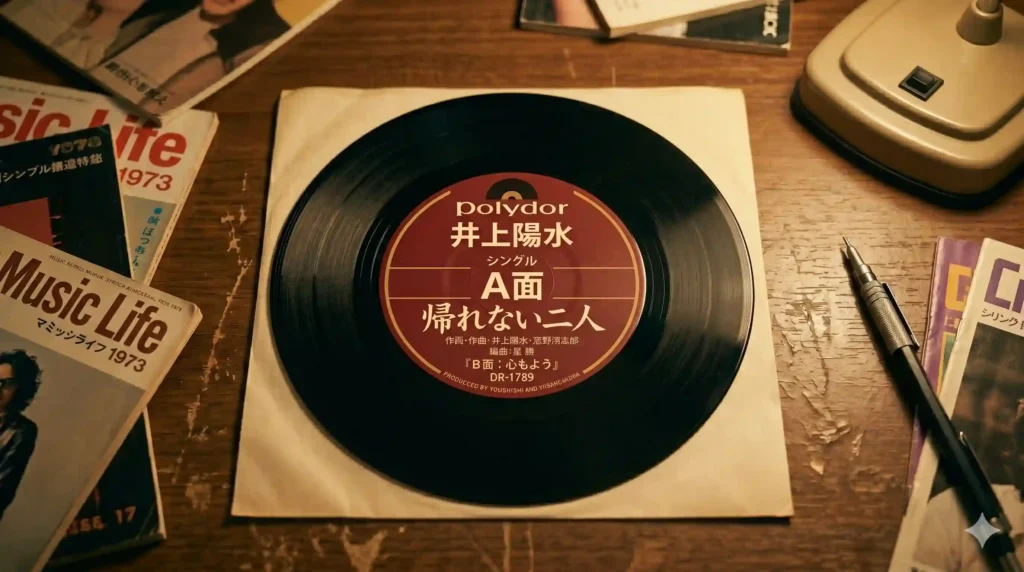
Then again, because “Kaerenai Futari” was never actually sent out into the world as an A-side, there is no real answer to which path was definitively correct.
The business-minded acumen of Kawase, which brought forth undeniable commercial fruits, and the brilliant artistic intuition of Yosui, who looked far over the horizon of the era. Which of the two possessed the superior vision remains an eternal mystery that no one can solve. Perhaps that is precisely why the historical alignment keeping this magnificent masterpiece tucked away on the B-side continues to capture our imaginations so deeply, even half a century later.

音楽ファン同士の交流・リクエストはこちら / Connect & Request Songs Here