- 🎧 Enjoy This Article in Audio
- Today is Kenji Sawada’s Birthday
- When I First Heard This Song
- The World Depicted in “Toki no Sugiyuku Mama ni”: Analysis (Part 1)
- The World Depicted in “Toki no Sugiyuku Mama ni”: Analysis (Part 2)
🎧 Enjoy This Article in Audio
You can quickly grasp the main points of this article through narration.
Recommended for those who want to catch the vibe of the music and the flow of the article before reading.
🎶 English Narration
An English audio introduction to the contents of this article.
⌛ Duration: Approx. 3 mins 30 secs
🎵 Japanese Narration
A Japanese audio introduction to the contents of this article.
⌛ Duration: Approx. 3 mins
* Listening to the audio before reading helps you better understand the world of the music and the main points of the article.
Today is Kenji Sawada’s Birthday
June 25th marks the birthday of Kenji Sawada, an artist who revolutionized the Japanese entertainment industry and continues to etch his name into the history of pop music. Born in Tottori in 1948, he was raised in Kyoto.
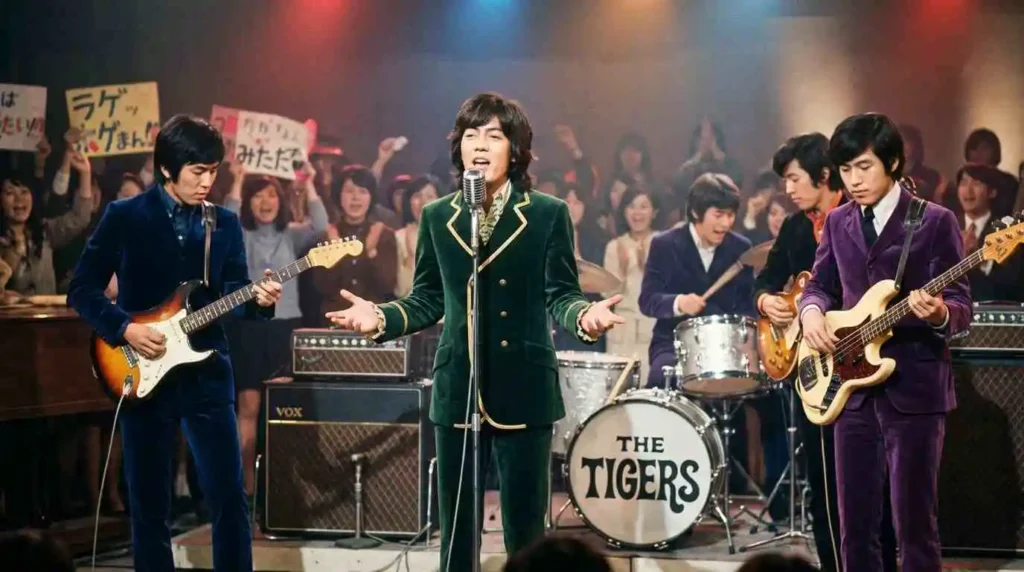
Since his debut in the late 1960s as the lead vocalist of the legendary Group Sounds band, The Tigers, he sparked a massive social phenomenon with his overwhelming star power. Even after transitioning to a solo career, he continued to reign at the pinnacle of the music world with his sharp looks, flawless vocal ability, and cutting-edge self-production skills.
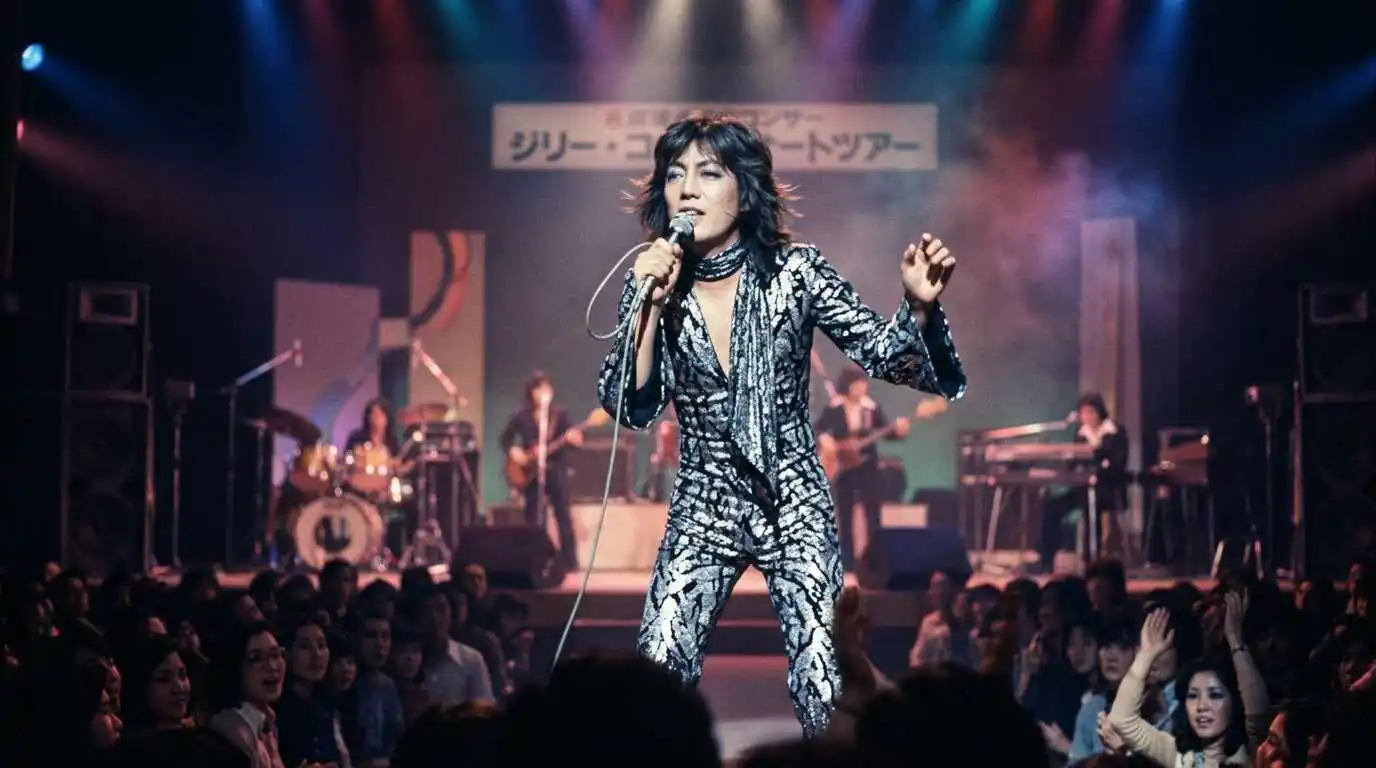
His avant-garde visual strategies—incorporating glittery lamé costumes, makeup, and even performing while wearing a parachute—sent shockwaves through households at the time. Going far beyond the definition of a mere “popular singer,” he can be described as an artist who completely reshaped the aesthetic standards of post-war Japanese mass culture.
Released on August 21, 1975, his 14th single is the very song we are spotlighting today: “Toki no Sugiyuku Mama ni” (As Time Goes By).
Upon its release, the track generated an explosive response, achieving the remarkable feat of staying at number one on the Oricon Weekly Chart for five consecutive weeks. With final cumulative sales reaching approximately 920,000 copies, it became the biggest commercial success of his career, cementing itself as his signature masterpiece among his numerous hits.
Winning the Broadcast Music Award at the 6th Japan Kayo Awards that same year, the track truly became an anthem representing the musical landscape of 1975.
English Translation (Interpretation)
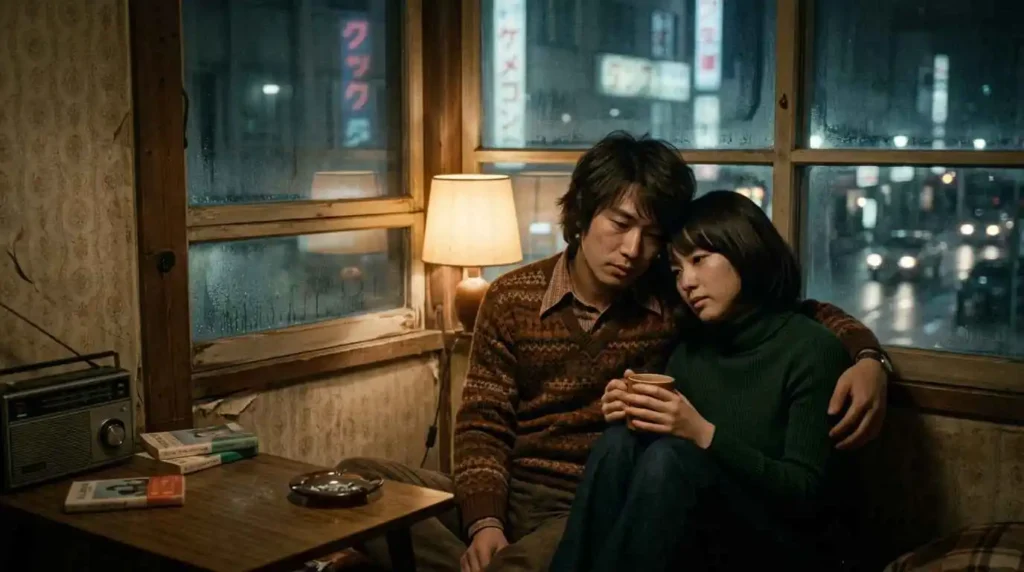
You look so completely exhausted.
Just for tonight, you can lock away those old wounds and faded songs deep within your heart.
You don't need to blame yourself anymore for the hours you spent crying alone.
Without fighting the flow of time, let us just hold each other close.
If we can still find love, even the view outside the window should start looking a little different.
💡 You Might Also Like: Click here for the official original Japanese lyrics (Opens in an external site)
If the lyrics are displayed only in Japanese, you can use your browser’s translation feature or an AI translation tool to understand the general meaning.
First, Please Watch the YouTube Videos
Common Credits
Kenji Sawada - "Toki no Sugiyuku Mama ni"
Lyrics: Yu Aku
Composition & Arrangement: Katsuo Ono
Original Release: August 21, 1975
Label: Polydor Records
Featured Work: Insert song for the TBS drama "Akuma no Yō na Aitsu" (That Fellow Like a Devil)
Vocal: Kenji Sawada

According to TBS Channel's program information, "Akuma no Yō na Aitsu" is a 17-episode TBS drama produced in 1975 starring Kenji Sawada, with "Toki no Sugiyuku Mama ni" officially credited as its insert song.
This video purely conveys the charm of the original studio recording.
Yu Aku’s decadent lyrics, Katsuo Ono’s shadow-laden melody, and Kenji Sawada’s mesmerizing vocals directly deliver the core essence of this masterpiece.
Commentary
Description note: 1975.8.21
With "stage mix" in the title, this appears to be a fan-edited compilation video blending multiple live stage clips and audio sources.
It offers a wonderful way to experience the 1975 release with the authentic atmosphere of a live performance.
Kenji Sawada's posture and the sheer magnetism of his expressions visually reinforce the dangerous beauty crafted by Yu Aku and Katsuo Ono.
Commentary
This video seems to be a custom cover mix that emphasizes the electric bass, using audio from the 2008 "Ningen Julie Matsuri" (Human Julie Festival) live concert.
The heavy, pulsing low-end adds a distinct layer to the original track's decadent beauty, allowing listeners to appreciate the profound depth of Sawada's later-year vocals from a fresh perspective.
When I First Heard This Song
| My Age | Elementary | Junior High | High School | University | 20s | 30s | 40s | 50s | 60s~ |
| Release Year | 1975 | ||||||||
| When I Heard It | ● |
I first heard this song in real-time when it was originally released in 1975. It was the golden age of music variety shows on television. Turn on the TV, and it was virtually impossible to go a day without seeing Julie (Kenji Sawada).
At the time, I was a sophomore in high school. To be perfectly honest, I had no way of understanding the helpless, heavy romantic relationships of adults depicted in the lyrics.
The Magic of a “Minor Ballad” That Hooked a Youth
Even so, this song held an intense attraction for me. Above all, that sorrowful, sinking melody composed by Katsuo Ono struck a chord deep inside me without needing any logical explanation.
I have always had a soft spot for ballads. The sheer beauty of that musical progression resonated fully with my teenage sensibilities even back then.
Humming Lines in a Search for Maturity
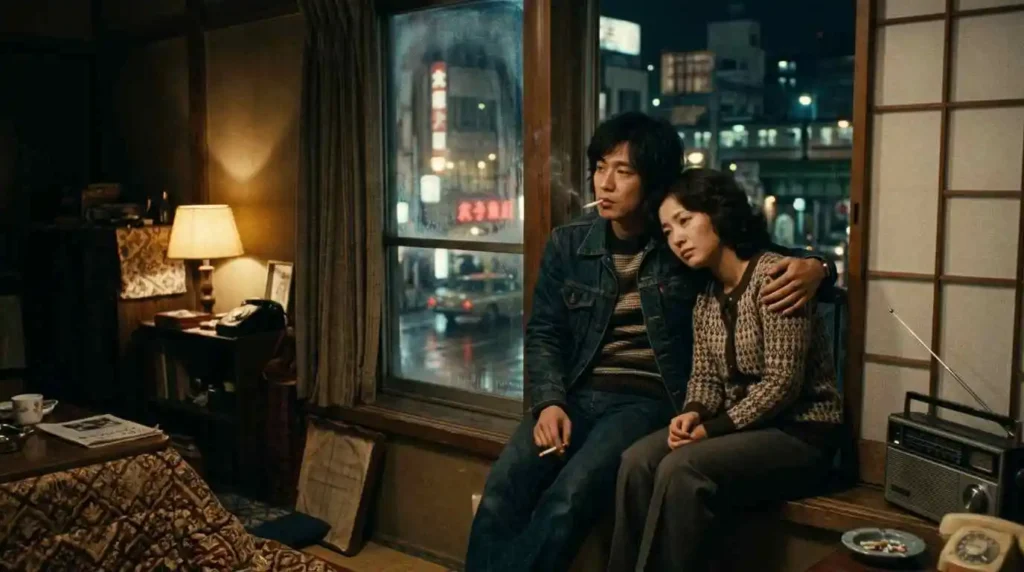
While I couldn’t fully digest the deep weight of the words, I interpreted them in my own way, immersing myself in that worldview as if attempting to stretch into adulthood.
“Karada no kizu nara naoseru keredo, kokoro no itade wa iyase waしない…” (Physical wounds can be healed, but the heart’s damage can never be mended…)
I remember humming those heavy lines, mimicking the emotion behind them. Moving past the boundaries of a simple pop hit, it remains a uniquely special track etched into the depths of my mind.
The World Depicted in “Toki no Sugiyuku Mama ni”: Analysis (Part 1)
The Atmosphere of “Decadence” Demanded by the Era of 1975
The Mid-70s: When a Turbulent Season Came to an End
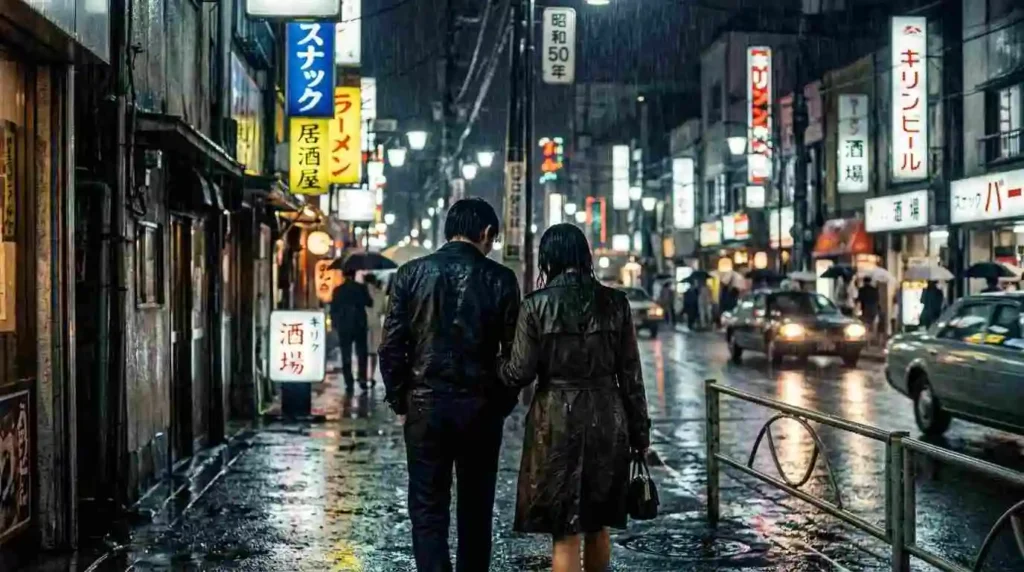
The year 1975, when this song was released to the public, was a time when Japan’s social climate and public psyche were undergoing a major shift. The fiery passions of the student movements from the late 1960s and early 1970s had rapidly cooled down, leaving a sense of powerlessness and disillusionment among the youth.
It was an era where people, despite acquiring material wealth through rapid economic growth, were losing their spiritual anchors, quietly harboring loneliness in the corners of urban landscapes.
The Statute of Limitations on the 300-Million-Yen Robbery and the Drama Tie-in
Furthermore, this specific year marked the looming 7-year statute of limitations for the “300-Million-Yen Robbery,” the greatest unsolved mystery in Japanese criminal history. The TBS television drama “Akuma no Yō na Aitsu,” starring Kenji Sawada himself, was explicitly built around this infamous heist.

The story followed the anxiety of a criminal facing the imminent expiration of his time, alongside the destructive elopement of a man and a woman. The dark, perilous tone of the show combined with the sinking minor-key resonance of the song to produce a flawless artistic synergy.
Kenji Sawada as an Unparalleled Performer
From Group Sounds Idol to Solo Titan
Ever since his days drawing hysterical screams from teenage girls as “Julie” of The Tigers, his presence was undeniable. However, as his solo career matured, his expressive capabilities took on a far deeper shade of nuance.
As if refusing to be consumed as a mere glittering idol, he carved out a vocal style that combined the mature sensuality of a grown man with a delicate, fragile vulnerability.
Visual Shock: Elevating Pop Music into “Theater”
His greatest asset lay in making a song not just something to “listen to,” but a complete theatrical act, calculated down to the costumes, his gaze, and the subtle movements of his fingers.
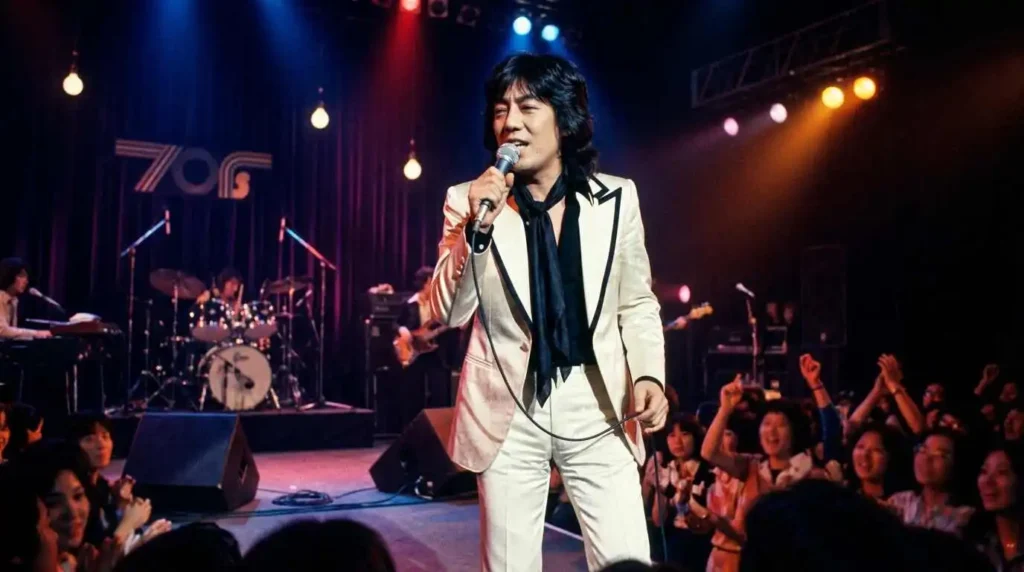
His stance while performing “Toki no Sugiyuku Mama ni”—holding the microphone with a listless, downcast gaze—gave audiences the illusion of watching a scene straight out of a cinematic film.
This pioneering edge in self-production transformed him from a basic vocalist into a definitive mirror reflecting the spirit of the age.
Yu Aku’s Pen Carving Out Human Nature
The “Broken Piano” as a Symbol of Past Trauma
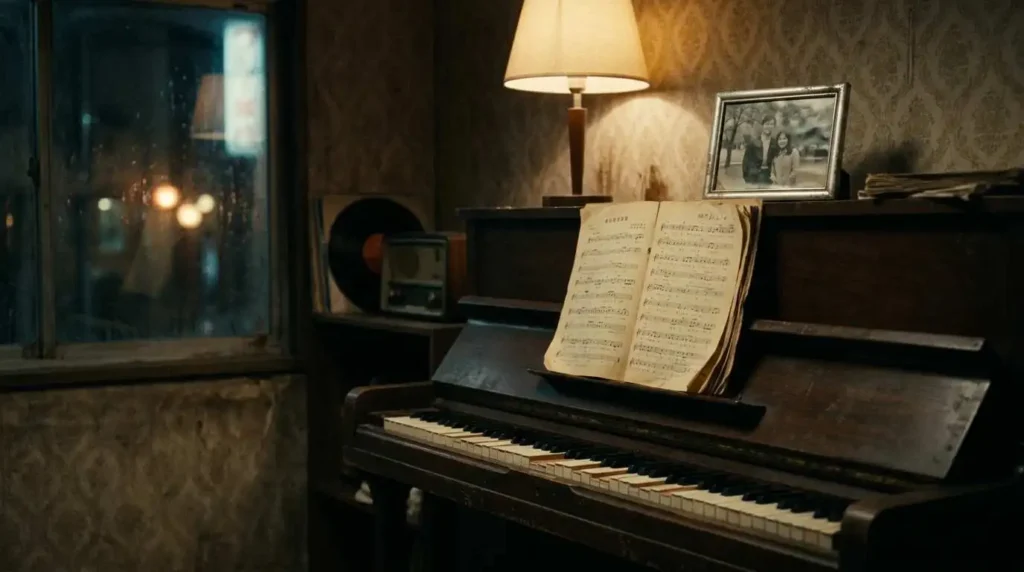
Lyricist Yu Aku was a masterful hitmaker who captured theatrical situations across countless classic tracks. The phrase “broken piano” introduced at the beginning of the song does much more than set a background scene.
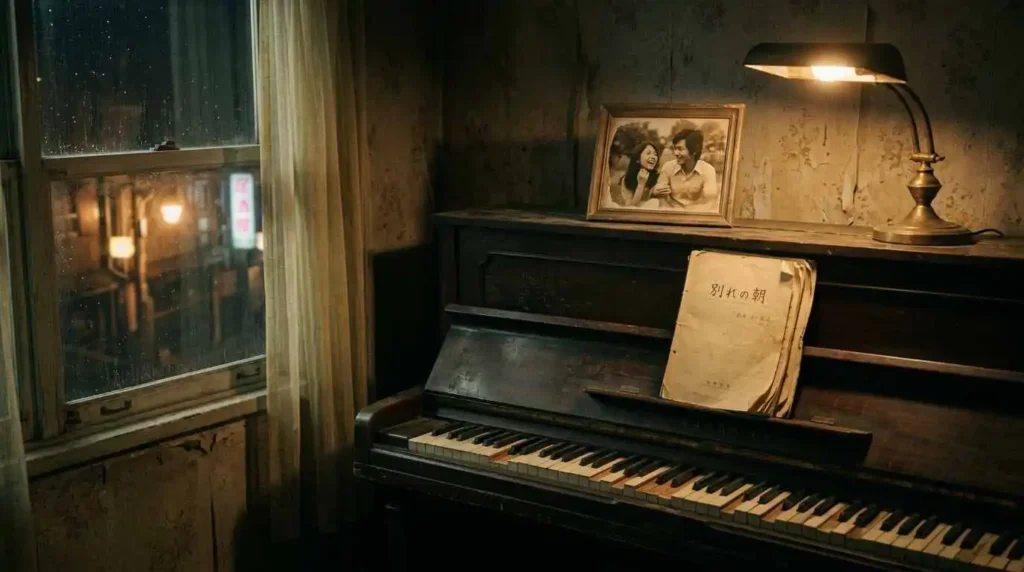
Like an instrument that has lost its tuning, it physically symbolizes the broken relationship of two people who have fallen off the rails of conventional society, capturing the irreparable wounds engraved upon their hearts.
The Real Weight Found in a “Ring”
The lyrics include a vivid image of a character staring at a ring digging into her pinky finger. This serves as a token of a past life tied to someone else, while simultaneously making the woman’s current anguish under inescapable reality visible and raw.
By casting aside cheap romantic clichés and placing specific, tangible items within the narrative, Yu Aku succeeded in projecting sharp cinematic contrasts directly into the listener’s mind.
The Structural Beauty of Katsuo Ono’s Melody
The Magic of Minor Chords Accenting Shadows
The compositional work by Katsuo Ono is equally brilliant. While Ono would later achieve widespread fame for composing iconic themes like “Detective Conan,” here he meticulously built a short-form minor melody saturated with sorrow.
The progression as it transitions from the verse to the chorus sinks gradually into the emotional depths, drawing the listener into an inescapable narrative web.

Heavy Backing by the Inoue Takayuki Band
Supporting Kenji Sawada’s musical vision during this landmark era was one of Japan’s premier rock ensembles, the Inoue Takayuki Band. Though operating within the mainstream pop genre, their accompaniment carried the robust dynamics of pure rock. The delicate phrasing of the electric guitar and the steady, heavy pulse of the bassline gave solid grounding to the vocals, lifting the track from a standard pop tune into an enduring work of art.
The World Depicted in “Toki no Sugiyuku Mama ni”: Analysis (Part 2)
The Drama and Masculine Resolve Hidden in the Lyrics
Pure Love Found Amidst Decadence
The prose spun by Yu Aku is by no means a fairy tale. It documents the desperate reality of a man and a woman living hidden existences at the bottom margins of society.
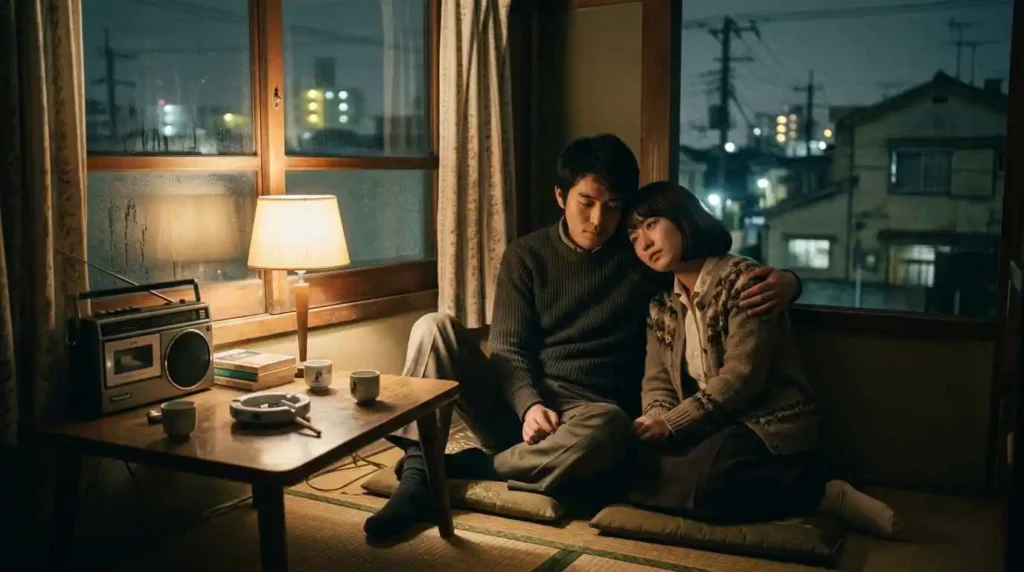
The phrase “Ochite yuku no mo shiawase dayo to” (Even falling to ruin is happiness) feels like a countdown to destruction. Yet, beneath that surface lies a form of ultimate devotions—an absolute commitment to love a single partner even if it means discarding the rest of the world.
Warmth Shared Between Cold Bodies
The line “Futari tsumetai karada awaseru” (Two cold bodies pressing together) is equally striking. Cut off from material luxuries or societal blessings, their physical warmth becomes their solitary salvation, a reality laid bare in this brief lyric.
Its Position in the Shōwa Music Movement
A Masterful Fusion of Pop and Rock
The mid-1970s was a transitional window where Japanese folk and rock music were evolving into what would be known as New Music. Within this climate, this track stood as a pioneering work that injected a rock sensibility straight into a traditional pop framework.
The tight instrumentation of the Inoue Takayuki Band and the sophisticated melodies of Katsuo Ono intersected perfectly with Kenji Sawada’s performance, producing a timeless recording that went far beyond basic pop entertainment.
A Future Where the Window’s View Changes
A Ray of Light at the End of Despair
As the song moves toward its finale, the music repeats its melancholy refrain. However, the lyrical conclusion refuses to settle entirely into hopelessness.
“Moshimo futari ga aeseru naraba, mado no keshiki mo kawatte yuku darō” (If the two of us can keep loving each other, the scenery outside the window will surely change)
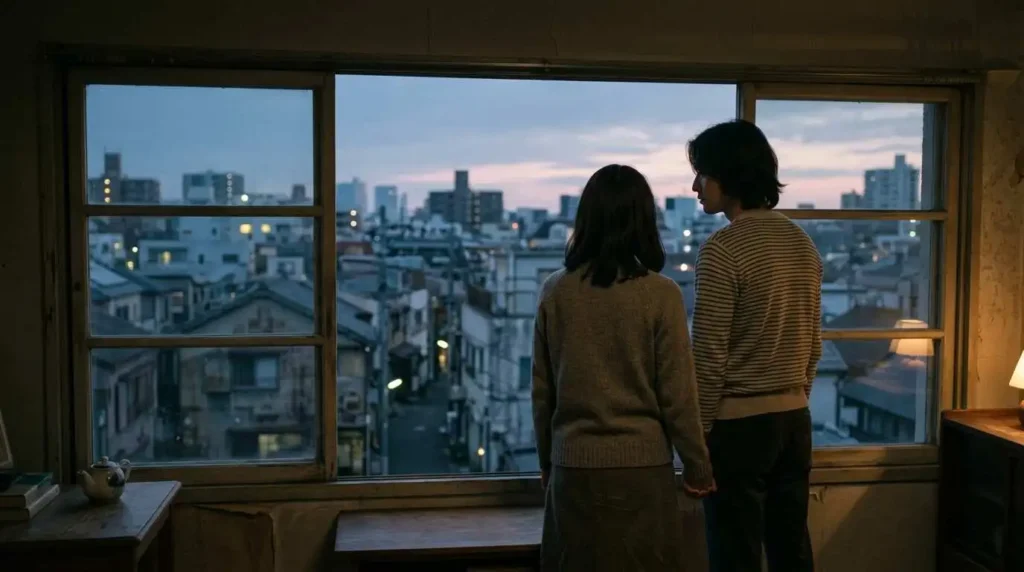
These words offer a slender beacon of hope within a harsh reality. While choosing to yield to the relentless flow of time, they convey a quiet resolve to transform the colors of the future through the power of human connection.
The Enduring Vitality of a Classic Masterpiece
The image of a man and a woman holding their breath in a quiet corner of the city feels entirely modern, showing no signs of aging even after half a century. Every time that opening note hits our ears, the sharp nostalgia and the raw memories of youth are instantly reawakened, proof that Julie’s vocal delivery struck squarely at the timeless core of human emotion.


音楽ファン同士の交流・リクエストはこちら / Connect & Request Songs Here