
- 🎧 Enjoy This Article in Audio
- [June 3rd] Celebrating Suzi Quatro’s Birthday—The Primal Rock Impulses of “Can the Can”
- First, Check Out the Official YouTube Music Video!
- The Primal Sonic Architecture of “Can the Can”
- “Can the Can”? The Unprecedented Wordplay Hidden in the Title
- The Early 1970s Paradigm Shift and the Glam Rock Frenzy
- In Conclusion: The Monumental Legacy She Left Behind
🎧 Enjoy This Article in Audio
You can quickly grasp the main points of this article through narration.
Recommended for those who want to catch the vibe of the music and the flow of the article before reading.
🎶 English Narration
An English audio introduction to the contents of this article.
⌛ Duration: Approx. 2 mins 30 secs
🎵 Japanese Narration
A Japanese audio introduction to the contents of this article.
⌛ Duration: Approx. 2 mins 30 secs
* Listening to the audio before reading helps you better understand the world of the music and the main points of the article.
[June 3rd] Celebrating Suzi Quatro’s Birthday—The Primal Rock Impulses of “Can the Can”
June 3, 1950, in Detroit, Michigan. A girl who would later send shockwaves through the global rock scene was born—Suzi Quatro. Radiating an explosive energy that defied her petite frame of just over 150 centimeters, she was the absolute embodiment of rock and roll.
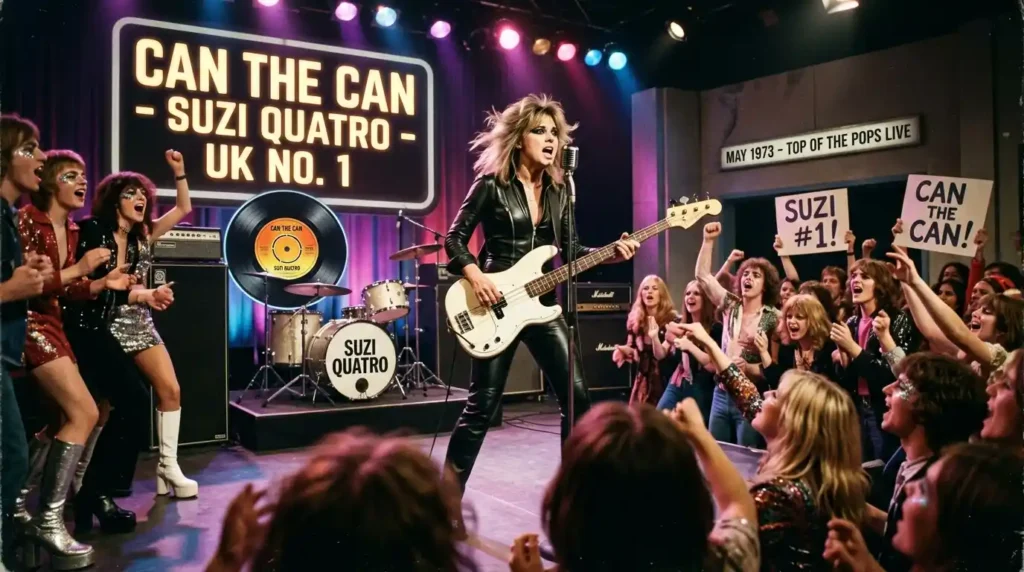
Her definitive and legendary single “Can the Can” was released in May 1973. In a UK music scene then dominated by the raging storm of glam rock, this track tore up the charts at breakneck speed to capture the UK number one spot.
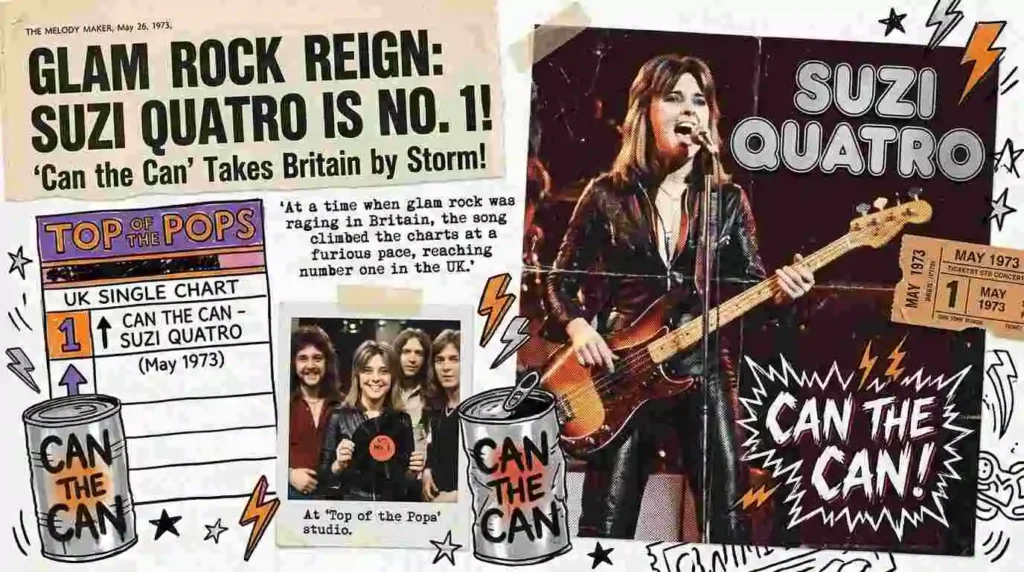
The heatwave crossed oceans to strike Australia and Japan, triggering a worldwide “Quatro-mania.” In Japan specifically, it held an absolute monopoly at the top of the foreign music charts.
In a male-dominated hard rock universe, her arrival—clad in a black leather jumpsuit, slinging a Precision Bass that looked larger than herself—was nothing short of a Copernican revolution in music history.
Lyrical Interpretation
Your man is an eagle flying high, but you're surrounded by alley cats showing their claws.
If you drop your guard, those girls will steal him away in a flash.
So don't just stand there watching; go out and hunt your man down right now.
While you still can, lock him down and make him yours entirely—just like stamping a lid on a can.
First, Check Out the Official YouTube Music Video!
Credits
Suzi Quatro - "Can the Can" Official Music Video
Written, Composed & Produced by Mike Chapman and Nicky Chinn
Artist: Suzi Quatro
Original Release: 1973, RAK Records
Two-Line Commentary
"Can the Can" is a quintessential 1970s glam rock masterpiece showcasing Suzi Quatro's heavy bass playing and fierce vocals. This official video captures the visual aura that redefined the archetype of female front-runners in rock.
Credits
Suzi Quatro - "Can the Can (Live)" Official Audio
From the Album: "Live and Kickin’"
Artist: Suzi Quatro
Copyright: ℗ Chrysalis Records Limited
Release Date: January 1, 1977
Provided by: Reservoir Media Management, Inc.
Two-Line Commentary
This live rendition of "Can the Can" unleashes a raw band energy that surpasses the studio version.
Suzi's dual command of the bass guitar and lead vocals takes absolute center stage.
When I First Heard This Track… ♫
| My Age | Elementary School | Junior High | High School | University | 20s | 30s | 40s | 50s | 60s+ |
| Track Release | 1973 | ||||||||
| When I Listened | ● |
I encountered the lightning bolt of “Can the Can” when I was a ninth-grader, shortly after its release. I still vividly recall the icy shiver running down my spine the exact moment that ferocious twin-drum intro burst from the late-night radio broadcast.
Cutting through the midnight silence came a scream so piercing and heavy it was hard to believe it belonged to a woman. It was backed by a subterranean, rib-rattling bass line that served as a masterclass for hard rock.
Seeing her in magazine pin-ups and TV features made her look like a warrior sent from the future. In 1973, rock was still widely considered a sacred masculine sanctuary where men sweated and roared. Yet Suzi kicked the doors off that sanctuary, reigning supreme with unmatched wildness and beauty. In that singular moment, the benchmark for what made a woman “cool” was completely rewritten for my generation.
The Primal Sonic Architecture of “Can the Can”
The Earth-Shaking Might of Twin Drums
The defining element that transforms “Can the Can” into an unparalleled rock anthem is its aggressive sonic layout. Right from the opening note, a heavy-gauge twin-drum assault hits your eardrums, channeling a relentless tribal jungle beat.
As a direct countermeasure to the over-polished pop and highly complex arrangements of progressive rock rising at the time, this track completely strips away delicate ornamentation.
Instead, it relies entirely on the driving bass line Suzi hammers out with her bare fingertips, locked with the razor-sharp metallic bite of a Fender guitar riff. The melody remains strictly linear, minimizing structural peaks. Much like ancient warriors beating war drums, the track relies on a hypnotic, heavy rhythmic loop to shake the listener’s core instincts awake.

The Calculated Tension and Release and the Climax
The song’s genius is highlighted by the dramatic break engineered into its midsection. Where generic hard rock bands would simply bulldoze forward with a wall of sound, the brilliant songwriting duo Chinn and Chapman laid a precise acoustic trap. The entire instrumental section cuts out concurrently, leaving nothing but a dry handclap rhythm ticking away.
During this sudden, breathless drop in volume, Suzi’s raspy vocal delivery builds up pressure like boiling magma waiting to explode.
Landing right on the money, her fierce scream unleashes the signature hook line: “Can the Can!” Instantly, the floodgates collapse, and the full instrumental force crashes back into a roaring sonic torrent. This meticulous contrast of dynamics maximizes the speed and sheer impact of the composition.
“Can the Can”? The Unprecedented Wordplay Hidden in the Title
Breaking the Traditional Feminine Mold via Lyrics
The true essence of this track rests within its peculiar title and the predatory lyrical perspective driving it.
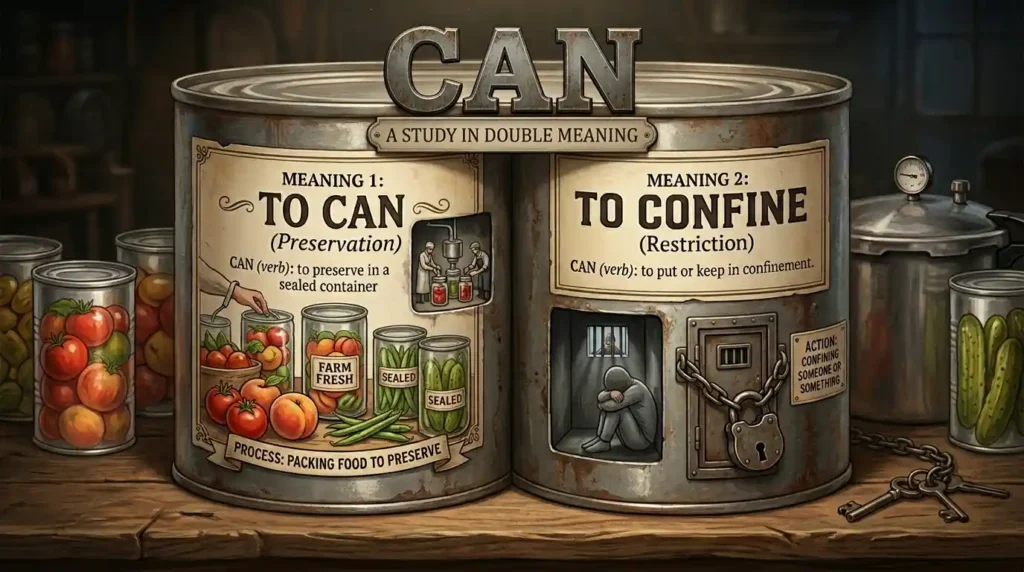
Hearing the phrase “Can the Can” for the first time, anyone would instinctively default to the auxiliary verb meaning “to be able to.” It is only natural to expect a meaning along the lines of ‘doing what is possible,’ making a literal interpretation of “putting a can inside a can” seem entirely bizarre and convoluted to foreign ears.
In truth, this title was a meticulously calculated “triple meaning” wordplay devised by songwriter Mike Chapman, who later offered a fascinating explanation regarding its true origin.
In the English language, apart from the familiar auxiliary verb, “can” exists as a noun meaning a metal container, and a verb meaning to preserve in a tin or to lock away securely. He stacked these meanings together like a puzzle.
“The idea is that it’s an impossibility. You can’t physically take a can and preserve it or pack it inside an identical can, right? By that extension, it’s impossible to take a reckless, unfaithful man who wants to run around wild and lock him up inside your own little container. It means ‘practically impossible.’ But the phonetic ring of the phrase was so incredibly powerful that I didn’t care if the average listener couldn’t crack the meaning immediately.”
Therefore, when Suzi screams “If you can, can the can,” she is declaring: “If you are able to (If you can), take that man (the can) and lock him away tight (can)!” It was a commanding, predatory ultimatum.
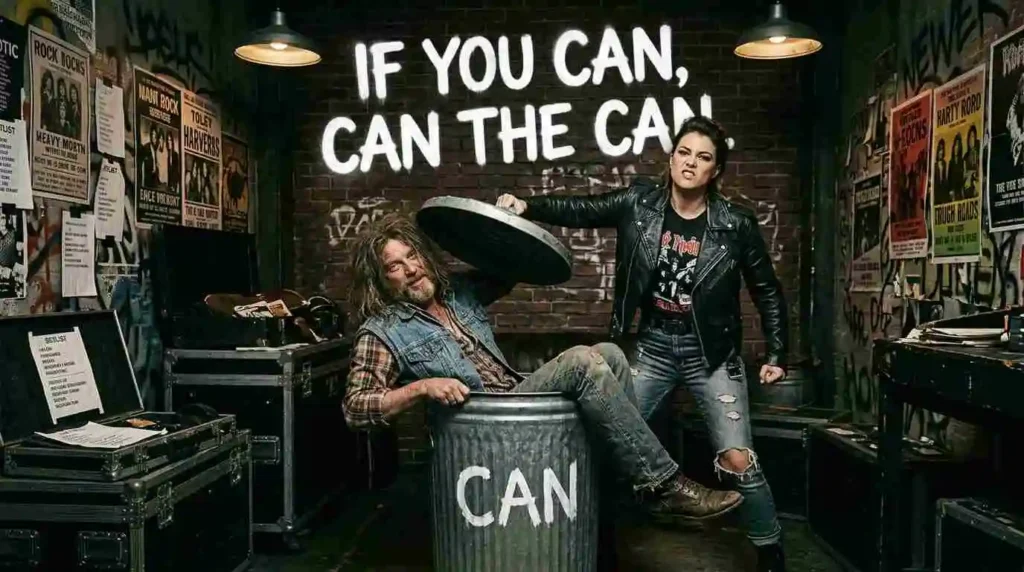
This point-of-view completely dismantled the traditional image of women weeping over lost loves, treating romance as an outright survival game of hunt-or-be-hunted. The blunt metaphor of locking down a lover delivered a rush of pure adrenaline to young listeners—much like snapping open a shaken soda can. (Back then, we roared along without knowing the deep etymology, but the visceral thrill was absolutely undeniable!)
Suzi Rearing as the Ultimate Apex Predator
Roaring through the industry jungle armed with a bass guitar, Suzi Quatro completely shattered the prevailing gender archetypes of the era.
She rejected the notion of playing vulnerable to win sympathy, opting instead to hunt down her prizes and hold them with an unyielding grip. This raw, uncompromised, and finely sharpened attitude elevated the track from a simple novelty hit into a historic liberation fanfare for women in rock.
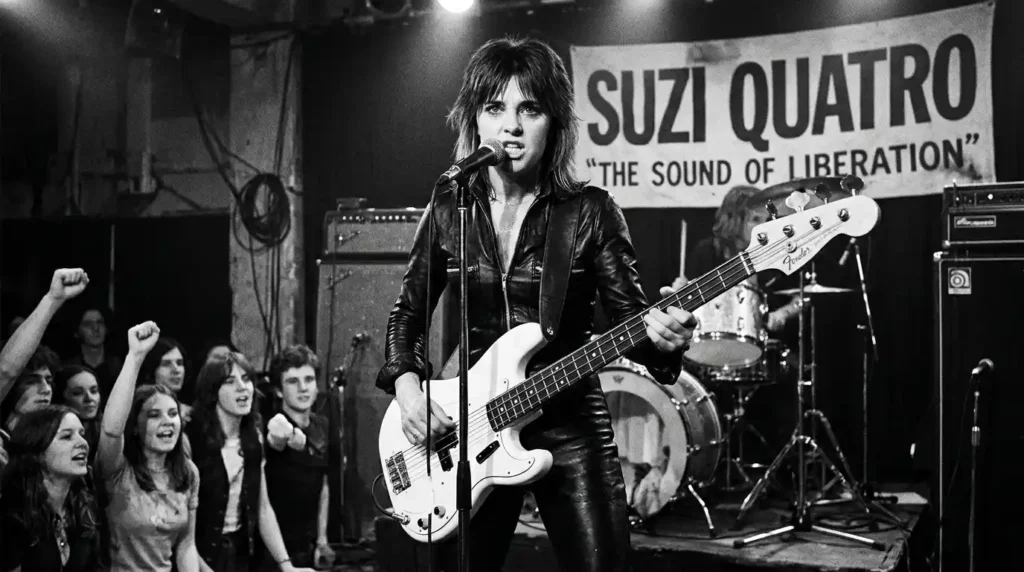
Suzi’s absolute refusal to coddle her audience or compromise her rock roots is the definitive reason why this driving rhythm refuses to age, continuing to boil our blood more than half a century down the line.
The Early 1970s Paradigm Shift and the Glam Rock Frenzy
The Massive Shift from Ideology to Visual Domination
The global dominance of “Can the Can” in 1973 coincided with a massive paradigm shift turning the UK, US, and Japanese music scenes completely upside down.
Across the British Isles, the glam rock phenomenon was hitting its zenith, spearheaded by Marc Bolan of T. Rex, David Bowie, Slade, and Sweet.
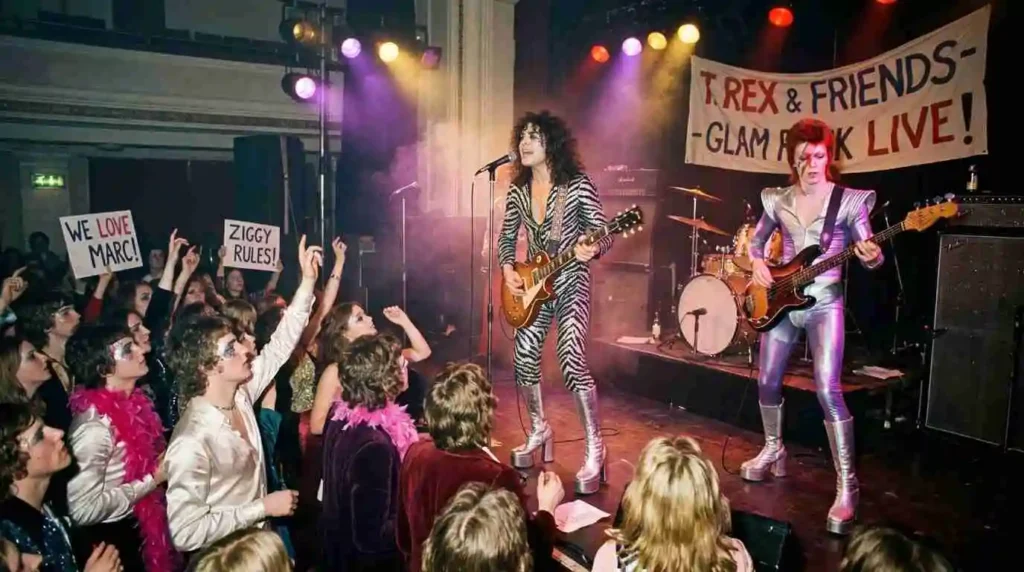
This movement operated as a direct counterforce against the politically heavy, conceptually dense, and overly serious rock that ruled the late 1960s.
Embracing glitter, satin, heavy makeup, and gender-bending allure, rock broke free from its rigid intellectual obligations, returning to its true form as an explicit visual spectacle and pure escapism. In the middle of this transformation, Suzi’s arrival—a diminutive woman delivering a heavy rock beat—became the ultimate exclamation point of the glam era.
Japan’s “Quatro Shock” and the Bold Media Campaigns
Meanwhile, Japan was undergoing its own cultural shake-up in 1973. The domestic pop landscape saw the historic debut of the legendary “Class of ’58” trio—Momoe Yamaguchi, Junko Sakurada, and Masako Mori—who happen to be the exact same age as me. The folk universe simultaneously witnessed Yosui Inoue releasing his monumental album “Ice World” (I am currently running a countdown feature for Yosui’s top 30 tracks on this blog!).

Just as Japanese domestic music was hitting its stride, youth hungry for raw international alternative culture were blindsided by the force of Suzi Quatro.
Japanese record labels capitalized on her image by giving her debut album the sensationalized localized title “The Queen of Sadistic Rock.”
They relentlessly pushed her leather-clad look through mainstream magazines, treating subsequent singles like “48 Crash” as an entirely dangerous, boundary-pushing variation of hard rock.
The marketing blueprint paid off massively, sending her wild persona viral across the country. Yet, what kept Japanese music fans fiercely loyal wasn’t just the provocative visual framing; it was the undeniable musical weight anchoring it.
Her exposed, heavy low-end bass was the antithesis of the polite pop dominating local airwaves. Absorbed directly through late-night radio, it sparked an unprecedented Quatro craze that defined an entire generation of music lovers.
In Conclusion: The Monumental Legacy She Left Behind
More than fifty years down the road, the primal, untamed lightning captured in “Can the Can” remains entirely unclouded. By blazing a trail in her black leather jumpsuit, she laid the foundation for Joan Jett, The Runaways, and the explosion of female-fronted rock outfits that defined the 1980s and beyond.
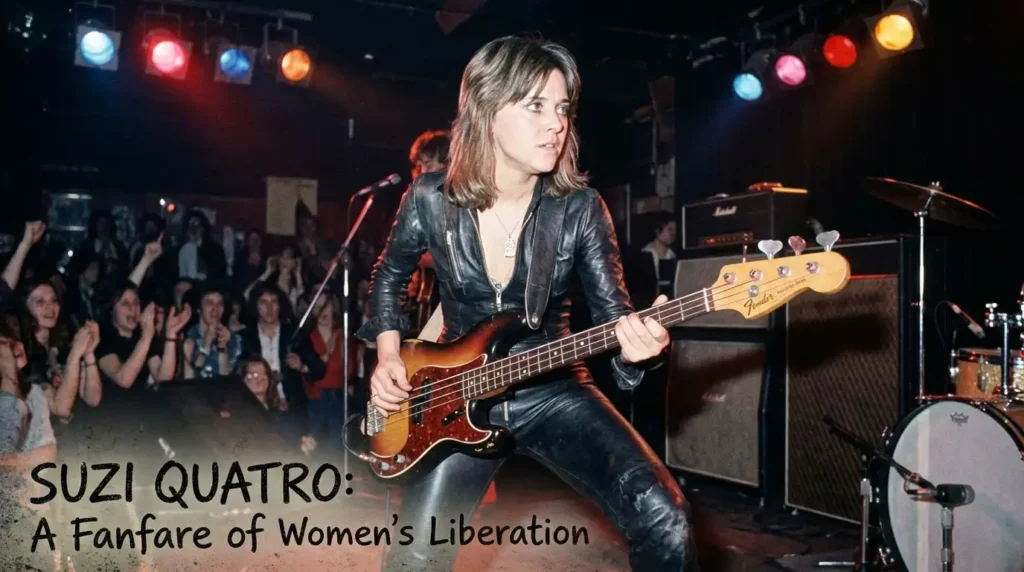
Whenever the routine of modern life leaves you feeling boxed in, dropping the needle on this track’s ferocious twin-drum pulse and letting Suzi’s vicious shout fill the room is the ultimate remedy to reawaken your dormant musical instincts. To celebrate her birthday, I’ll be turning the volume up to ten tonight and immersing myself in that glorious wall of sound once again.


音楽ファン同士の交流・リクエストはこちら / Connect & Request Songs Here