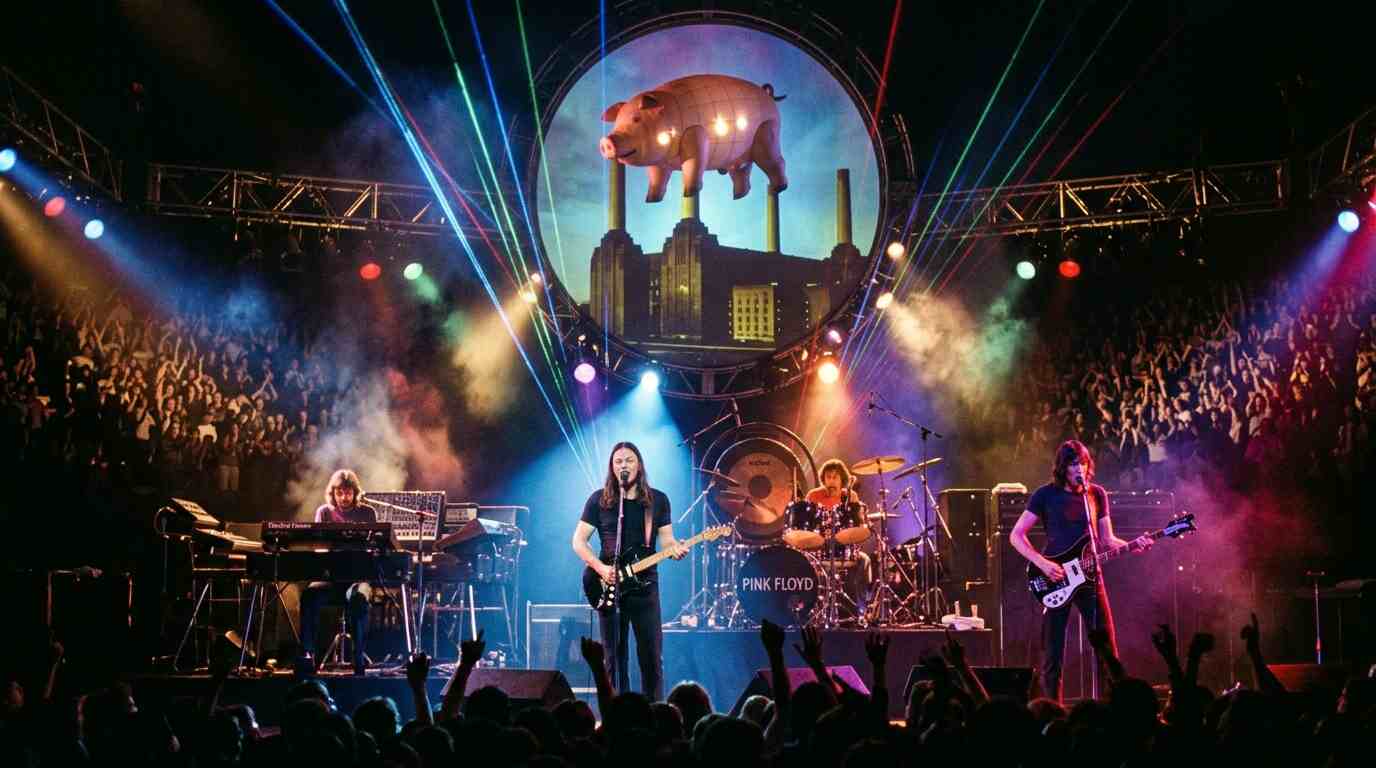
- 🎧 Listen to This Article
- Today Is Richard Wright’s Birthday
- First, Listen to the Official Audio on YouTube
- When I First Heard This Song
- The Path That Led to “Us and Them”
- A Musical World Created by Stillness and Force
- Conflict and Social Division in the Lyrics
- Its Role Within The Dark Side of the Moon
- The Pink Floyd Sound Created by Richard Wright
- In Closing
🎧 Listen to This Article
Explore the key points of this article through a short narration.
Recommended for listeners who want to understand the atmosphere of “Us and Them” and the overall direction of the article before reading.
🎵 English Narration
An English audio introduction to the content of this article.
🎶 Japanese Narration
A Japanese audio introduction to the content of this article.
Listening first will make it easier to understand the world of “Us and Them” and the main points of the article.
Today Is Richard Wright’s Birthday
July 28 is the birthday of Richard Wright, a founding member of Pink Floyd who developed a distinctive musical identity as a keyboardist, composer, and singer. Today, I would like to introduce “Us and Them,” composed by Wright.
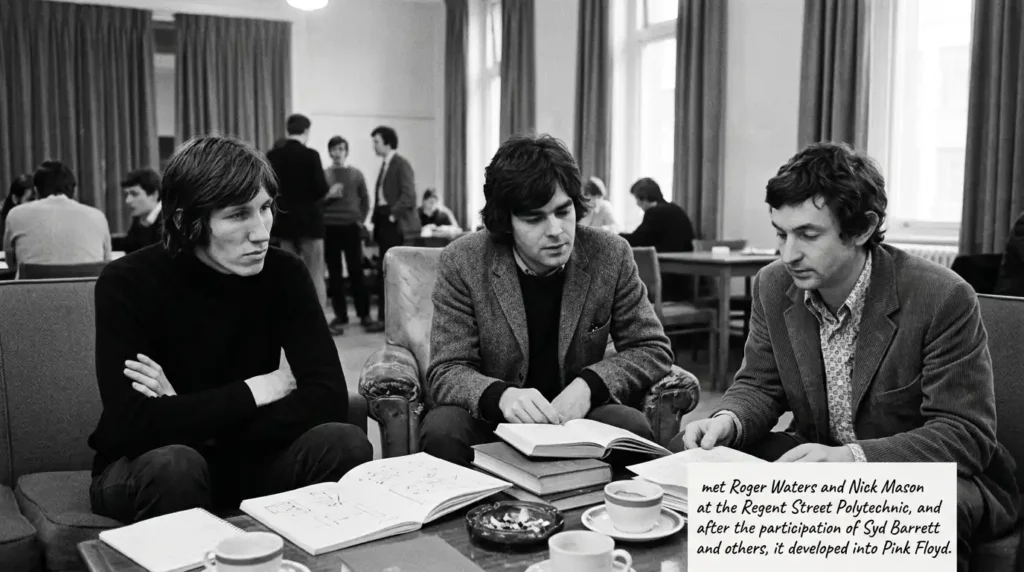
Richard William Wright was born on July 28, 1943, in Hatch End, then part of Middlesex, England. He studied architecture at Regent Street Polytechnic, where he met Roger Waters and Nick Mason.
The three played together in several student bands, which eventually developed into Pink Floyd after Syd Barrett and other musicians joined them. Wright used piano, organ, Mellotron, and synthesizers to shape the band’s sound, from its early psychedelic period to its ambitious works of the 1970s.
Wright was not as conspicuous as David Gilmour’s guitar or Roger Waters’s lyrics. Yet songs such as “Echoes,” “The Great Gig in the Sky,” and “Shine On You Crazy Diamond” reveal how decisively his harmonies shaped Pink Floyd’s musical identity.
His jazz- and classical-influenced chords, gentle singing voice, and ability to place each instrument effectively are all clearly present in “Us and Them.” Wright died on September 15, 2008, at the age of 65, but the sounds he created continue to be heard throughout the world.
Interpretive Translation
We are divided into allies and enemies, although both sides are made up of ordinary people.
Those in the rear move lines across a map and give orders, while those sent to the front lose their lives.
Differences in words become violence, until no one can remember who was supposed to be right.
Meanwhile, life in the city continues, leaving those who collapse in poverty behind.
First, Listen to the Official Audio on YouTube
Credits
Title: Us and Them
Artist: Pink Floyd
Music: Richard Wright
Lyrics: Roger Waters
Lead vocals: David Gilmour
Original album: The Dark Side of the Moon (1973)
Audio: 2023 Remaster
Official channel: Pink Floyd
Two-Line Commentary
This song places the psychology that divides people into allies and enemies, and the distance between those who issue orders and those who become their victims, within a beautiful melody.
Richard Wright’s delicate harmonies and Dick Parry’s tenor saxophone deepen the sorrow and social questions contained in the lyrics.
When I First Heard This Song
| My Age | Elementary School | Junior High | High School | University | 20s | 30s | 40s | 50s | 60 and Over |
| Release Year | 1973 | ||||||||
| When I Heard It | ● |
The first Pink Floyd song I ever heard was “Julia Dream.” I introduced that song in a birthday article last year.
After entering university, I listened to the album The Dark Side of the Moon and discovered “Us and Them.” Pink Floyd was not a band I listened to particularly deeply at the time.
Even so, the jazzy quality created by its gentle piano and saxophone stayed firmly in my memory. The way the quiet melody suddenly expands into a powerful surge of instruments and voices also possesses a distinctive elegance. It became a song whose title and sound never completely left me.
The Path That Led to “Us and Them”
An Unusual Single from The Dark Side of the Moon
“Us and Them” appeared on Pink Floyd’s eighth studio album, The Dark Side of the Moon, released in March 1973.
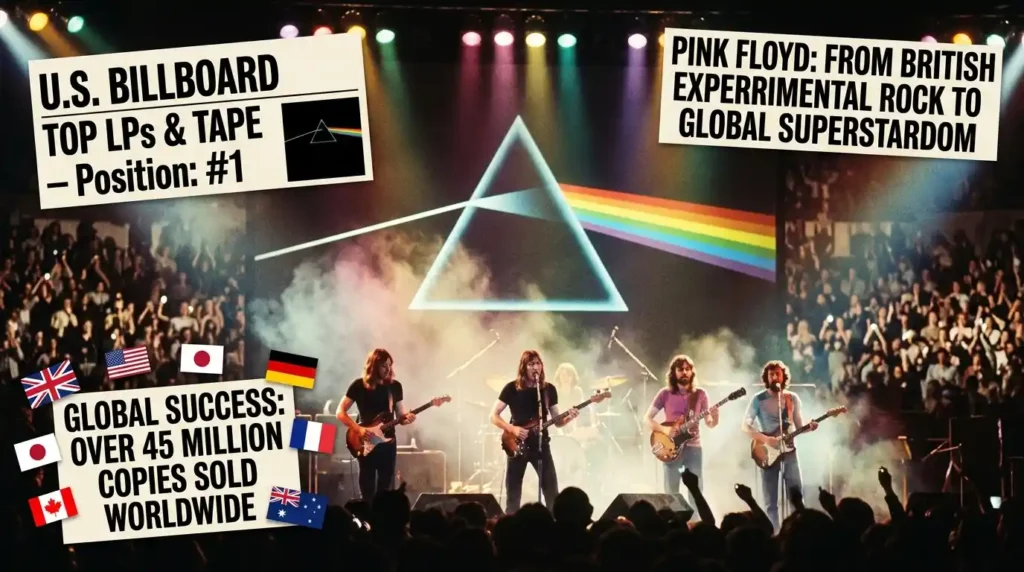
The Dark Side of the Moon reached No. 1 on the American album chart and became a worldwide success. Through this record, Pink Floyd developed from an experimental British rock band into an internationally popular act.
The album version lasts approximately seven minutes and forty-nine seconds, making it the longest track on The Dark Side of the Moon.
On February 4, 1974, an edited version lasting approximately three minutes and fifteen seconds was released as a single in the United States, paired with an edited version of “Time.” It reached No. 72 on the Cash Box Top 100.
The Revival of a Melody Rejected for a Film
The song originated in “The Violent Sequence,” an instrumental piece Richard Wright composed in 1969 for the film Zabriskie Point. It was a piano-led composition intended for a scene of unrest, but director Michelangelo Antonioni decided not to use it.
The melody was revived during the creation of The Dark Side of the Moon. Roger Waters wrote the lyrics, and the band rebuilt the arrangement, transforming it into “Us and Them,” a song about war, inequality, and group psychology.
A Musical World Created by Stillness and Force
Two Worlds Expressed Through Quietness and Volume
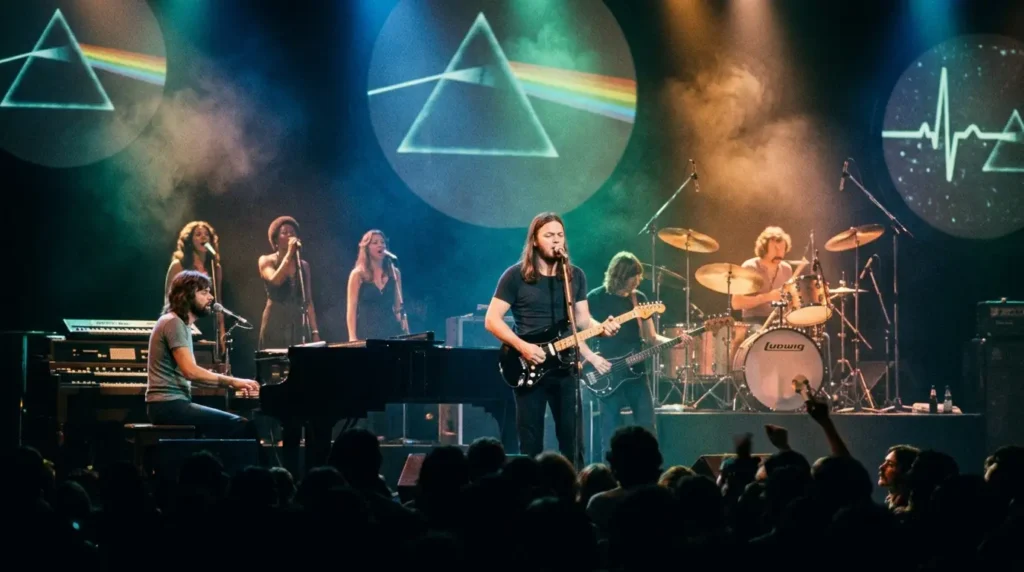
The song begins with a quiet introduction played on Hammond organ and piano. David Gilmour sings the contrasting words in a restrained voice before the drums, guitar, female backing singers, and Richard Wright’s harmony vocals combine in a sudden expansion of sound.
This contrast in volume suggests the distance between those who calmly decide military strategy from the rear and the soldiers who lose their lives carrying out those decisions. The subdued verses and powerful vocal sections turn the divide between command and destruction into sound.
The Unsettled Beauty of Jazz-Influenced Harmony
During the quieter verses, the bass remains largely fixed while the chords placed above it gradually change. The music never settles completely into either a bright major key or a dark minor key, allowing calmness and unease to exist together.
Dick Parry’s Tenor Saxophone
Dick Parry’s tenor saxophone links the melody with a restrained tone in the first half before developing into a powerful solo near the end. The combination of Wright’s complex harmony and Parry’s saxophone creates the jazzy quality that remained in my memory.
Conflict and Social Division in the Lyrics
What Separates “Us” from “Them”?
The title “Us and Them” refers to the division between “our side” and “their side.” The lyrics present a series of oppositions, including “me” and “you,” “up” and “down,” and “in” and “out.”
Yet the people on both sides are ultimately only ordinary men. They have families and experience the same fear and pain, but differences in nationality and uniform lead them to point weapons at one another.
Orders from the Rear and Death at the Front
The lyrics describe an order to advance being issued from behind the lines, followed by the death of those in the front rank. To a general, the lines on a map are symbols of military progress. Each time one of those lines moves, however, people on the ground are wounded or killed.
By placing these words within Wright’s beautiful melody, the song delivers its message not as an angry protest but as a controlled accusation. The pleasant sound and the severity of the reality being described create a powerful contrast.
When an Argument Turns into Violence
In the middle of the song, the lyrics suggest that the conflict was originally only a battle of words. In the spoken conversation that follows, a man minimizes the fact that he hit someone and justifies himself by claiming that the other person had behaved improperly.
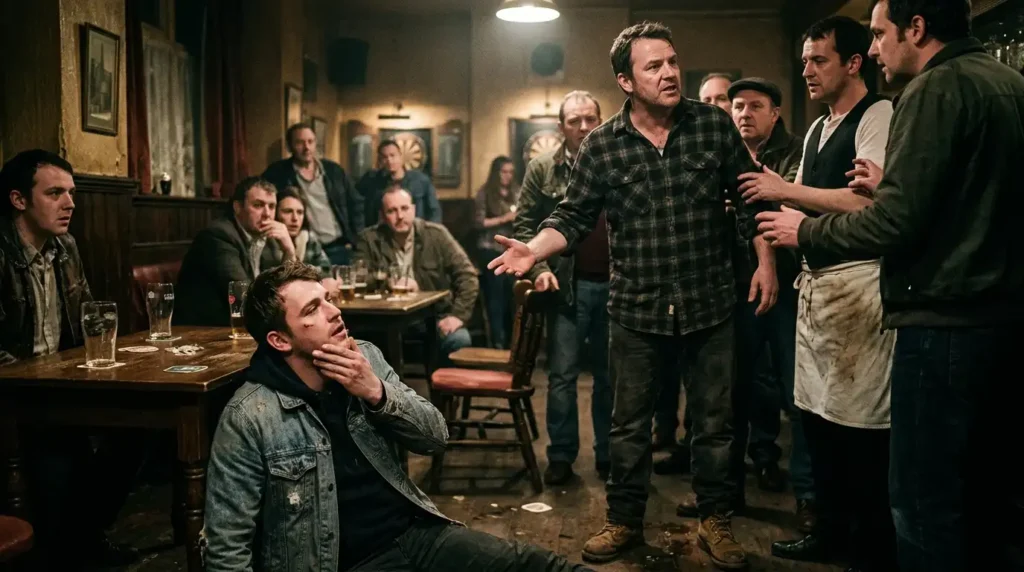
The song is not concerned only with war between nations. In everyday arguments, people also place themselves on the righteous side and transfer responsibility to their opponent. Although the scale is different, both situations depend on treating the other person as someone fundamentally separate.
The Double Meaning of “Black and Blue”
The phrase “black and blue” can describe a body covered in dark bruises after being struck. It is therefore possible to interpret the contrasting colours in the lyrics as the colours of injuries left by violence.
The following idea that no one knows which is which or who is who suggests that the distinction between the two sides has broken down. After both sides have harmed each other, the damage they share becomes clearer than the justice they originally claimed.
From the Battlefield to Poverty in the City
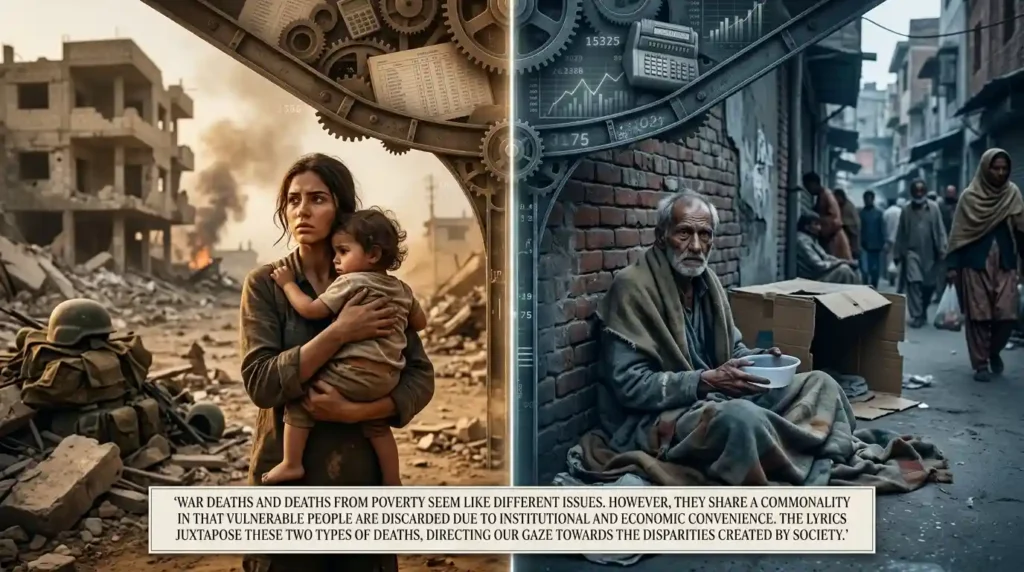
Near the end, the perspective shifts from the battlefield to everyday city life. While people hurry along the street, an old man dies because he cannot afford the price of tea and a slice of food.
Death in war and death caused by poverty may appear to be separate problems. Yet both involve vulnerable people being discarded by political, social, or economic systems. By placing these two deaths together, the lyrics direct attention toward inequality created by society.
Its Role Within The Dark Side of the Moon
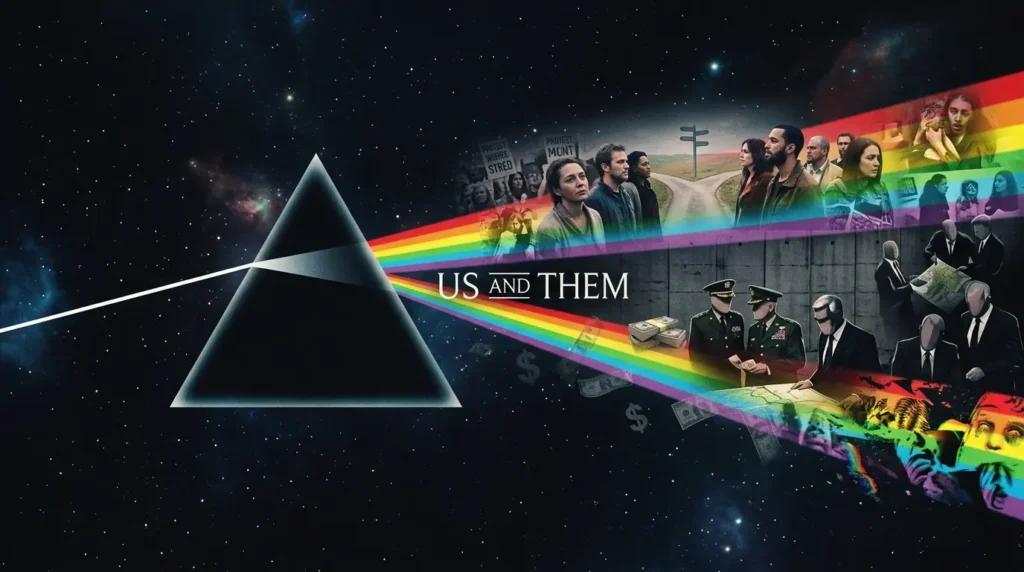
The Dark Side of the Moon examines pressures that can overwhelm human beings, including time, work, money, death, and mental collapse. The role of “Us and Them” is to address group conflict and social inequality.
The Theme of Division Emerging from “Money”
“Money,” the preceding track, focuses on greed and the desire for wealth. By placing “Us and Them” immediately after it, the album expands its subject from money itself to the division between those who possess wealth and those who do not.
Why the Official Video Ends So Abruptly
On the album, Dick Parry’s saxophone leads directly into “Any Colour You Like” without a break. For this reason, the final sound in the official video appears to be cut off suddenly. This is not a defect in the audio. It occurs because a continuous recording designed to flow into the next track has been divided at the end of “Us and Them.”
Although it is a highly accomplished song in its own right, its position becomes clearer when The Dark Side of the Moon is heard in full, as the album moves through money, division, choice, and mental collapse.
The Pink Floyd Sound Created by Richard Wright
Accounts of Pink Floyd’s history often focus on Syd Barrett’s departure or the conflict between Roger Waters and David Gilmour. Behind those dramatic events, Wright continued to create the harmonies that determined the character of the band’s music.
Serving the Song Without Taking Centre Stage
In “Us and Them,” Wright does not push his own playing to the front. Instead, he creates a structure in which Gilmour’s voice, Waters’s words, and Parry’s saxophone can be heard at their most effective. When Wright’s harmony vocals join Gilmour’s lead, an individual reflection becomes a question voiced by several people.
He strengthened the entire composition without attempting to dominate it. Without Wright, Pink Floyd might still have been a powerful and ambitious band, but it would not have possessed the same gentle and complex harmonic character.
In Closing
“Us and Them” is not simply an anti-war song. It examines the psychology that creates allies and enemies, the inequality between those who command and those who obey, violence in everyday life, and the gulf created by poverty.
Despite the weight of these subjects, the music never becomes preachy. The gentle keyboards, jazz-influenced harmony, and resonant saxophone capture the listener first. Only afterward does the severity of the lyrics become fully apparent.
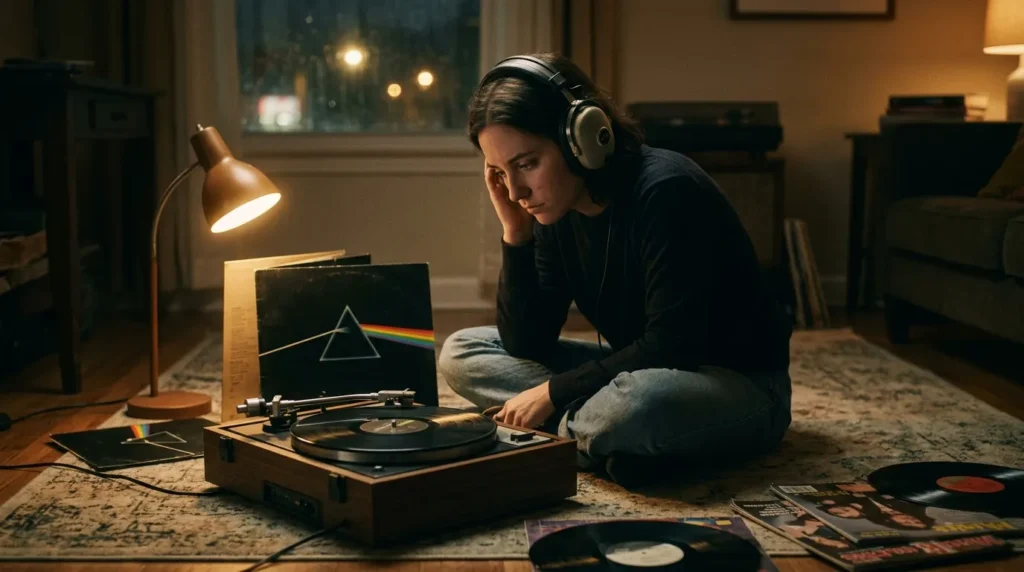
I now understand why this song remained in my memory even though I was never an especially devoted Pink Floyd listener during my university years. Its jazzy character is not merely decorative. It provides the musical framework needed to carry a subject that cannot be reduced to simple ideas of good and evil.
On July 28, Richard Wright’s birthday, listen to the complete album version, which lasts approximately seven minutes and forty-nine seconds. Who drew the line between “us” and “them,” and for what purpose? More than half a century later, Wright’s keyboards continue to make that question resonate.

音楽ファン同士の交流・リクエストはこちら / Connect & Request Songs Here