
Read about the history of Mayumi Itsuwa here!
- 🎧 Listen to This Article
- No. 8 is “Toki no Nagare ni: Tori ni Nare.”
- First, listen to the official YouTube audio.
- Placing a Hand in the Flow of Time
- The Freedom Represented by Birds and Clouds
- A Structure in Which Sorrow Becomes Hope
- Walking Together with “You”
- What Time Sings at the End
- How the Voice and Arrangement Portray Inner Change
- A New Side of Mayumi Itsuwa in 1986
- In Closing
🎧 Listen to This Article
You can quickly explore the main points of this article through narration.
Listen before reading to discover the atmosphere of “Toki no Nagare ni: Tori ni Nare” and understand the overall direction of the article.
🎵 English Narration
This audio introduces the article in English.
🎶 Japanese Narration
This audio introduces the article in Japanese.
Listening first will help you understand the world of “Toki no Nagare ni: Tori ni Nare” and the main points of the article more clearly.
No. 8 is “Toki no Nagare ni: Tori ni Nare.”
“Toki no Nagare ni: Tori ni Nare” was released as a single on April 1, 1986. It was also included on the original album Toki no Nagare ni, released on September 5 of the same year. Mayumi Itsuwa wrote both the lyrics and the music.
At the end of 1986, she performed the song at the 37th NHK Kōhaku Uta Gassen. It was her third appearance on the program, and the song revealed an expansive side of her artistry that differed from the image of a singer of tragic love established by such classics as “Koibito yo.”
The song begins with sorrow. However, it does not remain focused on the depth of that sorrow. Instead, it looks at memories rising through the passage of time and gradually turns its attention toward hope, love, and freedom.
Interpretive Translation
Let the sorrows of the past drift away into the open sky.
Even while carrying our memories, we can begin walking our own path again.
Like a bird spreading its wings or clouds traveling across the sky, the heart moves toward a new future.
In the end, what remains is not sorrow, but the love that sustains everything.
💡 You might also like: View the original Japanese lyrics (External site)
If the lyrics are available only in Japanese, you can use your browser’s translation feature or an AI translation tool to understand their general meaning.
First, listen to the official YouTube audio.
🎵 Credits
Toki no Nagare ni: Tori ni Nare / Mayumi Itsuwa
Provided to YouTube by Sony Music Direct (Japan) Inc.
Released as a single in 1986, the song was written and composed by Mayumi Itsuwa.
Two-Line Commentary
The song portrays a heart sending sorrow and tender memories into the open sky before turning toward the future once again.
Mayumi Itsuwa’s expansive singing gives voice to a structure in which the sorrow of the first verse becomes hope in the second.
Placing a Hand in the Flow of Time
An Opening That Receives Time Through the Body
The song opens with the protagonist placing her hand in the flow of time. Rather than observing time from a distance, she reaches out to touch it as though touching flowing water.
She is neither trying to recover the past nor forcing herself to forget it. She is touching the years that have carried her to the present and examining what remains within them.
Sorrow Rising Like Bubbles
What emerges from that flow is sorrow, compared in the song to bubbles. Bubbles rise to the surface, but they cannot maintain a fixed shape forever.

Through this image, sorrow is presented not as something that must be forcibly suppressed, but as something that naturally rises out of time and eventually changes its form. The protagonist does not reject the appearance of sorrow itself.
Furthermore, sorrow is not the only thing she tries to send into the sky. Tender memories are sent there as well. She does not attempt to cast away only the painful experiences while preserving the happy moments. She sends both away together as parts of the same past.
The Freedom Represented by Birds and Clouds
“Become a Bird” Is Not an Invitation to Escape
The bird named in the title appears as a creature spreading its wings and taking flight. However, it is not portrayed as a symbol of escape from life on the ground.
The protagonist does not ignore her sorrow and simply fly away. She first sends that sorrow into the open sky with her own hands, and only then does she call to the bird. Confronting the past comes before taking flight.
I understand freedom in this song not as a condition in which a person carries nothing, but as the ability to prevent the past from deciding the entire course of the future. After acknowledging what has happened, the protagonist chooses her next step for herself. That decision is contained in the words “become a bird.”

Clouds Drifting Like Travelers
After the bird, the clouds are compared to travelers. While a bird spreads its wings and flies by its own power, clouds change shape and move across the sky as they are carried by the wind.
In life, some things can be decided by our own will, while others remain beyond our control. Freedom does not mean possessing the power to make everything happen exactly as we wish. It means accepting change without losing our own sense of direction.
The bird and the clouds do not perform the same symbolic role. The bird represents the will to spread one’s wings, while the clouds represent the ability to continue traveling with the changing current. Together, they broaden the meaning of freedom within the song.
A Structure in Which Sorrow Becomes Hope
The Second Verse Is More Than a Repetition of the First
In the first verse, what rises from the flow of time is sorrow. In the second verse, sorrow is replaced by hope. The sentence structure remains similar, but the emotion that appears within it is reversed.
Time has not rewritten the facts of the past. Instead, the protagonist has passed through many years and can now view the same events from a different position.
Seeing the Distant Past as a Dream
In the second verse, the distant past rises like a dream. Events that once existed directly before her have become scenes that can no longer be reached, even when she extends her hand toward them.

Yet distance does not mean that those experiences have lost their value. When an experience is too close, only its sorrow may be visible. With time, however, a person may begin to recognize the meaning of having met someone and of having loved at all.
Sorrow itself has not magically transformed into hope. What has changed is the protagonist’s way of receiving the past. By placing the first and second verses in correspondence, Mayumi Itsuwa expresses the passage of many years with remarkable economy.
Walking Together with “You”
The Lyrics Do Not Confirm a Reunion
In the second verse, the protagonist turns her heart toward the open sky and speaks of a future in which she can walk with “you.” However, the song never makes clear whether the two have reunited or restored their former relationship.
The “you” in the song may be someone who is still beside her, or someone she can no longer meet. Because the circumstances are not defined, listeners can place their own important person within the song.
Walking in the Present with Memory
Even when that person is no longer here, there is no need to remove the time spent together from one’s life. Being immobilized by memory is not the same as living with memory as part of oneself.
A memory that once caused pain whenever it returned can eventually become an experience that provides support. The ideas received from another person and the emotions discovered within that relationship may continue to influence the rest of one’s life.

The words “I can walk with you” may represent not a declaration of returning to the past, but the point at which the protagonist can walk forward without placing the past and present in opposition.
What Time Sings at the End
Love as the Song’s Final Answer
Near the end, time itself is portrayed as something that sings. Until this point, time has reflected the protagonist’s inner state. It now becomes the voice that delivers an answer.
That answer is love. The word does not seem limited to romantic love. It can also include the fact that someone was cherished, the kindness the protagonist received, and the relationships formed throughout a lifetime.
Both sorrow and hope arise because something mattered. The pain of loss is also evidence that a time of love once existed. The song therefore does not treat sorrow as a failure, but as part of the time experienced by someone who has known love.

How the Voice and Arrangement Portray Inner Change
Mayumi Itsuwa’s Unhurried Singing
Mayumi Itsuwa does not forcefully project emotion from the opening. She sings as though carefully examining each word, giving the listener time to absorb the meaning of the lyrics.
She does not lower her voice excessively when singing of sorrow in the first verse, nor does she suddenly exaggerate brightness when hope appears in the second. As a result, the emotional change feels gradual and natural, rather than like an abrupt transformation into a different person.
A Voice Reaching Toward the Sky
When she sings of birds and clouds, her voice rises and the musical field seems to widen. She does not merely increase the volume. She preserves the shape of each word while allowing it to reach toward the open sky.
Itsuwa’s lower register contains the composure of someone who has accepted the passage of time. As the melody moves upward, her voice itself conveys the change through which a person who has known sorrow can once again look toward the sky.
An Arrangement Centered on the Song
The performance is built around Mayumi Itsuwa’s voice and lyrics. A steady rhythm and spacious accompaniment support the song’s movement from the flow of time toward the open sky.
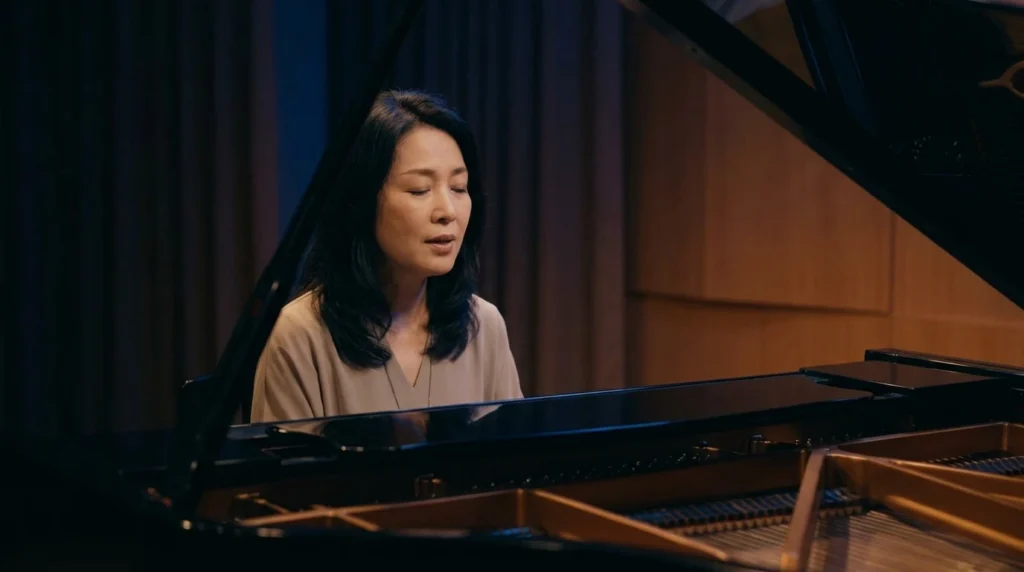
The sound carries the character of the 1980s, but it is not designed merely to display instrumental brilliance. The musical space expands in accordance with the progression from sorrow to hope, love, and freedom. For that reason, the central theme remains clear even when the song is heard today.
A New Side of Mayumi Itsuwa in 1986
Singing of the Time Beyond Heartbreak
Mayumi Itsuwa has many celebrated songs about the pain of losing someone she loves, including “Koibito yo.” Precisely because that image is so strong, the direction taken by “Toki no Nagare ni: Tori ni Nare” is significant.
Sorrow has not disappeared from this song either. However, sorrow is the entrance to the story, not its conclusion. The song moves from memory to hope, from hope to love, and finally reaches the idea of freedom.
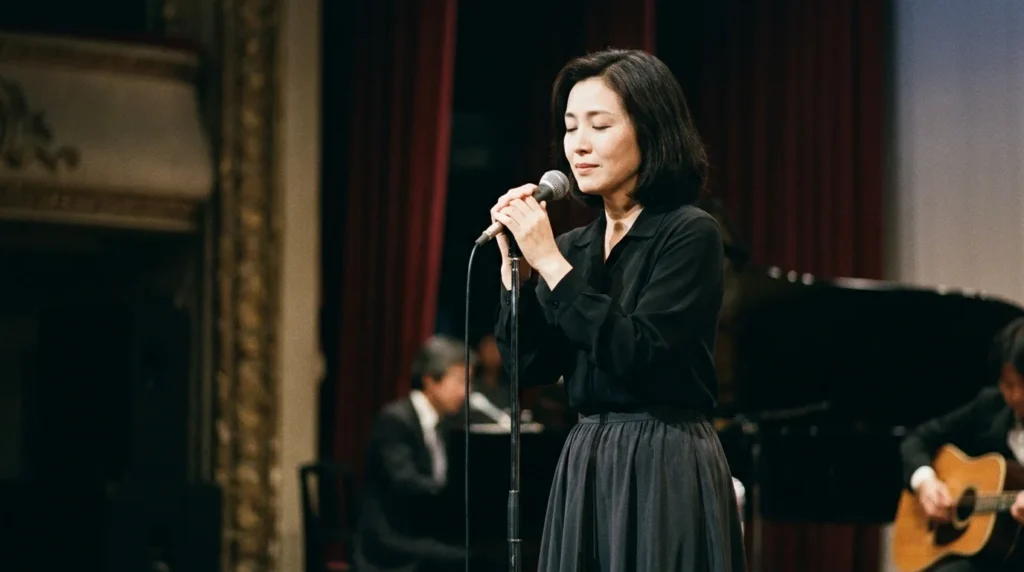
Because Itsuwa had already explored sorrow so deeply, she could portray the change that follows without reducing it to shallow encouragement. The song’s performance at the 37th NHK Kōhaku Uta Gassen also shows that it was an important work representing this stage of her career.
In Closing
“Toki no Nagare ni: Tori ni Nare” is not a song that teaches us how to forget the past. It tells us that even when a memory cannot be erased, we do not have to allow it to determine the whole course of our future.
When heard at a younger age, the birds and clouds may seem like bright symbols of departure toward the future. After many years of experience, however, the listener can also sense the hesitation and decision that came before the wings were opened.
The bird can fly not because it has discarded the past, but because it has accepted that the past formed part of its life and has still chosen to leave the ground.
Sorrow may not disappear, but time can give it a different meaning. Mayumi Itsuwa portrays a person looking toward the sky once again with an expansive and composed voice.
This is a song for someone who has known sorrow and is ready to move into the next chapter of life on their own wings. That enduring strength is why “Toki no Nagare ni: Tori ni Nare” remains a song that has never lost its meaning.

音楽ファン同士の交流・リクエストはこちら / Connect & Request Songs Here