
Bryan Ferry’s Musical Journey: Explore His History Here!
- 🎧 Listen to This Article
- My Personal miniBest7 — No. 5: “Dance Away”
- First, Listen to the Official Music Video on YouTube
- Yesterday’s Lover, Today’s Stranger
- What “Dance Away” Really Means
- The Road to Manifesto
- A Sound Both Buoyant and Wistful
- From “Dance Away” to Avalon
- In Closing — What Remains When the Dancing Ends?
🎧 Listen to This Article
Enjoy a short narrated overview of the key points in this article.
Discover the heartbreak behind “Dance Away” and the musical appeal of Bryan Ferry before reading the full article.
🎵 English Narration
Listen to an English-language narration of this article.
🎶 Japanese Narration
Listen to a Japanese-language narration of this article.
Listening first can help you appreciate the emotional story of “Dance Away” and follow the article more easily.
My Personal miniBest7 — No. 5: “Dance Away”
A 1979 Hit from the Reborn Roxy Music
On March 16, 1979, Roxy Music released their sixth studio album, Manifesto. My choice for No. 5, “Dance Away,” was written by Bryan Ferry and appears on that album.
Released as a single that April, it reached No. 2 on the UK Singles Chart and spent 14 weeks on the chart.
It also topped the chart in Ireland and became one of Britain’s major sellers of 1979. The song emerged from the band’s first studio album in nearly four years, following 1975’s Siren.
What first catches the ear is the buoyant beat and Ferry’s elegant voice.
Listen more closely to the words, however, and a different story appears: a man sees the woman he once loved walking with someone else. The music’s bright surface and the ache of a broken relationship fit together with surprising ease.

He dances not out of joy, but to shake off the pain in his heart. That contradiction is what draws me to this song.
A Poetic Interpretation
Only yesterday you were smiling beside me; tonight you lean toward someone I do not know.
The warmth we shared has become a dream that will never return.
Beneath the glittering lights, surrounded by the crowd, my heart alone seems left behind.
For this one night, let the music carry away my sorrow and tears.
If I keep dancing until dawn, will the memory of you finally begin to fade?
First, Listen to the Official Music Video on YouTube
Credits
Roxy Music — “Dance Away” (1979)
Source: Roxy Music Official YouTube Channel
Video: Official Music Video
In Two Lines
A hit from the 1979 album Manifesto that reached No. 2 in the UK.
Ferry's sweet, wistful vocals reveal the heartache beneath its lively rhythm.
Yesterday’s Lover, Today’s Stranger
A Relationship Changed in an Instant
The narrator remembers walking his sweetheart home and exchanging affectionate words at the end of the night. Yet now he sees her passing by, hand in hand with another man. The happiness of that memory stands in cruel contrast to what is happening before his eyes.
She is dressed to turn heads. The lyrics even contain a bitter joke about how devastating her beauty is to him. Rather than openly accusing her, he lets his hurt show through a flash of self-mocking wit.

Alone in a Crowd
The lyrics also present a striking paradox: loneliness in a crowded room.
Being surrounded by people and music does not guarantee a sense of connection. Sometimes the cheerful atmosphere around us only makes a personal loss more apparent.

A Crowd Is No Cure for Loneliness
That passage reminds me of the strange sensation of standing in a circle of conversation while feeling as though I am somewhere just outside it.
The number of people around us has little to do with how fulfilled we feel. This song places that truth against the backdrop of a city after dark.
What “Dance Away” Really Means
Dancing to Drive Something Away
In this context, “dance away” suggests trying to drive something off through dancing. What the narrator wants to banish is the pain of heartbreak, his tears, and his fears. This is more than an invitation to enjoy the dance floor.
Of course, moving to the music cannot erase a memory. But perhaps, for tonight, surrendering to the rhythm is easier than sitting alone with his thoughts. There is something deeply vulnerable beneath the song’s effortless sound.

A Quiet Act of Defiance Until Dawn
The narrator closes his eyes and dances until morning. The song never tells us that he has recovered. I hear it instead as the portrait of someone trying to get through the night without having found an answer.
After a breakup, an ordinary street corner or a once-familiar song can unexpectedly summon the past. We cannot simply delete our memories, but we may still choose when we are ready to face them.

Getting Through Tonight, Rather Than Forgetting
I do not hear this song as a declaration of recovery.
Even with the sadness still there, he finds a way to make it through one night. I find something profoundly human in that modest wish.
The Road to Manifesto
A New Sound After Nearly Four Years
After releasing Siren in 1975, Roxy Music stepped away from making new studio albums for a time. Ferry continued his solo career, releasing In Your Mind in 1977 and The Bride Stripped Bare in 1978.
On Manifesto, the reunited band retained traces of its early experimental character while bringing dance-oriented rhythms and contemporary pop influences further forward. “Dance Away” helped introduce that change to a wider audience.
A Song Passed Over Twice
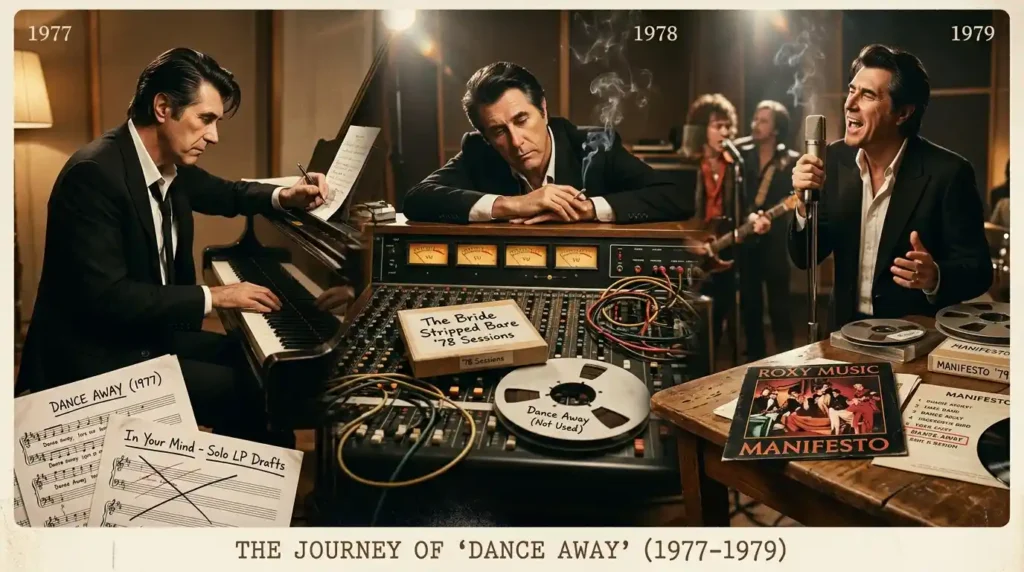
According to accounts of its development, Ferry originally wrote the song for his 1977 solo album In Your Mind. It did not make the final track list, and it was left off his next album, The Bride Stripped Bare, as well.
It eventually took shape as a Roxy Music recording and found its home on Manifesto. Knowing how long it took to reach listeners gives this familiar melody another dimension.
Finding Its Voice with the Band
How might it have sounded had Ferry released it as a solo track? We can only speculate. The version we know is the one brought to life by Roxy Music in 1979.
A song is shaped not only by the idea that inspires it, but also by the musicians and the moment that bring it to life. This recording makes me think about that relationship.
A Sound Both Buoyant and Wistful
An Irresistible Pulse and an Unforgettable Melody
The drums and bass keep a steady pulse, while the guitars and keyboards give the arrangement its flowing character. It carries the atmosphere of the late 1970s, when disco was flourishing, yet it feels like more than a track designed simply to get people dancing.

The melody is easy to remember, and the song moves with an unforced sense of direction.
Rather than relying on dramatic twists, it draws the listener into its current almost unnoticed. To me, that accessibility is one of its greatest strengths.
The Shades of Emotion in Ferry’s Voice
There is sweetness and poise in Ferry’s singing, but also a hint of fragility. His gently wavering phrase endings and fluid delivery are far removed from the raw outbursts we might expect in a song about a broken heart.
Because he never forces the emotion, the narrator can sound as though he is trying to maintain his composure. That distinctive vocal style may be what connects the painful lyrics with the brightness of the arrangement.

When a Bright Tune Makes the Sadness Sharper
A cheerful melody does not always carry a happy story. In “Dance Away,” the lively performance does not conceal the heartbreak; as the song unfolds, the contrast becomes increasingly affecting.
That is where I hear Ferry’s unmistakable sense of style.
From “Dance Away” to Avalon
The Path Toward Roxy Music’s Later Years
Following Manifesto, Roxy Music released Flesh + Blood in 1980 and Avalon in 1982. Both albums reached No. 1 on the UK Albums Chart and became landmarks of the band’s later period.
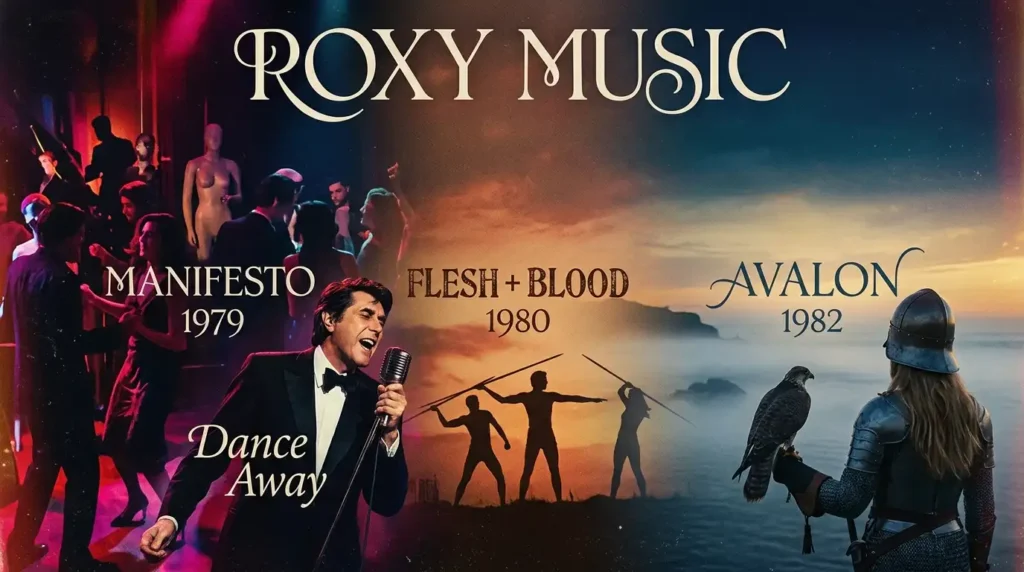
It was Avalon that first made me pay close attention to Roxy Music. I was captivated by its intricate layers of sound and dreamlike atmosphere. “Dance Away,” recorded three years earlier, has a more immediate, physical pull.
Ferry’s Identity Through Changing Sounds
The two recordings feel quite different, yet I hear a shared reluctance to reduce romance to either simple happiness or outright tragedy. Ferry’s ability to set complicated feelings within sophisticated, urban music remains recognizable even as the band’s sound evolves.

“Dance Away” is an essential stop on the journey from the band’s adventurous early rock to the polished beauty of Avalon.
In Closing — What Remains When the Dancing Ends?
“Dance Away” is one of Roxy Music’s signature hits and a fine expression of Bryan Ferry’s appeal. Its graceful melody, inviting rhythm, and richly expressive voice are enough to make me return to it again and again.
Yet whenever I listen, I picture a man dancing alone on a magnificent dance floor.

To an observer, he might look perfectly happy. But no one can see what he carries inside. There are nights in life when all we can do is wait for the hours to pass while holding questions that have no answers.
Music cannot bring back a lost love. Still, it can give someone who has been standing motionless a reason to take a step. He dances, even though he cannot forget. That is what makes this song so moving to me.
Eventually the lights go out and morning arrives. The song offers no answer about what remains in his heart. But he can at least greet a morning different from yesterday’s. I listen to the final notes imagining that small, uncertain change.

音楽ファン同士の交流・リクエストはこちら / Connect & Request Songs Here