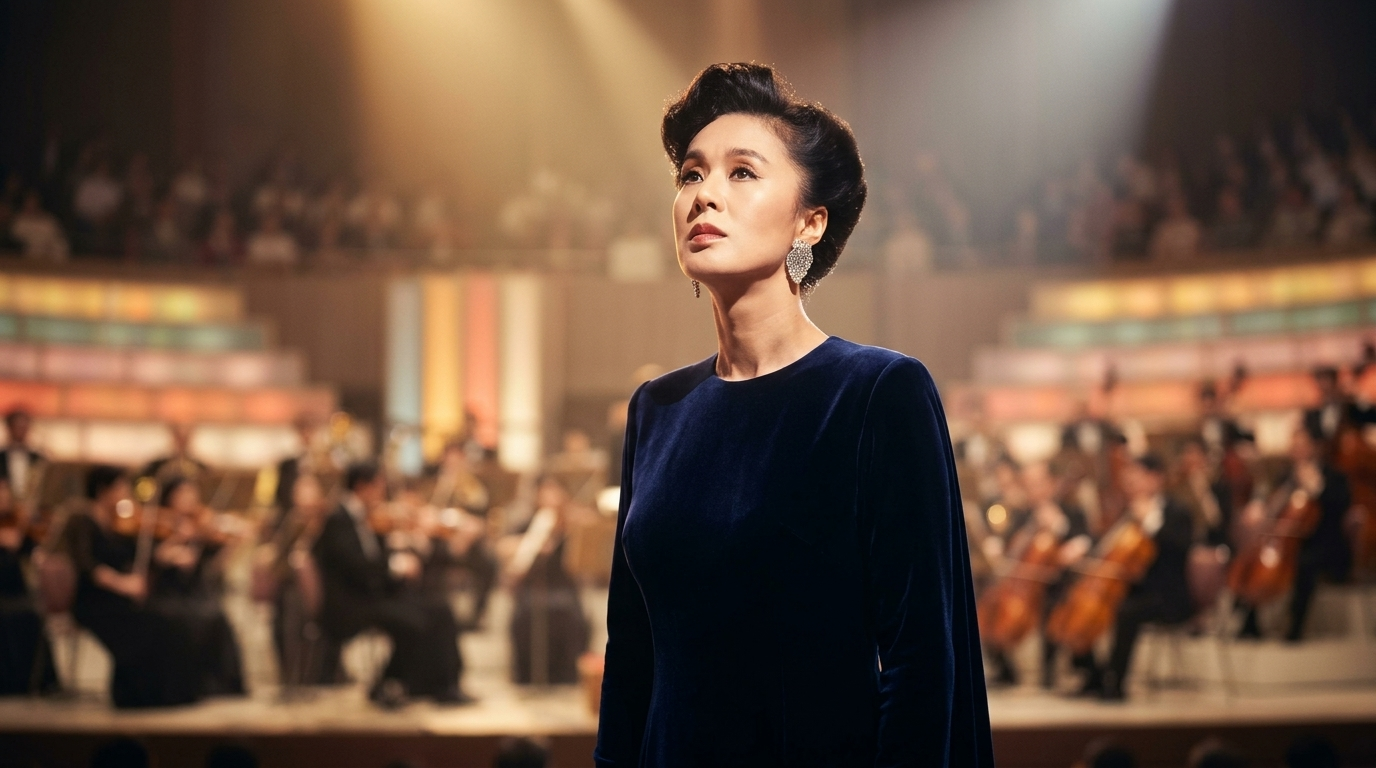
- 🎧 Enjoy This Article in Audio
- September 17 Is Chiaki Naomi’s Birthday: Featuring “Kassai”
- First, Watch the Official Video on YouTube
- When I First Heard This Song
- “Kassai” — The Light of the Stage and the Darkness Within
- What Makes Chiaki Naomi Such an Extraordinary Singer
- 1972 — From Release to the Japan Record Award in Just Over Three Months
- Listening to “Kassai” Again More Than 50 Years Later
- A Long Silence Since 1992
- Happy Birthday, Chiaki Naomi!
🎧 Enjoy This Article in Audio
Listen to a concise narration covering the key points of this article.
Listen before reading to get a feel for “Kassai” and the overall flow of the article.
🎶 English Narration
Listen to an English narration of this article.
🎵 Japanese Narration
Listen to a Japanese narration of this article.
Listening first makes it easier to grasp the world of “Kassai” and the key points of the article.
September 17 Is Chiaki Naomi’s Birthday: Featuring “Kassai”
September 17 is Chiaki Naomi’s birthday. She was born in Itabashi, Tokyo, in 1947.
Influenced by her mother, she began learning tap dance at the age of four and appeared on stage at the Nichigeki theater when she was five. She later honed her singing and dancing skills while performing at U.S. military camps, and began working professionally as a singer at the age of 13. In 1969, she made her record debut with “Ame ni Nureta Bojo.”
Chiaki Naomi explored a remarkably wide range of music, extending beyond kayokyoku and enka into jazz, chanson, fado, and traditional Japanese popular songs. There is something distinctive about her singing that cannot be explained simply by saying that she has “a great voice.”
Rather than simply singing a song, she seems to inhabit and perform an entire story.
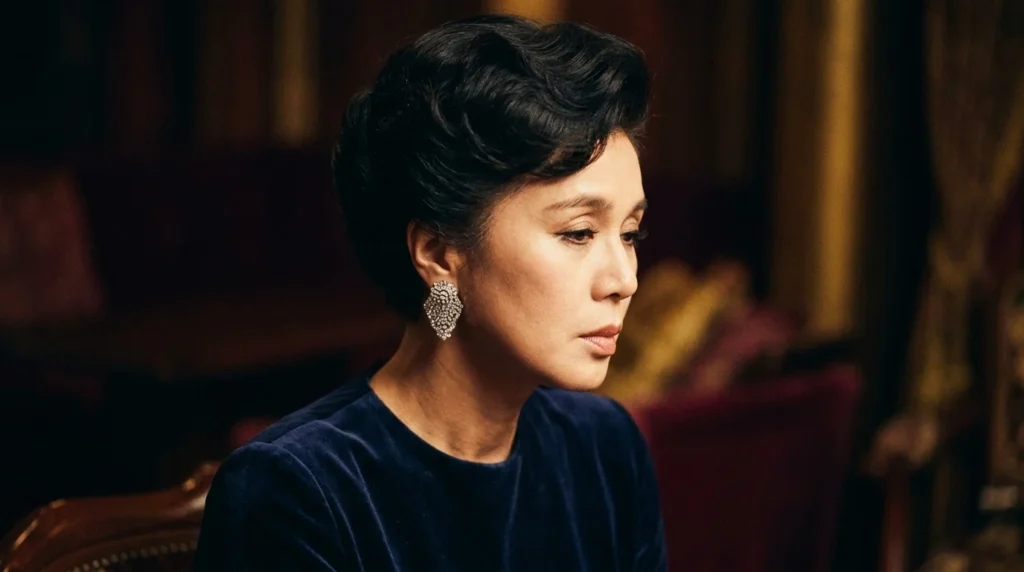
That is the impression Chiaki Naomi has always given me.
For me, the first song that comes to mind whenever I think of Chiaki Naomi is “Kassai.”
Released on September 10, 1972, it won the 14th Japan Record Award later that same year. It became not only one of Chiaki Naomi’s signature songs, but also an essential classic in the history of Showa-era Japanese popular music.
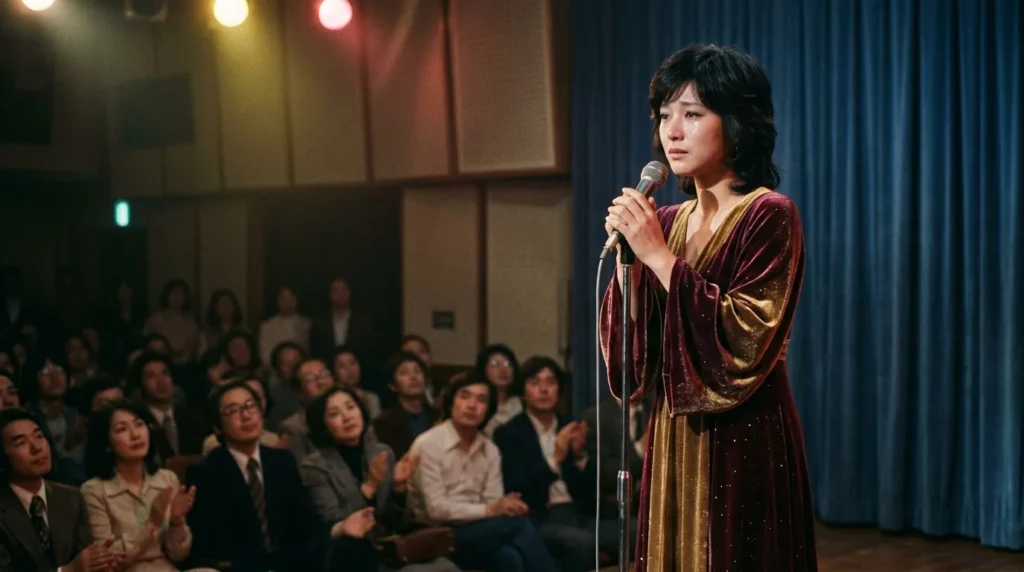
The lyrics were written by Ou Yoshida, the music was composed by Yasushi Nakamura, and the arrangement was by Hiroshi Takada. The song moves almost like a sequence of scenes from a film: the singer performing on stage in the present, the arrival of news of a death, a farewell three years earlier, and a woman dressed in mourning standing at a church.
My Interpretation
Once again today, I stand on the stage and sing as I always have.
But the news that reaches me brings back the time I thought I had left behind with you.
That day, I left you standing at the station and boarded the train alone.
And now, as I stand here dressed in mourning, you are no longer before me.
Memories of the bright stage and the depth of my loss quietly overlap within my heart.
💡 You might also like: View the original Japanese lyrics (External site)
If the lyrics are available only in Japanese, you can use your browser’s translation feature or an AI translation tool to understand their general meaning.
First, Watch the Official Video on YouTube
Official Audio Credits
Chiaki Naomi – “Kassai”
Lyrics: Ou Yoshida
Music: Yasushi Nakamura
Arrangement: Hiroshi Takada
Original Release: September 10, 1972
Winner of the 14th Japan Record Award
Audio: Chiaki Naomi / Kassai [Official Audio]
Source: Chiaki Naomi Official YouTube Channel
In Two Lines
A 1972 classic in which the present-day image of a singer on stage intersects with memories of a woman learning of the death of someone she once loved.
Chiaki Naomi’s restrained performance, rather than displaying emotion openly, makes the sense of loss all the more profound.
When I First Heard This Song
| My Age | Elementary School | Junior High | High School | University | 20s | 30s | 40s | 50s | 60+ |
| Year Released | 1972 | ||||||||
| When I First Heard It | ● |
I first heard this song in 1972, the year it was released, when I was around my second year of junior high school.
I remember hearing it frequently on television music programs.
Listening to it again now, I realize just how heavy its subject matter is. At the time, however, I did not think deeply about the meaning of the lyrics. I was first drawn to the melody. Even then, I did not listen to much Japanese popular music, and among my music-loving friends there was a certain feeling that kayokyoku was a little uncool.
But none of those labels mattered when it came to “Kassai.” I simply liked the song.
Her voice was not what I would call crystal clear. It had a slightly rough texture, and rather than laying her emotions bare, Chiaki Naomi sang with quiet restraint. I think that was what attracted me to her singing.
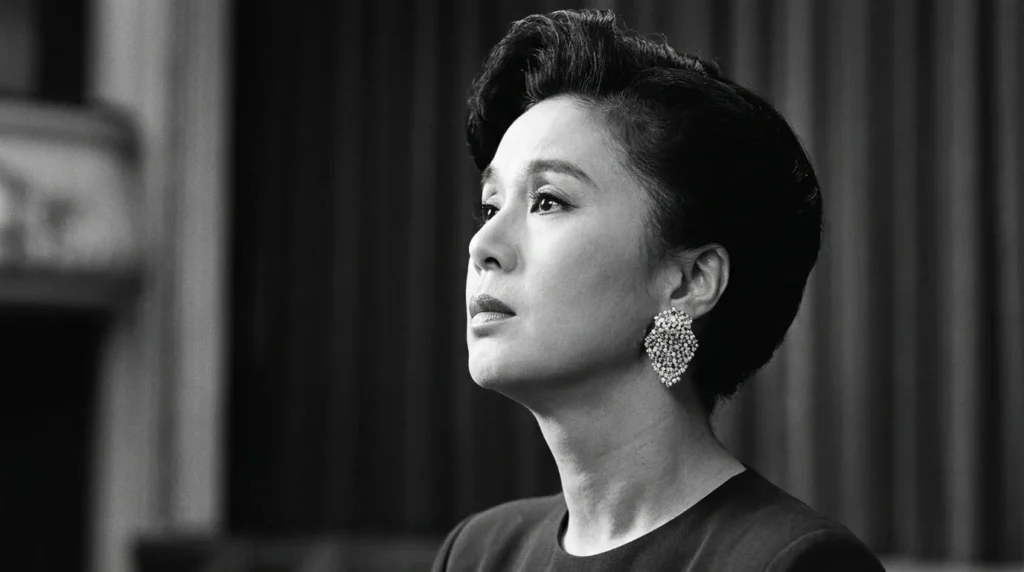
The Weight of “Kassai” I Couldn’t Understand as a Teenager
Of course, I do not think the junior-high-school version of me truly understood the world portrayed in this song.
I was still too young to connect the idea of losing someone forever, or of time that could never be recovered, with my own life.
And yet the song stayed with me. The melody, the arrangement, and above all Chiaki Naomi’s voice. Even without fully understanding the words, I must have sensed that there was a profound sadness somewhere within the song.
“Kassai” — The Light of the Stage and the Darkness Within
A Story Where Present and Past Intertwine
What fascinates me when I listen to “Kassai” now is that its story does not unfold in a straight line.
The curtain rises, and in the present she sings a love song as usual. Then a black-bordered notice arrives, and the story moves back three years. We see the person she left behind at the station, the train beginning to move, and then another change of scene: a woman dressed in mourning standing before a church.
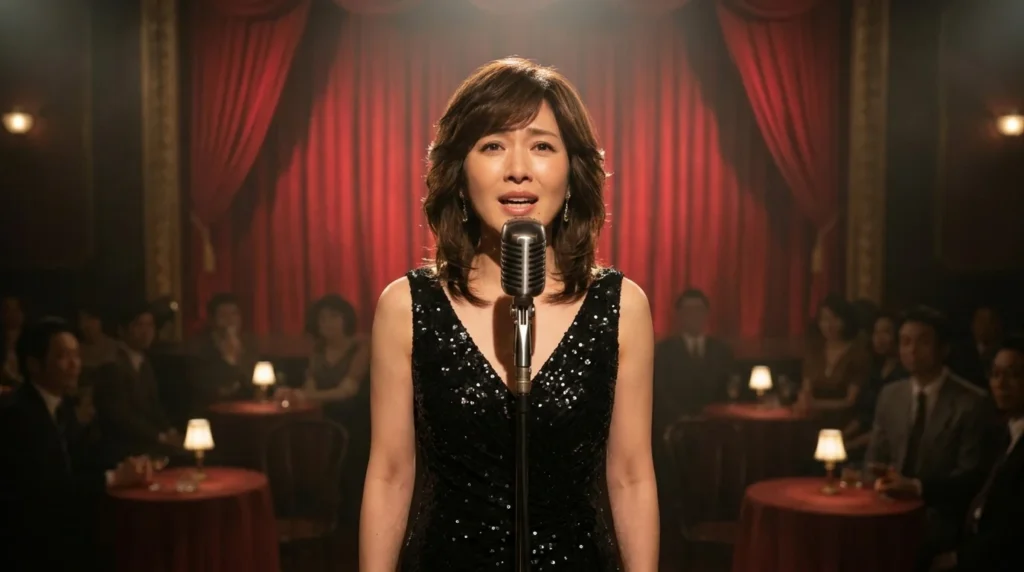
Within the span of a single song, the present and the past move back and forth as one scene after another appears and fades away.
The brilliance of the stage and a loss that cannot be shown to anyone else. It is the contrast between these two worlds that gives “Kassai” its distinctive power.
The Sadness Is Stronger Because She Never Cries It Out
What ultimately gives this story its emotional force is Chiaki Naomi’s singing. She does not sing as though she were breaking down in tears. Instead, she holds her emotions back, and that restraint makes the woman’s sorrow all the more vivid.
Because she never tries to explain everything by raising her voice, the listener is left with room to imagine what lies beneath the surface.
By revealing less of the sadness, she somehow makes it feel even deeper.
I think this is one reason “Kassai” continues to feel so emotionally heavy, no matter how many times I hear it.
The Contrast Created by the Title “Kassai”
The title itself also becomes more striking the more I think about it.
The Japanese word “kassai” means applause or acclaim, evoking a stage, an audience, applause, and public success. Yet what the song portrays is an intensely personal loss—the very opposite of that outward brilliance.
In front of others, she stands on stage as a singer. Inside, however, she carries a sorrow no one else can see.
The life visible from the outside is not always the same as the life a person carries within.
By giving the song a title associated with applause and public acclaim, the contrast at the heart of the story becomes even sharper.
What Makes Chiaki Naomi Such an Extraordinary Singer
She Doesn’t Just Sing — She Becomes the Person in the Story
When I think about Chiaki Naomi’s appeal, her expressive ability is impossible to overlook.
It goes far beyond technical qualities such as accurate pitch or vocal power. The very character of her voice seems to change from song to song, until it feels as though the person at the center of the story has appeared before us.
Rather than placing her own emotions into a song, she seems to become the person who lives inside it.
That, I think, is one of the qualities that makes Chiaki Naomi such a distinctive singer.
A Singer Who Could Never Be Confined to One Genre
It is difficult to describe Chiaki Naomi simply as an “enka singer” or a “kayokyoku singer.”
When she began working professionally as a singer at 13, she mainly performed Western music such as rockabilly. She later expanded her repertoire into Japanese popular songs, and from the 1980s onward explored chanson, jazz, fado, and other styles as well.
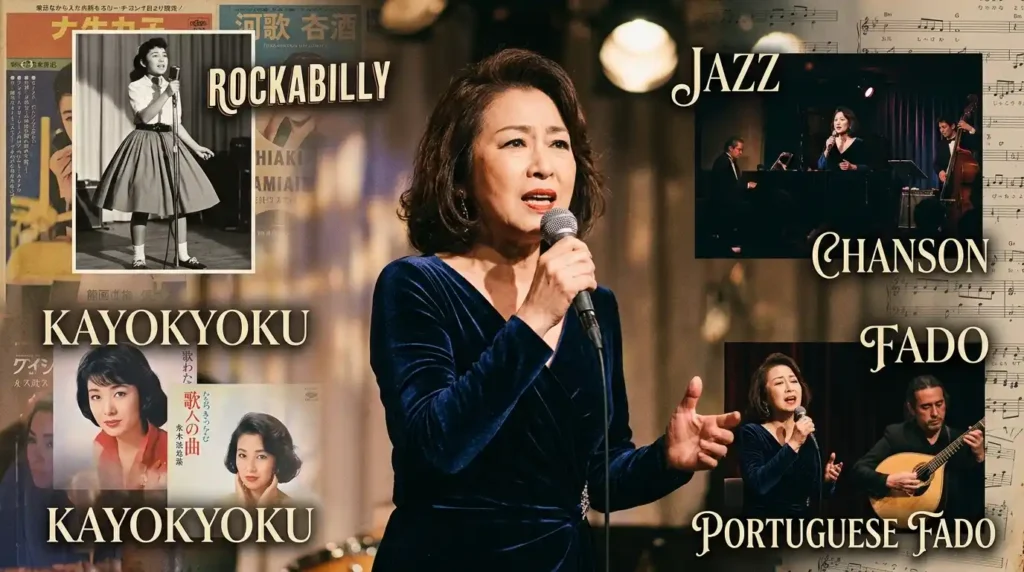
“Kassai” itself has a dramatic quality that cannot be contained within the boundaries of conventional enka. Perhaps that is why, even as a junior-high-school student who kept some distance from Japanese popular music, I was naturally drawn to this song.
1972 — From Release to the Japan Record Award in Just Over Three Months
“Kassai” was released on September 10, 1972. On December 31 of that same year, it won the 14th Japan Record Award.
Lyrics by Ou Yoshida, music by Yasushi Nakamura, arrangement by Hiroshi Takada. Their work came together with Chiaki Naomi’s remarkable performance, and in just over three months, the song had become one of the defining hits of the year.
1972 was also a year when “Onna no Michi” by Shiro Miya and Pinkara Trio became a huge hit, while Mari Amachi, Rumiko Koyanagi, Saori Minami, Kenji Sawada, and many other singers were prominent figures on the Japanese music scene.
At the time, I was gradually becoming more interested in Western music, folk, and rock. Even so, “Kassai” left a lasting impression on me as a junior-high-school student.
Listening to “Kassai” Again More Than 50 Years Later
The “Kassai” I heard as a junior-high-school student in 1972 and the “Kassai” I hear more than 50 years later are the same recording. Yet what I receive from it now feels very different.
Back then, what first appealed to me was the melody and Chiaki Naomi’s voice. I was not thinking of the life portrayed in the lyrics as something that had any connection with my own.
But now that I am older, the ideas of “someone you can never see again” and “time you can never return to” feel far more real than they once did.
Music also has a mysterious power. Even memories we rarely think about anymore can suddenly return, along with the scenery and atmosphere of those days, the instant we hear a particular song.
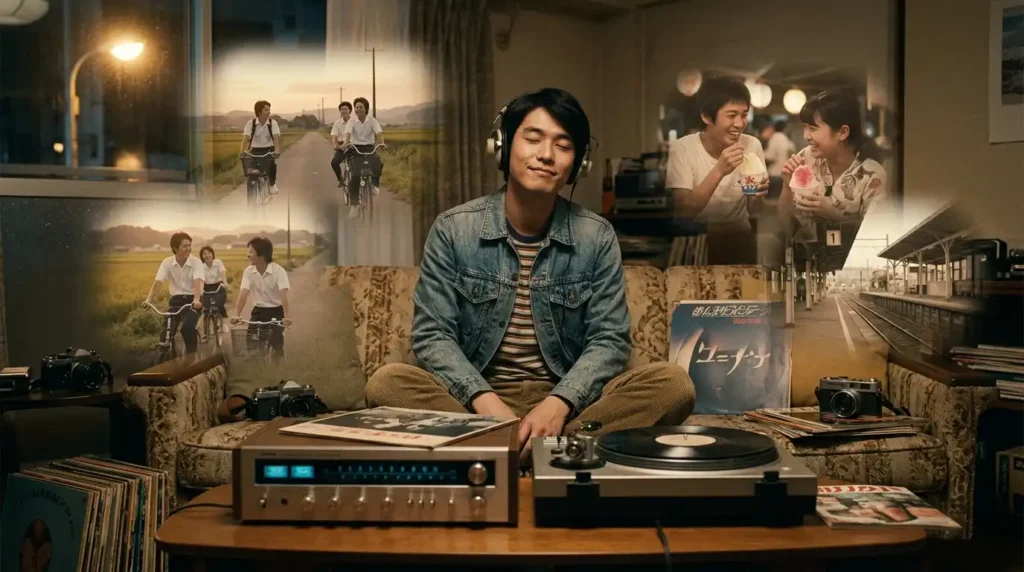
For me, “Kassai” has become one of those songs.
When the introduction begins, the television music programs of 1972 and the junior-high-school student who watched them somehow reconnect across more than half a century.
The music itself may never change, but as the listener’s life changes, the way a song sounds can change as well.
Perhaps that is one of the great pleasures of returning to a song we have known for decades.
A Long Silence Since 1992
Chiaki Naomi stepped away from her career in 1992 following the death of her husband. Since then, she has remained away from public performances.
Yet her music has never been forgotten. In 2024, marking the 55th anniversary of her debut, more than 300 recordings from her years with Columbia, Victor, and Teichiku became available digitally, and an official YouTube channel was also launched.
Even without new performances, the recordings she left behind continue to be heard across generations. “Kassai,” too, is a song that cannot be confined to the label of “nostalgic Showa-era Japanese popular music.”
Happy Birthday, Chiaki Naomi!
September 17 is Chiaki Naomi’s birthday.
As a junior-high-school student, I loved “Kassai” without thinking much about whether it belonged to the world of kayokyoku. More than 50 years later, I can now feel a depth in the song that I could not understand back then.
The music itself may never change, but as the listener’s life changes, the way a song sounds can change as well.
For me, “Kassai” is a song that connects the person I was in 1972 with the person I am today.


音楽ファン同士の交流・リクエストはこちら / Connect & Request Songs Here