
Kyosuke Himuro’s History ➡ Click Here!
- 🎧 Listen to This Article
- No. 2 is Kyosuke Himuro’s “Tamashii wo Daite Kure.”
- First, listen to the official audio on YouTube.
- What It Means to “Hold Someone’s Soul”
- A Love Song That Begins with Everyday Life in the City
🎧 Listen to This Article
Listen to a concise narration covering the key points of this article.
Recommended if you want to get a feel for “Tamashii wo Daite Kure” and the overall flow of the article before reading.
🎵 English Narration
An English narration introducing the key points of this article.
🎶 Japanese Narration
A Japanese narration introducing the key points of this article.
Listening first will help you grasp the atmosphere of “Tamashii wo Daite Kure” and the key points of the article more easily.
No. 2 is Kyosuke Himuro’s “Tamashii wo Daite Kure.”
Released as a single on October 25, 1995, the song was later included as the “ALBUM MIX” on Himuro’s sixth original album, MISSING PIECE, released on September 30, 1996. The lyrics were written by Takashi Matsumoto, with music composed by Kyosuke Himuro.
The single reached No. 2 on the weekly Oricon chart and remained on the chart for 17 weeks.
It was also used as the theme song for the TV Asahi drama Kaze no Keiji: Tokyo Hatsu!, becoming one of the ballads that came to represent Kyosuke Himuro in the mid-1990s.

The title “Tamashii wo Daite Kure” — literally, “Hold My Soul” — is a strikingly powerful phrase.
Yet the man portrayed in the song is not trying to display strength or bravado. He has adapted to life in the city and learned how to get through each day in his own way, but in front of the person he loves, he wants to remain completely unguarded.
Rather than trying to look impressive, he wants someone to understand what lies deep inside him. That longing seems to be what gives the word “soul” such weight in this song.
My Interpretation
I have learned to live in my own way while keeping pace with the city around me.
But even in front of you, I do not want to pretend to be some admirable man.
I want you to see all of me, both the good parts and the parts that are not so beautiful.
If we can understand each other without putting everything into words, then for now, I only want you to stay close.
💡 You might also like: View the original Japanese lyrics (External site)
If the lyrics are available only in Japanese, you can use your browser’s translation feature or an AI translation tool to understand their general meaning.
First, listen to the official audio on YouTube.
🎵 Credits
Song: Tamashii wo Daite Kure
Artist: Kyosuke Himuro
Lyrics: Takashi Matsumoto
Music: Kyosuke Himuro
Single Release: October 25, 1995
Album: MISSING PIECE
Album Release: September 30, 1996
YouTube Release Source: MISSING PIECE
Audio Provided by: Universal Music LLC
YouTube: KYOSUKE HIMURO Official Artist Channel
🎵 Two-Line Commentary
A ballad about a man living in the city who wants the person he loves to accept him without pretense.
Takashi Matsumoto’s evocative imagery and Kyosuke Himuro’s expansive melody give an intimate emotion a sweeping sense of scale.
What It Means to “Hold Someone’s Soul”
When we think of “holding” someone, physical closeness is usually the first thing that comes to mind. But the word chosen for this title is “soul.” It seems to point not to the body or to superficial tenderness, but to something much deeper — the person at their very core.
The protagonist does not portray himself as an ideal man. He is aware of the grime he has picked up while living in the city, as well as his own selfishness. Even so, what he wants from the person he loves is not admiration for a polished version of himself, but acceptance of who he is, including those imperfect parts.
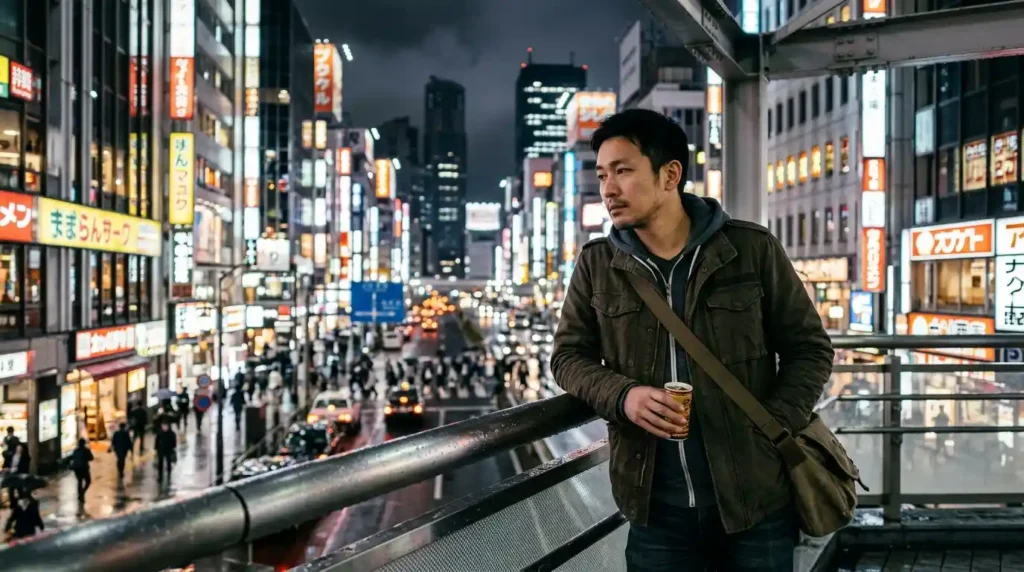
That is why “Tamashii wo Daite Kure” is probably not simply a passionate declaration of love.
It sounds more like an urgent plea for someone to look beyond what can be seen from the outside and reach the person underneath.
Wanting to Be Understood Before Words Are Needed
One of the most striking things about this song is that the protagonist is not looking for explanations. What he wants is simply for the other person to stay close.
He is not trying to explain every detail of his circumstances from the beginning in order to be understood. Instead, he seems to hope that even the things he cannot fully put into words will somehow be felt.
He is not asking his lover to change his life, nor is he asking her to erase his pain. There are simply things that only someone who remains close can understand. That sense of intimacy takes “Tamashii wo Daite Kure” somewhere slightly beyond a straightforward declaration of love.
A Love Song That Begins with Everyday Life in the City
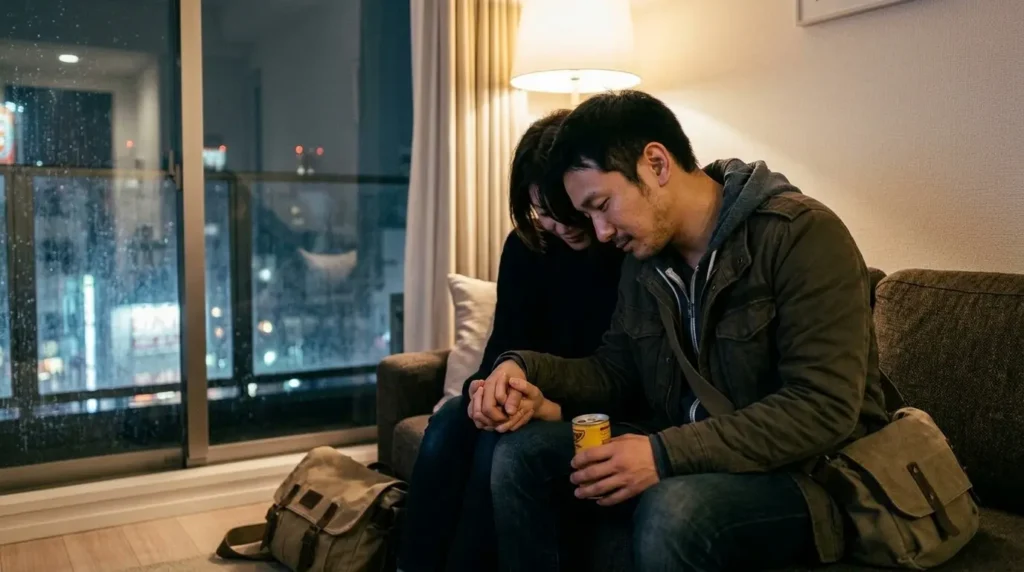
The opening does not depict some extraordinary romantic moment. Instead, we are given an ordinary urban scene: a rainy city, morning, and a life moving according to the clock.
The protagonist is not trying to escape from that world. He has learned how to live while adjusting to the people and circumstances around him. What makes Takashi Matsumoto’s lyrics so interesting is that they do not reject that social life. Instead, they portray the man who lives in the outside world and the man who stands before his lover as one and the same person.
During the day, he lives according to schedules and compromises with those around him. Yet in front of the person he loves, a social mask is no longer enough. As the song progresses, the perspective gradually moves away from the cityscape and draws closer to the private relationship between the two people.
The Landscape Shifts from Summer to Autumn
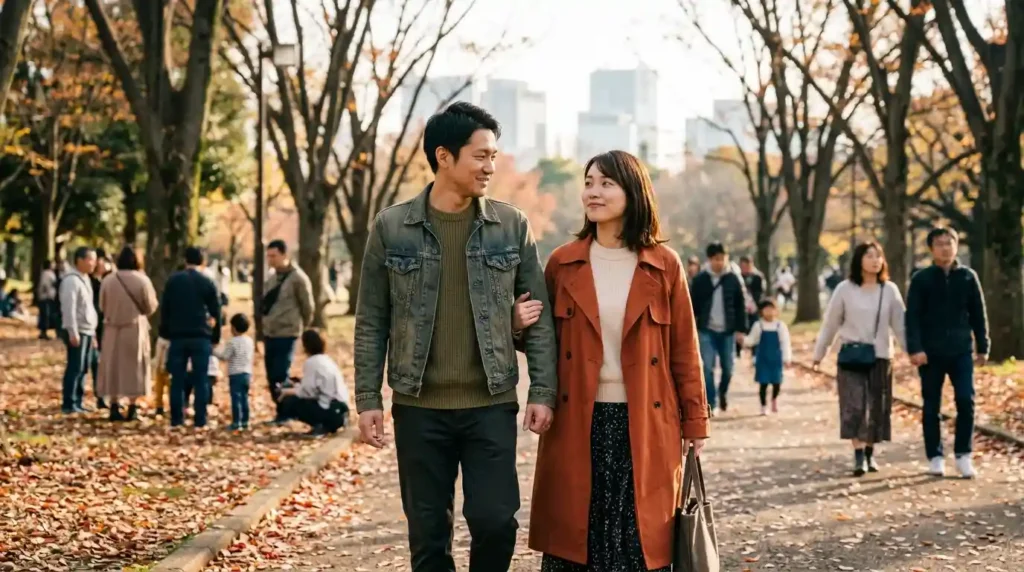
Another memorable element is the changing of the seasons. The imagery begins with a scene that evokes the summer seaside, before gradually moving toward autumn. Time passes within only a few words, giving a sense of duration to the relationship as well.
Even after the heat of the season has passed, something remains between them. To me, this gives the song a calm sense of maturity. Rather than focusing on the excitement of falling in love, it looks toward what remains after time has passed.
Takashi Matsumoto’s Words and Kyosuke Himuro’s Melody
“Tamashii wo Daite Kure” features lyrics by Takashi Matsumoto and music by Kyosuke Himuro. That combination is also important when considering the character of the song.
In this miniBest series, I have also covered several BOØWY songs whose lyrics were written by Himuro himself. Compared with those songs, this one places much more emphasis on detailed scenery — the city, rain, the sea, and the changing seasons. Matsumoto’s distinctive touch lies in showing us those landscapes first, then gradually leading us toward the feelings of the man standing within them.
A Melody That Expands Quiet Words into Something Larger
Himuro’s melody, by contrast, does not keep the emotion confined. It begins gently, but the vocal range opens up in the chorus, allowing the words of the title to rise to the very center of the song.
Read on the page alone, the lyrics feel deeply personal and intimate. Himuro’s melody transforms them into a sweeping ballad. The fact that a private confession and a large-scale sound can coexist so naturally is one of the song’s defining qualities.
Kyosuke Himuro’s Identity Remains Intact Even in a Ballad
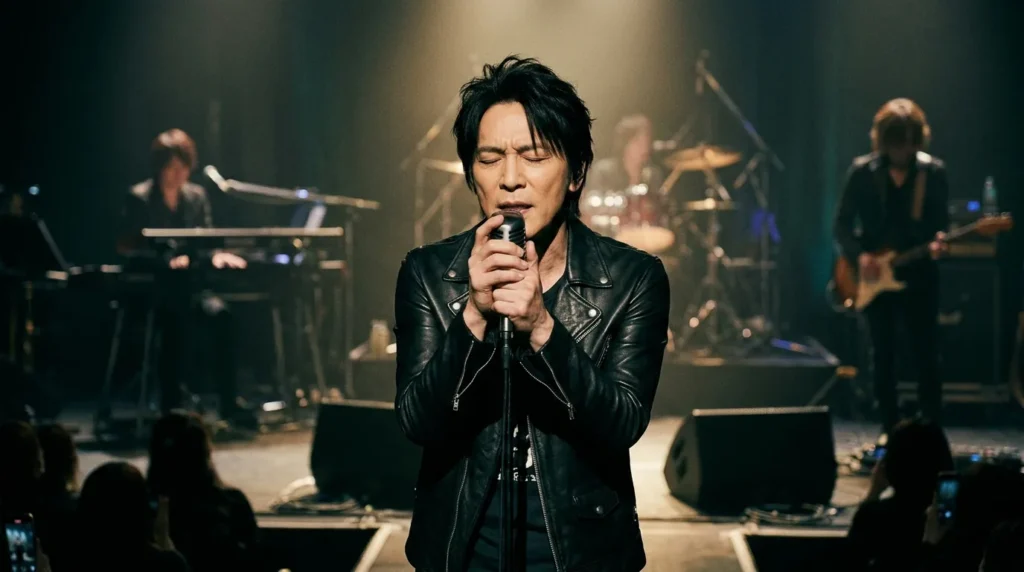
“Tamashii wo Daite Kure” is a restrained, slower ballad, yet the distinctive edge of Kyosuke Himuro’s voice remains unmistakable. The arrangement never pushes forward more than necessary; keyboards, guitars, and the rhythm section support the song, while the vocal at the center carries its emotional weight.
What stands out in particular is that even when the emotion intensifies in the chorus, Himuro never sounds as though he is collapsing into tears. He keeps every word clearly defined and maintains the tension and firmness characteristic of his singing until the very end.
A Voice That Feels Close Rather Than Overpowering
During the BOØWY era, one of Himuro’s great strengths was the way he could place words sharply over the beat and cut straight through the band’s sound. In “Marionette,” that style of singing heightened the tension of the entire band.
In “Tamashii wo Daite Kure,” however, his voice feels much closer to the listener. The power of a rock vocalist is still there, of course, but what matters here is not force so much as the sense that he is speaking directly to someone.
That difference shows the breadth Kyosuke Himuro developed during his solo career.
What Becomes Clear When Compared with No. 3, “Marionette”
BOØWY’s “Marionette,” which I ranked at No. 3, is a song about recognizing what is holding you back and choosing to move forward on your own. Its gaze is directed outward, and there is a strong determination to stand on one’s own feet.
By contrast, “Tamashii wo Daite Kure” turns toward one particular person. Here, independence and the need for another person are not opposites. The protagonist lives his daily life on his own, yet still longs for a deep connection with someone else.
If “Marionette” is a song about trying to reclaim yourself, then “Tamashii wo Daite Kure” is a song about searching for someone who truly understands you.
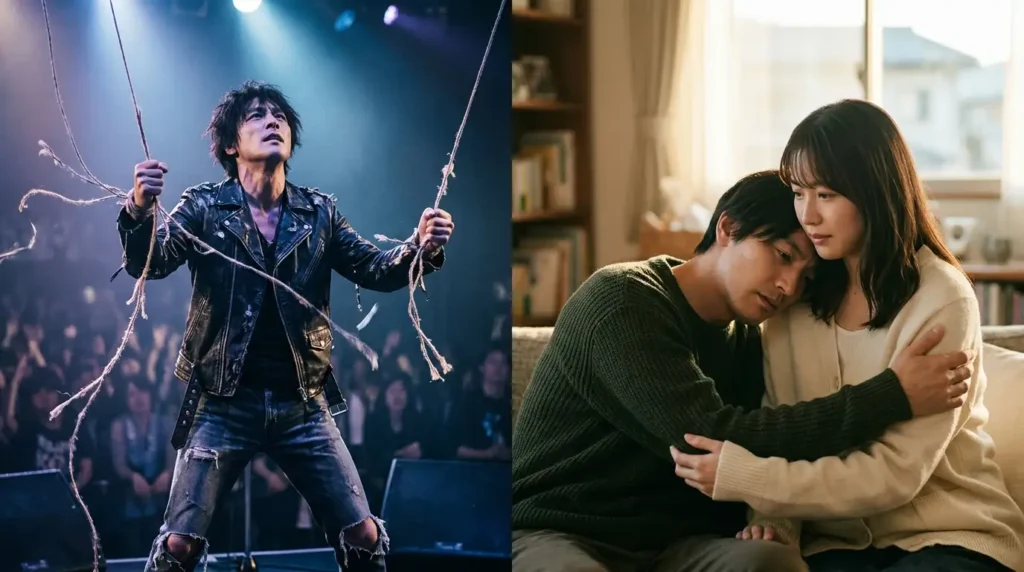
1995: Kyosuke Himuro in His Eighth Year as a Solo Artist
Kyosuke Himuro made his solo debut in 1988. He went on to release songs such as “ANGEL,” “SUMMER GAME,” “JEALOUSY wo Nemurasete,” “KISS ME,” and “VIRGIN BEAT,” and by 1995 he had already built a substantial track record as a solo artist.
Released during that period, “Tamashii wo Daite Kure” showed Himuro’s presence in a way quite different from his more flamboyant rock numbers. Its peak position of No. 2 on the Oricon chart and its 17-week chart run also show that it was more than a temporary hit — it was a song that continued to be heard by a wide audience.
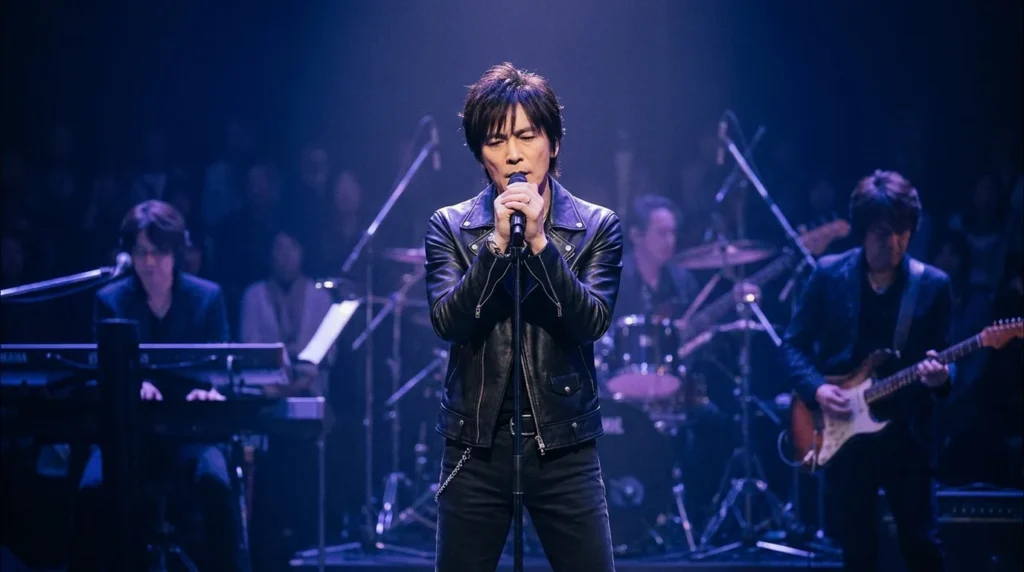
The following year, in 1996, it was included on MISSING PIECE as the “Album Mix.”
The fact that the song did not remain only a standalone single, but carried forward into the next album, also suggests how important it was within Kyosuke Himuro’s work at the time.
In Closing — The Desire to Be Truly Understood
“Tamashii wo Daite Kure” is not a song about heartbreak. Nor is it about trying to possess someone or escape from something. It is about a man living his everyday life in the city while searching for someone who can understand him deeply as a person.
Through the rainy city, the sea, and the changing seasons, Takashi Matsumoto sketches the contours of that man’s life. Kyosuke Himuro then turns that inward longing into a ballad through the expansive melody he composed himself and the strength at the core of his voice.
He has the strength to live on his own, yet he still wants someone to understand who he really is. That feeling may not belong only to romantic love. Perhaps it is something that arises whenever people try to form a truly deep connection with another person.
Rather than filling the song with dramatic language, it gathers all of that emotion into a single word: “soul.” The force of hearing that word sung in Kyosuke Himuro’s voice is the reason I chose “Tamashii wo Daite Kure” as No. 2 in my miniBest7.

音楽ファン同士の交流・リクエストはこちら / Connect & Request Songs Here