
Kyosuke Himuro’s History ➡ Click Here!
- 🎧 Listen to This Article
- No. 3 is BOØWY’s “MARIONETTE.”
- First, listen to the official audio on YouTube
- What Does “MARIONETTE” Represent?
- You Know It’s “MARIONETTE” from the Intro Alone
- Kyosuke Himuro’s Vocals — More Than Sheer Power
- 1987: BOØWY Reaches No. 1
- Track 6 on PSYCHOPATH
- What Becomes Clear When Compared with No. 4, “B・BLUE”
- In Closing — Refusing to Remain a Puppet
🎧 Listen to This Article
Get a quick overview of this article through narration.
Recommended if you want to get a feel for “MARIONETTE” and understand the flow of the article before reading.
🎵 English Narration
Listen to an English narration introducing the main points of this article.
🎶 Japanese Narration
Listen to a Japanese narration introducing the main points of this article.
Listening first will help you grasp the appeal of “MARIONETTE” and the key points of the article before reading.
No. 3 is BOØWY’s “MARIONETTE.”
Released on July 22, 1987 as BOØWY’s sixth single, “MARIONETTE” was later included on their sixth and final studio album, PSYCHOPATH, released on September 5 of the same year. The lyrics were written by Kyosuke Himuro, with music composed by Tomoyasu Hotei.
Released ahead of PSYCHOPATH, “MARIONETTE” became BOØWY’s first single to reach No. 1 on the singles chart.
The band had already been climbing steadily: “B・BLUE” peaked at No. 7 the previous year, followed by “ONLY YOU” at No. 4 in April 1987. With “MARIONETTE,” they finally reached the top.

What continues to strike me whenever I hear this song is the frustration of living according to other people’s expectations—and the determination to break away from them. Despite being a dazzling 1980s rock anthem, at its core lies something far more personal: the urge to question how we are living our own lives.
“Is it really enough to live as someone else wants you to?” To me, that question still sounds as relevant today as it did nearly four decades ago.
My Free Interpretation
It’s time to stop playing a role that someone else chose for you.
Instead of being moved by invisible strings, choose your own direction.
Rather than standing still for fear of making a mistake, trust your instincts and move.
You are not a puppet. Start walking as the person you truly are.
💡 Read the original Japanese lyrics: Uta-Net (external website)
First, listen to the official audio on YouTube
🎵 Credits
Song: MARIONETTE
Artist: BOØWY
Lyrics: Kyosuke Himuro
Music: Tomoyasu Hotei
Album: PSYCHOPATH
Single Release: July 22, 1987
Album Release: September 5, 1987
Audio Provided by: Universal Music Group
YouTube: BOØWY - Topic
🎵 In Two Lines
BOØWY’s first No. 1 single and one of the defining songs of the band’s remarkable final year.
Hotei’s razor-sharp guitar, Makoto Takahashi and Tsunematsu Matsui’s powerful rhythm section, and Himuro’s commanding vocals come together with extraordinary force.
What Does “MARIONETTE” Represent?
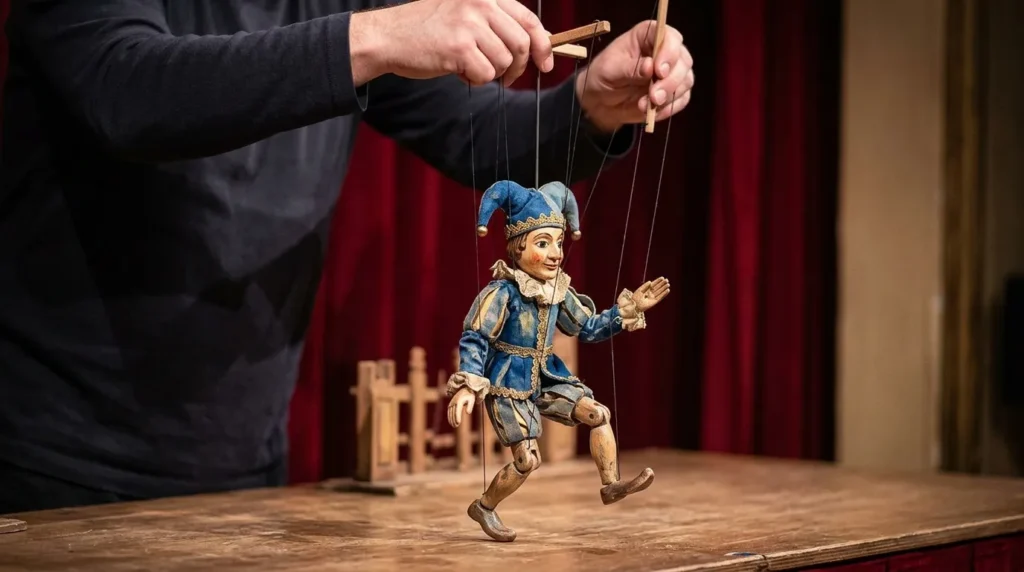
A marionette is a puppet whose arms and legs are controlled by strings from above. It may appear to move of its own will, but in reality, someone else is determining every movement.
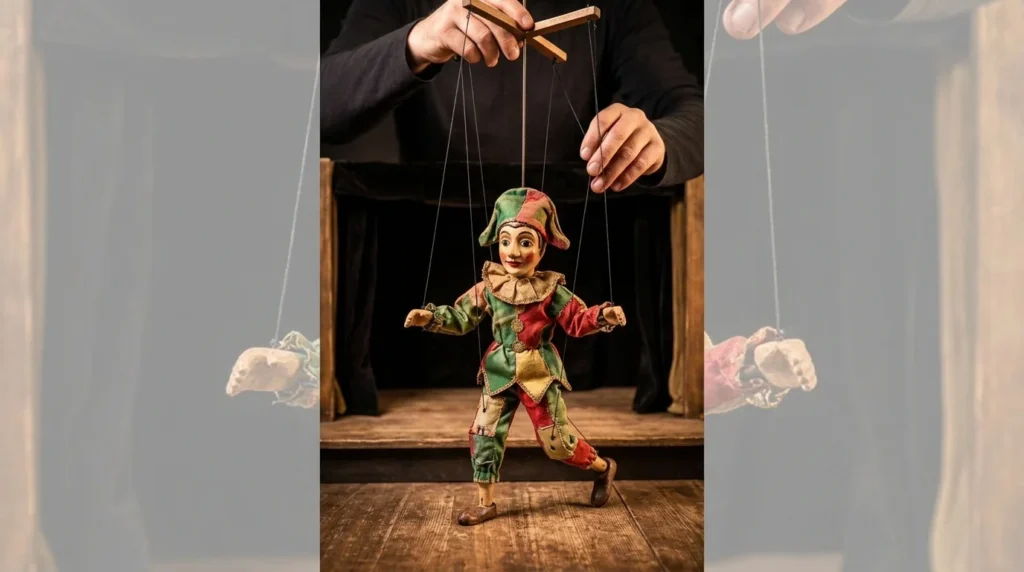
To me, the song uses that image as a metaphor for the way people live. It is not simply about being directly ordered around by someone else. It suggests something subtler: living within a framework created by others for so long that you begin to lose touch with your own instincts. That sense of confinement is what I hear in the word “marionette.”
The Marionette in the Mirror
In the song, the images of the “mirror” and the “marionette” are brought together. This, I think, is what makes the song more than a straightforward anthem of rebellion. The figure reflected in the mirror is not an enemy or society itself. It is the person looking into it.
For me, that shifts the focus away from simply blaming the outside world. The gaze also turns toward the person who has continued living this way. Of course, living in society requires us to adjust to other people. But when that becomes a habit and we can no longer tell what we genuinely want, something has changed.
Choosing for Yourself
If you follow an answer someone else has prepared for you, there is less uncertainty in making a choice. And if things go wrong, you can always tell yourself, “It wasn’t my decision.” But once you choose for yourself, you also have to accept the consequences of that choice.

That is why “MARIONETTE” does not sound to me like a song that simply shouts for freedom. It is a song about moving forward while accepting the fear and responsibility that come with making your own choices.
You Know It’s “MARIONETTE” from the Intro Alone
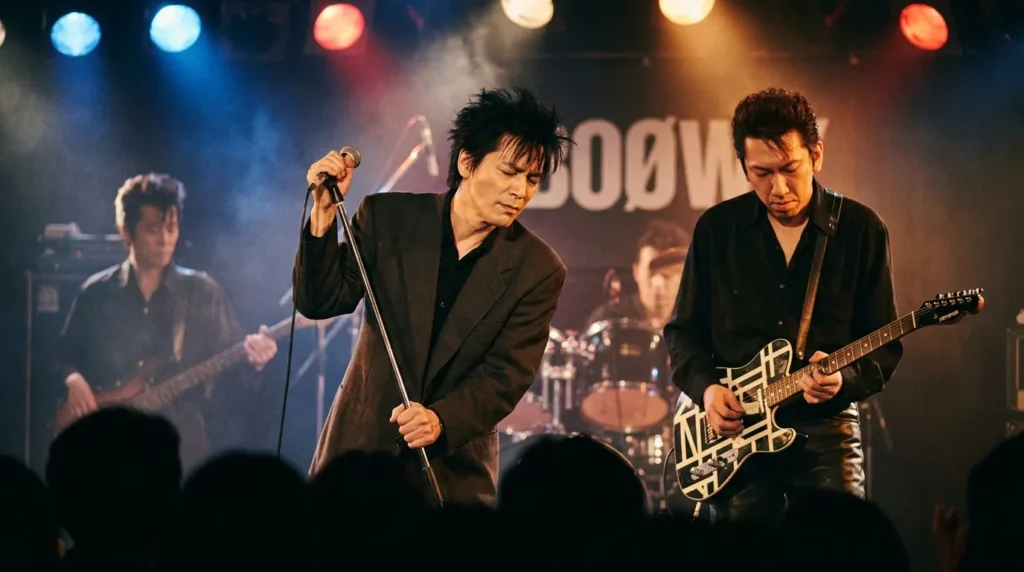
It is impossible to talk about the appeal of this song without mentioning Tomoyasu Hotei’s guitar. The distinctive opening phrase has such a strong identity that it takes only a few seconds to recognize “MARIONETTE.” That is not simply because the song is famous. The sound itself has an unmistakable character, establishing the song before Himuro even begins to sing.
Tsunematsu Matsui’s bass and Makoto Takahashi’s drums then lock into a powerful beat, and Kyosuke Himuro’s voice cuts straight through the center.
Four Distinct Personalities, One Song
One of the fascinating things about BOØWY is that the band never sounds as though only one member matters. Hotei’s guitar has an instantly recognizable presence, while the rhythm section refuses to disappear into the background. Yet even within such assertive instrumentation, Himuro’s voice is never buried—and the vocals never force the rest of the band into a supporting role.
Each of the four musicians pushes his own personality forward, yet everything comes together as a single song. “MARIONETTE” is one of the clearest examples of what made BOØWY sound like BOØWY.

A Precise Beat and a Deeply Human Voice
The rhythm moves forward with power and certainty. Against that disciplined motion, Himuro’s singing is full of subtle shifts in intensity, and the placement of his words is never completely uniform. At times his delivery is sharp; at others, he eases back. Those changes bring a distinctly human emotion to the performance.
There is no need to force a direct connection between the lyrics and the arrangement. Even so, to my ears, the contrast between the tightly controlled instrumentation and the voice that seems determined to break beyond it creates much of the song’s distinctive tension.
Kyosuke Himuro’s Vocals — More Than Sheer Power
Himuro does not simply overpower “MARIONETTE” with volume from beginning to end. He carefully varies his delivery—hitting some words hard, holding others back, then suddenly surging forward. Calling him simply “cool” would be easy, but that alone cannot explain what makes this performance so compelling. There is real craft in the way he sings the song.
The Tension in the Way He Places the Words
What draws me in is not just the strength of Himuro’s voice, but the way he places words against the rhythm. One phrase may sound almost dismissive, while the next flows smoothly into the music. Those shifts give the vocal performance depth and movement.

Even in a song where Hotei’s guitar makes such a powerful statement, Himuro’s vocals remain equally memorable. That refusal of either the instrumentation or the voice to yield to the other keeps “MARIONETTE” under tension until the very end.
1987: BOØWY Reaches No. 1
1987, the year “MARIONETTE” was released, was an extraordinary one in BOØWY’s history. “ONLY YOU” arrived on April 6, followed by “MARIONETTE” on July 22. Soon afterward, the band staged “GIGS” CASE OF BOØWY at Kobe Portopia World Memorial Hall on July 31 and Yokohama Cultural Gymnasium on August 7.
BOØWY performed 39 songs at each of the two concerts. These enormous shows served as something close to a summation of everything the band had built up to that point. Then, on September 5, their final studio album, PSYCHOPATH, was released.
A Breakup Announced at the Height of Their Popularity
With “MARIONETTE,” BOØWY achieved their first No. 1 single. Their popularity was still rising, and from the outside, it seemed as though the band could continue racing forward for years to come.
Yet only about five months later, on December 24, the band suddenly announced their breakup at Shibuya Public Hall. Their final performances as a four-piece came at Tokyo Dome on April 4 and 5, 1988, under the title “LAST GIGS.” 1987 was therefore the year BOØWY surged to the height of their popularity—and the year the end of the band was announced.

Of course, there is no evidence that the meaning of “MARIONETTE” was directly connected to BOØWY’s breakup, and the two should not be treated as though one explains the other. Still, looking back with the benefit of history, I cannot help noticing the curious coincidence: a song about breaking free from being controlled became one of the defining hits of BOØWY’s final year.
Track 6 on PSYCHOPATH
PSYCHOPATH contains 12 tracks, with “MARIONETTE” placed at No. 6, closing the first half of the album. It is preceded by “LIAR GIRL,” “ANGEL PASSED CHILDREN,” “LONGER THAN FOREVER,” “GIGOLO & GIGOLET,” and “RENDEZ-VOUS (Live in Hamburg July 1987),” recorded in Hamburg, Germany.
The second half continues with “PLASTIC BOMB,” “PSYCHOPATH,” “CELLULOID DOLL,” “FANTASTIC STORY,” “MEMORY,” which I ranked No. 5 in this series, and finally “季節が君だけを変える” (“Kisetsu ga Kimi Dake wo Kaeru”).
As a single, “MARIONETTE” has enough force to stand completely on its own. Within the album, however, its placement at the end of the first half gives it another role. Hearing it as part of PSYCHOPATH reveals a different perspective from hearing it simply as one of BOØWY’s biggest hits.
What Becomes Clear When Compared with No. 4, “B・BLUE”
“B・BLUE,” which I ranked No. 4, also carries a powerful sense of moving forward. But to me, the two songs move in slightly different directions. In “B・BLUE,” I hear a protagonist who carries emotional wounds yet continues onward. In “MARIONETTE,” what stands out more strongly is the determination to change the situation itself.
The song is not limited to romantic relationships. Its message can be connected to work, relationships with other people, social expectations, and many other parts of life. That breadth, combined with the force created by guitar, bass, drums, and Himuro’s voice, is what pushes “MARIONETTE” to No. 3 on my list.
In Closing — Refusing to Remain a Puppet
“MARIONETTE” was BOØWY’s first No. 1 single and remains one of their signature songs. But nearly four decades after its release, its enduring appeal cannot be explained by its popularity at the time alone.
Sometimes, after spending so long adapting to the people around us, we can lose sight of what we wanted in the first place. That experience does not disappear simply because times change. Perhaps what matters is not dramatically rebelling against someone else, but first recognizing the situation we have allowed ourselves to remain in.
If the figure in the mirror is a version of yourself being controlled by invisible strings, then what happens next is yours to decide.
Kyosuke Himuro’s words and voice, Tomoyasu Hotei’s guitar, and the powerful rhythm of Tsunematsu Matsui and Makoto Takahashi turn that feeling into something physical rather than merely intellectual. For me, “MARIONETTE” is far more than just one of BOØWY’s coolest and most famous songs.
Do we continue playing the role someone else has given us, or do we trust our own instincts and move for ourselves? Nearly four decades later, “MARIONETTE” still delivers that question with the force of razor-sharp rock and roll.
“`


音楽ファン同士の交流・リクエストはこちら / Connect & Request Songs Here