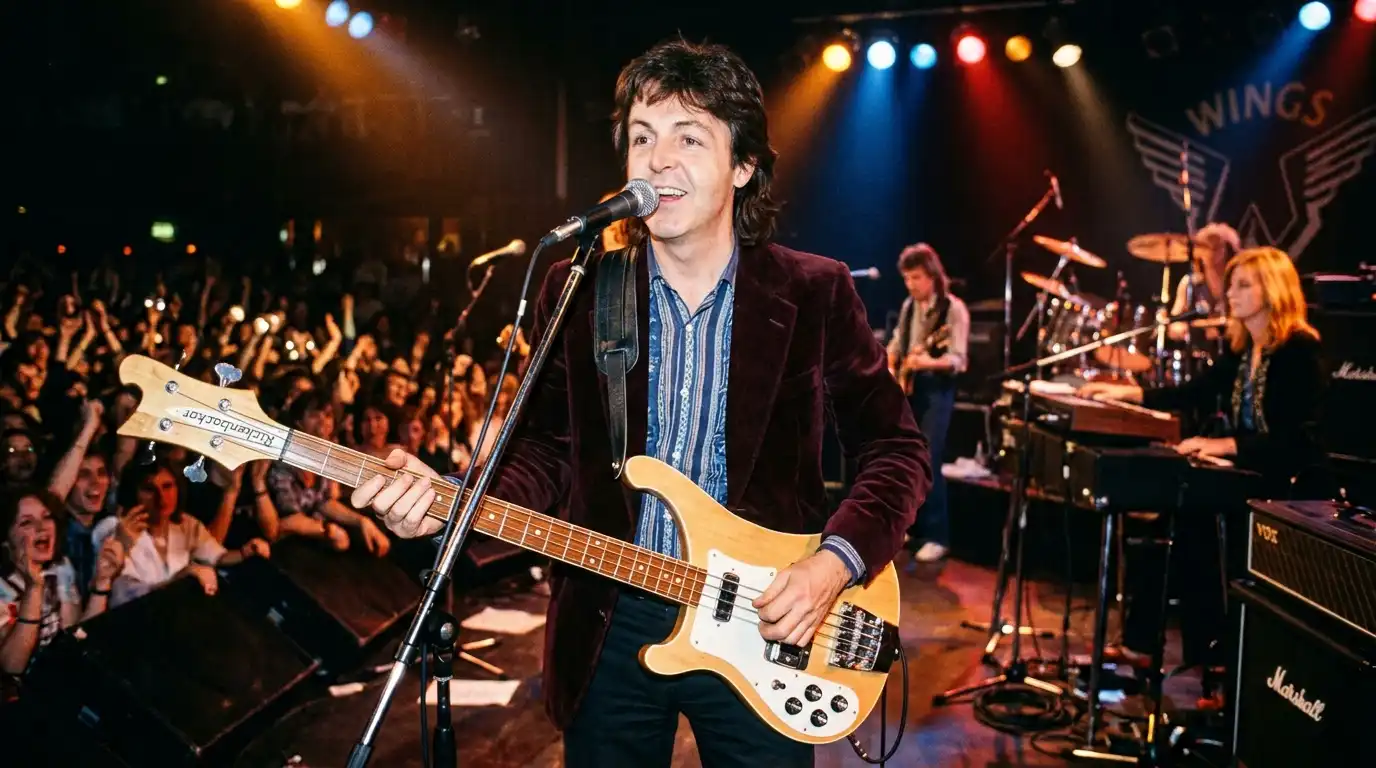
Explore Paul McCartney’s Journey Here!
- 🎧 Enjoy This Article in Audio
- No. 13 is “This One”
- 🎥 First, as always, listen to the official YouTube recordings.
- From “This One” to “This Swan”
- At the Heart of the Lyrics: Missing the Moment
- Intricate Sounds Beneath an Easygoing Melody
- Flowers in the Dirt and McCartney’s Return to the Road
- Two Promotional Videos for “This One”
- In Closing — A Song That Grew from a Tiny Play on Words
🎧 Enjoy This Article in Audio
Listen to a concise narration covering the key points of this article.
Recommended if you would like to get a feel for “This One” and the overall flow of the article before reading.
🎵 English Narration
An English narration introducing the content of this article.
🎶 Japanese Narration
A Japanese narration introducing the content of this article.
Listening first will make it easier to grasp the atmosphere of “This One” and the main points of the article.
No. 13 is “This One”
No. 13 is “This One.” The song appeared on the album Flowers in the Dirt, released on June 5, 1989, and was issued as a single on July 17 of the same year.
The album reached No. 1 on the UK Albums Chart, while “This One” climbed to No. 18 on the UK Singles Chart. It arrived at a time when Paul McCartney was preparing to embark on his first full-scale world tour in roughly a decade.
The song does not begin with some grand event. Instead, it asks a series of deeply personal questions: Did I hold you? Did I look you in the eye and tell you how I felt? Did I truly let you see what was inside my heart?
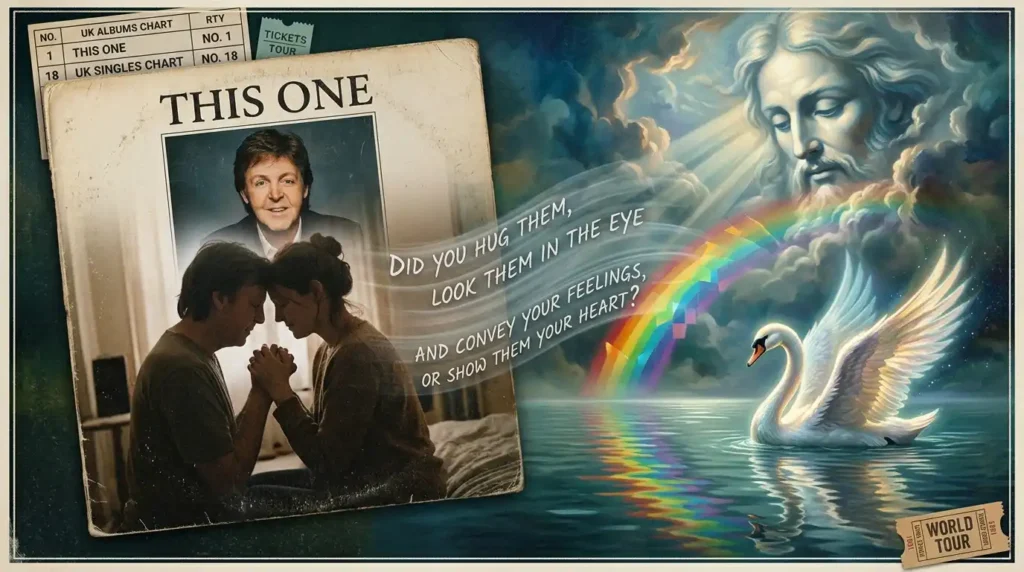
And then, in the middle of these intimate questions, an almost mythical scene appears: a swan, a god, calm water, and a rainbow. A realistic love song suddenly opens onto an entirely different landscape. Behind that unexpected combination lies one of McCartney’s characteristic pieces of wordplay.
Interpretive Translation
I kept my feelings inside, waiting for a better time to tell you.
But while I waited, the moments that mattered quietly slipped away.
If you are going to open your heart to someone you love, the time is not someday — it is now.
Like a swan gliding across the ocean, even the most beautiful moments eventually disappear into the dark.
🎥 First, as always, listen to the official YouTube recordings.
Common Credits
Artist: Paul McCartney
Song: “This One”
Written by: Paul McCartney
Provided to YouTube by: Universal Music Group
Channel: Paul McCartney Official Artist Channel
🎵 This One (Remastered 2017)
Album: Flowers in the Dirt
Original Release: 1989
Remaster: 2017
Produced by: Paul McCartney
Two-Line Commentary
The 2017 remaster of “This One,” originally included on the 1989 album Flowers in the Dirt.
Its approachable melody and carefully layered instrumentation reveal the craftsmanship behind one of McCartney's finely constructed pop songs.
🎤 This One (Live)
Album: Tripping the Live Fantastic
Album Release: 1990
Recording: Live version
Two-Line Commentary
A live version of “This One” recorded during McCartney's 1989–90 world tour and released on Tripping the Live Fantastic.
Compared with the studio recording, the band's rhythmic drive comes further forward, showing how naturally the song worked onstage.
From “This One” to “This Swan”
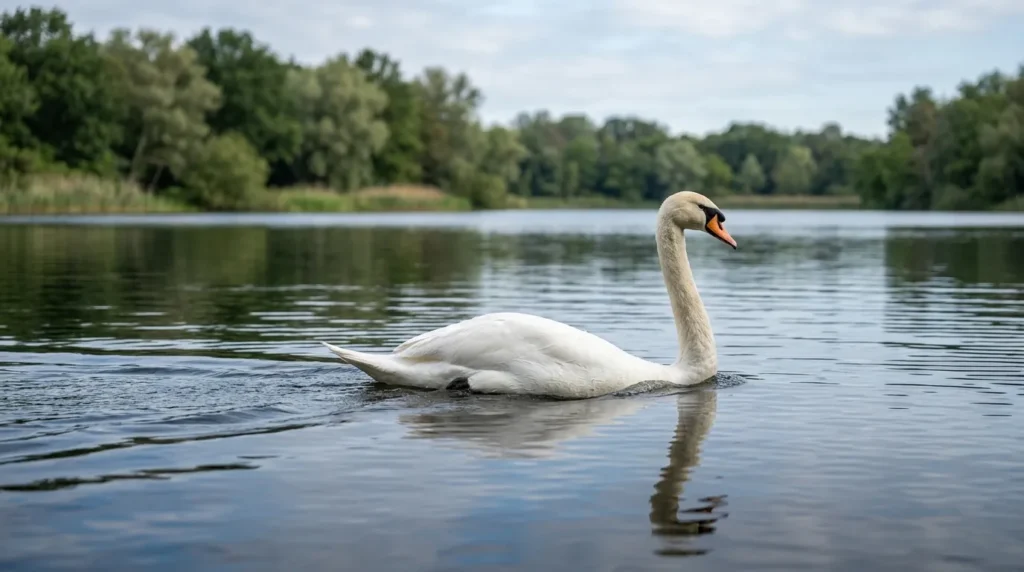
The most fascinating part of the song’s origin is the way its title became connected with the image of a swan. McCartney has explained that after hearing someone say “This One,” the sound of the phrase made him think of “This Swan.”
He was not searching for another word with a similar meaning. The idea began simply because the two phrases sounded alike. Once the word “swan” entered his imagination, the image of a swan gliding across the water found its way into the song.
A Love of Words Inherited from His Father Jim
When discussing the origin of this idea, McCartney has also mentioned that his father, Jim McCartney, enjoyed words and crossword puzzles. Paul himself developed an interest in wordplay during his school years, and that instinct remained with him when he became a songwriter.
Many McCartney songs expand from the sounds, double meanings, or everyday associations of familiar words rather than relying on deliberately difficult language. “This One” is a particularly vivid example of that instinct becoming part of the song’s very subject matter.
Where Did the God Riding on the Swan Come From?
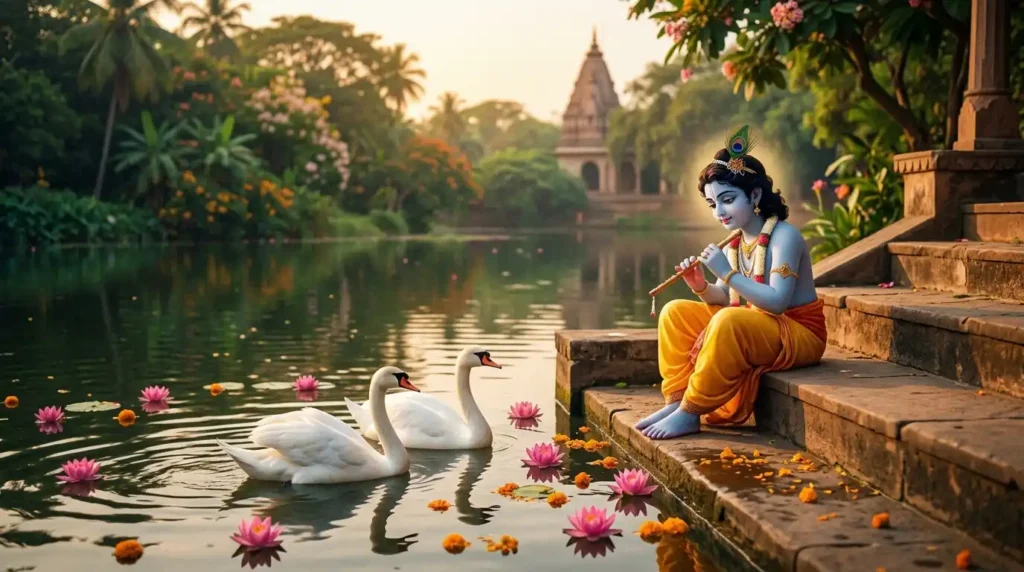
The swan suggested by the phrase “This Swan” then became connected with another memory. McCartney recalled Hare Krishna posters and imagery reminiscent of Hindu art that he had often seen in India.
Those images included Krishna, swans, flowers floating on the water, and a sense of calm. McCartney was not presenting himself as a follower of a particular religion. Rather, he explained that he was attracted to beautiful imagery found across different religious traditions.
An ordinary phrase — “This One” — suddenly sounded like “This Swan.”
From that small change in sound, a love song acquired its images of a swan and a god.
At the Heart of the Lyrics: Missing the Moment
The swan imagery is memorable, but the central emotion of the song is firmly grounded in everyday human experience. McCartney himself has described “This One” as essentially a love song.
The narrator wanted to express his feelings to someone he loved. Yet he kept thinking that a slightly better opportunity might come along, and so he failed to act. Looking back, he begins to question that decision.
The Longer We Wait for the Perfect Moment, the More Time Passes
The more important something is, the more carefully we often try to express it. We choose our words, watch the other person’s mood, and wait for a more suitable opportunity. Yet excessive caution can make the opportunity itself disappear.

“This One” does not explain that psychology in a preachy way. Instead, it gradually reveals why the opportunity was lost through a series of questions addressed to a loved one.
If the “better moment” never arrived, perhaps the moment that was already there was the right one after all. The title “This One” compresses that realization into two simple words.
Intricate Sounds Beneath an Easygoing Melody
“This One” is not a song designed to startle the listener with a huge guitar riff or a dramatic modulation. What stays with you first is its flowing melody and the instantly memorable title phrase.
Yet the recording contains an unusually broad range of sounds: acoustic and electric guitars, keyboards, harmonium, sitar, harmonica, percussion, and more. McCartney himself played several instruments in addition to bass.
An Arrangement That Never Feels Overcrowded
What is striking is that, despite the number of musical elements involved, the arrangement never feels congested. Each instrument contributes a short phrase, texture, or accent before ultimately supporting the vocal and melody.
The sitar and harmonium are particularly effective. Their timbres sit naturally alongside the lyrical imagery of swans and Krishna, giving the track a character that differs subtly from more conventional late-1980s pop.
How the Studio and Live Versions Reveal Different Designs
- In the studio version, numerous instruments are carefully placed around the vocal, creating a wide range of textures without overwhelming the melody.
- In the live version, the band’s rhythm section and backing vocals become more prominent, giving the song greater forward momentum onstage.
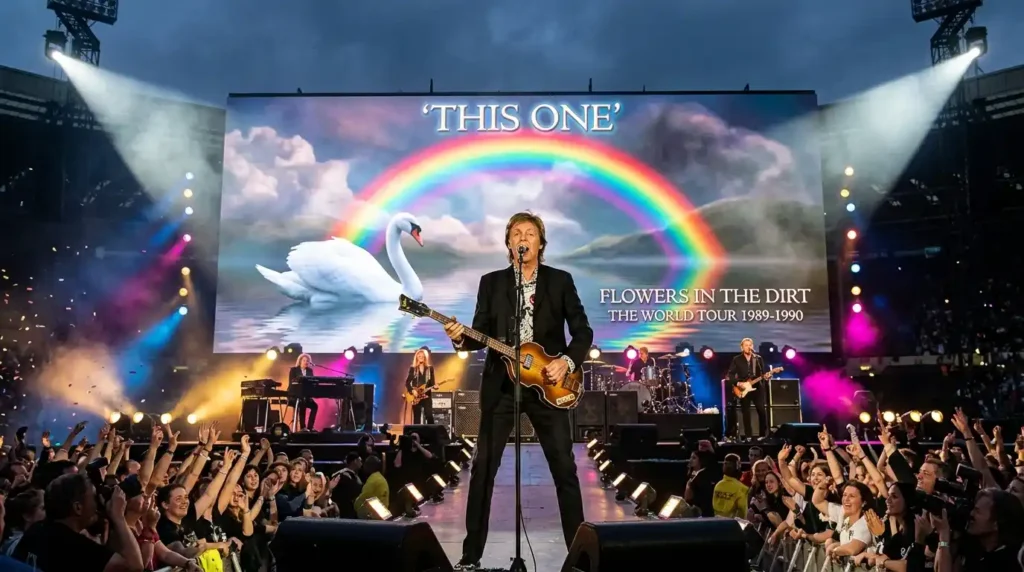
Flowers in the Dirt was made with the large-scale world tour beginning in September 1989 very much in mind.
“This One” was also performed on that tour, where it took on a character distinct from its carefully constructed studio recording.
Flowers in the Dirt and McCartney’s Return to the Road
One of the major talking points surrounding 1989’s Flowers in the Dirt was McCartney’s songwriting collaboration with Elvis Costello. Four songs on the album — “My Brave Face,” “You Want Her Too,” “Don’t Be Careless Love,” and “That Day Is Done” — were written by the pair.
“This One,” however, was written by McCartney alone. While the album as a whole involved extensive collaboration with other musicians and producers, this particular song brings his own fascination with words and his instinct as a melodist directly to the surface.
Back on a Major World Tour
In September 1989, McCartney began his 1989–90 world tour. It was his first full-scale tour since 1979, and “This One” was performed onstage as one of the representative songs from his new album.
Rather than relying exclusively on Beatles and Wings classics, McCartney placed his current material alongside them in the set list. In that sense, Flowers in the Dirt was more than another studio album: it also provided the foundation for his return to large-scale live performance.
Two Promotional Videos for “This One”
Two different promotional videos were produced for “This One” in 1989. The fact that the song received two separate visual treatments also suggests the importance it was given during the promotion of Flowers in the Dirt.
Tim Pope’s Eastern-Inspired Vision
The first video was directed by Tim Pope and filmed in June 1989 at Albert Wharf Studio in Battersea, London. Often referred to as the “Eastern promo,” it features Paul, Linda, the band, and Indian dancers.
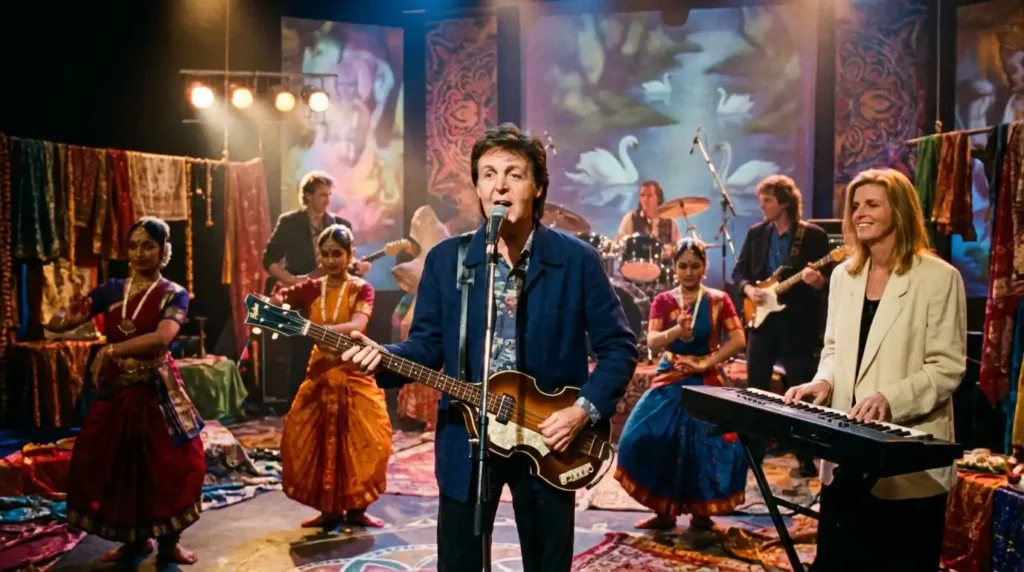
Considering the chain of associations that led McCartney from the swan to Krishna, the visual approach is more than decorative. It can be seen as an extension of imagery that had already emerged while the song itself was being created.
A Second Vision from Dean Chamberlain
A second version was made the following month under the direction of photographer Dean Chamberlain. It was filmed in a rehearsal barn in southeast England and used distinctive lighting techniques to create an atmosphere very different from the first video.
Making two separate films for a single song allowed McCartney to explore two different visual approaches. “This One” therefore also offers a glimpse of how actively he was experimenting with music video imagery in 1989.
In Closing — A Song That Grew from a Tiny Play on Words
Tracing “This One” back to its origin reveals an unexpectedly simple starting point. The everyday phrase “This One” sounded like “This Swan,” and from there the association expanded toward a swan, Krishna, and a tranquil waterside scene.
Yet the emotion at the heart of the song never leaves ordinary human relationships. It is about failing to say what needed to be said, waiting too long for the right opportunity, and discovering that time has moved on. Mythic imagery and familiar emotion coexist within the same song.
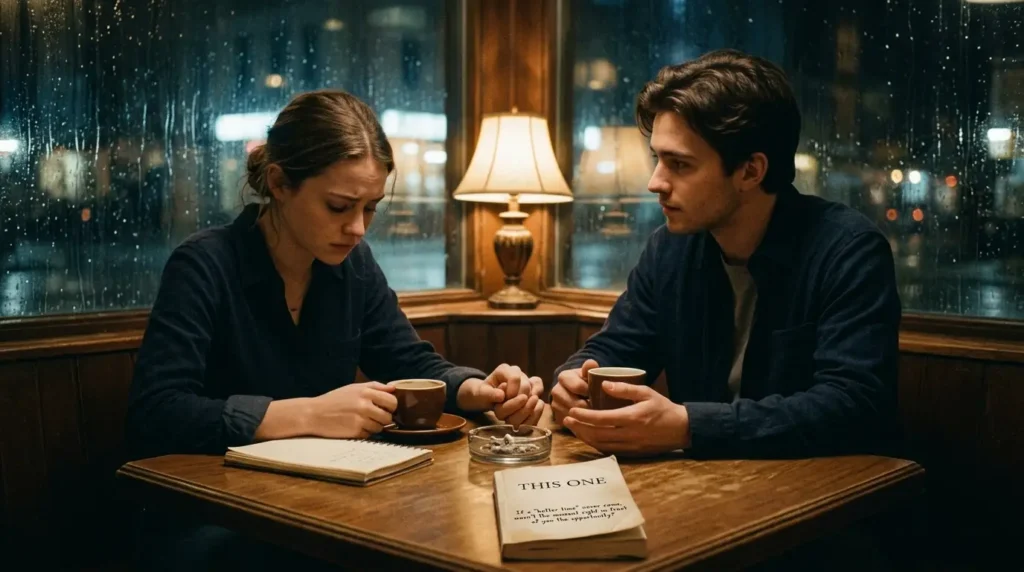
What I find so fascinating about “This One” is how far McCartney can expand a song’s world from nothing more than a small association between two sounds, without needing a grand subject to begin with.
From “This One” to “This Swan.”
Born from that small piece of wordplay, the song remains a wonderfully clear example of Paul McCartney’s flexible imagination as a songwriter.

音楽ファン同士の交流・リクエストはこちら / Connect & Request Songs Here