- 🎧 Enjoy This Article in Audio
- Prologue — The Presence of Kyosuke Himuro
- Chapter 1: Before BOØWY — Committing His Life to Rock
- Chapter 2: BOØWY — From Six Members to Four, and the Breakthrough
- Chapter 3: Kyosuke Himuro Goes Solo — Choosing Not to Continue BOØWY
- Chapter 4: Los Angeles — Changing His Environment to Create Music
- Chapter 5: 2016 — Another “LAST GIGS”
- My Personal miniBest — Why I Don’t Separate BOØWY and Himuro’s Solo Career
- Conclusion — From BOØWY to His Solo Career, and on to 2016
🎧 Enjoy This Article in Audio
You can quickly explore the key points of this article through narration.
Recommended before reading if you would like an overview of Kyosuke Himuro’s journey from BOØWY to his solo career and through LAST GIGS in 2016.
🎵 English Narration
An English narration introducing the key points of this article.
🎶 日本語ナレーション
この記事の内容を日本語で紹介する音声です。
Listening first will make it easier to follow Kyosuke Himuro’s journey from BOØWY to his solo career and grasp the main points of the article.
Prologue — The Presence of Kyosuke Himuro
In the 1980s, Japanese rock underwent a dramatic transformation. Rock bands moved beyond live houses into concert halls, stadiums, and eventually domes, becoming a major force in youth culture. One of the bands that came to symbolize that change was BOØWY.
Standing at the front of that band was Kyosuke Himuro.
His voice combined an edgy sharpness with a distinctive sensuality. He had his own way of shaping words into melody, and a stage presence that could change the atmosphere the moment he appeared. For many people, Himuro remains memorable not only for the songs he sang, but for the way he embodied them onstage.
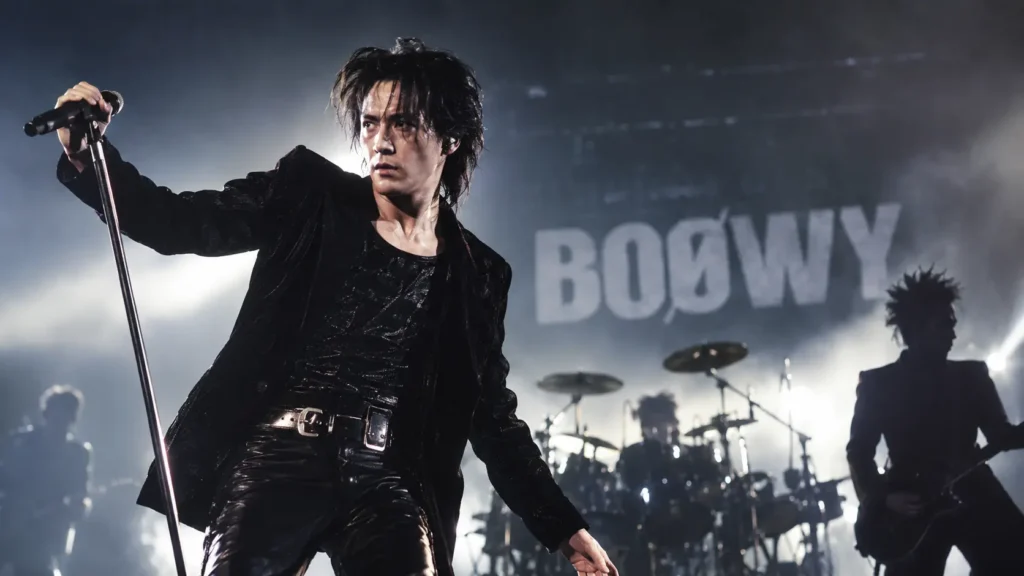
But Himuro’s story cannot be told through BOØWY alone. After the band broke up, he started again as a solo artist and went on to build a long career of his own through the 1990s and beyond.
Introducing My Personal miniBest
This time, I am changing the format slightly from my usual “My Personal Best 10,” “Best 15,” and “Best 20” series. Instead, I have selected seven songs for a new feature I call “My Personal miniBest.”
For me, a Best 10 or longer ranking is reserved for artists whose music I have explored extensively over many years and for whom I can readily rank ten or more songs I truly love.
But there are also many artists whose entire catalog I may not have explored as deeply, yet I can still name around seven favorite songs without hesitation.
Leaving those artists out simply because I cannot make a full Best 10 would be a missed opportunity. That is why I decided to create this new “miniBest” format.
By adding miniBest to the series, I can feature a much wider range of artists in a substantial, self-contained format. When I do not have enough favorites even for a miniBest, I can continue introducing individual songs through features such as my birthday series.
The first artist I chose is Kyosuke Himuro.
This ranking includes not only his solo work but also songs from his years with BOØWY. I will explain why later in the article, but first, let us trace his path from the years before BOØWY through his 2016 “LAST GIGS.”
Chapter 1: Before BOØWY — Committing His Life to Rock
From Gunma into the World of Music
Born October 7, 1960
Kyosuke Himuro was born on October 7, 1960. He is two years younger than I am. He spent his youth in Gunma and developed a strong attraction to rock music at an early age.
At the time, succeeding in a rock band was hardly the kind of career path that seemed readily available. Even so, Himuro chose music and eventually began pursuing his career in Tokyo.
Joining Forces with Tomoyasu Hotei
One person who would become indispensable to the story of Himuro’s musical career was Tomoyasu Hotei, another musician who came from Gunma.
Himuro’s vocals and Hotei’s guitar: when these two powerful personalities came together in the same band, a story began that would leave a major mark on the history of Japanese rock.
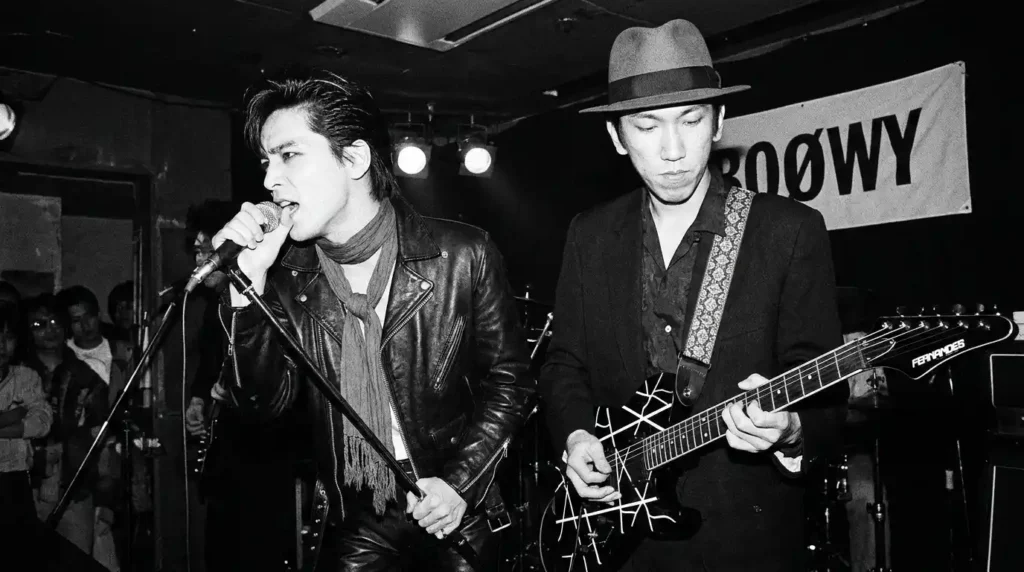
Chapter 2: BOØWY — From Six Members to Four, and the Breakthrough
1981: Beginning as a Six-Member Band
BOØWY Wasn’t Always the Four-Piece We Remember
BOØWY was formed in 1981. It was also the year I graduated from university and began my working life.
The original lineup was not limited to the four members who later became widely known — Kyosuke Himuro, Tomoyasu Hotei, Tsunematsu Matsui, and Makoto Takahashi. Guitarist Atsushi Moroboshi and saxophonist Kazuaki Fukazawa were also members, making BOØWY a six-piece band at the beginning.
Moroboshi and Fukazawa later left, and from the autumn of 1982 onward, BOØWY consisted of Himuro, Hotei, Matsui, and Takahashi. That lineup remained intact until the band broke up.
MORAL — A Raw Beginning
In March 1982, BOØWY made its record debut with the first album MORAL. Early BOØWY had a rawness reminiscent of punk and new wave, quite different from the sharply refined sound the band would later develop.
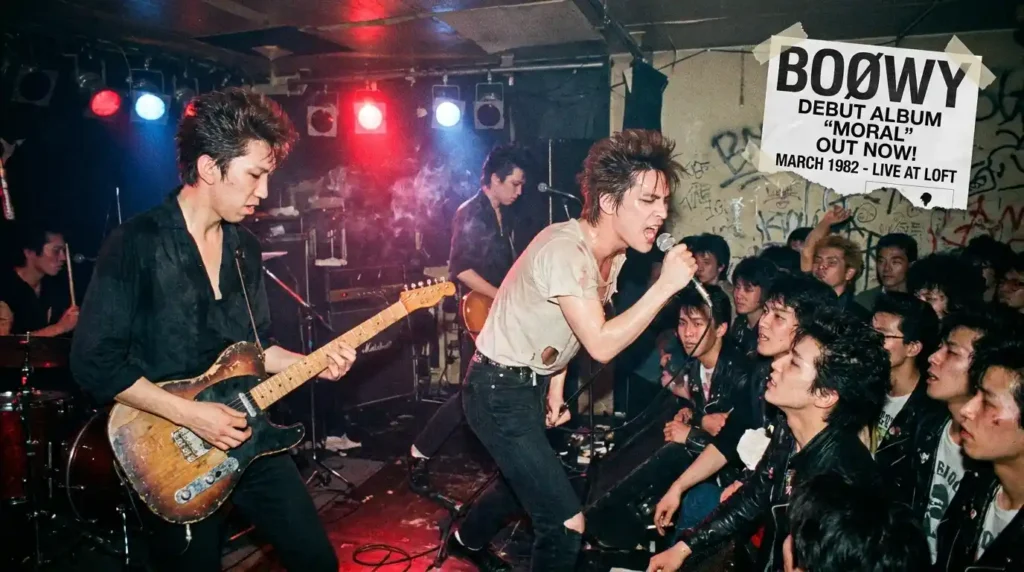
It was edgy, rough, and carried a certain sense of danger. The trial and error of those early live-house years helped lay the foundation for the BOØWY that would emerge later.
The Shape of BOØWY Emerges as a Four-Piece
Himuro’s Voice and Hotei’s Guitar
Once BOØWY became a four-piece, one of the first things that commanded attention was the relationship between Himuro’s vocals and Hotei’s guitar.
Himuro’s voice raced over Hotei’s angular, rhythmic guitar. Rather than one simply supporting the other, the collision of two strong personalities created a distinctive tension within the songs. For me, that was one of BOØWY’s great attractions.
The Foundation Built by Tsunematsu Matsui and Makoto Takahashi
Supporting them were Tsunematsu Matsui on bass and Makoto Takahashi on drums. By avoiding unnecessary clutter and keeping each instrumental role clearly defined, they created the space that allowed the guitar and vocals to stand out.
It was not simply flashy; even the placement of the sounds was cool. That remains one of the qualities I enjoy most when listening to BOØWY.
1985 — BOØWY and the Emergence of Their Definitive Sound
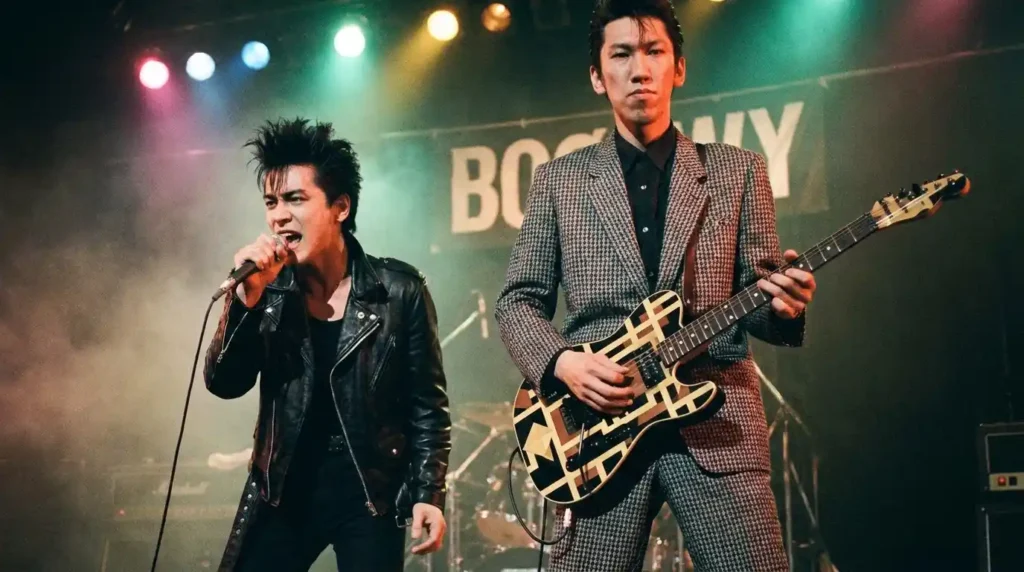
The band’s third album, BOØWY, released in 1985, marked a major turning point. Songs such as “HONKY TONKY CRAZY” and “BAD FEELING” emerged from this period, and while the energy of the early years remained, both the playing and production became considerably more refined.
From here, BOØWY began accelerating beyond the live-house circuit toward much larger stages.
JUST A HERO — The Decisive Breakthrough of 1986
Their First Nippon Budokan Concert
With the release of their fourth album, JUST A HERO, in 1986, BOØWY entered the period of its decisive breakthrough.
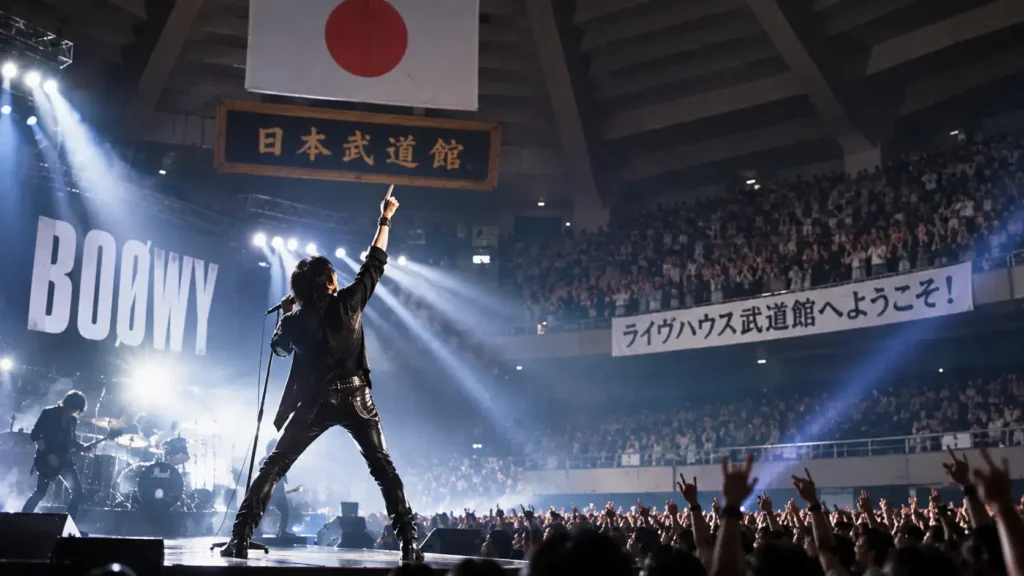
On July 2 that year, the band performed at Nippon Budokan for the first time. Himuro’s famous greeting — “Welcome to the live house Budokan!” — has remained one of the phrases most closely associated with BOØWY.
From BEAT EMOTION to PSYCHOPATH
The same year brought the single “B・BLUE” and the album BEAT EMOTION. In 1987 came “ONLY YOU,” “MARIONETTE,” and the album PSYCHOPATH.
With a succession of hit releases in a remarkably short period, BOØWY expanded beyond the core rock audience and became one of the best-known bands in Japan.
Choosing to Break Up at Their Peak
December 24, 1987 — Shibuya Public Hall
Any account of BOØWY must eventually confront the way the band ended. On December 24, 1987, at Shibuya Public Hall, BOØWY announced its breakup while still at the height of its popularity.
This was not a band fading away after its popularity had declined. BOØWY stopped at a point when people still wanted to see what might come next. Perhaps that is one reason the band left such an enduring impression.
Tokyo Dome — “LAST GIGS”
On April 4 and 5, 1988, BOØWY held “LAST GIGS” at the newly opened Tokyo Dome. Around 100,000 tickets for the two performances sold out in just ten minutes, and the flood of reservation calls was so intense that telephone lines in Tokyo’s Bunkyo Ward were overwhelmed.
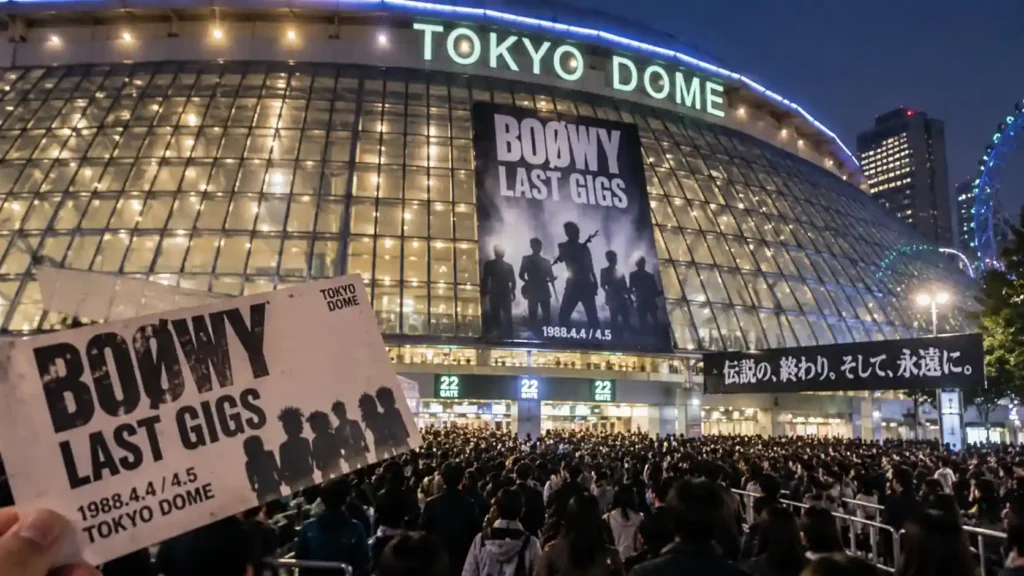
BOØWY thus came to an end while still commanding enormous popularity.
Chapter 3: Kyosuke Himuro Goes Solo — Choosing Not to Continue BOØWY
“ANGEL” — A New Beginning in 1988
About three months after BOØWY’s final performances, Kyosuke Himuro made his solo debut on July 21, 1988, with “ANGEL.”
What began here was not an attempt to continue BOØWY by himself. Free from the fixed structure of a band, Himuro began building a new career centered on his own voice and melodic identity.
An Expression That Went Beyond Rock Alone
His solo work retained the edge of rock while expanding into ballads and more pop-oriented material. He carried the powerful image of BOØWY with him without simply recreating it. To me, that is part of what made Himuro’s solo career so interesting.
The 1990s — Establishing Himself as a Solo Artist
“KISS ME” and Memories Of Blue
The 1992 single “KISS ME” surpassed one million in sales. The following year’s album, Memories Of Blue, went on to sell more than 1.5 million copies.
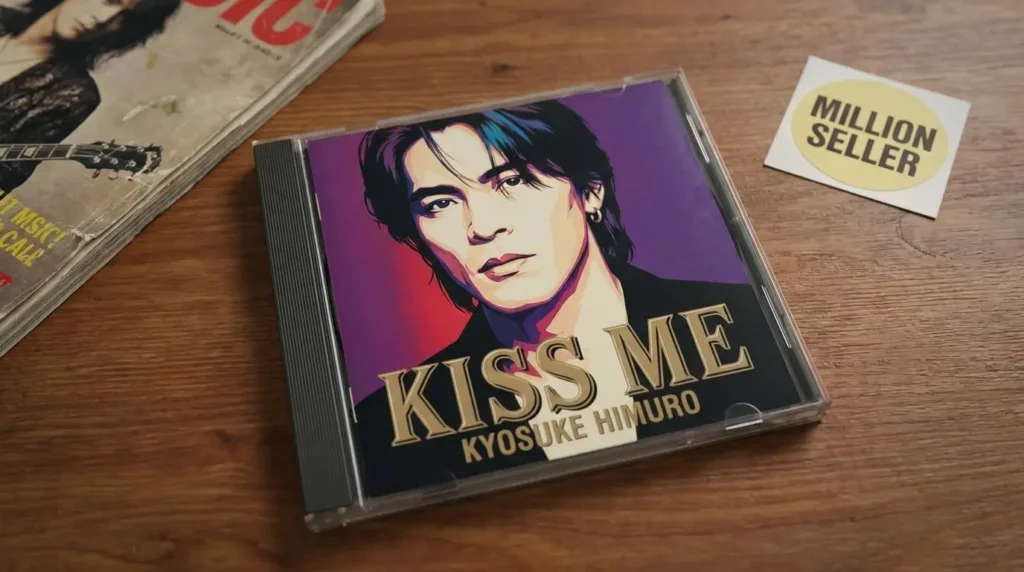
About five years after BOØWY’s breakup, Himuro could no longer be adequately described simply as “the former vocalist of BOØWY.” He had firmly established an independent identity as a solo artist.
Chapter 4: Los Angeles — Changing His Environment to Create Music
1997 — Moving His Base to the United States
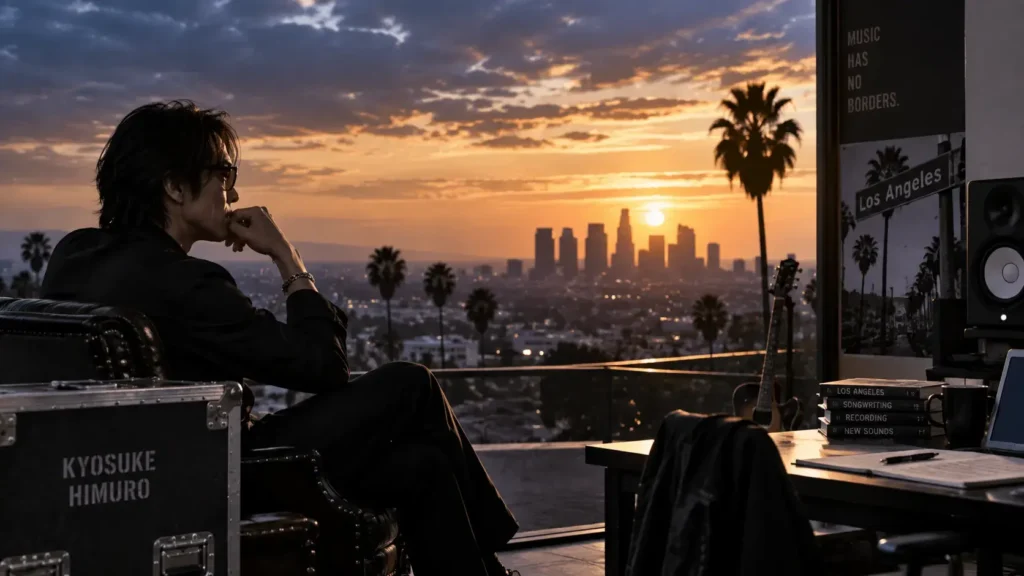
In 1997, Kyosuke Himuro moved his base of operations to Los Angeles. He continued creating music while returning to Japan for live performances.
He had already established a secure position in Japan, yet chose to change the environment in which he worked. To me, that decision reflects a determination not to remain tied to one place or one established style, but to keep pursuing his own music.
The “Ø” in BOØWY has been associated with the idea of “belonging nowhere and wanting to be like no one else.” Those words belong to the story of the band’s name, yet in retrospect they also seem to echo something in the path Himuro later chose for himself.
Reconnecting with the Songs of BOØWY
2004 — “21st Century Boøwys vs HIMURO”
On August 22, 2004, Himuro performed “21st Century Boøwys vs HIMURO ~An Attempt to Discover New Truths~” at Tokyo Dome, bringing songs from both the BOØWY era and his solo career onto the same stage.
After spending years building an independent career, Himuro did not reject the songs of his former band. Instead, he sang them again as part of his own musical history. For fans who had followed both BOØWY and his solo career, it was a symbolic concert.
2011 — An Entire Tokyo Dome Concert of BOØWY Songs
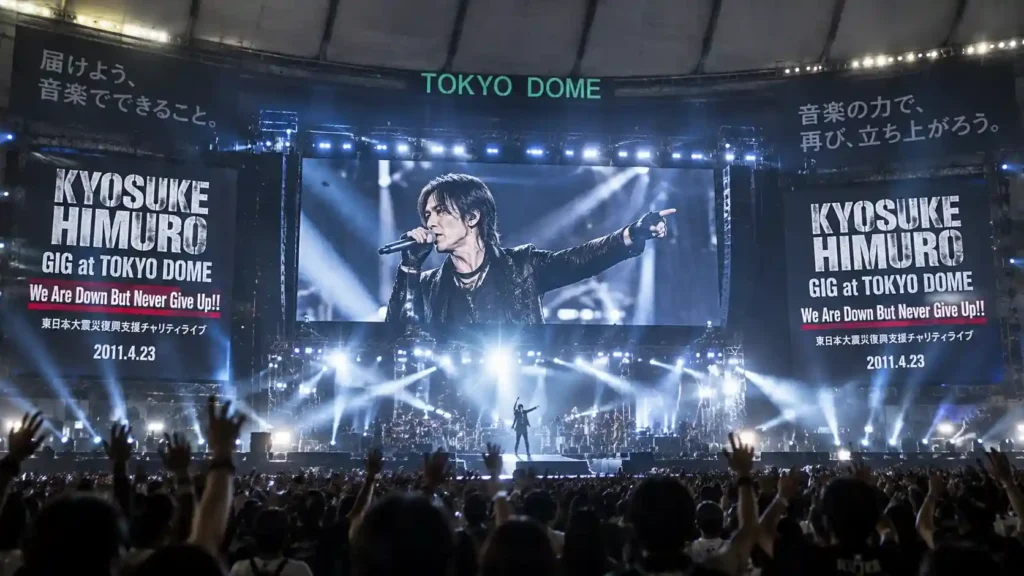
On June 11 and 12, 2011, Himuro held the Great East Japan Earthquake reconstruction charity concerts “GIG at TOKYO DOME ‘We Are Down But Never Give Up!!’”
The entire program consisted of BOØWY songs. More than two decades after the band’s breakup, those songs once again filled Tokyo Dome in Himuro’s own voice.
Chapter 5: 2016 — Another “LAST GIGS”
Hearing Problems and an Indefinite Hiatus from Live Performance
In 2014, Himuro revealed that problems with his hearing were making it increasingly difficult for him to continue performing at a level he could personally accept, and he announced his intention to step away from live performance.
The Four-Dome Tour “KYOSUKE HIMURO LAST GIGS”
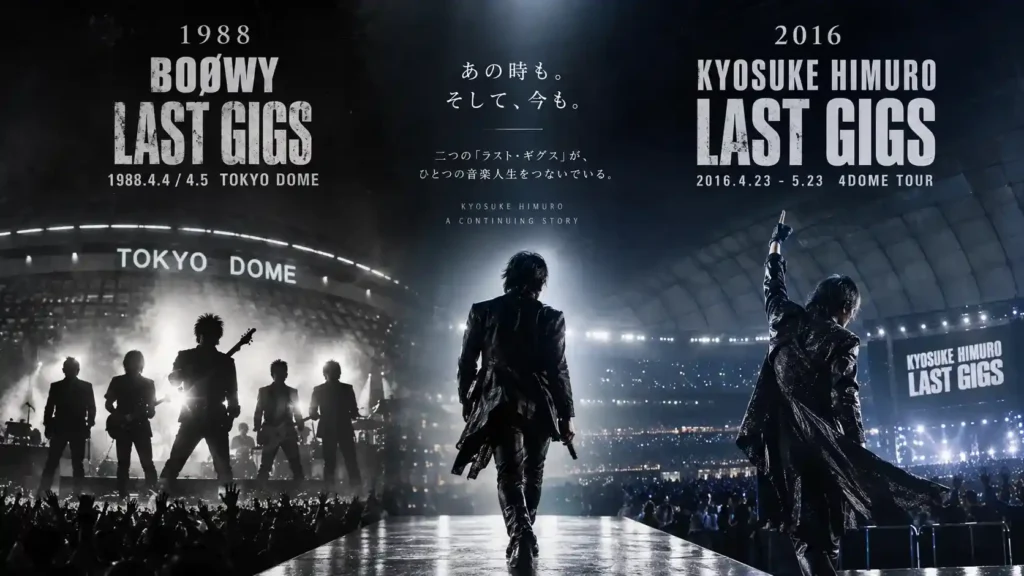
From April through May 2016, Himuro embarked on the four-dome tour “KYOSUKE HIMURO LAST GIGS.” Seven concerts were held in Osaka, Nagoya, Fukuoka, and Tokyo, drawing approximately 300,000 people.
The final performance took place at Tokyo Dome on May 23. Himuro sang 35 songs spanning both the BOØWY years and his solo career, bringing a major chapter of his life as a live performer to a close.
1988 and 2016 — Two “LAST GIGS”
In 1988, BOØWY’s final concerts carried the title “LAST GIGS.” Twenty-eight years later, the same words appeared again on the tour that marked Himuro’s withdrawal from live performance.
After bringing BOØWY to an end and moving forward as a solo artist, Himuro arrived at “LAST GIGS” once again 28 years later. To me, the recurrence of those words draws a single line through his musical life.
My Personal miniBest — Why I Don’t Separate BOØWY and Himuro’s Solo Career
BOØWY Was a Band Created by Four Individuals
For this edition of “My Personal miniBest,” I am ranking Kyosuke Himuro’s solo work together with songs from his BOØWY years.
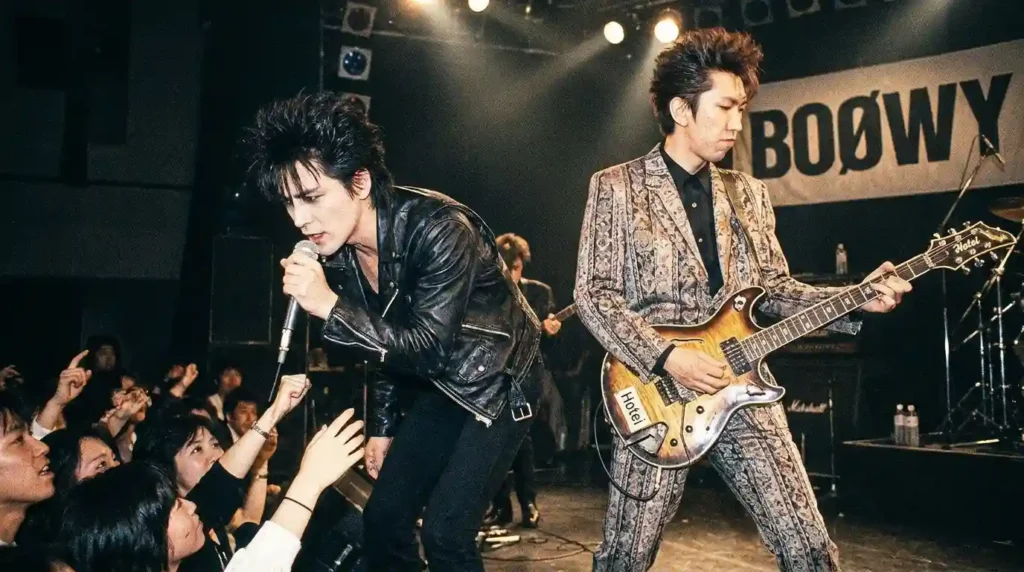
Of course, I do not regard BOØWY simply as “Kyosuke Himuro’s band.” There was Tomoyasu Hotei’s guitar, Tsunematsu Matsui’s bass, and Makoto Takahashi’s drums. And if we include the original six-member period, BOØWY was a band created through the combination of several distinct personalities.
Yet to My Ears, It All Forms One Continuous Story
At the same time, I have never listened to the BOØWY years and Himuro’s solo career as two completely separate worlds. Because his voice remains at the center, the two periods connect naturally in my mind.
So this is not a ranking of BOØWY’s achievements, nor is it an attempt to decide whether the band or Himuro’s solo career was better. I am simply choosing the seven songs I love most from the music I have listened to as “songs sung by Kyosuke Himuro.” That is my only criterion.
Conclusion — From BOØWY to His Solo Career, and on to 2016
From BOØWY’s formation in 1981, the band moved from live houses to Nippon Budokan and finally Tokyo Dome. After breaking up at the height of its popularity, Himuro began a new path as a solo artist in 1988.
During the 1990s, he established himself firmly as a solo artist, and in 1997 he moved his base to Los Angeles. In the years that followed, he continued his career while also reconnecting with songs from the BOØWY era, before bringing his live activities to a major turning point with “LAST GIGS” in 2016.
Looking back over that journey, what strikes me about Kyosuke Himuro is that he neither discarded his past nor remained trapped by it. He carried the history of BOØWY with him while building a separate life and body of work as a solo artist.
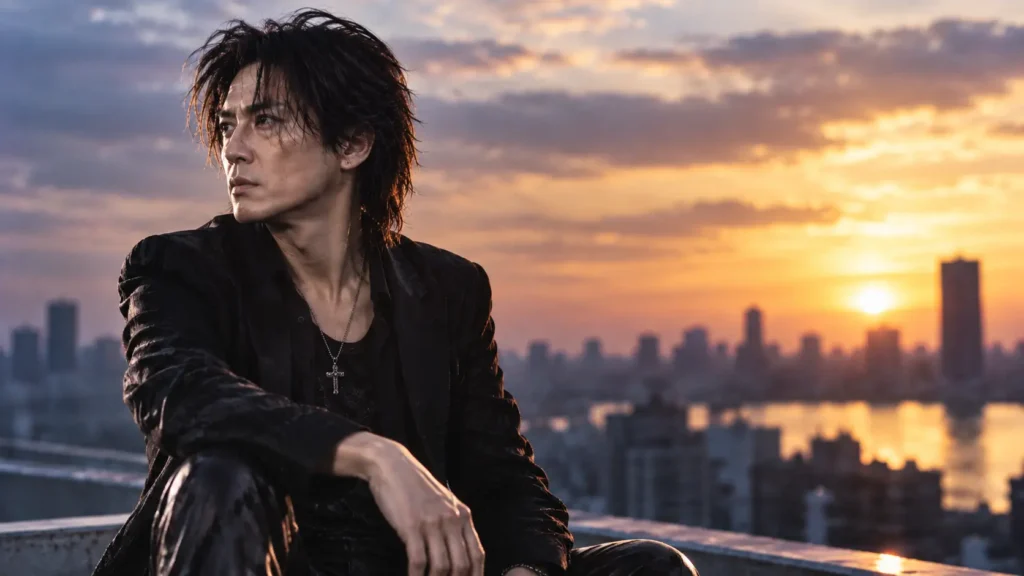
Starting with the next article, I will begin “My Personal miniBest: Kyosuke Himuro.”
This is not about BOØWY versus his solo career.
These are simply the “Kyosuke Himuro songs” I love.
On that basis alone, I chose seven.

音楽ファン同士の交流・リクエストはこちら / Connect & Request Songs Here