
■For more details about 【Led Zeppelin】, click here・・・・➡ 🎈(Zeppelin)
- 🎧 Listen to the Audio
- 🎸【Led Zeppelin Series】No.7 is・・・・
- 1973: An Answer to George Harrison’s “Question”
- The Sonic “Moisture” Painted by Page’s Guitar
- Robert Plant’s “Rain-Soaked” Vocals That Repaint the Seasons
- From No.8’s “Motion” to No.7’s “Erosion”: A Borderless Catharsis
- My No.7: The Luxury of Music That Doesn’t Rush for Answers
🎧 Listen to the Audio
This article is also available as an approximately 3-minute audio narration.
Follow the gentle atmosphere of rain and the immersive soundscape of No.7, “The Rain Song.”
Please enjoy listening before reading, or after you’ve finished.
🇺🇸 English Narration
🇯🇵 Japanese Narration
🎸【Led Zeppelin Series】No.7 is・・・・
No.7 is “The Rain Song.”
After the dazzling, blinding world we experienced with No.8, “The Song Remains the Same,” we are now wrapped in the quiet presence of rain. Here, the band’s explosive, kinetic energy is gently subdued, allowing sublime droplets of sound to seep into the most delicate corners of the heart.
【Ultra-brief: The Turning Seasons of Love】
The budding of spring that signals the beginning of love, the summer sunlight that illuminates hardship, and the winter cold that freezes everything. As the seasons turn, a once-burning passion transforms its shape and settles into a quiet “rain.” This is not a tale of despair, but a record of compassionate acceptance—embracing all things and leading gently toward the next rebirth.
🎥 As always, please start by watching the official YouTube video.
🎬 Official Video Credits (Official Audio)
 Song: The Rain Song
Artist: Led Zeppelin
Album: Houses of the Holy (1973)
Written by: Jimmy Page / Robert Plant
Source: Remastered version (official audio)
 Two-line Commentary
A lyrical masterpiece blending delicate 12-string guitar arpeggios with John Paul Jones’s majestic Mellotron. Beginning in stillness and gradually swelling with orchestration, its dramatic arc draws the listener in completely.
1973: An Answer to George Harrison’s “Question”
The Provocation: “Don’t You Write Ballads?”
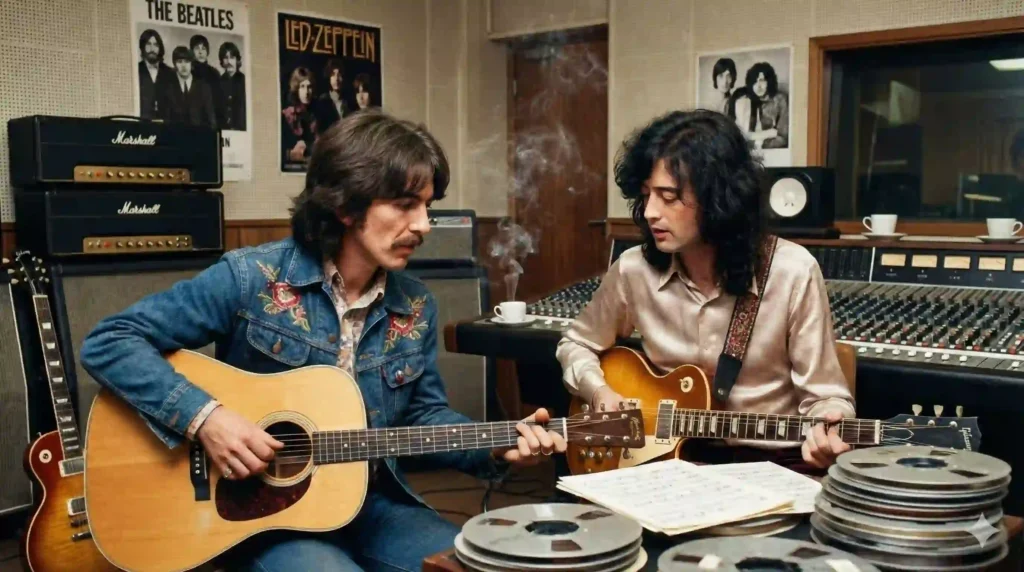
The birth of this song is tied to a fascinating anecdote. It is said that George Harrison of The Beatles once asked Jimmy Page, “Led Zeppelin is great, but why don’t you write ballads?” This question became the catalyst, and the response was this expansive lyrical epic, stretching over seven minutes.
A Deliberate Homage Disguised as Quotation
It is often said that the opening chord progression subtly nods to George Harrison’s signature song, “Something.” Yet what unfolds from there transcends the boundaries of a simple ballad—it is pure “sonic orchestration,” achievable only by Zeppelin.
The Sonic “Moisture” Painted by Page’s Guitar
Beyond Physical Resonance: Painting a Landscape
Jimmy Page’s guitar work on this track can only be described as divine. The depth created by alternate tunings and the resonant 12-string guitar does more than play melodies—it conjures “damp air” and even the “scent of wet earth” right before the listener’s eyes.
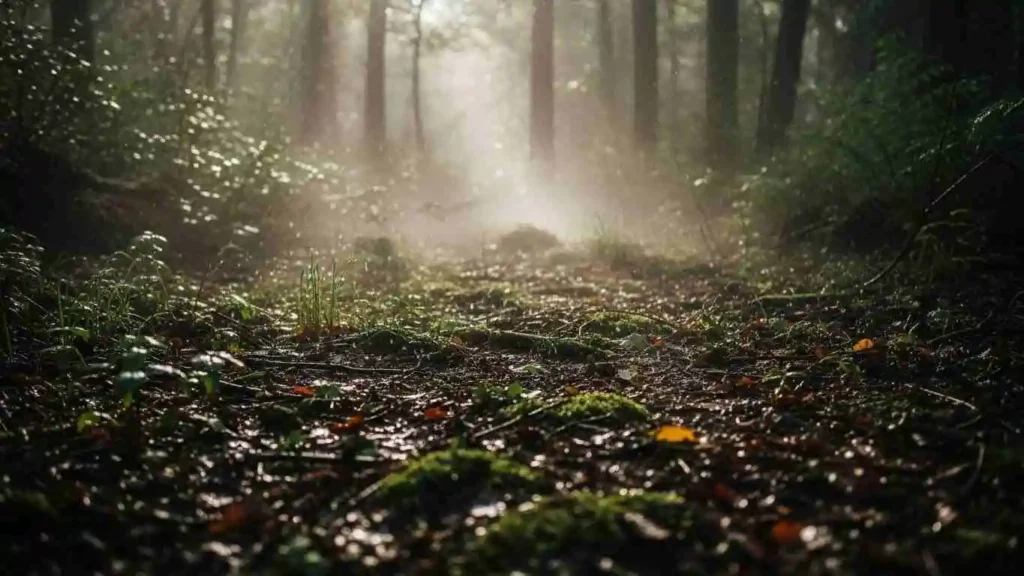
What captivates me most is the “mass” of each individual note. Though never struck forcefully, every sound particle reaches the skin like a cool drizzle, carrying a tangible chill. Immersed in these tones, I forget the room I’m in and feel as though I’m standing at the edge of a rain-shrouded forest in some distant land.
An Ecstatic Experience Born of Ambiguous Dynamism
A structure so unique that one can’t tell whether it truly “builds” or not—this is what makes the song singular. While many tracks accelerate toward a clear climax, this one slowly but surely engulfs our emotions, like a rising tide or a sky subtly shifting its colors.
Robert Plant’s “Rain-Soaked” Vocals That Repaint the Seasons
The Shape of Passion Revealed After Silencing the Shout
In this song, Robert Plant carefully restrains his trademark piercing wails. What reaches us instead is a breathy, astonishingly wet vocal delivery.
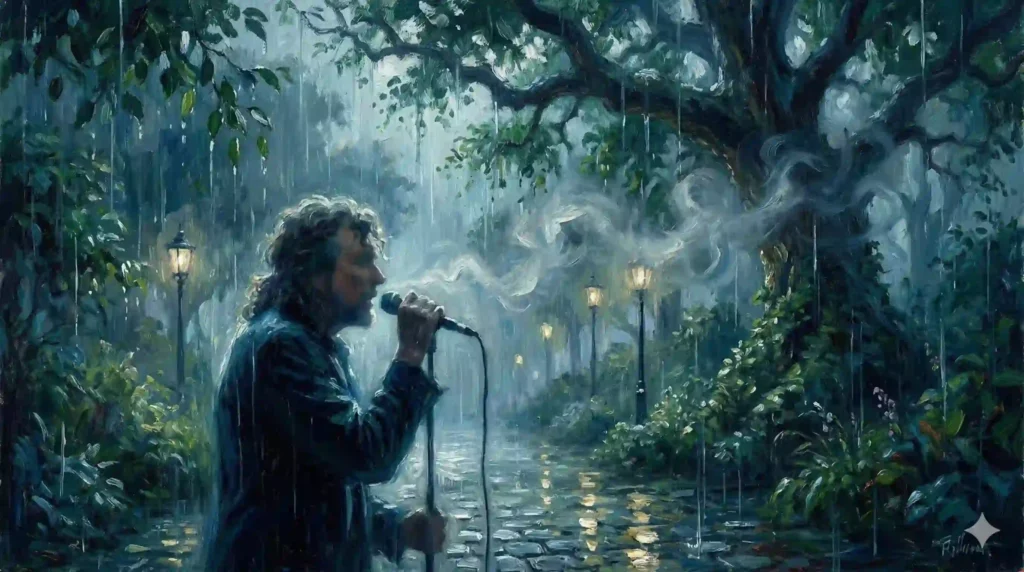
The lyrics are filled with vivid imagery—“the spring of love,” “sunlight in troubled times,” “the cold of winter.” Yet when filtered through Plant’s voice, every scene feels slightly distant, as if viewed through mist. Perhaps it is because his voice itself fills the spaces between sounds with fog.
The Salvation in the Words “Just a Little Rain”
The repeated phrase near the end, “Just a little rain”. A fierce love drama is ultimately accepted as a natural phenomenon, an unavoidable part of life. This graceful placement of emotion is precisely why this song continues to draw us in, time and time again.
From No.8’s “Motion” to No.7’s “Erosion”: A Borderless Catharsis
A Luxurious Timeline That Refuses to Define a Climax
This strange sensation—wondering whether there is a climax at all—may be the most luxurious musical experience this song offers.
If No.8, “The Song Remains the Same,” is a vertical surge that rockets to top speed from the intro, then No.7 is a horizontal erosion, like water slowly rising from the ground. Where is the peak? When did the ecstasy begin? With those boundaries blurred, we find ourselves deeply submerged in a vast orchestral whirlpool. This comfort of dwelling in a gradient where light and shadow are indistinct marks one artistic pinnacle that Led Zeppelin reached.

Endless Ripples Drawn by Page’s Guitar
Here, we are captivated not by speed or sharpness, but by the beauty of how the notes fade away. Freed by alternate tuning, the overlapping strings interfere with one another, eroding our consciousness like ripples spreading across water. This subtle placement of sound transcends mere “skill,” carrying an improvised rawness—as if the air itself were being soaked with sound.
My No.7: The Luxury of Music That Doesn’t Rush for Answers
The Memory of a “Light Rain” That Repaints the Room
I love listening to this song on dim, rainy days. The droplets of sound from the speakers slightly lower the room’s temperature, turning everyday colors into monochrome. There is no exhilaration like that of No.9 or No.8—but instead, a deep stillness that allows quiet reflection within oneself.

Not rushing to an answer, not forcing a conclusion—simply accepting the rain as it is. Perhaps this strength, which affirms ambiguity, is what I need most right now.
What This Ranking Order Means
Placing this “ultimate mist” immediately after the “ultimate light” of No.8 was a deliberate choice on my part. By juxtaposing light and dark, motion and stillness, I wanted to reaffirm the vast expressive range that Led Zeppelin possessed.
Less clearly defined than No.8, yet once entered, impossible to escape—this deep wetness. After finishing “The Rain Song,” what lingers in our hearts is a gentle dampness, and something like residual warmth that remains unresolved.


コメント