■For more details about 【Led Zeppelin】, click here・・・・➡ 🎈(Zeppelin)
🎧 Listen to the Audio
This article is also available as an approximately 3-minute audio narration.
Experience the sonic journey of No.6, “Over the Hills and Far Away,” as it grows from quiet stillness into powerful motion,
and captures the exhilaration of crossing into the unknown.
🇺🇸 English Narration
🇯🇵 Japanese Narration
🎸【Led Zeppelin Series】No.6 is・・・・
No.6 is “Over the Hills and Far Away”—a track that transforms vividly from delicate acoustic phrasing into a thunderous full-band sound.
This song holds both the exhilaration of a traveler crossing an unknown boundary and a kind of longing for a far-off world. With the Top 5 just ahead, I wanted to place here a piece that condenses the very essence of Zeppelin’s dynamism.
From the opening acoustic guitar—like a single beam of light slipping in—to the explosive midsection where the view suddenly opens up: every time I hear it, I feel a comfortable “absence of borders,” as if I’m being carried somewhere far away.
【Ultra-brief: Setting Out for Uncharted Lands】
A traveler’s monologue, moving forward toward an unseen ideal place while carrying the pains of encounters, farewells, and experience. It is a story of will—one that feels the weight of the baggage, yet chooses to let the heart race at the infinite possibilities beyond the hills, searching for hope in the wind.
🎥 As always, please start by watching the official YouTube video.
🎬 Official Video Credits (Official Audio)
Song: Over the Hills and Far Away
Artist: Led Zeppelin
Album: Houses of the Holy (1973)
Written by: Jimmy Page / Robert Plant
Source: Remastered version (official audio)
Two-line Commentary
A classic that begins as delicate folk—guided by the sparkling tone of a 12-string guitar—then suddenly alchemizes into hard rock. The meticulous layering of guitars, unique to studio recording, gives the song’s world a deep sense of dimension.
🎬 Official Video Credits (Live Footage)
Song: Over the Hills and Far Away
Artist: Led Zeppelin
Live: Live at Madison Square Garden (1973)
Film: The Song Remains the Same
Two-line Commentary
An overwhelming performance that runs over six minutes. From the hush of the acoustic opening to the moment Jimmy Page’s solo erupts, this is a precious document that lets you experience the band’s dramatic dynamism in perfect form.
1973: The Moment Folk and Rock Happily Married
A New Direction Proposed by “Houses of the Holy”
On their fifth album, released in 1973, they fused acoustic texture and heavy rock as naturally as it gets. Rather than the earlier split between a “folk side” and a “hard rock side,” this track shows an organic transformation within a single song—like a plant growing into a great tree.

It also matters that this song is placed as the album’s second track. After the headlong rush of the opener “The Song Remains the Same”, it resets the listener and draws them into a deeper labyrinth of “story.” That calculated sequencing is proof of the band’s seemingly invincible production sense at the time.
The “Growth of a Story” Drawn by Page’s Guitar
From a Solitary Phrase to Polyphonic Euphoria
Jimmy Page’s opening arpeggio feels somehow lonely, yet it carries a dignified strength. From there, layers gradually accumulate, and as the 12-string joins, the sound’s particles spread into every corner of the room.
What draws me so strongly to this song is this process of “sound growing.” It doesn’t merely switch to something louder; it unfolds with necessity—like a delicate ember expanding into a great flame. The Les Paul’s roar never kills the acoustic afterglow; instead, it inherits that narrative and lifts it to a higher plane.

The Traveler’s “Breath” Living Inside the Voice
Robert Plant’s voice is also exceptionally expressive here. It begins with a soft, low tone that feels almost conversational, and the moment the band enters, it changes into a power that seems to split the sky.
That evolution reaches me like a physical sequence: the traveler starts walking, then breaks into a run, then finally cries out. More than technique, it’s the reality of that “breath” that gives the song a living depth as a narrative.
The “Release” of Crossing a Boundary: What the Live Version Reveals
A Happy Collision Between Studio Precision and Live Wildness
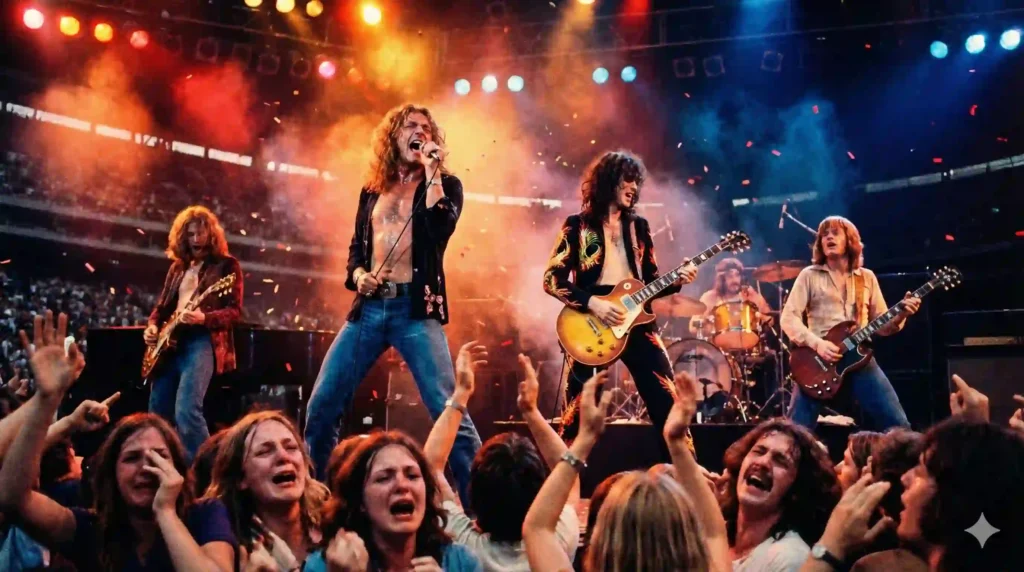
In the studio version, the track carries the feel of a meticulously crafted “sound artifact,” built through Jimmy Page’s layered overdubs. But when you watch the 1973 Madison Square Garden footage I’ve shared here, you witness how that artifact transforms into a “living beast.”
Each acoustic note absorbs the “gravity” of tens of thousands of people filling the venue, then breaks through into band sound like thunder. The catharsis of seeing the studio’s delicate shading repainted into raw passion onstage—this isn’t mere reproduction. It feels as if the song itself is granted new life under the lights, shedding its skin at ferocious speed.
An Unfamiliar Horizon Opened by Page’s Guitar Solo
Most notable is the mid-song guitar solo. What you hear from Jimmy Page here goes beyond what the word “fluid” can cover. Slicing the space with a distorted tone, it urges us onward—farther, deeper—without letting up.
Even with a full six-minute runtime, every second is dense with sound, so it never feels long—perhaps because he isn’t simply “playing notes,” but “performing the travel scenery itself.”
What Do We Find “Over the Hills”?
Gold, Fate, and an Endless Journey
Follow the lyrics and you’ll find words that carry the weight of a life lived—like “Many have I loved, many have I craved”. And then there’s the repeated refrain: “Over the hills and far away.”
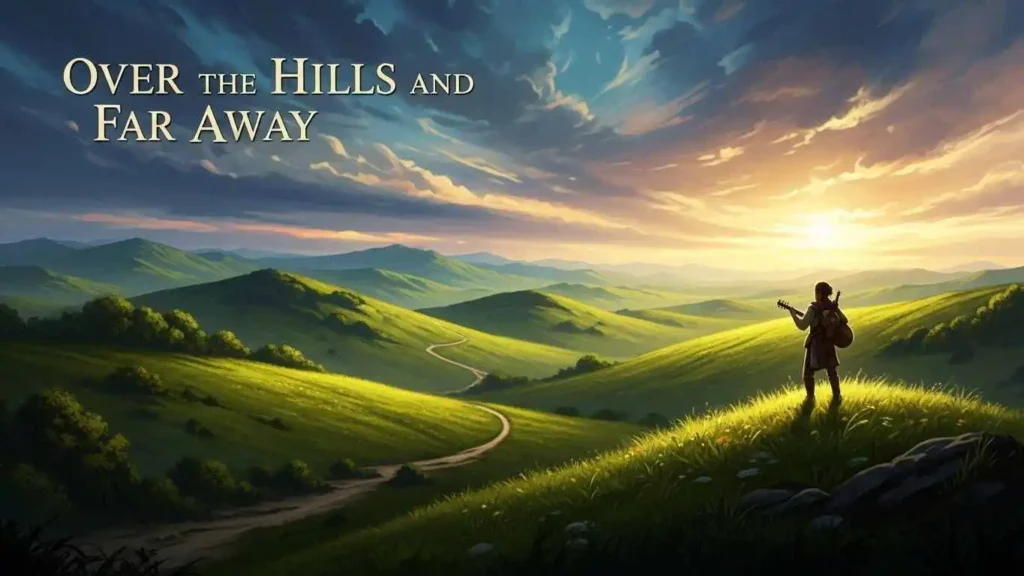
I don’t think “over the hills” points to some literal place on a map. Rather, it may symbolize our “inner thirst”—a longing that can never be fully satisfied, no matter how many years pass or how much we experience. Gold, fortune—things that seem within reach yet remain out of grasp. The pain of continuing to chase them dissolves into that beautiful, fierce melody with a strange transparency.

My Own Original Landscape, Living in the Gaps Between Words
I love the time I spend sinking into this song alone in my room at dusk.
The particles of sound from the speakers blend with the scenery outside the window, and the boundary lines of everyday life begin to blur. In moments like that, faces of places I once traveled to—and people I can no longer meet—float up softly on the waves of sound.
This song doesn’t instruct us, as if trying to teach a lesson. It simply seems to quietly affirm a desire sleeping deep inside the heart—an unbearably pure and bittersweet wish to “go somewhere.”
No.6 as a Proud Waypoint: A Bridge to the Top 5
Why “This Rank”?
Because this is where Led Zeppelin’s two souls—“stillness” and “motion,” “folk” and “rock”—are balanced and harmonized with the greatest perfection.
From No.25 to No.7, we’ve been unraveling their many facets one by one. As a conclusion to that journey—or as the “best energy” needed to step into the supreme realm of the Top 5—I felt this was exactly the right spot.
The Best Energy to Open the Next Door
If No.7, “The Rain Song”, sank our hearts into drizzle and gave us introspective depth, then No.6, “Over the Hills and Far Away,” turns that heavy contemplation into a powerful spring—and releases us back into the “outer world.”
“There are still unseen sights. There are still sounds we must hear.”
Now that we’ve finished listening to a song that gives us that certainty, a staircase finally appears before us—leading to the Top 5, a temple of rock. The view from there should be colored in tones entirely different from what we’ve seen so far.
コメント