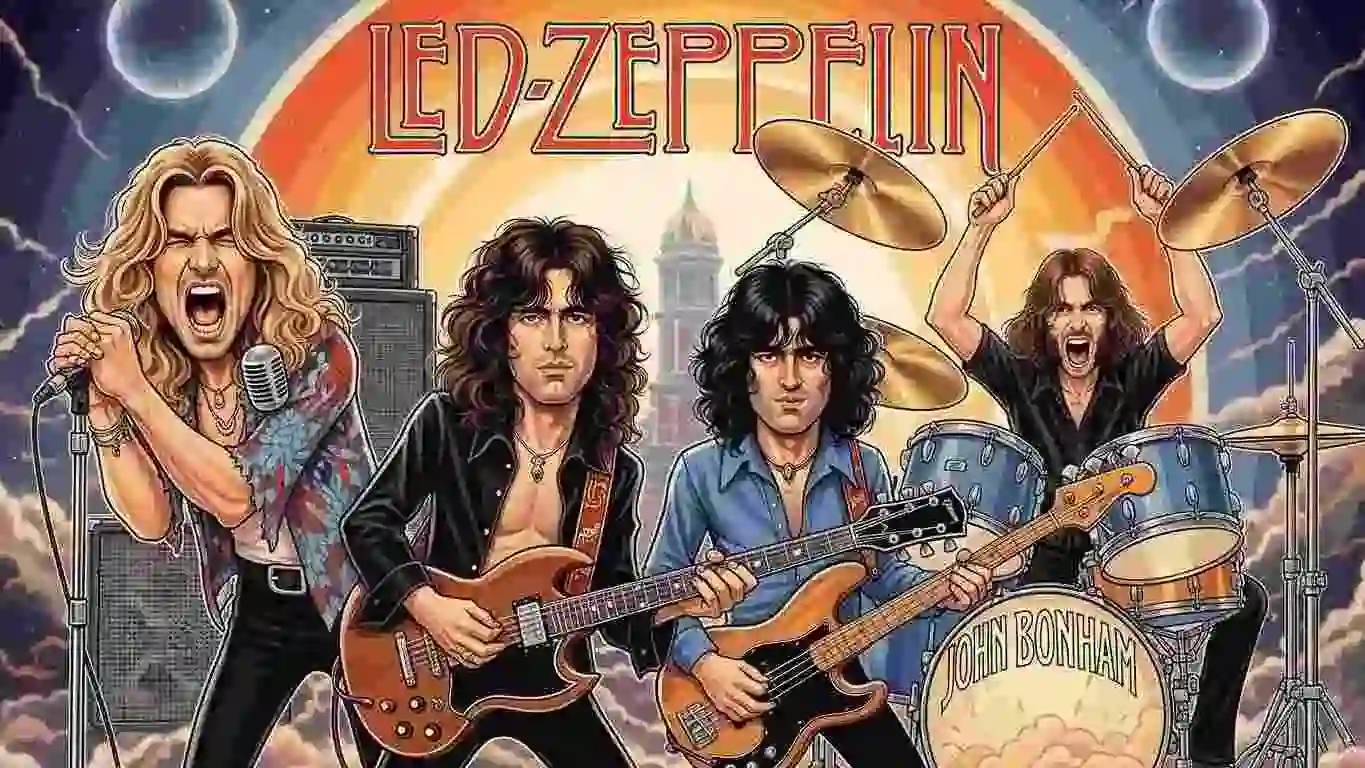
■For more details about 【Led Zeppelin】, click here・・・・➡ 🎈(Zeppelin)
*Note: This is the longest article I’ve ever written. The narration only serves as a summary, so please take your time and read through to the end. It should be a moving story.*
- 🎧 Listen to the Audio
- 🎸【Led Zeppelin Edition】No.1 is…
- 🎥 First, as always, please watch the official YouTube videos.
- Official Tribute Performance (2012 Kennedy Center Honors: Heart)
- 🎭 The Peak of the Myth — and the Time That Followed
- The Miracle of Headley Grange: A “Sketch of Light” Born Before the Fireplace
- The Depth of the Lyrics: Plant’s “Illusion of Gold”
- The Secret of the Gear: The Telecaster That Opened the Wall of Sound
- John Bonham’s Silence: The 4-Minute, 18-Second Restraint
- Urban Legends and Truth: The Backmasking Controversy
- Closing Thoughts
🎧 Listen to the Audio
This article is also available as a short, approximately three-minute audio narration.
Following the flow of the text, the narration explores the song’s tension and its relentless forward momentum.
Feel free to listen before you read, or after you finish the article.
🇺🇸 English Narration
🇯🇵 Japanese Narration
🎸【Led Zeppelin Edition】No.1 is…
No.1 is “Stairway to Heaven.” No one should be surprised. It simply couldn’t be anything else.
An 8-minute-and-2-second epic from Led Zeppelin IV (1971), “Stairway to Heaven.” Speaking about this song goes beyond discussing rock — it feels like interpreting a myth. At last, we have arrived here. Or perhaps, we were destined to arrive.
This melody is so famous and so thoroughly heard that it should have worn thin long ago. Yet even after more than half a century, it still shakes our souls. Why? Because this song is not merely a masterpiece — it is the highest form of architectural beauty the human spirit can reach. No matter how many words of praise we pile up, they fade into mist before the light this song emits. Its overwhelming presence leaves even admiration powerless. That is what this song is.

【Ultra-Short Summary: A Golden Stairway Toward Eternity】
A woman seeks a stairway that leads to heaven.
Captivated by glittering things,
she still cannot face what truly matters beyond them.

A hint of wind, the rustling of trees, a guiding sound from afar.
Doubt and awakening quietly exchange places within the heart.

There is not only one path—small realizations can change where we go.
Eventually everything resonates together, returning to a single melody—
leaving behind a faint hope.
A vine of sound sprouting from the seed of silence, stretching step by step toward light. Acoustic delicacy and hard-rock power blend in perfect proportion, freeing the listener’s soul from the gravity of everyday life — the most beautiful rite of ascension in rock history. It is the highest art permitted only when four geniuses crossed paths in miraculous alignment.
🎥 First, as always, please watch the official YouTube videos.
This time I’ve prepared two official videos (studio audio / live), plus one special extra: an official tribute performance.
🎬 Official video credits (official audio)
Song: Stairway to Heaven
Artist: Led Zeppelin
Album: Led Zeppelin IV (1971)
Writers: Jimmy Page / Robert Plant
Audio: Remastered (official audio)

Two-line note
Often called one of the most-played songs in radio history, this immortal masterpiece connects folk, blues, and hard rock into one unbroken line — a summit of popular music.
🎬 Official video credits (live footage)
Song: Stairway to Heaven (Live at Earls Court 1975)
Artist: Led Zeppelin
Show: Earls Court Arena (May 25, 1975)
Video release: Led Zeppelin DVD (2003)

Two-line note
A document from an era that fits the phrase “the ease of champions.” You can feel the elasticity of live time as they command a massive venue with a single shared breath.
The 1975 Earls Court performance captures Led Zeppelin at the height of their reign. Page’s double-neck guitar fills the venue with cathedral-like resonance, as if sound itself were reshaping space.
The moment Bonzo’s drums enter mid-song, the air density changes instantly. From stillness to motion, and then to heat — the “stairway” structure becomes vividly three-dimensional in the live setting.
Official Tribute Performance (2012 Kennedy Center Honors: Heart)
🎬 Official video credits (award tribute)
Song: Stairway to Heaven (Led Zeppelin Tribute)
Performance: Heart (Ann & Nancy Wilson) + Jason Bonham (Drums)
Event: Kennedy Center Honors (2012)
Video: Official Kennedy Center release
🎖️ The Stage Called the Kennedy Center Honors

The Kennedy Center Honors is a national tribute awarded to individuals who have had profound and lasting influence on American culture and the arts. In 2012, Led Zeppelin — Jimmy Page, Robert Plant, and John Paul Jones — were honored. President Obama and the First Lady attended, making it a moment when the nation itself honored music history.
On that stage, Heart delivered their tribute performance of “Stairway to Heaven.”
Why This Performance Is Special
This performance is historically significant not simply because it is a great cover. With the three Led Zeppelin members watching from the audience, their signature song was reborn as a hymn before their eyes. That condition alone was nearly miraculous.
The atmosphere was not that of a music show, but of a national ceremony honoring lifetime achievements. In that setting, “Stairway to Heaven” was treated not as a hit song, but as cultural heritage. That weight makes it fundamentally different from an ordinary live performance.

The core of the performance was carried by Heart’s Ann & Nancy Wilson. Ann’s vocal doesn’t attempt to recreate an idol — it raises the melody as if in prayer.
And the decisive turning point is the presence of Jason Bonham on drums — the son of Led Zeppelin’s drummer John Bonham, who passed away suddenly in 1980.
He does not leave his father’s absence as a “blank,” yet he is not a “replacement” either. Each strike re-supports the song’s skeleton with the weight of bloodline — that act itself becomes the meaning.
The performance also gains orchestral thickness, and the Joyce Garrett Youth Choir joins in. From the middle onward, the music transforms from a live performance into a ritual. “Stairway to Heaven” begins to sound not as youthful mystique or rock bravado, but as a remembrance and blessing for those who have lived through long stretches of time.

What Robert Plant’s Tears Mean
One of the biggest reasons this video is still talked about is Robert Plant’s expression.
He quietly wells up with tears, visibly overwhelmed.
Plant has been quoted in the past as someone who did not like other people covering “Stairway to Heaven.” That’s precisely why his reaction that night felt special. What we see there is not “evaluation,” but the way a person receives a song as a reflection of life itself.
Beside him, Jimmy Page wears a smile as if savoring the moment, while John Paul Jones watches the stage with a gentle gaze. They looked not like “composers,” but like spectators watching their own lives from the outside.

In that moment, “Stairway to Heaven” was no longer merely their “work.” It had become the time they had lived.
The Lingering Afterglow — Why Do We Cry?
This performance was broadcast on television and later spread worldwide through YouTube.
It’s said that many people cried — and I’ve watched this video dozens of times myself. Each time, my chest grows hot, and before I know it, tears begin to fall.
I love Heart too, and the sheer force of this singing is overwhelming.
But that alone isn’t why the tears come. What truly strikes the heart is the expressions on the faces of Led Zeppelin — Jimmy Page, Robert Plant, and John Paul Jones — seated in the audience. Each time the camera finds them, I feel, from the bottom of my heart, a deep happiness that I was able to live in the same era as they did.
■ The Moment a Myth Returns to a “Human Song”
After the song became too famous, too mythical — so much so that even the creators could no longer touch it lightly — there comes a moment when, through another person’s reverence and love, it is recovered once more as a “human song.” This video captures precisely that miracle.

What’s condensed there is:
・The feelings of artists facing an eternal classic
・An expression of friendship and respect
・The inheritance of music across generations
And above all, the tremor of emotion born only when music overlaps with human life.
That’s why this video is not merely a tribute.
It became a legend as a record of the moment when “someone else’s song” turns into “our life.”
🎭 The Peak of the Myth — and the Time That Followed
This 2012 Kennedy Center performance stands in a completely different place from the “beginning of the myth” that young Led Zeppelin once sounded.
Think back to the 1975 Earls Court footage (the second video).
Back then, they were reigning champions at the summit. The music was fired toward the future; energy surged outward and upward. “Stairway to Heaven” was still a myth in motion — a massive device built to lift the audience into ascension.
But on the night of the Kennedy Center, the song flows in the opposite direction.
Not toward the future, but toward the past. Not outward, but inward.
It was no longer a stairway to reach something ahead — it had become music that looks back on the stairs already walked.

■ How Time Changed Its Meaning
What we are witnessing here is not a matter of better or worse performance — it is a difference in the quality of time.
The original song in youth carried mystery toward the unknown, longing for the spiritual world, and upward-driving energy.
Meanwhile, what dwells in the 2012 performance is the quiet weight that only those who have passed through life can possess.
If the original is “symbol,” this night is “memory.”
If the original is “dream,” this is “retrospect.”
If the original is “the birth of a myth,” what sounds here is “the lived reality of those who survived the myth.”
That is why this tribute stopped being a “cover.”
When Heart sings, when Jason Bonham plays, when the choir joins, “Stairway to Heaven” slips from the authors’ hands and transforms into a shared life across generations.

And the sight of the three men watching from the audience finalizes that transformation.
They were no longer “creators” of the song, but “witnesses” looking at the time they had lived — from the outside.
■ Music That Climbed — and Music That Came Back Down
If Earls Court represents “the peak of the myth,” then the Kennedy Center became “the place where the meaning of the myth was gathered back.”
If the former was “ascending music,” the latter was “music that descended back to earth.”
The same song passing through time can take on such completely different meanings — that transformation itself proves that “Stairway to Heaven” belongs not merely to the category of “a work,” but to the timeline of human life.
From here, let’s trace why this song could become a “myth” — through its origin, structure, lyrics, and sonic design. First, we begin at the place of its birth: Headley Grange.
The Miracle of Headley Grange: A “Sketch of Light” Born Before the Fireplace
The birth of this song involved a moment that feels almost like magic. At the end of 1970, the band secluded themselves in an old mansion in Hampshire, England called Headley Grange. In the stillness where only the crackling of the fireplace could be heard, Jimmy Page picked out an acoustic guitar phrase, while Robert Plant wrote the lyrics on the spot.
Plant later said, “The words just poured out as if I were possessed.” One especially important element is the multi-layered choice of instruments. The recorder ensemble heard in the opening — chosen by John Paul Jones instead of keyboards — gave the song its medieval, folkloric fragrance and a uniquely refined elegance.

Musical Structure: A Descending Bassline and a Melody That Continues to Rise
What makes this song feel like a “stairway” lies in the sonic architecture Jimmy Page constructed.
That melancholic melody heard in the intro — listen carefully and you’ll notice the bass notes quietly descending, while the layered guitars and recorders seem to rise skyward. This structure, where the foundation sinks while the soul feels lifted, creates a psychological “ascending experience” through sound, almost like a visual illusion translated into music.
Eight Minutes and Two Seconds of Trinity: Page’s “Three Sections”
Jimmy Page described the song as being composed of three carefully calculated, independent sections.
- Silence (Stillness): Acoustic guitar and recorders create a folk section reminiscent of a misty forest.
- Development (Motion): Electric guitars layer in, John Paul Jones’ Fender Rhodes adds color, and rhythm begins to move.
- Explosion (Heat): John Bonham’s drums break the balance, unleashing hard rock catharsis.
This gradual build from quiet beginning to explosive finale — the “slow-burn” structure — later became a standard of structural beauty in rock music.

The Depth of the Lyrics: Plant’s “Illusion of Gold”
Plant’s words are not merely lyrics — they form a philosophical poem.
“There’s a lady who’s sure all that glitters is gold / And she’s buying a stairway to heaven.”
This piercing line still feels prophetic today. The belief that material success can purchase spiritual salvation is exposed as illusion. Gold may buy the staircase as an object — but never the spiritual liberation called “heaven.” Plant saw this truth at just 23 years old.

Choice of Paths and the Meaning of Silence
“Yes, there are two paths you can go by, but in the long run / There’s still time to change the road you’re on.”
This line has comforted countless lost souls. Yet Plant is not offering easy optimism. He repeatedly sings “And it makes me wonder.” Rather than presenting answers, he suggests that continuing to question oneself in silence is itself a step up the stairway.

The Secret of the Gear: The Telecaster That Opened the Wall of Sound
That historic guitar solo was recorded not with a Les Paul, but with a 1959 Fender Telecaster once given to Page by Jeff Beck. The amp was a small Supro.
The Telecaster’s sharp yet delicate overtones were essential as the missing link between the acoustic beginning and the hard-rock climax. When that solo begins, the song ceases to be “a song” and becomes a pure cry of will.

John Bonham’s Silence: The 4-Minute, 18-Second Restraint
One of the reasons this song stands among the greatest rock compositions ever made lies in John Bonham’s sense of timing.
Most bands would have introduced drums much earlier to build excitement. But Bonzo remains completely silent for 4 minutes and 18 seconds — not a single strike.

This restraint builds unbearable tension. The listener unconsciously begins craving rhythm, the pulse quickening. Then, when his heavy snare finally lands, the song’s mass multiplies instantly. This is not merely drumming skill — it is musical intelligence, knowing exactly when to detonate.
Urban Legends and Truth: The Backmasking Controversy
This song also became surrounded by controversy in the 1980s, when rumors spread that satanic messages could be heard if the song were played backward. Evangelical preachers fueled the hysteria, turning it into a social phenomenon.

Page, who had an interest in the occult, consistently denied the claims. He joked that they could barely finish writing the song normally, let alone hide messages in reverse. The phenomenon was simply pareidolia — the human tendency to perceive meaning in randomness.
Closing Thoughts
Speaking about “Stairway to Heaven” is not merely introducing a song — it is facing the weight of music we have carried with us for decades.
This piece shows different faces each time we hear it. The exhilaration of youth, the shadows we notice as time passes, and the quiet understanding that only comes now. Few songs teach us so clearly how music overlaps with life and changes meaning along the way.
“To be a rock and not to roll.”
These final words seem to remind us to keep an inner core even as the world keeps turning. Something unchanging lives inside music. This song may be one of its clearest symbols.
While preparing this Top 25, I revisited Led Zeppelin’s entire catalog and found myself loving the band even more than before. Now that these 25 songs are done, I feel like slowly listening through every album again.
Thank you sincerely to everyone who read this far.
The journey through music continues — and I hope somewhere along the way we meet another song that shakes the soul.
(No.1 “Stairway to Heaven” / Led Zeppelin Edition)

コメント