
Click here for Yosui Inoue’s History!
- 🎧 Enjoy This Article in Audio
- No. 29 is “Asia no Junshin” (True Asia)
- First, please listen via the YouTube video
- The Surrealism Reached by the “Elimination of Explanation”
- The Unruly Groove Drawn Out by the “Foreign Object” Named Tamio Okuda
- Going Even Further Beyond the “Elimination of Explanation”—The “Complete Erasure” of Meaning
- In Conclusion
🎧 Enjoy This Article in Audio
You can quickly grasp the main points of this article through narration.
Recommended for those who want to catch the vibe of the music and the flow of the article before reading.
🎶 English Narration
An English audio introduction to the contents of this article.
⌛ Duration: Approx. 2 mins 30 secs
🎵 Japanese Narration
A Japanese audio introduction to the contents of this article.
⌛ Duration: Approx. 2 mins 30 secs
* Listening to the audio before reading helps you better understand the world of the music and the main points of the article.
No. 29 is “Asia no Junshin” (True Asia)
As you may know, this massive hit was originally provided to PUFFY as their debut song in 1996, giving it a slightly different flavor from Yosui’s pure original solo works.
However, Yosui later self-covered it, singing it with his own unique groove live. I believe this song represents a “certain pinnacle” in his songwriting.
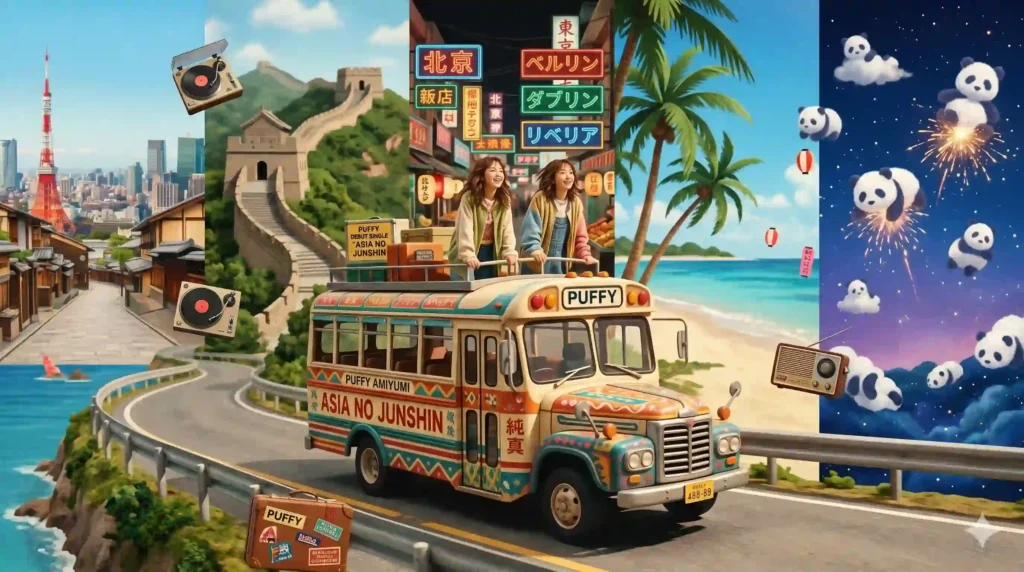
That is the thorough “abandonment of meaning.”
Many of Yosui’s songs that I have loved listening to over the years have a certain shadow, hiding deep loneliness or passion behind the words. However, “Asia no Junshin” has none of that heaviness.
Through a chemical reaction with Tamio Okuda, an exceptional melody maker, Yosui stopped speaking of his inner self and lightly leaped into a completely new dimension, enjoying words purely as a “sequence of sounds.”
Super Translation (Summary)
Transcending borders and words, names and scenery from all over the world flow into a rhythm.
White pandas and pure hearts shine like symbols of hope and love bursting in the night sky.
Carrying tears, heat, and chance encounters, we move forward into the future.
Though it can't be explained by logic, it's a song where your heart opens up, accessing love and freedom.
First, please listen via the YouTube video
(*Currently, the majority of Yosui Inoue’s audio sources available on the internet are not officially distributed. Therefore, out of consideration for copyright, this blog adopts a format of linking to external sites from uniquely prepared images rather than embedding videos directly.)
Please click the image below.

Japanese Credits
Song: Asia no Junshin (True Asia)
Vocals: Yosui Inoue
Lyrics: Yosui Inoue
Composition: Tamio Okuda
Original Vocals: PUFFY (YouTube video posted at the end)
Two-line Commentary
A representative J-POP song of the 1990s that combines Yosui Inoue's mysterious, rhythmic word choices with Tamio Okuda's catchy melody. Unlike the bright pop feel of the PUFFY version, Yosui Inoue's vocals bring the lyrics' humor and unique floating sensation to the forefront.
Next is the live version. Please click the image below.

Credits
Video Title: Tamio Okuda & Yosui Inoue - Asia no Junshin
Song: Asia no Junshin (True Asia)
Vocals: Tamio Okuda, Yosui Inoue
Lyrics: Yosui Inoue
Composition: Tamio Okuda
Original Vocals: PUFFY (YouTube video posted at the end)
Two-line Commentary
A masterpiece representing 1990s J-POP, where Yosui Inoue's mysterious sense of words overlaps with Tamio Okuda's light rock feel. Unlike the PUFFY version, the performance by the lyricist and composer themselves conveys the song's humor and relaxed flavor much more deeply.
The Surrealism Reached by the “Elimination of Explanation”
When talking about the charm of Yosui’s lyrics, I often want to use the phrase “elimination of explanation.” It is a technique that stimulates the listener’s imagination by intentionally not explaining scenes and emotions too much.
However, the “elimination of explanation” in “Asia no Junshin” has a completely different vector.
Here, emotions and stories themselves do not exist from the beginning. Beijing, Berlin, Dublin, and Liberia—unrelated place names are thrown out one after another, and like a surrealist painting, words with no logical connection collide with each other.

The moment this linguistic sense, which would normally fall apart, rides on the robust, laid-back rock sound created by Tamio Okuda, it generates an immense sense of elation.
The left brain’s attempt to understand the meaning of the words is forcibly shut down, and we are comfortably thrust into a state where we have no choice but to surrender ourselves to the swell of the sound.
Memories of My Student Days in Tokyo and the Thirst for Meaninglessness
Let me share a somewhat personal story.
During my college years, when I was living in a small apartment in Tokyo, I feel like I was vaguely searching for “hidden deep meanings” and “consistent themes” in every expression whenever I read books or watched movies. It was an immature period when I somehow believed that things without meaning had no value.
However, as time passed and I was tossed about by the rough waves of society, that feeling gradually changed.
Day by day, wrestling with mountains of documents, facing a continuous stream of suffocating negotiations built solely on logic and numbers. In a daily life where “clear reasons” and “rational explanations” were demanded for everything, my mind was wearing down without me even realizing it.
During such an extremely busy period, the piercing “meaninglessness” of this song, which I unexpectedly heard, was exactly like a sudden gust of wind.
_202605162012--1024x572.webp)
“It’s okay if there’s no meaning, isn’t it?”
Yosui’s seemingly nonsensical wordplay forcefully pried open my mind, which had been locked in the cage of logic.
Combining words like a puzzle, establishing a song purely on the fun of its sound. For me, carrying the heavy pressure of daily life, that boundless freedom resonated as more of a salvation than any beautiful ballad.
That was when I was 38 years old. It was exactly the time when I was in a position where I had no choice but to operate on the front lines, bearing a fair amount of responsibility.
The Unruly Groove Drawn Out by the “Foreign Object” Named Tamio Okuda
In Yosui’s long career, there are many collaborations with other artists.
However, his pairing with Tamio Okuda shines with an exceptionally unique light among them, and it’s no exaggeration to call it an event that forcefully opened a new door for Yosui. (We plan to introduce another wonderful collaboration song in the higher rankings, so look forward to it!)
What Okuda brought was a rock sound where the tension in the shoulders is completely gone, yet the framework is infinitely thick and undulating. It was an act of directly clashing “earthiness” and “unruliness” in a good sense against the meticulous, shadowy, literary worldview that Yosui had built up until then.

This unprecedented approach of prioritizing the sound and feel of words, intentionally severing the connection of meaning, would never have worked without Okuda’s crisp, dry rock ‘n’ roll mentality.
In 1996, when meticulously calculated J-POP dominated the hit charts, the foreignness of the “just right temperature” and the boundless cheerfulness this song radiated can only be described as thrilling, even looking back now.
The “Awesomeness and Exquisite Playfulness” of an Adult Residing in the Self-Cover Version
And what I particularly want to emphasize in this ranking is not the version provided to PUFFY, but the existence of the self-cover version by Yosui himself.
What happens when Yosui, the creator, personally sings that melody which permeated the world through the fresh, pop vocals of a female duo? It completely transforms into a different creature.
What is worth noting is its formidable “awesomeness.”
The enumeration of disjointed place names like Beijing and Berlin, and the series of outlandish phrases about a white panda.
Yosui sings them in all seriousness, riding on a heavy band groove with his characteristically sticky, sometimes even shamanic, vocals.
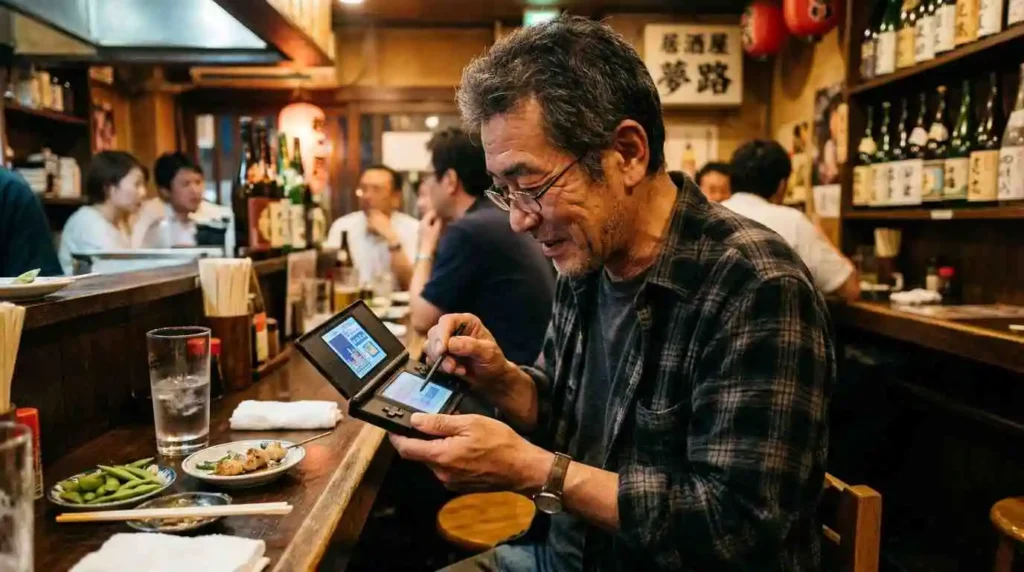
What is there is the very image of an adult who has tasted the bitter and the sweet, putting all their effort into immersing themselves in “meaningless play.” It’s not the momentum of youth, but the ultimate “relaxation” that only someone who has accumulated experience and thoroughly knows the complexity of society and the constraints of logic can reach.
The waves of words that shouldn’t have any meaning, by passing through the filter of Yosui’s voice, somehow bear an irresistible persuasiveness and sex appeal. This can be said to be a blissful musical experience permitted only to a veteran artist, at the opposite end of the spectrum from the cuteness of the original version.
Going Even Further Beyond the “Elimination of Explanation”—The “Complete Erasure” of Meaning
I have touched on the “elimination of explanation” in Yosui’s lyrics and the resulting “margins of words” several times before.
It is a refined technique that Yosui excels at: intentionally not speaking much, presenting only fragments of a scene, and leaving a rich space for imagination in the listener’s mind.
However, what he did in “Asia no Junshin” is not on the level of leaving a beautiful margin. It is the complete “total erasure” of meaning and storytelling.
An undeniable violence and exhilaration, as if the canvas itself had been painted over with brightly colored paint. That is precisely why I think this song worked directly on a heart that was hardened tight amidst responsibility and pressure, like mine at age 38.
This song, which does not allow an approach trying to understand it with the head, bypasses the listener’s brain and appeals directly to the body and senses.
The fatigue that could never be unraveled by gentle words of comfort or passionate, encouraging message songs was lightly blown away by the “energy of meaninglessness” that this song possesses.

In Conclusion
In modern society, where clear reasons are demanded for everything and peer pressure or “easy understandability” tends to be prioritized, it seems to me that the nonsensical energy radiated by “Asia no Junshin” shines even brighter.
Even if there’s no meaning, it’s enough if the sound of that moment is pleasant and makes your heart dance. A masterpiece that laughs off our rigid frameworks of thought and liberates us into infinite freedom in such a way. That is the 29th ranked song, “Asia no Junshin.”
Finally, as a bonus, I would like to introduce the original official MV by PUFFY.
Credits
Video Title: PUFFY "Ajia no Junshin" Original Music Video
Japanese Title: PUFFY "Asia no Junshin" OFFICIAL MUSIC VIDEO
Channel: PUFFY YouTube Official Channel
Song: Asia no Junshin (True Asia)
Vocals: PUFFY
Lyrics: Yosui Inoue
Composition/Arrangement: Tamio Okuda
Release Date: May 13, 1996
Label: Epic Records Japan
Remarks: PUFFY's debut single. The lyricist, composer, arranger, and release date can be confirmed via Uta-Net and Sony Music Artists-related information.
Two-line Commentary
"Asia no Junshin" is a massive hit symbolizing PUFFY's debut, combining Yosui Inoue's leaping wordplay with Tamio Okuda's light rock feel.
In the official MV, the pop colors and relaxed atmosphere typical of the 1990s enhance PUFFY's natural charm and the song's uninhibited worldview.

音楽ファン同士の交流・リクエストはこちら / Connect & Request Songs Here