
◆Click here for Yosui Inoue’s History!
- 🎧 Enjoy This Article in Audio
- No. 26: “Yamiya no Kuni kara” (From the Land of Dark Night)
- First, Listen on YouTube
- What a Journey Without Compass or Magnet Forces Us to Confront
- The Twilight of 70s Folk and the Hard-Edged Sonic Vision of Katsuru Hoshi
- In Closing—Why We Still Search for That Ship in the Night
🎧 Enjoy This Article in Audio
You can quickly grasp the main points of this article through narration.
Recommended for those who want to catch the vibe of the music and the flow of the article before reading.
🎶 English Narration
An English audio introduction to the contents of this article.
⌛ Duration: Approx. 3 mins
🎵 Japanese Narration
A Japanese audio introduction to the contents of this article.
⌛ Duration: Approx. 3 mins
* Listening to the audio before reading helps you better understand the world of the music and the main points of the article.
No. 26: “Yamiya no Kuni kara” (From the Land of Dark Night)
My Personal Top 30 Tracks by Yosui Inoue.
Holding the 26th spot is “Yamiya no Kuni kara” (From the Land of Dark Night), released as a standalone single in April 1974.
It was unleashed upon the world right in the middle of the unprecedented, meteoric success of his early masterpiece album, Koori no Sekai (Ice World)—as if to quietly mock the surrounding societal uproar.
Perhaps it is only when all safety nets are stripped away that a person truly comes face-to-face with “authentic raw existence.”
In this piece, I would like to delve deep into the sublime “aesthetic of reality detachment” that Yosui masterfully concealed beneath the surface of this lighthearted folk-rock melody.

The Poetical Essence of “Yamiya no Kuni kara”
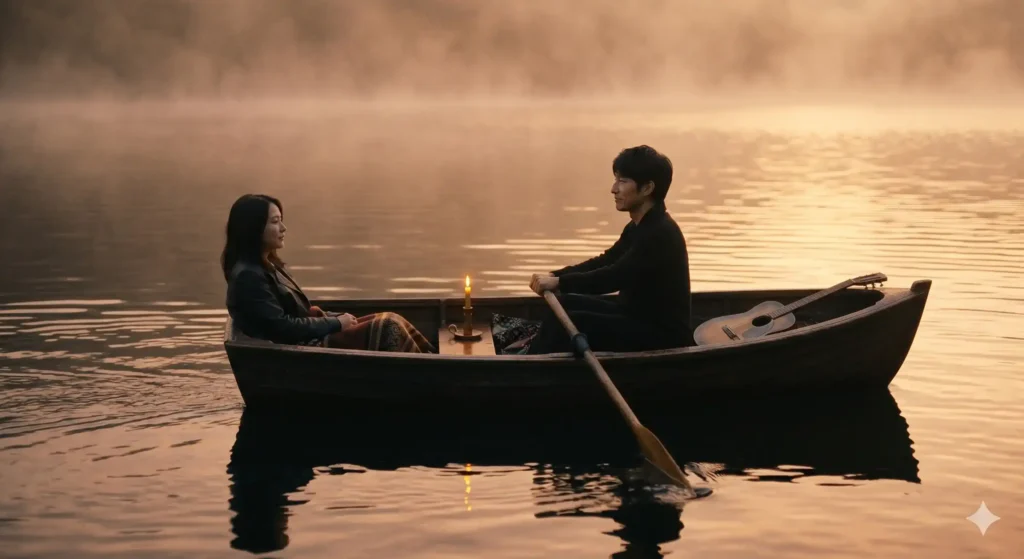
Without a map, without a magnet or a compass, we set sail in a tiny boat into the pitch-black night.
There is no grand purpose out there, nor any guaranteed promise for tomorrow.
Laughing away the fragile, hollow words of everyday life, we simply dissolve into the infinite darkness together, stifling a quiet yawn.
First, Listen on YouTube
(*Note: Since the majority of Yosui Inoue’s audio sources available on the internet are not official uploads, this blog respects copyright boundaries by linking custom-made images directly to external video sites rather than embedding the videos directly.)
Essential Track Information
Title: Yamiya no Kuni kara (English Title: “From the Darkness Land” / “From the dark country”)
Lyrics, Composition & Vocals: Yosui Inoue
Arrangement: Video 1: Katsuru Hoshi / Video 2: Jack Nitzsche / Video 3: Yosui Inoue & The Premium Night Band
Click the image below to watch the YouTube video.
– Original Single Version (Spring 1974 • Recorded in Japan)

“A Meticulous Studio Recording Engineered with a Simulated Live Energy”
The applause and cheers that open and close this track are actually ambient sound effects layered over a pristine studio session to create a “pseudo-live” atmosphere. Driven by the crisp, country-rock phrasing of Japan’s top studio musicians of the era, this initial version wraps a profound theme in a festive, accessible package.
Click the image below to watch the YouTube video.
– From the Album Nishiki no Koma (Autumn 1974 • Recorded in Los Angeles)
_-1024x572.webp)
“An Authentic Studio Overhaul with Top-tier American Heavyweights”
Released just months after the single, Yosui traveled to the U.S. to push his musical boundaries further, completely re-recording the track with legendary local funk-soul session players. Shifting away from the breezy country rhythm, this version transforms the song into a heavy, Western-influenced funk-rock beast, marked by a low, driving bassline and an undulating 16-beat groove.
Click the image below to watch the YouTube video.
– “The Premium Night” Live Version (August 19, 2006 at Showa Women’s University Hitomi Memorial Hall)
“The Ultimate Live Performance Backed by a Legendary Band of Master Craftsmen”
This historical footage captures the final tour performance at Hitomi Memorial Hall on August 19, 2006. Backed by a flawless, ironclad ensemble featuring Tsuyoshi Kon (Gt), Chiharu Mikuzuki (Ba), and Hideo Yamaki (Dr), a mature Yosui delivers an effortless, deep vocal performance that creates an exquisite, soulful groove.
What a Journey Without Compass or Magnet Forces Us to Confront
Where the Boundaries Between “The Immediate Next” and “The Distance Ahead” Dissolve
The sheer brilliance of Yosui’s songwriting lies in how he destabilizes our modern values from the very first line. “A journey with no sea charts, no magnets, and no compass.” In any logical framework, this is nothing short of a reckless, suicidal act of being lost at sea.
Living in the modern world, we are constantly hunting for a “navigation system.” We set a definitive destination, seek out the shortest route, and systematically eliminate variables of risk. Yet, the two individuals Yosui portrays willingly and intentionally discard every single guidepost.
There is a breathtaking social commentary hidden within his depiction of a state where one can no longer distinguish between a planned “future” and an unpredictable “tomorrow.” In our daily lives, perhaps we domesticate time by calling things we can schedule “the future” and things we cannot control “tomorrow.” When that boundary completely disintegrates, all that remains is the absolute, unadorned reality: “Right now, we are rowing a boat through the dark.”

The Catharsis of Breaking Free From the Fetters of Ordinary Language
Floating in the boat, the pair reduce all their shared words into mere “jokes” and continue to laugh. In our day-to-day existence, we are perpetually bound by language, wounded by language, and constantly striving to validate our identity through language.
Promises, contracts, logic, and social decorum—all these words that carried absolute weight within the theater of society lose their utility entirely on the open nocturnal sea. Rather than portraying this profound nihilism as something dark and depressing, Yosui presents it as an astonishingly buoyant pop track.
This reveals his signature creative instinct: exposing the underlying illusions of our daily routines. It subtly hints that the reality we so desperately cling to might actually be a beautifully engineered fiction. A quiet, lingering dread and a weightless sense of liberation coexist perfectly inside this concise musical phrase.

The Twilight of 70s Folk and the Hard-Edged Sonic Vision of Katsuru Hoshi
Behind the Hysteria of Koori no Sekai
Looking back at the cultural landscape of 1974 highlights just how singular this track truly was. Japanese folk music had fully ascended into the mainstream, yet it was simultaneously traversing a volatile transition period where it risked losing its counter-cultural purity.
An art form born in tiny, modest apartments was rapidly morphing into a massive, stadium-sized entertainment industry. Sitting squarely at the apex of this commercial storm was Yosui Inoue. It was a time when the public hung on his every word as if it were gospel, ravenously anticipating his next move.
Released amidst this chaos, “Yamiya no Kuni kara” carried a cold, detached quality that almost pushed the listener away. While the monumental hit album Koori no Sekai pointed an explicit, sharp blade at societal structures, this particular song turned its gaze inward, focusing squarely on the deep, quiet void within the human soul.
An Arrangement Demanding a Break From Comfortable Norms
The arrangement by Katsuru Hoshi serves as a major pillar supporting the song’s literary depth. The driving acoustic guitar strumming that ignites the intro is far from a sweet, comforting rhythm.
It sounds dry, mechanical, and rhythmic—resembling the tireless, monotonous stroke of oars slicing through a midnight sea. The damp, sentimental tropes common to standard folk tunes are completely excised in favor of a modern, crisp sonic blueprint.
Yosui’s vocal delivery similarly avoids any trace of over-sentimentalism. He sings with a cool, removed perspective, almost as if he is stifling a yawn while observing his own drift into the unknown. This aesthetic of “withdrawing from the hysteria”—this cold, clinical tone—is precisely why the track refuses to feel dated even half a century later.
In Closing—Why We Still Search for That Ship in the Night
In my youth, this song felt like an elusive fable belonging to an entirely different world. However, looking back over a lifetime spent carrying heavy responsibilities and running at full speed, the track carries a radically different resonance.
Somewhere along the line, we became experts at collecting sea charts and securing reliable compasses. We convinced ourselves that following a pre-planned route and anchoring safely in a secure harbor was the only correct way to live. Yet, those rare moments that truly make the heart shudder—the raw, unfiltered realization of being alive—often only find us after our compass breaks.

To lose everything is synonymous with becoming entirely free. I cannot help but harbor a profound respect for the terrifyingly sublime conceptual peak that Yosui reached when he was only in his mid-twenties.
As the night deepens in my study and I listen closely to the dry, persistent acoustic strumming, I feel as though the small, quiet boat inside my own mind is slowly, silently drifting out into the boundless dark.

音楽ファン同士の交流・リクエストはこちら / Connect & Request Songs Here