
Click here for Yosui Inoue’s History!
- 🎧 Enjoy This Article in Audio
- No. 16 is “Tsumetai Heya no Sekaichizu” (World Map in a Cold Room)
- First, Please Listen to the YouTube Videos
- A Leap from a Confined Room to the Boundless Ocean
- Relationships That Merely Pass By, and a Quiet Acceptance
- The Exquisite Distance Shaped by Acoustic Guitar and Strings
- “The Country I Am Bound For” as an Ideal Land
- In Closing
🎧 Enjoy This Article in Audio
You can quickly grasp the main points of this article through narration.
Recommended for those who want to catch the vibe of the music and the flow of the article before reading.
🎶 English Narration
An English audio introduction to the contents of this article.
⌛ Duration: Approx. 4 mins
🎵 Japanese Narration
A Japanese audio introduction to the contents of this article.
⌛ Duration: Approx. 3 mins 40 secs
* Listening to the audio before reading helps you better understand the world of the music and the main points of the article.
Click here for Yosui Inoue’s History!
No. 16 is “Tsumetai Heya no Sekaichizu” (World Map in a Cold Room)
In the early career of Yosui Inoue, his memorable debut album “Danzetsu” released in February 1972, and his second album “Yosui II Sentimental” released in December of the same year while maintaining his creative momentum, held deep, semi-autobiographical shadows that broke away from the existing framework of Japanese folk music at the time.
Among them, “Tsumetai Heya no Sekaichizu,” which I am introducing today as No. 16, is a song given the distinct role of opening Side A as the first track on that second album, “Yosui II Sentimental.”

The quiet, understated presence that unfolds the very moment the needle touches the record beautifully shapes the contours of the sharp sense of confinement early Yosui harbored, along with his romantic escape from it.
Whenever I listen to this song, I am reminded of the helplessness I felt during my student days, sitting in an apartment room in Tokyo, vaguely pondering an unseen future. The contrast between the freezing air outside the window and the free imagery expanding inside my head somehow seems to overlap with my state of mind back then.
In this article, I would like to carefully untangle the unique lyricism of this track that signals the opening of the album, the psychological sense of distance hidden behind the words, and its refined sonic world.
Poetic Translation
To a see a country far, far away, I set out on a sea voyage all by myself.
Rocked by the waves, I wish to gaze at clouds that resemble someone, and just look out into the distance, brushed by the sea breeze.
The sharpness of parting deepens just as much as the kindness I touched, yet I say goodbye to the passing ships and forge ahead.
Heading toward the country I am bound for, which surely lies beyond the horizon.
First, Please Listen to the YouTube Videos
Please click the image below. (This is the studio-recorded version, not a live performance)
Credits
Yosui Inoue - "Tsumetai Heya no Sekaichizu"
YouTube Title: "つめたい部屋の世界地図 井上陽水"
Lyrics & Composition: Yosui Inoue / Arrangement: Katsuru Hoshi / From the album "Yosui II Sentimental"
Two-Line Review
With a relatively clear sonic image, the contours of the vocals and words step forward.
Rather than a lonely voyage, the quiet movement of a mind gazing into the distance surfaces softly.
Please click the image below. (This is the studio-recorded version sourced from the vinyl record).
Credits
Yosui Inoue - "Tsumetai Heya no Sekaichizu"
From the original vinyl record released in 1972, Album "Yosui II Sentimental"
Two-Line Review
Carrying the characteristic texture and moisture of vinyl, the air of the old room settles deep behind the sound.
The loneliness of the song rises not as a polished sound, but as a slightly soot-stained memory.
(Note: The vast majority of Yosui Inoue’s audio sources available on the internet are not official releases. Out of consideration for copyright, this blog opts for a format where we link to external sites using our own custom images instead of directly embedding the videos.)
A Leap from a Confined Room to the Boundless Ocean
The Room of Introspection and the Sea of Imagination
An interesting aspect of this song’s structure lies in its penmanship, which instantly transports the listener from the extremely narrow and closed space of the “cold room” presented at the beginning to the vast stage of “a ship voyage to an unknown country.”
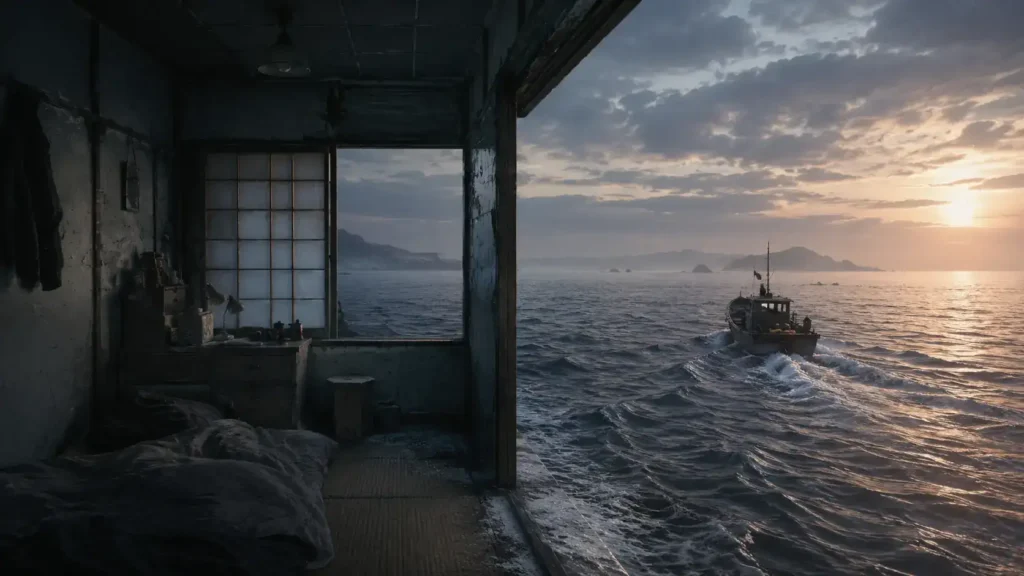
Hasn’t everyone, during their youth, felt as though their own room was the entire extent of their world?
The world Yosui paints here is no mere travel song lightly singing of a longing for a trip. Rather, I feel it is like a quiet space of one’s own, envisioned by a mind that has grown slightly weary of everyday life, seeking a gentle place to take refuge.
The room being “cold” is the flip side of the comfort found in the absence of other people’s presence, and at the same time, perhaps it is because the inside of one’s own head has become strangely clear.
The single world map pinned up inside that chilly space becomes the sole window connecting to the outside world, serving as the trigger for the imagination that rescues him.
A Perception of the World Where “Kindness is Broken”
The unique expression regarding the colors of the world presented in the middle of the song carries a striking, poignant sorrow. The reason the color of the sea surrounding the world appears inexplicably sad is that Yosui perceives that the “kindness” which ought to exist within human affairs has already been damaged.
The sea depicted here bears no relation to the bright blue of a tropical resort. It is rather a slightly gray-tinted, somewhat lonely blue that spreads quietly on a cloudy day. Looking out at the world from one’s room while keeping a distance from the surroundings, the exterior might well appear as a place where colors are muted and everything has fallen silent.

- The Collapse of Reality: The loss of warmth that should have existed within human relationships
- The Inversion of Sight: The moment the sea, which should naturally be beautiful, turns into a symbol of sadness
- The Isolation of the Self: The illusion that the entire world is rejecting you
Despite holding such a sharp perception, Yosui’s singing voice never allows itself to be swept away by passion. As if it were someone else’s business, he delivers that scenery to our ears with a detached yet certain persuasiveness. This unique stance of intentionally stepping back from enthusiasm was the solitary charm early Yosui held, setting him apart from other folk singers.
Relationships That Merely Pass By, and a Quiet Acceptance
An All-Too-Early Parting That Follows “Hello”
In the middle of the journey, the ship we ride passes by another vessel. They sound their whistles to each other and achieve a momentary crossing, yet no deep interaction or dramatic development is prepared there. The very moment after greetings are exchanged, the forms of each other recede beyond the horizon, and parting arrives.
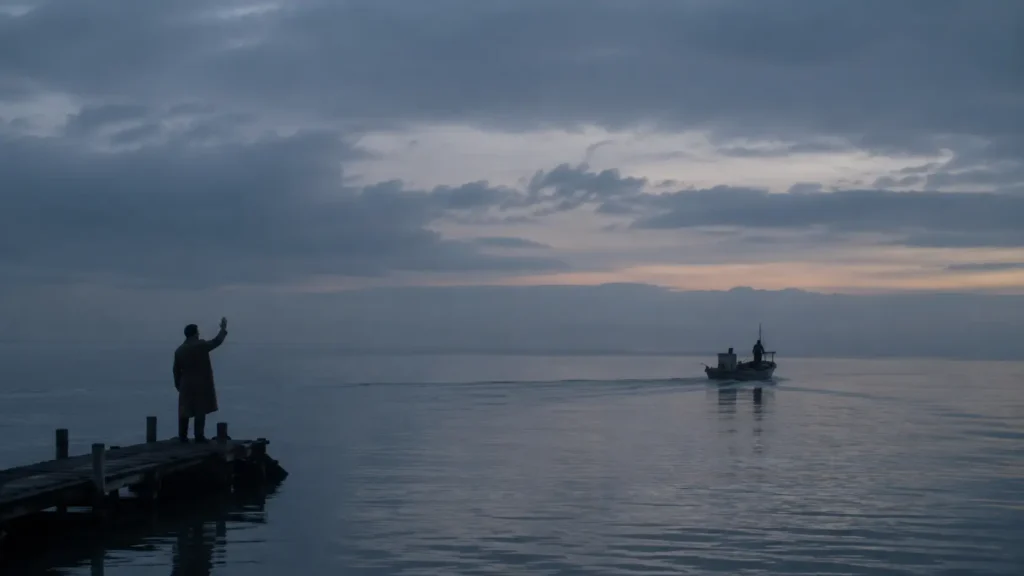
This depiction reads like a miniature of our own human relationships.
On the long voyage of life, we encounter countless people and see them depart. It is not uncommon to find ourselves losing touch with someone we were once deeply involved with before we even realize it.
Yosui expressed the fleeting nature of human connections through the metaphor of ships passing each other. Breathing within it is a sort of “detached acceptance” that avoids placing excessive expectations on connecting deeply with others. Precisely because we know from the start that we are meant to merely pass by, the sound of that momentary whistle echoes deeply in our hearts.
The Exquisite Distance Shaped by Acoustic Guitar and Strings
The Sonic Blueprint by Katsuru Hoshi
A major reason this track does not end up as a merely damp folk song lies in the exceptionally objective and cool sound design by arranger Katsuru Hoshi. When you listen closely, the backbone of the song is formed by a simple, regular acoustic guitar arpeggio.
The strings that intertwine there do not engage in any dramatic swelling to inflame the singer’s emotions. Rather, they merely coat the background in a low, quiet manner, like the walls of the “cold room” where the protagonist stands, or like a mist blocking the path ahead. Through this meticulous arrangement that keeps the overlapping of sounds to a minimum, each and every word spun by Yosui resonates clearly, as if cold drops of water were falling onto the floor.

Furthermore, the fact that the assertions of the rhythm section, such as the drums and bass, are kept to a bare minimum accentuates that the “ship voyage” in this song is not a physical movement, but a mental wandering within the brain. By not relying on flashy sonic decorations, it bypasses the trends specific to its era, maintaining a fresh musicality even now.
The Greatness of a Yosui Who Does Not Scream
As an artist, the early Yosui Inoue occasionally displayed high tones that seemed to harbor a touch of madness, or vocal deliveries that hurled fierce passions at the listener. However, his singing voice in “Tsumetai Heya no Sekaichizu” is kept at an astonishingly room-temperature level.
Instead of heightening his emotions and tearfully appealing his loneliness, he sings through the loss of color that occurred to him in a detached manner, as if reading someone else’s diary. I feel this low-temperature vocal approach acts as a salvation for the listener, while simultaneously serving as a mechanism that leaves a profound lingering resonance.

When we feel an indescribable loneliness or a disconnect from our surroundings in our daily lives, what we truly need is probably not a heated encouragement to “hang in there” or exaggerated sympathy.
This song’s sense of taking a step back, gently affirming that “it is fine to just be there,” is precisely what softly nestles against a wounded heart.
“The Country I Am Bound For” as an Ideal Land
What Lies Beyond the Horizon
Near the end of the lyrics, as “I” advance the ship, a boundless horizon spreads out ahead. Then, the phrase “the country I am bound for,” which presumably lies far beyond, is presented. What kind of place is this country?

It is surely an “ultimate sanctuary” where a complete individual is established—where one cannot be hurt by anyone, and there is no need to cater to anyone’s moods.
Not an actual foreign country existing in reality, but a sanctuary within the mind where one’s heart can remain at peace. Yosui may have allowed his soul to take flight toward that sanctuary by secluding himself in his small room and staring at the world map.
The Boundary the Seagulls Teach Us
The depiction of the seagulls appearing toward the end of the song represents the sole “other” in this introspective journey, serving as the contact point with reality. Seeing the birds flying about, the protagonist realizes that “land is near.”

This land signifies the end of the journey, while simultaneously acting as a premonition of returning once again to that everyday world of human relationships where “kindness is broken.”
One cannot drift upon the sea of imagination forever; eventually, one must make landfall back into society. The flapping of the seagulls’ wings sounds as if it is thrusting that melancholic boundary line upon us.
This is exactly why the phrase repeated at the very end, “When going alone, a ship voyage is best,” echoes so much more dearly and painfully in the chest. It is because the modest wish to fully live out that solitary time undisturbed by anyone, at least until the moment of return, is concentrated right there.
In Closing
Even after a vast stretch of time has flowed since its release in 1972, the song “Tsumetai Heya no Sekaichizu” continues to teach us the essence of how to face the deep-seated loneliness within human nature every time we listen to it.
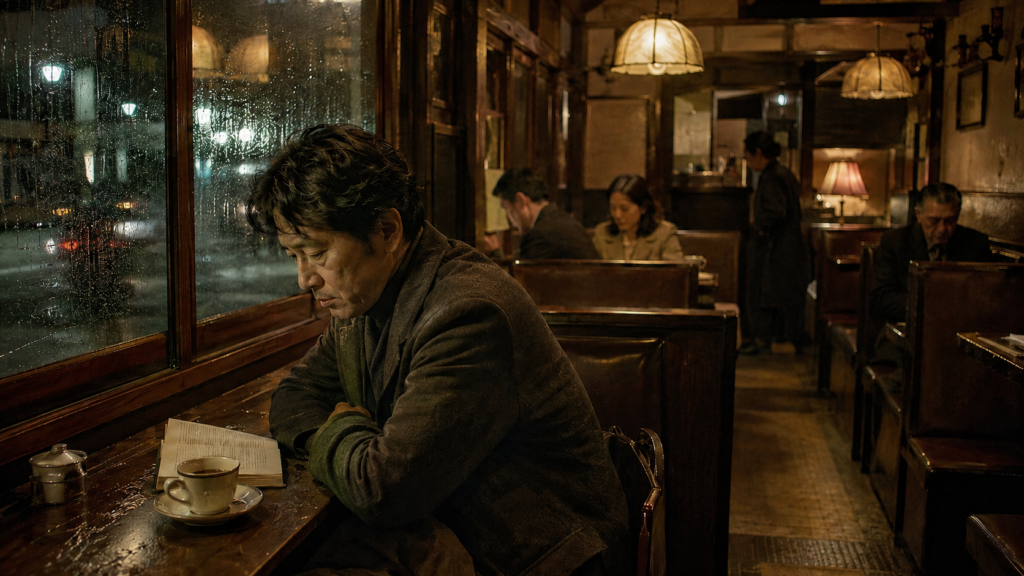
Without dressing things up in exaggerated language, it simply gazes quietly at its own interiority and presents a pale blue scenery. Precisely because this unique sense of balance is maintained throughout, this song continues to cast an unfading radiance as the opening track of the album “Yosui II Sentimental.”

音楽ファン同士の交流・リクエストはこちら / Connect & Request Songs Here