
- 🎧 Enjoy This Article via Audio
- 🎹Today Is Robert Fripp’s Birthday
- The Monumental Debut Album In the Court of the Crimson King
- First, Please Watch the Official King Crimson Video on YouTube
- In 1969, Rock Began to Reveal a Different Landscape
- What to Listen for in “The Court of the Crimson King”
- Robert Fripp as Architect
- Why Does It Still Sound Fresh Today?
- Finally: For Robert Fripp’s Birthday
🎧 Enjoy This Article via Audio
You can quickly grasp the main points of this article through narration.
Recommended for listeners who want to understand the song’s atmosphere and the article’s flow before reading.
🎶 English Narration
This narration introduces the article in English.
⌛ Duration: Approx. 3.5 min
🎵 Japanese Narration
This narration introduces the article in Japanese.
⌛ Duration: Approx. 3.5 min
* Listening to the narration before reading helps you understand the song’s atmosphere and the key points of the article more clearly.
🎹Today Is Robert Fripp’s Birthday
The One Constant at the Heart of King Crimson
On May 16, 1946, in Wimborne Minster, Dorset, England, a guitarist who would later reshape the course of rock history was born.
His name is Robert Fripp.
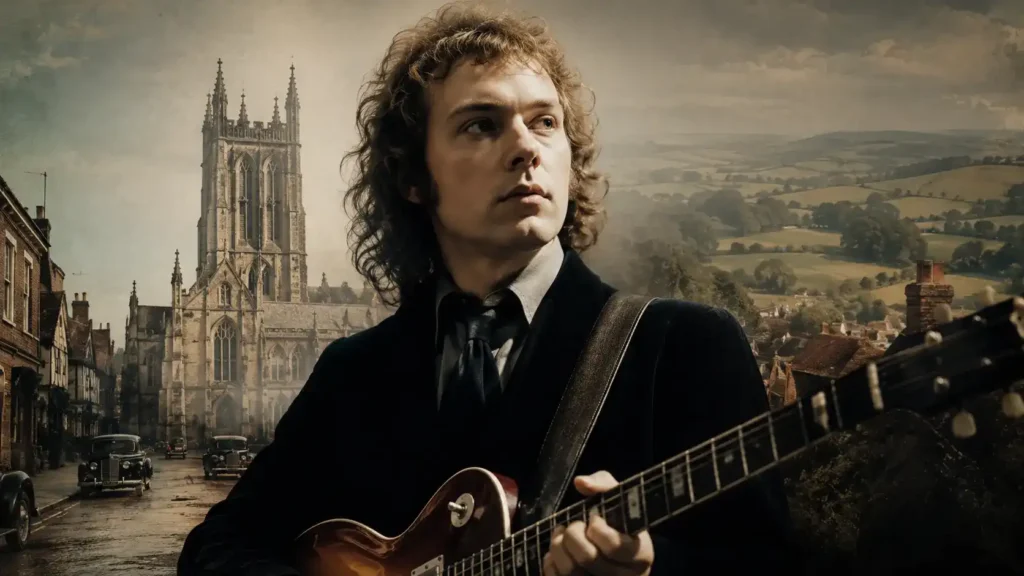
When people hear his name, the first thing that comes to mind is, of course, King Crimson. Formed in 1969, the band has changed shape again and again, yet Fripp has remained its founding member and the only continuous central figure throughout its long history.
A Guitar Style Like Precision Machinery, Not Emotional Explosion
Fripp’s guitar playing is very different from the so-called “crying guitar” style of blues rock. Rather than stretching notes to release raw emotion, his sound has a cool, precise quality, like a sharp blade carving geometric patterns into a metal plate.
His playing has less of the rough spontaneity of a rock guitarist relying on familiar licks, and more of the tension of a mathematician writing complex formulas on a blackboard. Every note seems built into the structure of the piece as a whole.
A Career of Collaborations Beyond Genre
Beyond King Crimson, Fripp has worked with artists who crossed many musical boundaries, including Brian Eno, David Bowie, Peter Gabriel, Talking Heads, and David Sylvian.
His musical life cannot be contained by the word “guitarist.” He is also a composer, producer, sound experimenter, and the architect of King Crimson as an ever-changing musical mechanism.
The Monumental Debut Album In the Court of the Crimson King
The Shock Released on October 10, 1969
King Crimson’s debut album, In the Court of the Crimson King, was released on October 10, 1969.
It is regarded as one of the defining monuments of progressive rock, reaching No. 5 on the UK Albums Chart and No. 28 on the US Billboard 200.
“The Court of the Crimson King,” Placed at the End of the Album
The song I am introducing today, “The Court of the Crimson King,” is the final track on that album.
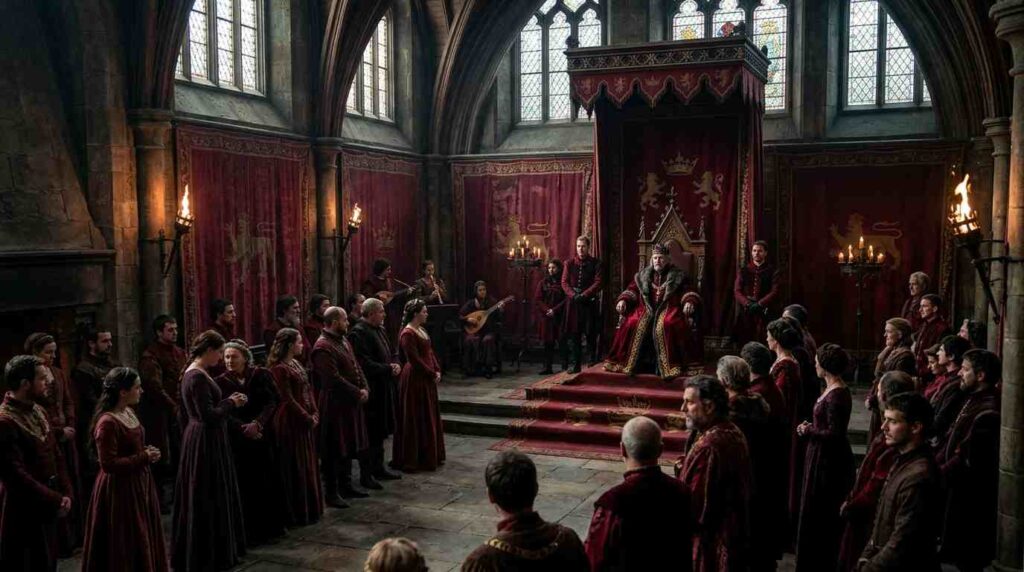
Chaos, allegory, a royal court, puppets, witches, jesters, and a queen. Rather than ordinary rock lyrics, the world of this song feels like a fusion of a medieval picture scroll and a nightmare circus, spreading across a majestic melody.
What Is the Court of the Crimson King?
The “court of the Crimson King” in this song is not merely a fantasy kingdom.
It is portrayed as a symbolic stage where power, madness, celebration, control, faith, and spectacle gather around a single throne.
The gardener plants evergreen trees while trampling flowers, the black queen chants the funeral march, and the jester pulls the strings of puppets.
It looks like a beautiful painting, yet something is quietly breaking behind that painting.
A Free Japanese-Style Rendering of the Lyrics
Rusty chains are broken, and the sun shatters the imprisoned moon.
I walk along a shifting horizon, while the purple piper plays for the court.
The jester pulls the strings, and the black queen chants a funeral march.
All the puppets dance, and the world is drawn into the court of the Crimson King.
First, Please Watch the Official King Crimson Video on YouTube
Credits
King Crimson, “The Court of the Crimson King”
Music: Ian McDonald / Lyrics: Peter Sinfield
Personnel: Robert Fripp, Ian McDonald, Greg Lake, Michael Giles, Peter Sinfield
Album: In the Court of the Crimson King (1969)
Two-Line Commentary
This is one of early King Crimson’s signature songs, closing the band’s 1969 debut album In the Court of the Crimson King. The majestic sound of the Mellotron and the allegorical lyrics helped define the dramatic world of progressive rock.
Credits
King Crimson
“King Crimson in Concert: Live in Munich 1982”
Featuring: Robert Fripp, Adrian Belew, Tony Levin, Bill Bruford
Recorded: September 29, 1982, Alabamahalle, Munich, Germany
Two-Line Commentary
This official live footage from Munich captures the tightly interlocked polyrhythms and New Wave sharpness of 1980s King Crimson. The four-piece lineup of Fripp, Belew, Levin, and Bruford balances improvisation and structural beauty at remarkable density.
When I First Heard This Song
| My Age | Elementary School | Junior High | High School | University | 20s | 30s | 40s | 50s | 60+ |
| Year of Release | 1969 | ||||||||
| When I Heard It | ● |
The song was released in 1969, when I was around fifth grade in elementary school, so I did not hear it in real time.
I definitely heard it during my university days in Tokyo, in my room at that apartment in Higashi-Matsubara, Setagaya.
I suspect I first came across the song on the radio or television. And perhaps that was the very moment when I first encountered progressive rock. In any case, it made a tremendous impact on me.
So I immediately bought the album In the Court of the Crimson King… or at least that is how the story should go. In reality, what I bought was A Young Person’s Guide to King Crimson, King Crimson’s first compilation album.
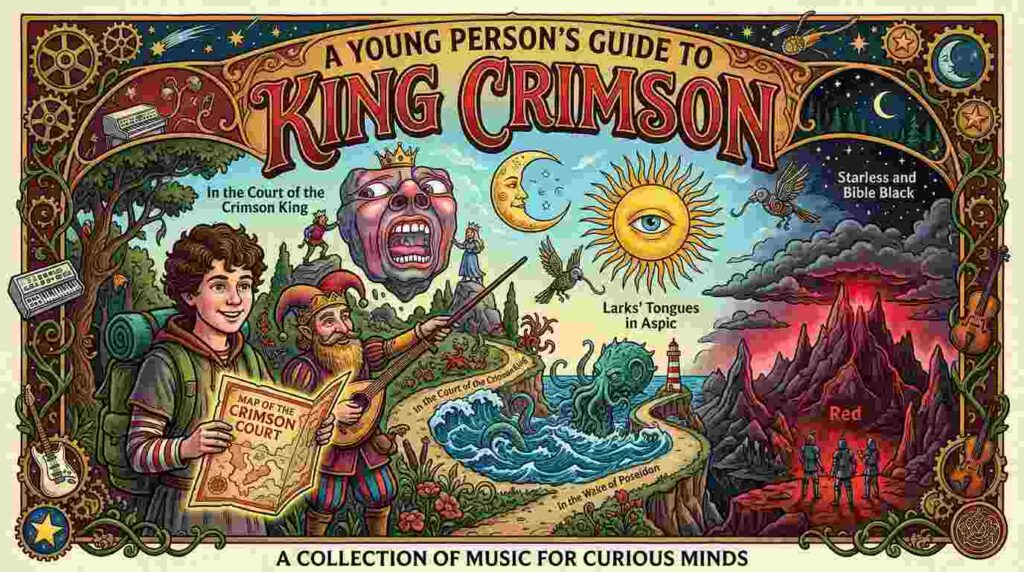
This album was released in February 1976 as a double album, after King Crimson had ceased activity in the autumn of 1974 and following the live album USA in 1975.
I listened to it intensely. On this day last year, I introduced “Epitaph,” the track from that album that moved me most deeply.
Next year, I will introduce “Moonchild”!
In 1969, Rock Began to Reveal a Different Landscape
The Year of the Beatles, Led Zeppelin, and Woodstock
The year 1969 was especially dense in rock history. The Beatles released Abbey Road, while Led Zeppelin released both their debut album and second album in the same year. In the United States, the Woodstock Festival took place, and rock rapidly expanded into a symbol of youth culture.
Against that backdrop, King Crimson arrived with a sound unmistakably different from other rock bands. They boldly packed blues heat, jazz sharpness, classical structure, the unease of modern music, and the symbolism of fantasy literature into a single album.
Not a Long Song, but a Vast Structure
The reason In the Court of the Crimson King was groundbreaking was not simply that the songs were long. The opening track, “21st Century Schizoid Man,” confronts the listener with the violence of modern civilization. “Epitaph” sounds out a heavy premonition of ruin. Finally, “The Court of the Crimson King” leads the listener into a fantastical court.
In other words, this album was not a collection of unrelated songs. It was an architectural work of sound, designed from entrance to exit. I believe it was one of the moments when rock stepped beyond three-minute entertainment and entered a realm comparable to literature and film.

What to Listen for in “The Court of the Crimson King”
The Mellotron Creates an Unreal Court Orchestra
What determines the impression of this song above all is the sound of the Mellotron. The Mellotron is an instrument that plays tape-recorded sounds of strings and choirs when its keys are pressed. Unlike today’s smooth digital sound sources, its tone contains wavering and grain.
Yet that slightly aged texture creates an overwhelming effect here. It sounds like a real orchestra, yet somehow artificial; like a choir, yet with a low, almost cold temperature. That imperfect majesty perfectly suits the stage of the Crimson King’s court.
Greg Lake’s Voice Paints a Strange Picture Scroll
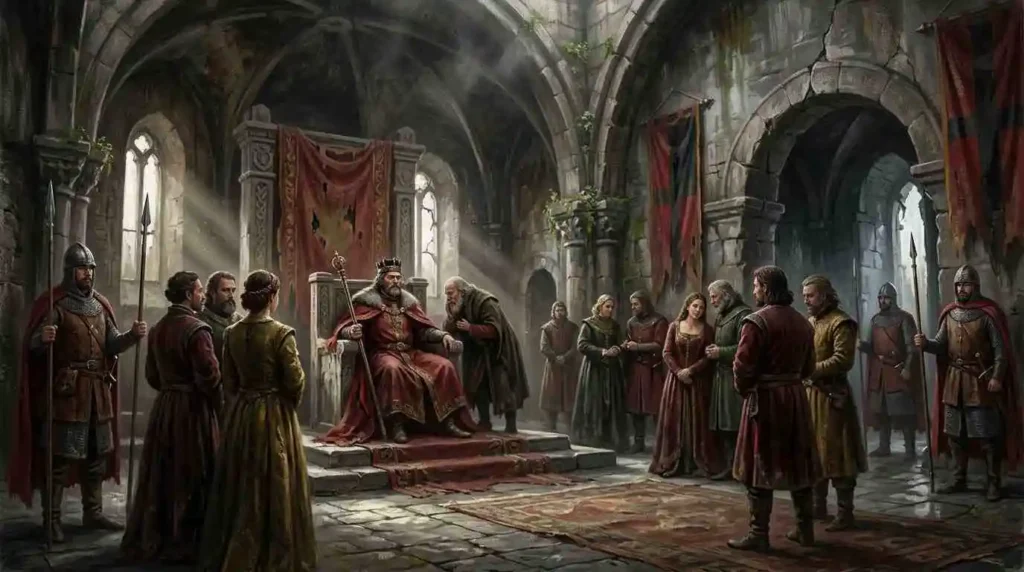
Greg Lake’s voice is also magnificent. He does not shout with exposed emotion; instead, he calmly delivers the events taking place in the court. The purple piper, the black queen, the yellow jester, the gardener, the pilgrim, the fire witch—the figures in the lyrics feel like characters from an old allegory.

And yet, this world is far from a comforting fairy tale. The gardener plants evergreen trees while trampling flowers, and the jester pulls puppet strings instead of performing. Behind the beautiful melody, control, anxiety, and madness move quietly.
The Fear of a Jester Pulling the Strings
One especially striking image is the yellow jester pulling the puppet strings. A jester is usually someone who makes people laugh. But the jester in this song does not serve as a maker of laughter. He quietly moves the puppets.
This scene can be read as fantasy, but it can also be read as an image of people being moved according to someone else’s convenience within society. Trends, authority, advertising, public opinion. What if the choices we thought were our own were actually being pulled by invisible strings? The fantasy of this song connects to that kind of real-world fear.
Robert Fripp as Architect
A Guitarist Who Builds the Whole, Rather Than Simply Playing Fast
Robert Fripp’s greatness cannot be measured only by speed or flashy solos. Even in “The Court of the Crimson King,” he does not cover the song with guitar. He places the necessary sounds in the necessary places and maintains the tension of the entire piece.
He is not the type of guitarist who becomes the hero at the front of the stage. Rather, he feels like the person designing the court itself. He gathers the Mellotron, vocals, rhythm, and lyrical imagery into a single structure that listeners can walk through.

The Man Who Created a Band That Kept Changing
King Crimson changed members many times throughout its long history. For an ordinary band, lineup changes would be seen as a crisis. In King Crimson’s case, however, change itself became a source of life.
The 1969 version of King Crimson was like the first monster to appear. Later versions of the band would become more complex, sharper, and more experimental. Even so, the debut album still carries the special force that belongs only to a first strike.
Why Does It Still Sound Fresh Today?
Because They Built Their Own Kingdom, Not a Sound Based on Fashion
Although “The Court of the Crimson King” is a song from 1969, it has not become mere nostalgia. The reason is simple: the song does not depend only on the musical fashion of its time.
It does not fit neatly into blues-rock formulas, easily understandable pop structures, or the period color of psychedelia. King Crimson used those elements as materials, but created a strange kingdom entirely their own. That is why, even decades later, it does not sound like music trapped in a specific era.
Difficulty Turns into Fascination
This is not a user-friendly song. Reading the lyrics once does not reveal every meaning, and the song structure does not fit neatly into a simple verse-bridge-chorus format. Yet that difficulty becomes the force that makes listeners return again and again.
When you are young, the sheer force of the sound surprises you. With a little more age, the symbolism of the lyrics pulls you in. As you listen more closely, you begin to notice the placement of the Mellotron and vocals, and Fripp’s power of design. The same song reveals a different landscape depending on when you hear it. That, I think, is the strength of this song.

Finally: For Robert Fripp’s Birthday
The Court of the Crimson King Still Resounds
“The Court of the Crimson King” is a piece that showed rock could become more complex, more literary, and more dramatic. With this one song, King Crimson greatly expanded the expressive territory of rock.
Robert Fripp was not merely an outstanding guitarist. Under the name King Crimson, he created a system in which music could continue to change. At the starting point of that system stands In the Court of the Crimson King, an album that still radiates a strange brilliance today.
The Crown Does Not Age, and the Court Does Not Collapse
Who is the Crimson King? Where is the court? Why does the jester pull the strings instead of performing? The answers cannot be reduced to one fixed explanation.
That is precisely why this song can be heard again and again. The moment the vast sound of the Mellotron begins, a stone gate rises before the listener, and we are led once more into the court of the Crimson King.
As a song to hear on Robert Fripp’s birthday, few choices could be more fitting than “The Court of the Crimson King.” Fantasy, madness, structural beauty, and the future of rock—all of them continue to resound inside this song.


音楽ファン同士の交流・リクエストはこちら / Connect & Request Songs Here