🌐 English|🌐 日本語
- 🎧 Listen to This Article
- 1984–1991: Four Musicians Who Kept Creating Until the End
- 1984: The Works Brings Rock and Pop Together
- 1985: A United Band on the Live Aid Stage
- 1986: A Kind of Magic and the Final Tour
- 1987–1989: Individual Projects Lead Back to The Miracle
- 1991: The Voice and Musicianship Preserved on Innuendo
- November 1991: Freddie Mercury’s Death
- 2018: Seeing Bohemian Rhapsody Twice
- 30 January 2020: Rediscovering an Attachment to the Original Four at Nagoya Dome
🎧 Listen to This Article
Listen to a narrated overview of the final part of our introduction to Queen.
Follow the band from The Works to Innuendo, through Live Aid, their final tour, and Freddie Mercury’s later recording years.
🎵 English Narration
Listen to the article’s key points in English.
🎶 Japanese Narration
Listen to the article’s key points in Japanese.
1984–1991: Four Musicians Who Kept Creating Until the End
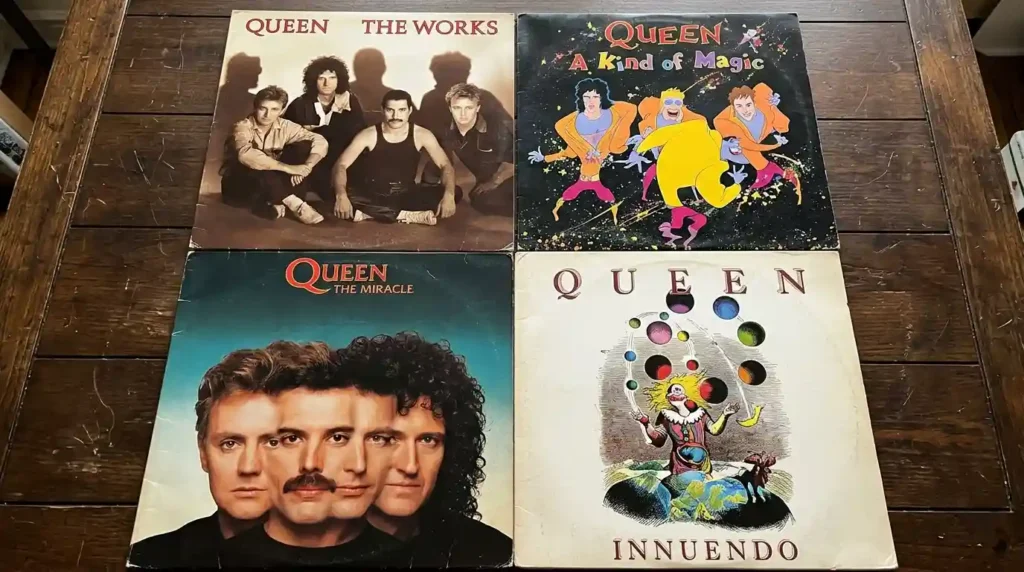
From The Works in 1984 to Innuendo in 1991, Queen moved from performing before vast crowds to concentrating their efforts on recording.
These years also brought controversial concerts and opportunities for the members to pursue their own musical interests. This final part of the introduction follows the changing relationship between the four musicians and the development of their music through their last tour and later recordings.
1984: The Works Brings Rock and Pop Together
Four Songwriters, Four Distinct Voices
Released in February 1984, The Works was co-produced by Queen and Mack. Guitar-driven songs sat alongside tracks built around synthesizers and electronic rhythms, combining forceful rock with accessible pop.
Roger Taylor’s “Radio Ga Ga” builds a sweeping chorus over a repeating electronic pulse. The overhead handclaps featured in its promotional video became a familiar way for concert audiences to join in.
John Deacon’s “I Want to Break Free” is an immediately memorable pop song with a light, buoyant rhythm.
Brian May’s “Hammer to Fall” is driven by a hard-edged guitar riff. Freddie Mercury’s “It’s a Hard Life” uses piano and layered vocals to give an expansive musical shape to an earnest expression of love.
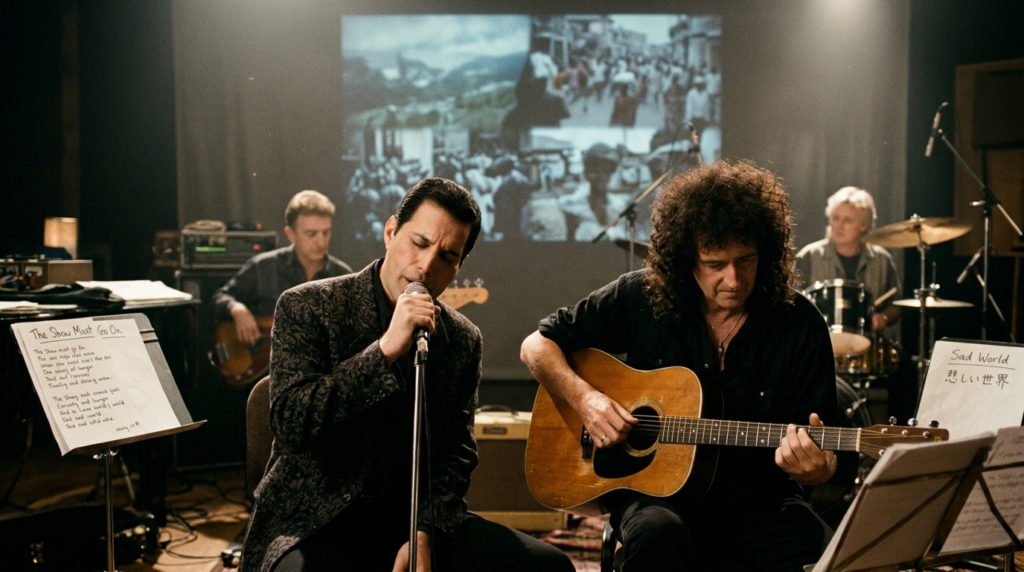
Each member wrote a song that became a single from the album, reflecting the strength of Queen’s songwriting across all four musicians. The record closes with “Is This the World We Created…?”, written by Freddie and Brian. Centred on voice and acoustic guitar, it considers poverty and hunger.
Criticism of the Sun City Concerts
In October that year, Queen performed at Sun City in South Africa. Apartheid, the system of racial segregation, remained in force, and the United Nations and other organisations had called for a cultural boycott.
The band explained that they were playing for a racially mixed audience and did not intend to support the political system. Nevertheless, their decision to perform despite the boycott drew severe criticism.
1985: A United Band on the Live Aid Stage
An Active Touring Band Prepares for Twenty Minutes
Queen began 1985 with appearances at Rock in Rio in January, followed by concerts in Australia, New Zealand and Japan during the spring. Freddie also released his solo album Mr. Bad Guy that April.
On 13 July, Queen appeared at Wembley Stadium in London for the British leg of Live Aid, the charity concert organised to raise money for famine relief in Ethiopia.
The four rehearsed carefully, working out how to connect their songs and make the most of their limited time onstage.
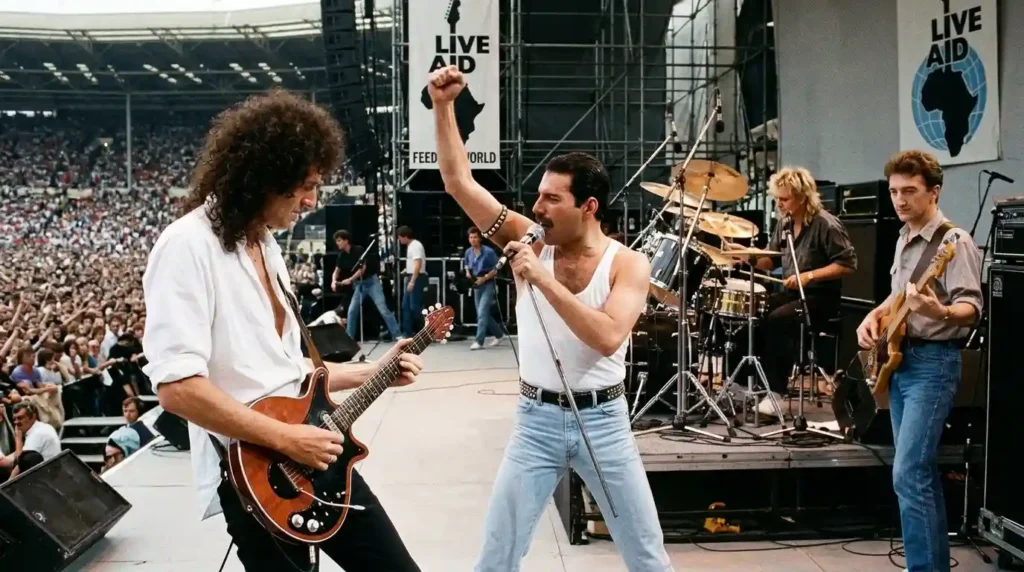
Their roughly twenty-minute early-evening set included “Bohemian Rhapsody”, “Radio Ga Ga”, “Hammer to Fall”, “Crazy Little Thing Called Love”, “We Will Rock You” and “We Are the Champions”. Shortened songs and tight transitions maintained the momentum while creating opportunities for the audience to take part.
Freddie, the Band and the Audience Respond to One Another
Freddie’s vocal exchanges with the crowd and the coordinated handclaps during “Radio Ga Ga” became defining images of the performance. Even before an audience gathered for many different artists, he demonstrated his ability to draw people in through his voice and gestures.
Brian’s guitar, John’s bass and Roger’s drums supported Freddie’s interaction with the crowd and carried the performance from one song to the next. Years of experience in large venues were concentrated into that short set.
The appearance gave the band renewed confidence. That November, they released “One Vision”, with songwriting credits shared by all four members. Footage of the recording sessions also preserves their exchanges of ideas as they built the song together.
Comparing the Original Performance with the Film
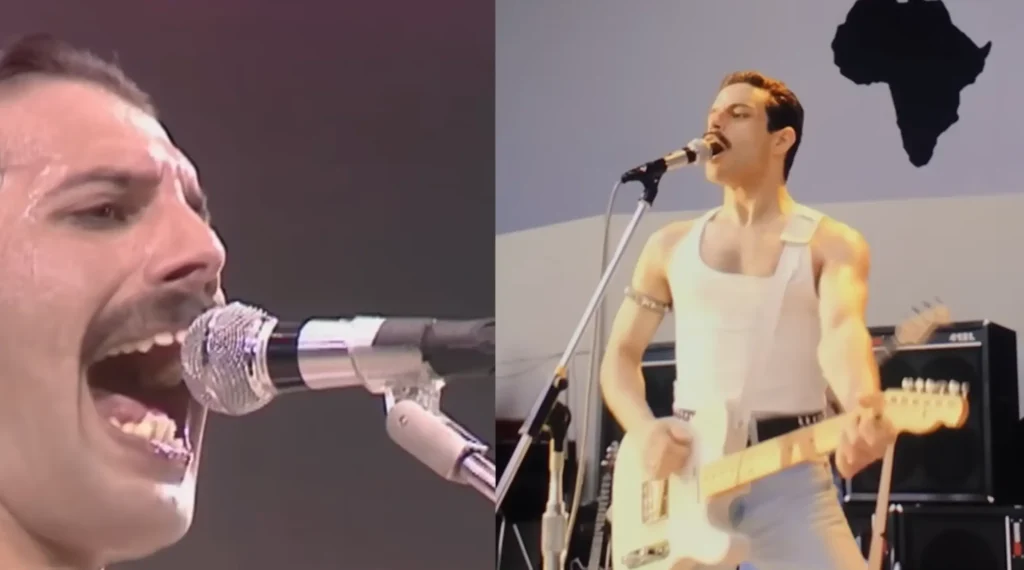
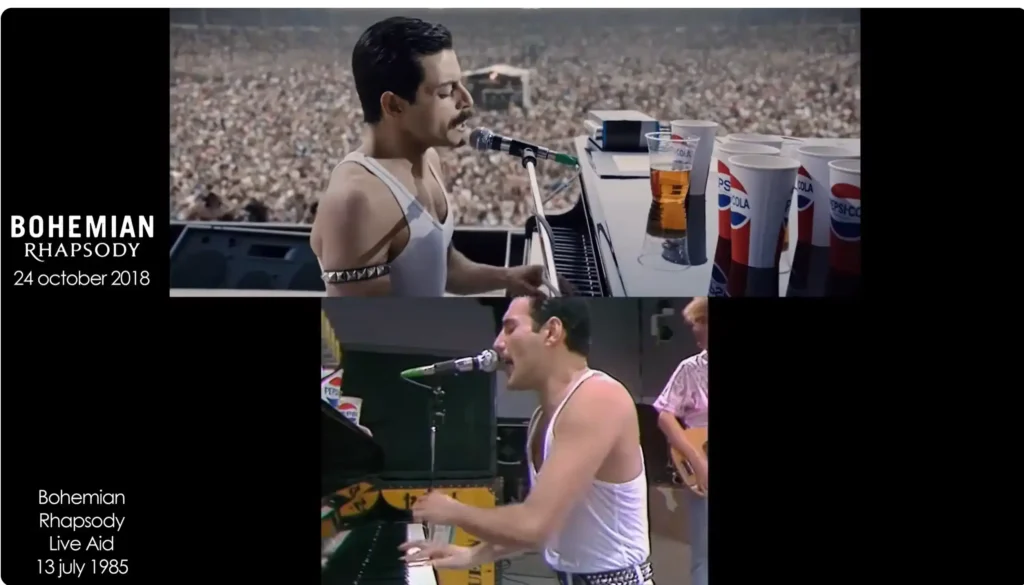
In the Live Aid sequence from Bohemian Rhapsody, the four actors convey a determination to inhabit their characters that goes beyond simply resembling the musicians.
The comparison videos below reveal how closely details such as gestures and the way instruments are held match the original performance. Alongside the actor playing Freddie, watch the three actors portraying Brian, Roger and John.
Click either image below to open the comparison video on YouTube.
Comparison Video 1 — Approximately 17 Minutes
Comparison Video 2 — Approximately 23 Minutes
1986: A Kind of Magic and the Final Tour
Songs Written for a Film Become an Album
Released in June 1986, A Kind of Magic grew around songs written for Highlander. Some were rearranged or restructured for the album, while material not used in the film was added to create a record that stood on its own.
Freddie helped reshape Roger’s title track into a lighter, more buoyant song than the version heard in the film. Freddie’s “Princes of the Universe” uses fierce vocals and guitar to express the story’s conflict.
Brian’s “Who Wants to Live Forever” emerged from the relationship between an immortal protagonist and a loved one whose life must end. Brian and Freddie share the vocals, with orchestral accompaniment intensifying the emotion. The song began with the film’s story; it was not written about Freddie’s illness.
John’s “One Year of Love” is a ballad featuring saxophone. “Friends Will Be Friends”, written by Freddie and John, sets words of mutual support to a broad melody suited to singing together with an audience.
From Wembley to Knebworth on 9 August
The Magic Tour began that June and comprised 26 concerts across Europe, including Britain. Spike Edney supported the band on keyboards and other instruments as they travelled with a large stage and lighting production.
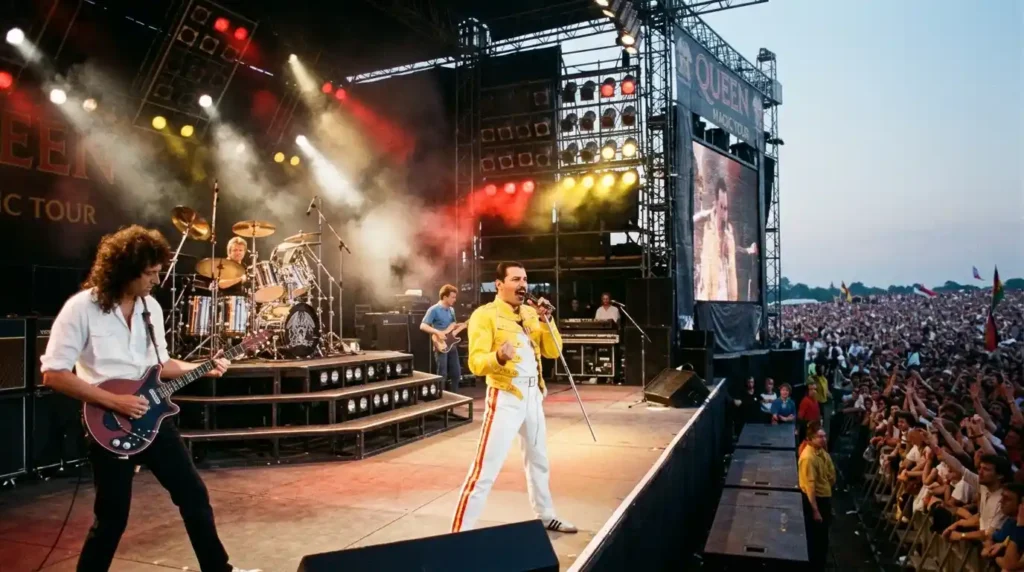
On 11 and 12 July, Queen headlined Wembley Stadium. It was the same venue as Live Aid, but this time they had a full concert in which to present their music. The footage from the second night became an important record of their playing during this period.
The tour ended at Knebworth Park in England on 9 August. That show would prove to be Queen’s final concert with Freddie and the other three original members. It had not been announced as a farewell performance.
1987–1989: Individual Projects Lead Back to The Miracle
Separate Musical Paths and a Return to the Studio
After the tour, the members also devoted time to individual projects. Freddie worked with opera singer Montserrat Caballé, releasing Barcelona in 1988. Roger formed another band, The Cross, while Brian pursued work with other artists.
Queen began recording their next album in January 1988. The Miracle, co-produced with David Richards, followed in May 1989. Its cover merged the four members’ faces into a single image, expressing their renewed unity.
What Shared “Queen” Songwriting Credits Meant
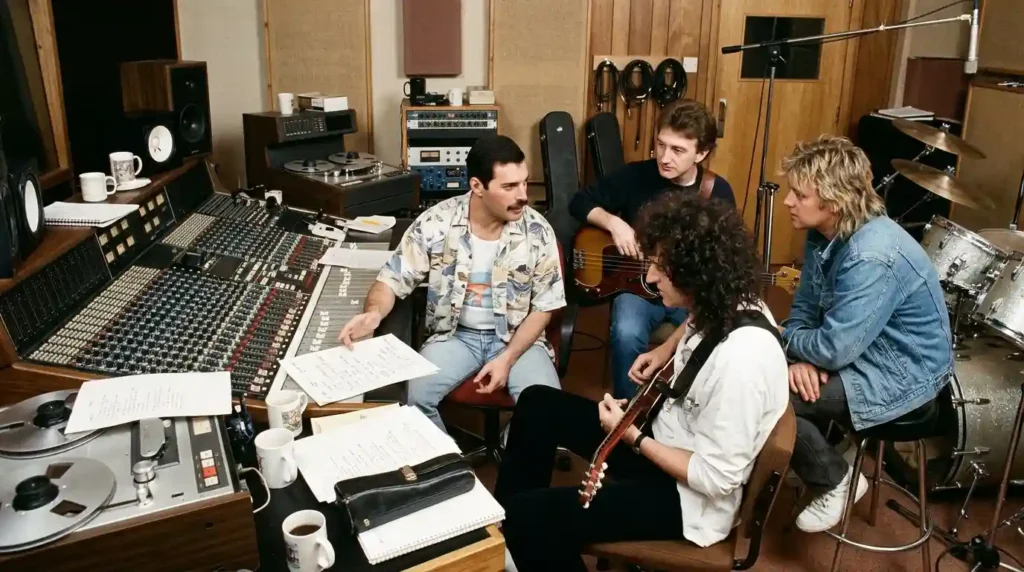
Every song on The Miracle was credited to Queen. Even when an individual member originated a song, the songwriting credits and royalties were shared equally among all four.
According to the band’s official account, this change eased disagreements over matters such as whose song should become a single, allowing them to concentrate more fully on making music.
“I Want It All” puts heavy guitar and powerful vocals at the forefront. “Breakthru” shifts from a choral opening into a driving rhythm. “The Invisible Man” emphasises electronic sounds and an active bass line, while the title track connects memorable melodies through changes of musical direction.
Meanwhile, Freddie’s illness was progressing. He had not made his condition public, and the members continued recording. No tour followed The Miracle, and Queen focused their efforts on creating new material.
1991: The Voice and Musicianship Preserved on Innuendo
An Extended Composition and Contrasting Moods
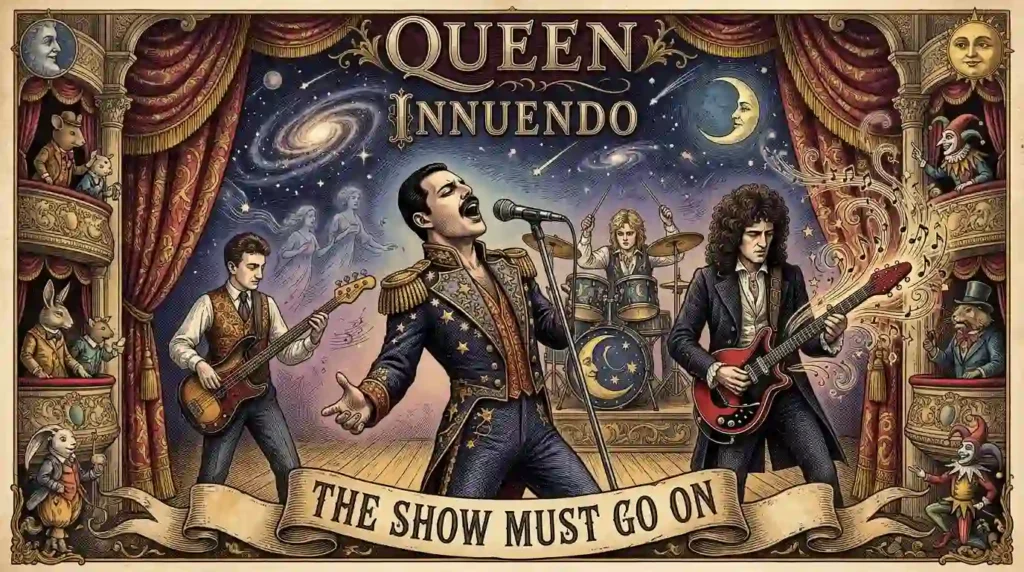
Released in February 1991, Innuendo was the final original studio album issued during Freddie’s lifetime. Queen again co-produced the record with David Richards.
The title track runs for more than six minutes. A weighty opening gives way to flamenco-influenced guitar before the music returns to a full rock arrangement. Steve Howe of Yes also contributed guitar. The ambition to develop a song through contrasting sections and layers of voices and instruments remained very much alive.
“Headlong” surges forward on energetic guitar, while “I’m Going Slightly Mad” introduces eccentric humour. In “Delilah”, Freddie sings affectionately about his cat. The album retains an aggression and playfulness that cannot be understood through his illness alone.
Two Songs That Preserve Freddie’s Later Voice
“These Are the Days of Our Lives”: Roger Reflects on Time
Originated by Roger, “These Are the Days of Our Lives” looks back on the past while also valuing the present. Freddie sings over a gentle rhythm, and Brian’s guitar carries the melody onward.
Freddie filmed his contribution to the song’s video on 30 May 1991, making what would become his final music-video appearance. Brian’s scenes were filmed separately at a later date. In the finished video, Freddie moves relatively little, yet his expression and gaze convey his determination as a performer.
“The Show Must Go On”: Three Musicians Support the Voice
“The Show Must Go On”, developed principally by Brian, closes the album. Freddie delivers its demanding high notes with a full, ringing voice. Layers of guitar and backing vocals, together with bass and drums, support his performance.
November 1991: Freddie Mercury’s Death
On 23 November 1991, Freddie issued a statement confirming that he was HIV-positive and had AIDS. He died the following day at his London home from bronchial pneumonia resulting from AIDS. He was 45.
Freddie continued recording after the release of Innuendo whenever his health allowed. Some of the vocals from his final months can be heard on recordings completed by the other members after his death.
His death ended the possibility of the four gathering to record new performances together. Their records and films nevertheless preserve the distinctive sound created by those different musical personalities.
2018: Seeing Bohemian Rhapsody Twice
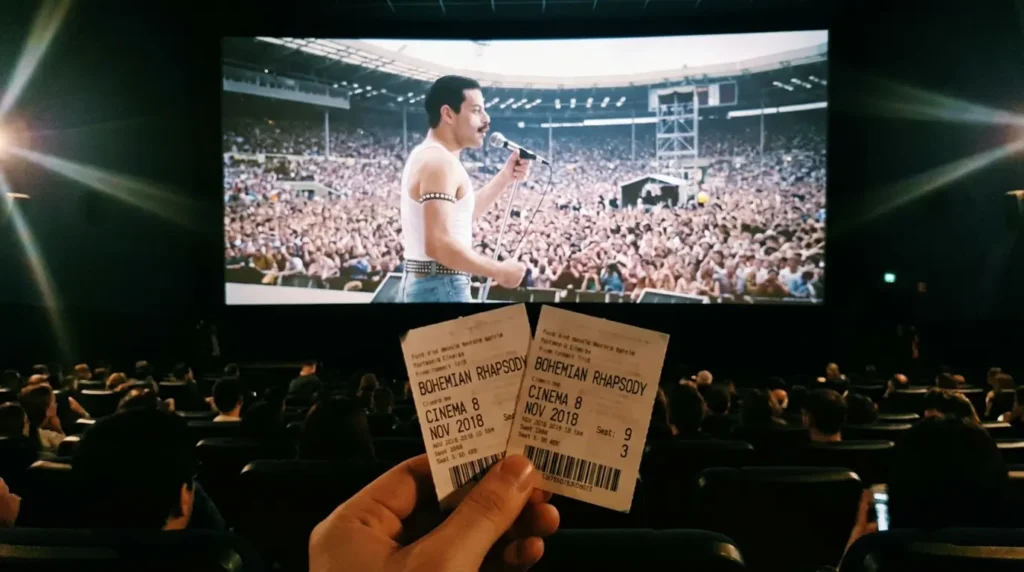
I saw Bohemian Rhapsody, released in 2018, twice at the cinema. Of all the music films I have seen, it remains my favourite.
The four actors are a major part of its appeal: Rami Malek as Freddie, Gwilym Lee as Brian, Ben Hardy as Roger and Joseph Mazzello as John. They capture the musicians’ individual characteristics so well that it almost seems as though the filmmakers gathered their lookalikes.
Brian and John, who often appear comparatively reserved, particularly caught my attention. As a longtime fan, simply watching the actors reproduce their subtle characteristics was a pleasure.
The film does, however, rearrange events and relationships for dramatic purposes. Its account of a lengthy break and reunion before Live Aid differs from the band’s actual history.
For Queen fans who have not yet seen it, this is a film well worth seeking out through a film-streaming service or another viewing opportunity.
30 January 2020: Rediscovering an Attachment to the Original Four at Nagoya Dome
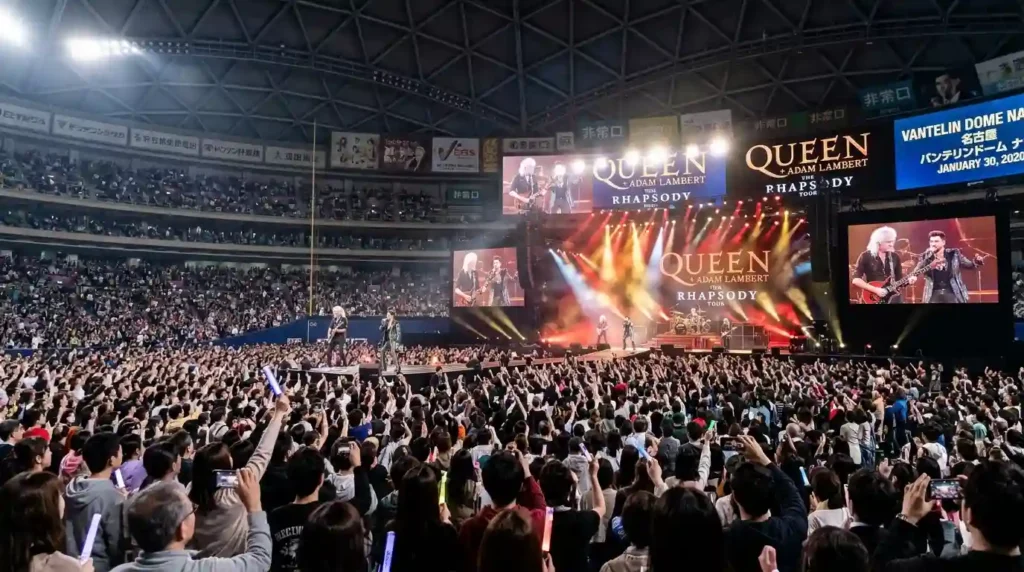
My second Queen concert was the Queen + Adam Lambert show at Nagoya Dome on 30 January 2020. The number of young people in the audience was striking, revealing how widely Queen’s music was recognised across generations.
While enjoying Brian and Roger’s playing, I also realised that my deepest attachment remained with the four-member Queen, complete with Freddie’s voice and John’s bass. The pleasure of hearing Adam sing existed alongside that longstanding affection for the sound of the original band.
Following these three introductory articles, the “Queen Best” series will explore the songs in this order: hard rock; rock ’n’ roll, pop and experimental songs; and ballads. Each category will have its own ranking, with no overall ranking across the three.
Now it is time to listen more closely to the music those four musicians left us, one song at a time.
音楽ファン同士の交流・リクエストはこちら / Connect & Request Songs Here