
- 🎧 Enjoy This Article with Audio
- 🎤 [May 6] is Miwa Yoshida’s Birthday
- 1989: A Dramatic Turning Point and the Birth of “New Pop”
- The Growth of a Relationship and Masterful Scenery Painted by Brilliant Lyrics
- The Historical “Invention” of Blinking Brake Lights Five Times
- Overwhelming Vocals and a Precision Machine-Like Soundscape
- A Grand “Future Map” and the Modest Everyday Life at Our Feet
- In Conclusion: Overlaying My Own “Future Map”
🎧 Enjoy This Article with Audio
You can easily grasp the main points of this article through audio.
Recommended for those who want a quick summary before reading.
🎵 English Narration
Listen to the content of this article with English narration.
⏳ Playback time: Approx. 3 min
🎶 Japanese Narration
You can also listen to the same content in Japanese.
⏳ Playback time: Approx. 3 min
* Listening to the audio before reading the text will help you understand the song’s worldview and the article’s key points more fully.
🎤 [May 6] is Miwa Yoshida’s Birthday
Miwa Yoshida, born on May 6, 1965, in Ikeda, Nakagawa District, Hokkaido, is a singer-songwriter best known as the vocalist of the music duo DREAMS COME TRUE. She handles all the lyrics and many of the compositions for the group, giving birth to numerous masterpieces such as “Mirai Yosouzu II” (Future Map II) and “LOVE LOVE LOVE“. With her overwhelming vocal prowess and emotionally rich expressiveness, she continues to have a massive impact on the Japanese music scene. Furthermore, in her hometown of Ikeda, there is “DCTgarden IKEDA,” a place where you can trace her footsteps, making it a sacred place for fans.
First, check out the song through the official YouTube videos!
Credits
DREAMS COME TRUE "Mirai Yosouzu II"
Lyrics & Music: Miwa Yoshida / Arrangement: Masato Nakamura
Audio provided by: Sony Music Labels Inc.
℗ 1989 Sony Music Entertainment (Japan) Inc.
2-Line Commentary
A signature love ballad by DREAMS COME TRUE, a warm masterpiece that quietly envisions a future with a loved one.
Released in 1989, it remains one of "Dreams Come True's" greatest standards, sung across generations.
 Credits
DREAMS COME TRUE "Mirai Yosouzu II"
Lyrics & Music: Miwa Yoshida / Arrangement: Masato Nakamura
Video: from DWL2007 Live Ver.
Featured Video Product: "The Greatest Traveling Amusement Park: DREAMS COME TRUE WONDERLAND 2007"
2-Line Commentary
Live footage of "Mirai Yosouzu II" released from the 2007 National Stadium performance "DWL2007".
Featuring a beautiful piano by musical director Hiroshi Sato, it delivers the warmth of this masterpiece on a grand live scale.
Credits
DREAMS COME TRUE "Mirai Yosouzu II ~VERSION'07~"
Lyrics: Miwa Yoshida / Music: Miwa Yoshida
Included in: 40th Single "A-I-Shi-Te-Ru no Sign ~Watashitachi no Mirai Yosouzu~" B-side
Video: Live from DWL 2015 Live Ver.
2-Line Commentary
A 2007 reconstruction of the masterpiece "Mirai Yosouzu II", a definitive love ballad by DREAMS COME TRUE.
In the live footage from DWL 2015, the epic stage presence and Miwa Yoshida's vocals convey the warmth of the song even more vividly.
When I First Heard This Song… ♫
| My Age | Elementary | Jr. High | High School | University | 20s | 30s | 40s | 50s | 60s~ |
| Release Year | 1989 | ||||||||
| When I Heard It | ● |
Exactly one year ago today. On Miwa Yoshida’s birthday, I introduced “LOVE LOVE LOVE”.
In that article, I wrote: “…It’s hard to rank them, but ‘Mirai Yosouzu II’ is equally compelling. It’s a highly attractive song as well. I hope to have the chance to introduce it somewhere ( ;∀;)”
…I had written that, and incredibly, a year has passed, and I am finally able to introduce it to you.
I believe I first heard this song upon its release in 1989. I was in my 9th year as a working adult, 31 years old.
I was living my usual busy days.
However, things were relatively stable both at work and at home. I had been working at the branch office in Oita City for two years, and I remember expressing my intentions to the branch manager at the time, saying, “For my next transfer, I want to go to the Tokyo branch.” (Ultimately, I ended up going to the Osaka branch instead of Tokyo… !(^^)!)
Days of facing numbers endlessly from early morning to late at night.
My life in Oita was fulfilling, but somewhere in my heart, a burning ambition to “test my abilities on a larger stage” was smoldering. I wanted to stand on the front lines of business in the big city of Tokyo. While carrying a feeling akin to impatience, “Mirai Yosouzu II” suddenly flowed from the car stereo on my drive home at night.
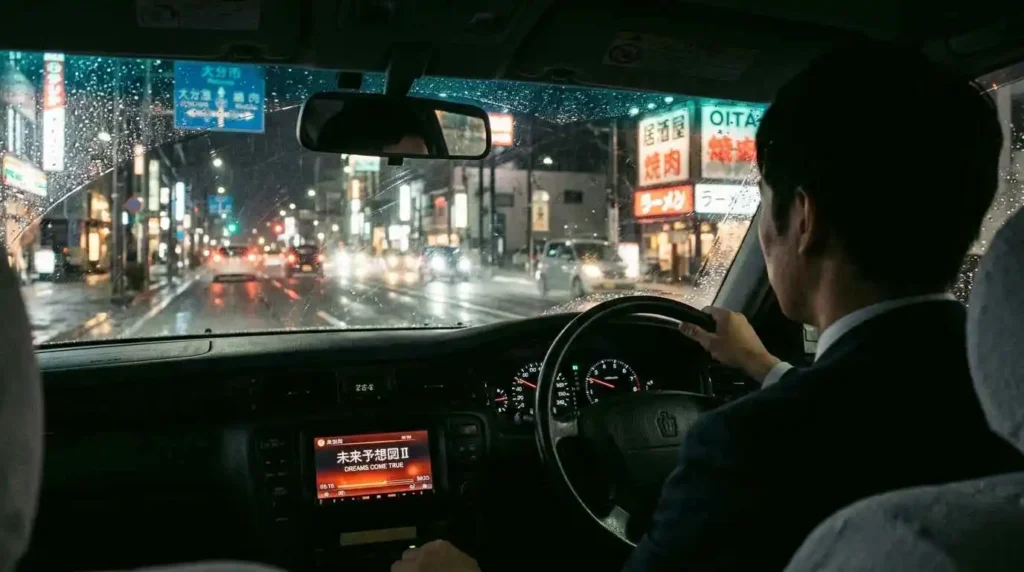
At the time, perhaps I was desperately trying to draw my own “future map” for my career and life, trying to pull it closer to reality. That’s exactly why the theme of this song—”an unwavering future found within everyday life”—seeped deeply into my heart, like water soaking into dry sand.
I wasn’t a particularly devoted fan of DREAMS COME TRUE, but I felt something truly exceptional in Miwa Yoshida’s talent as a singer-songwriter, completely different from other artists of that era.
1989: A Dramatic Turning Point and the Birth of “New Pop”
The year 1989 (Heisei 1), when this masterpiece “Mirai Yosouzu II” was released, was an extremely symbolic and turbulent turning point for both Japanese society and the music scene.
The world was at the absolute peak of the bubble economy. Luxury cars flooded the streets, expensive champagne was popped open in VIP rooms at discos, and people reveled in a glamorous consumer society that seemed to endlessly rise.
It was the same even in the rural city of Oita. At the bank branch where I worked, many salarymen came to borrow money to buy stocks. “Borrowing money to buy stocks” seems incredibly risky looking back now, but it was a truly abnormal era where doing so would actually make your assets grow rapidly.
The Transition from Kayokyoku to J-POP
Looking at the music scene, it was a transition period where the long-standing era of “Kayokyoku” shifted to a new wave of music later called “J-POP.” The TV program “Ikasu Band Tengoku” (Ika-Ten) sparked an unprecedented band boom, with raw, edgy rock bands making their debuts one after another.
」_202605-1024x572.webp)
Amidst that noise and frenzy, DREAMS COME TRUE presented Japanese listeners with music pointing in a completely new direction. It was an incredibly high-quality soundtrack that brilliantly elevated the sophisticated grooves of American Black music, Soul, and R&B into exquisite pop melodies that touched the hearts of the Japanese people.
A National Anthem Never Released as a Single
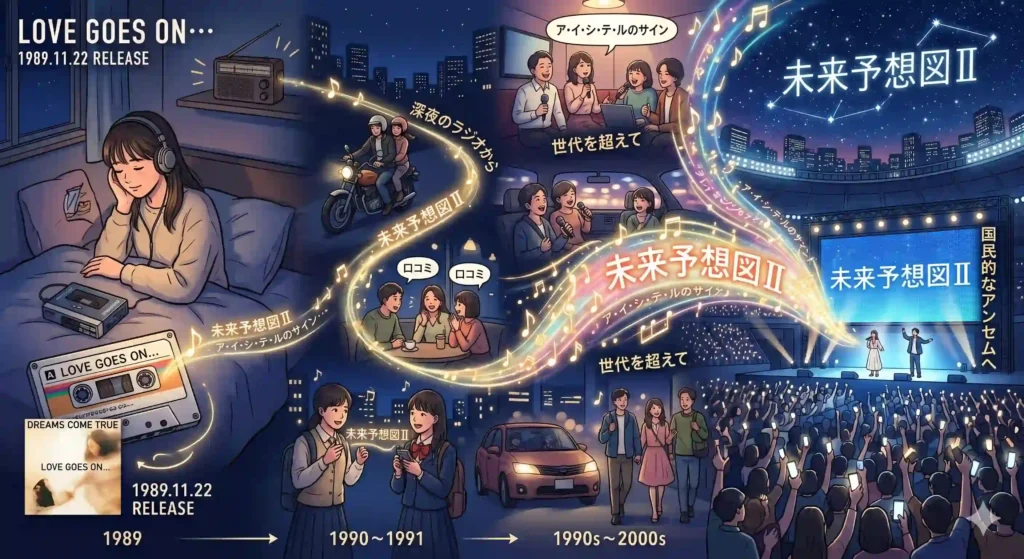
Surprisingly, “Mirai Yosouzu II” was not released as a standalone single. It was quietly introduced to the world on November 22, 1989, as the 10th and final track closing their second smash-hit album, “LOVE GOES ON…”.
It wasn’t equipped with a massive TV commercial tie-up or extensive promotion right from the start. It slowly caught fire through late-night radio airplay and enthusiastic word-of-mouth from listeners who picked up the album, eventually growing into a national anthem sung across generations. This unique trajectory alone proves the pure strength inherent in the song itself and its timeless universality.
The Growth of a Relationship and Masterful Scenery Painted by Brilliant Lyrics
Reading the lyrics closely again this time, I can only marvel at Miwa Yoshida’s extraordinary descriptive skills and storytelling prowess as an artist.
From Motorcycle to Car. Vehicles as Indicators of “Passing Time”
The song opens with an extremely specific phrase: “Already the third spring since graduation.” With just this single line, listeners accurately grasp the protagonists’ current position in life.
_202605061402-1-1024x572.webp)
And the scenery description that follows is nothing short of brilliant. “The road home we sped along on a motorcycle back then / Now we’re driving while looking at the stars through the roof”
They used to ride tandem on a motorcycle, feeling the cold night wind on their bodies. Now, they are protected in a warm, heated car, looking up at the winter starry sky through the sunroof. This represents much more than just a change in economic wealth, like “our salaries went up so we could buy a car.”
It perfectly expresses how their relationship has matured from a precarious phase fueled only by passion into a deep, stable love that gently envelops each other. Using the visual and easy-to-understand motif of “changing vehicles,” it depicts the process of them both becoming adults and firmly establishing their place in society.
The Historical “Invention” of Blinking Brake Lights Five Times
And the biggest factor that makes this song an eternal masterpiece shining brilliantly in J-POP history is that phrase in the chorus.
After dropping me off, I watch until you turn the corner
Always flashing the brake lights five times
The sign for ‘A・I・SHI・TE・RU’ (I Love You)
A quiet residential area at night. The girlfriend, after getting out of the car, watches her boyfriend’s car drive away with endless affection. Right before he turns the corner at the intersection and disappears, the bright red brake lights rhythmically flash five times in the darkness of the night (representing the 5 syllables of “A-I-Shi-Te-Ru,” the Japanese phrase for “I love you”).
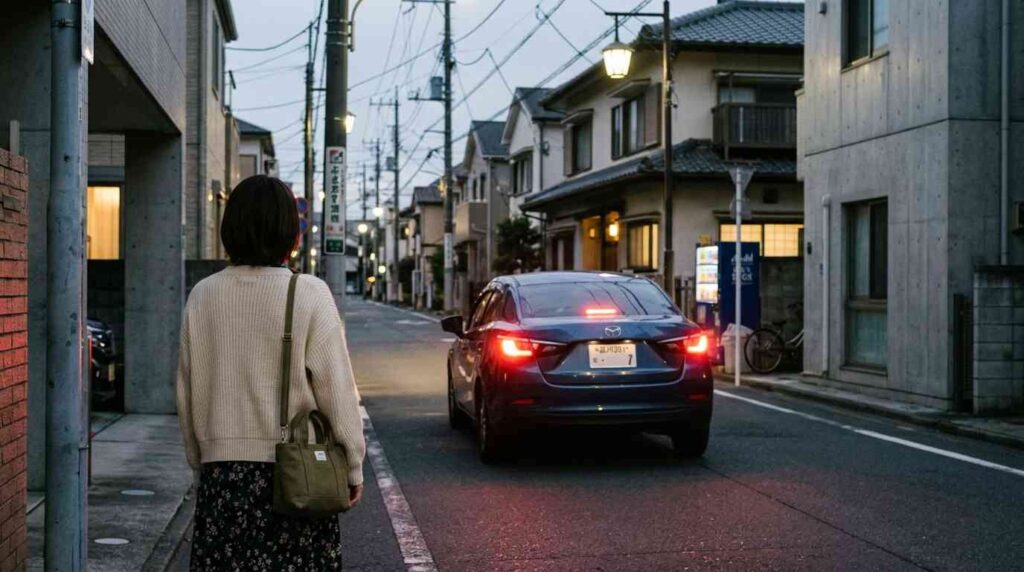
This phrase cast a powerful magic on the romantic views and behaviors of young people all over Japan at the time. Looking someone directly in the eye and saying “I love you” out loud is inherently embarrassing given the typical Japanese sensibility. However, by using a secret code just between the two of them, they could easily leap over that bashfulness and directly convey a deeper, stronger love.
Young people went crazy for this magic that transformed the mundane, mechanical act of “stepping on a car brake” into an extremely private and romantic ritual. Couples actually flashing their brake lights five times at intersections late at night became so common that it caused traffic jams and confused trailing drivers—an anecdote that is still passed down as a legend symbolizing 1989.
The Form Changes, but the Essence Remains the Same
What makes these lyrics even deeper is the setting that this is an extension of their code from their student days: “That signal of bumping our motorcycle helmets five times.” “Even though the sign has changed now, with the same feelings / I honestly love you”
Even as they age, their living environments change, and the way they express love (the sign) shifts from a motorcycle helmet to a car’s brake lights, the underlying feeling of caring for each other hasn’t changed a single millimeter. This unwavering trust and universal love deeply strike the listener’s heart, no matter how many years pass.
Overwhelming Vocals and a Precision Machine-Like Soundscape
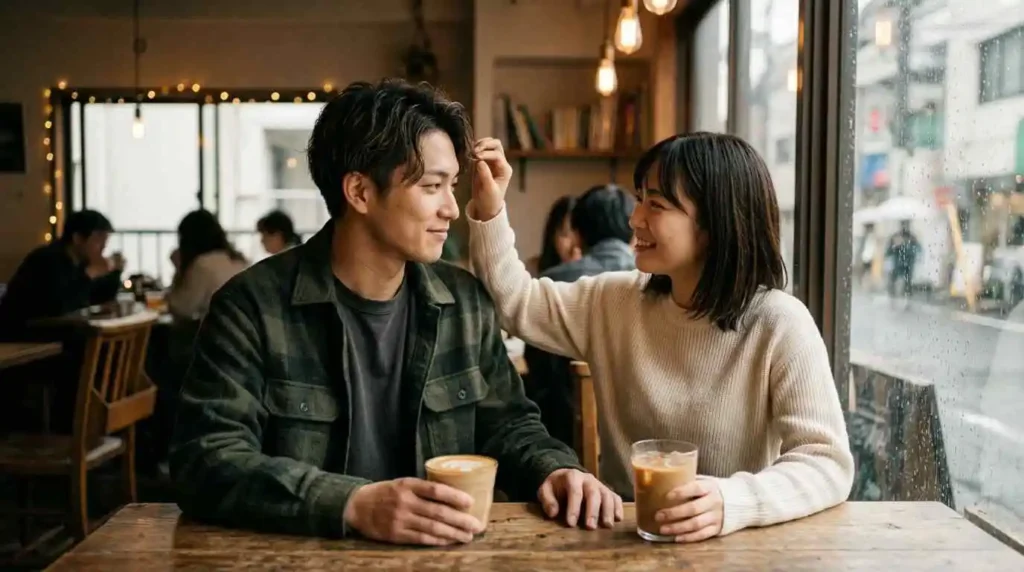
It’s not just the lyrics that support the song’s power. Miwa Yoshida’s vocals possess a sheer intensity that can only be described as a natural gift.
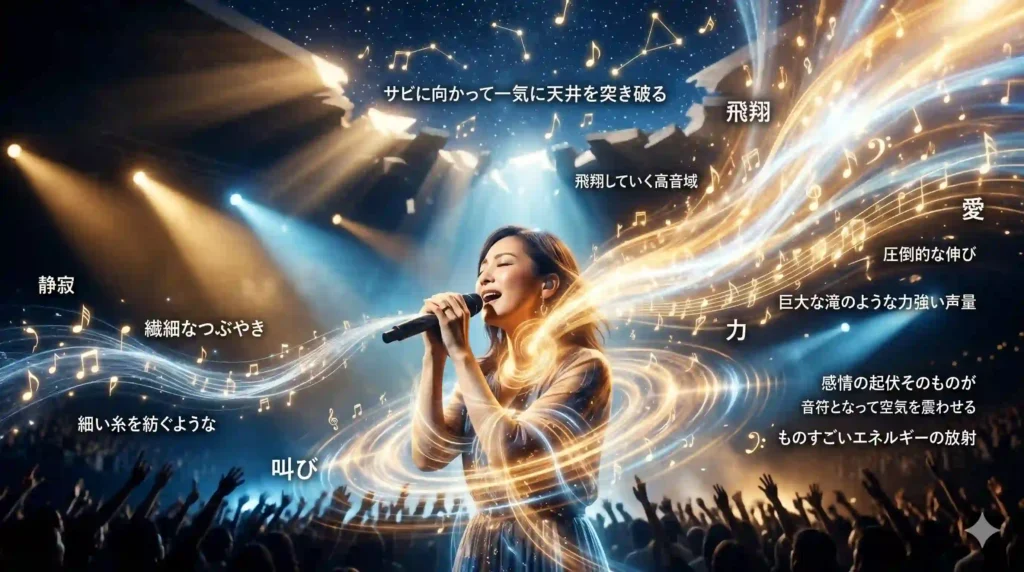
Starting with quiet whispers in the lower register, her incredibly expansive high notes soar upward as if breaking through the ceiling toward the chorus. Her voice controls her vocal cords flawlessly, from delicate expressions like spinning a thin thread to powerful volumes resembling a massive waterfall. It’s a tremendous radiation of energy, as if the emotional fluctuations themselves have become musical notes vibrating the air.
Meticulous Production by Masato Nakamura
And Masato Nakamura’s sound production, which fundamentally supports those miraculous vocals, is calculated as perfectly as a precision machine.
In the beginning, the rhythm section is subdued as the song progresses quietly, but by layering the tones of strings and synthesizers manifold, it develops into grand orchestration as the track unfolds. His sense of choosing universal tones that never sound outdated, even while fully utilizing the latest programming technology of 1989, is truly hats off.
Especially toward the end of the song, in the repeating phrase “Look, it’s coming true exactly as we thought,” the chorus work surges in like heavy waves over and over. It creates a sense of scale as if the highlights of the couple’s lives are being projected onto a massive movie theater screen. This dynamism that pulls the listener into a vortex of emotion is the true essence of a supreme pop ballad.

A Grand “Future Map” and the Modest Everyday Life at Our Feet
The future the protagonist envisions in this song is never anything flashy like that. “I’m sure no matter how many years pass, we’ll be able to live on / with these unchanging feelings, because I’m with you”
Occasionally opening an old album together on a holiday afternoon, laughing at pictures of when they were still mischievous. Sharing those “casually passing days” together forever. The song gently teaches us the truth that even without special major events occurring, gazing at the same scenery with a loved one and accumulating the same days together is actually the hardest “future map” to attain in life, and the most precious.

That is exactly why, no matter how drastically times change or how social values diversify, this song continues to be chosen for weddings—life’s greatest milestones—and remains beloved across generations.
In Conclusion: Overlaying My Own “Future Map”
A truly long time has passed since then. I was 31 at the time; it’s been more than 35 years.
Now, while expressing my passion for music on my own blog like this, I am fully enjoying days that the 1989 version of me couldn’t even have imagined.
The “future map” of my career that I envisioned changed shape with the times, redrawn on an entirely different canvas. However, as a result, it lies on the extension of those “unchanging feelings” I felt from this song back then. Though the form has changed, I truly feel that the most important future map for me has, despite many twists and turns, mostly come true.
As the eras transition from Showa to Heisei, and then to Reiwa, and the cars young people drive change from gasoline engines to quiet hybrids and EVs, the essence of caring for someone important never changes. Listening to the beautiful melody of “Mirai Yosouzu II” once again on Miwa Yoshida’s birthday strongly reaffirms the importance of living life without overlooking the small happiness blooming right at our feet.



音楽ファン同士の交流・リクエストはこちら / Connect & Request Songs Here