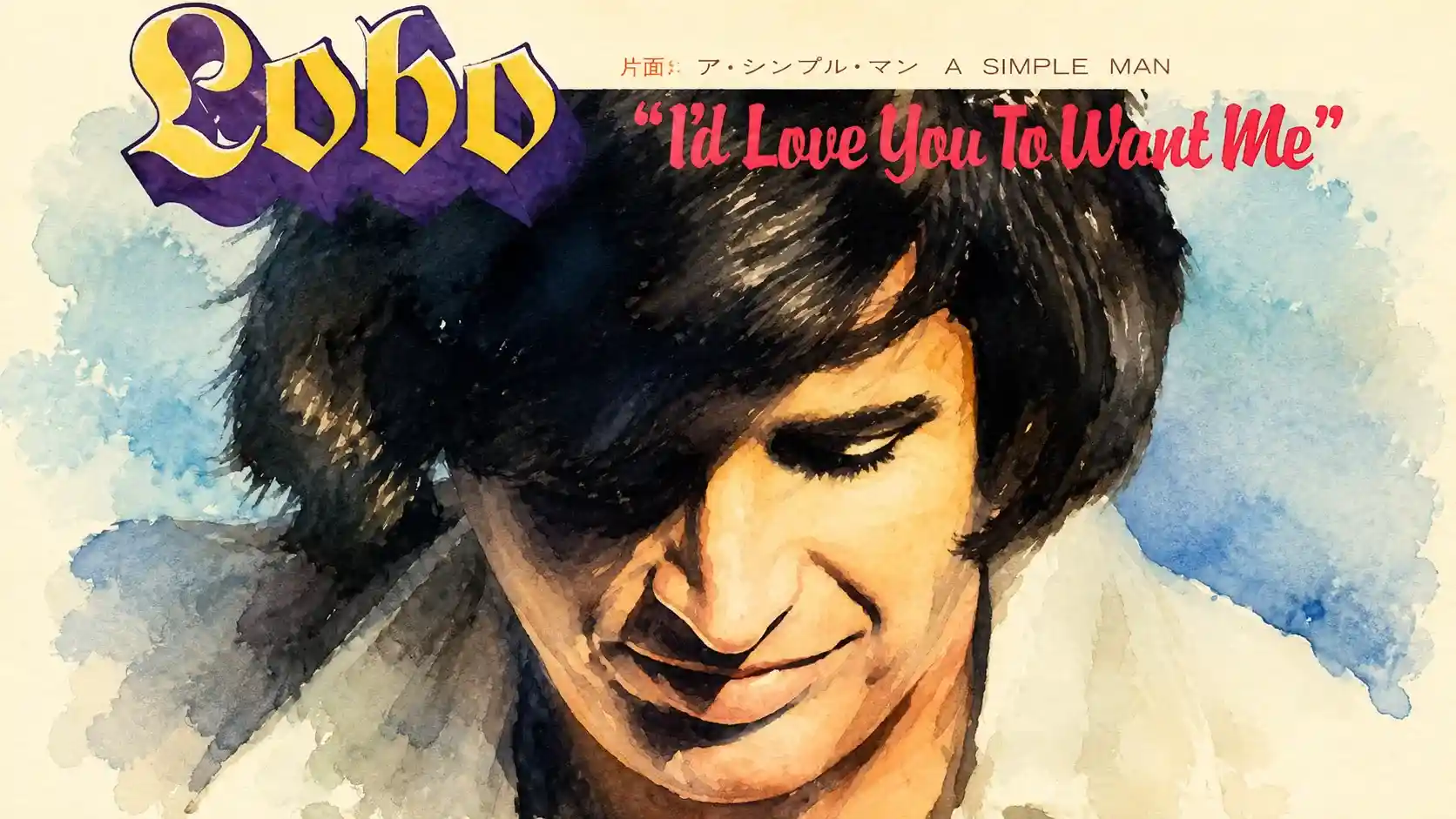
- 🎧 Listen to This Article
- Today Is Lobo’s Birthday
- First, Listen to the Official Recordings on YouTube
- When I First Heard This Song
- A Love That Seems Close but Remains Out of Reach
- The Music of 1972 and Lobo’s Distinctive Style
- Two Recordings Shaped by the Passage of Time
- An Unfulfilled Love That Has Endured for More Than Fifty Years
🎧 Listen to This Article
Enjoy a narrated summary of this article before you start reading.
Recommended if you’d like to experience the beauty of “I’d Love You to Want Me” and get an overview of the article first.
🎵 English Narration
Listen to an English narration of this article.
🎶 日本語ナレーション
この記事の内容を日本語で紹介する音声です。
Listening to the narration first makes it easier to appreciate the song and understand the key points of the article.
Today Is Lobo’s Birthday
July 31 is the birthday of American singer-songwriter Lobo.
The Singer-Songwriter Who Called Himself a Lone Wolf
Lobo was born on July 31, 1943, in Tallahassee, Florida. His real name is Roland Kent LaVoie.
The name “Lobo” is the Spanish word for “wolf.” He reportedly chose it because he felt a personal connection with the image of a lone wolf.
He did not receive formal musical training from an early age. His first step into music came when a neighborhood boy taught him several guitar chords.
In 1961, he joined a local band called the Rumours. He later worked with musicians including Gram Parsons and Jim Stafford, gaining experience in performance and recording through several different groups.
In 1969, he released a solo single under the name Kent LaVoie. Two years later, “Me and You and a Dog Named Boo” became a major success and introduced the name Lobo to a much wider audience.
Lobo’s approachable style blends folk, country, and pop without forcing any one element to the front. Through memorable melodies and his calm, gentle voice, he has sung about familiar subjects such as love, separation, travel, and loneliness.
The Release and Worldwide Success of “I’d Love You to Want Me”
“I’d Love You to Want Me,” the song featured in this article, was released as a single from Lobo’s second album, Of a Simple Man, in September 1972.
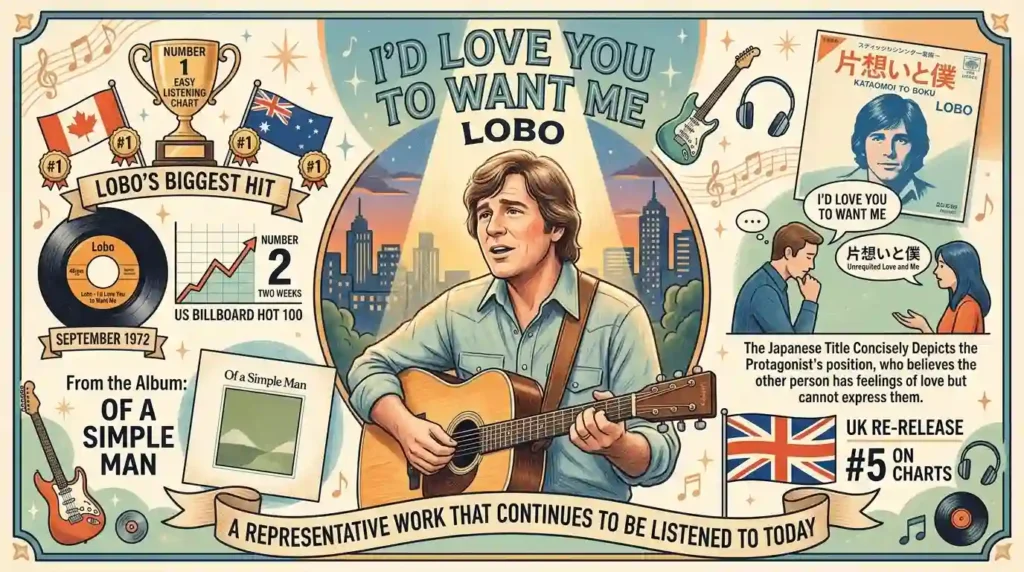
The song remained at No. 2 on the US Billboard Hot 100 for two weeks and reached No. 1 on the Easy Listening chart. It also topped the charts in countries including Canada, Australia, and New Zealand.
In the United Kingdom, a 1974 reissue climbed to No. 5. It became the biggest hit of Lobo’s career and remains his best-known recording.
In Japan, the song was released under the title “Kataomoi to Boku,” meaning “Unrequited Love and Me.” A more direct rendering of the original title would be, “I wish you wanted me too.”
Although the Japanese title is not a literal translation, it clearly expresses the position of a man who believes the woman has feelings for him but cannot persuade her to reveal them.
A Free Interpretation
Deep within your eyes, I found a feeling you could not conceal.
There is only one thing I ask: that you might want me as I want you.
Forget the title you were given and the promises of long ago.
Be honest with your heart, and place that feeling in my hands.
First, Listen to the Official Recordings on YouTube
The Original 1972 Recording
Credits
“I’d Love You to Want Me” / Lobo
Artist: Lobo
Written by: Roland Kent LaVoie
Album: Of a Simple Man
Audio: Original 1972 recording
Two-Line Commentary
This is the original recording of Lobo’s biggest hit, included on his 1972 album Of a Simple Man.
His gentle voice and the acoustic-centered arrangement convey the earnest longing of a man waiting for the woman he loves to respond.
A Reimagined Version Recorded Decades Later
Credits
“I’d Love You to Want Me” Reimagined Version / Lobo
Artist: Lobo
Written by: Roland Kent LaVoie
Published by: Lobo - The Official YouTube Channel
Format: Official video / Re-recorded version
Two-Line Commentary
This Reimagined Version of Lobo’s signature song was released through his official YouTube channel.
It preserves the melody of the 1972 recording while his older voice gives the song the feeling of looking back upon a distant love.
When I First Heard This Song
| My Age | Elementary School | Junior High | High School | University | 20s | 30s | 40s | 50s | 60 and Over |
| Year Released | 1972 | ||||||||
| When I First Heard It | ● |
A Song I Discovered Through Friends Who Loved Western Music
I believe I first heard this song when I was in my second year of junior high school.
At the time, my friends and I exchanged information about singers and records we had discovered. There was no internet or online video streaming. Conversations with friends, radio programs, and record-store displays were our most important gateways to unfamiliar music.
It was through those exchanges that I discovered Lobo’s “I’d Love You to Want Me.”
The first time I heard it, I was so deeply moved that I almost cried. It was not a song driven by a powerful voice or an arrangement that rose to a dramatic climax. Even so, its flowing melody and its portrait of a man who longs for someone but cannot take the final step remained deep within me.
Memories of the Single and Its Lyric Sheet
I soon became completely absorbed in the song and bought the single. I opened the lyric sheet, followed Lobo’s voice, and played the same record again and again.
Of course, I could not understand every line of English at that age. Still, as I followed the words, examined the sentence structures, and sang along, each phrase gradually found its way into my memory.
A Phrase from the Song Appeared on an English Test
Sometime later, an English expression used in the lyrics appeared as a question on a school test.
The moment I saw it, I realized, “That expression was in that song,” and I was able to work out the correct answer. I no longer remember which expression it was. Yet even after more than fifty years, I can still clearly recall the surprise and pleasure of seeing something I had learned from a song appear on an examination.
I would lower the needle onto the record and open the lyric sheet. When the song ended, I moved the needle back to the beginning and played it once more.
Because we could not instantly access an enormous library of music as we can today, we spent far more time with each record we owned. I listened until both the melody and the words had become part of me.
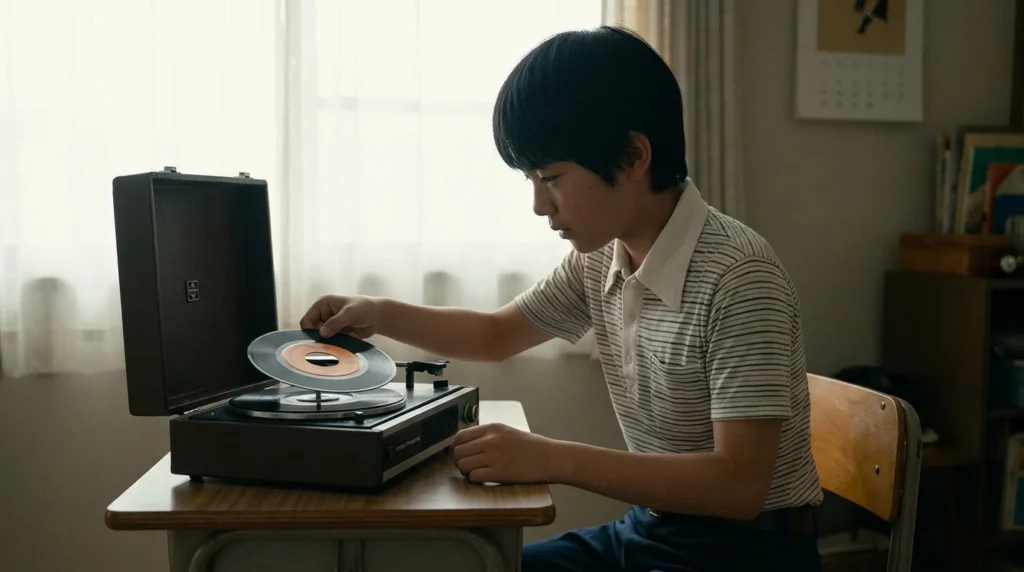
For me, “I’d Love You to Want Me” cannot be described merely as an old hit song. My second year of junior high school, conversations with friends about Western music, the feel of a vinyl record, and the hours spent following each line of English all return vividly whenever I hear it.
A Love That Seems Close but Remains Out of Reach
Emotion Rising Within a Gentle Arrangement
“I’d Love You to Want Me” does not begin with a dramatic introduction.
An acoustic-guitar-centered accompaniment establishes the mood before Lobo’s voice enters naturally above it. The arrangement uses relatively few sounds, but its central melody is clear and easy to remember even after a single hearing.
The opening lines remain in a lower register, while the melody rises on the chorus phrase “I’d love you to want me.” The desire he has kept under control briefly reaches the surface, allowing the emotion to intensify without any need for a raised voice.
Describing the Moment of Falling in Love Through Physical Sensation
At the beginning of the song, the narrator sees the woman standing there and feels as though he might fall out of his chair. When she begins to speak, he feels his blood rush down toward his feet.

The image of blood rushing to his feet may initially sound unusual. Read as the shock of his mind going blank and the strength leaving his legs, however, it creates a vivid picture of someone being physically overwhelmed by love at first sight.
It has been reported that the Hollies, to whom Lobo considered offering the song, asked him to change this line. Rather than accept a condition that would have required him to surrender part of the songwriting credit, Lobo chose to record the song himself.
“I Wish You Wanted Me Too”
The title phrase, “I’d love you to want me,” expresses the wish that she might desire him in the same way that he desires her.
The narrator believes he can see love for him in her blue eyes. She nevertheless refuses to bring those feelings into the open.
In the second verse, the song suggests that she decided many years earlier not to reveal her emotions. It is impossible to say with certainty whether the phrase “for the title that they gave” refers to a position created by marriage or to a role imposed by family or society.
Why This Is More Than a Simple Song of Unrequited Love
The Japanese title means “Unrequited Love and Me,” yet the narrator believes that the woman also has feelings for him.
The problem is not that she feels nothing for him. He senses that she loves him too, but she cannot openly acknowledge those feelings, leaving them unable to be together.

Their hearts draw close, but they never fully unite. That unresolved situation gives the gentle melody an underlying sense of pain.
The Music of 1972 and Lobo’s Distinctive Style
An Era That Embraced Singer-Songwriters
During the early 1970s, audiences increasingly embraced singer-songwriters who expressed everyday emotions through songs they had written themselves.
Artists such as James Taylor, Carole King, Cat Stevens, and Don McLean found major success with self-written material built around acoustic instrumentation.
Lobo’s music combined the simplicity of folk, the accessibility of country, and the clear structure of pop.
“I’d Love You to Want Me” likewise avoids complicated developments or extended instrumental passages. A straightforward chord progression and a recurring chorus lead the listener directly to the emotional center of the song.
Two Recordings Shaped by the Passage of Time
Young Love and a Memory Revisited Decades Later
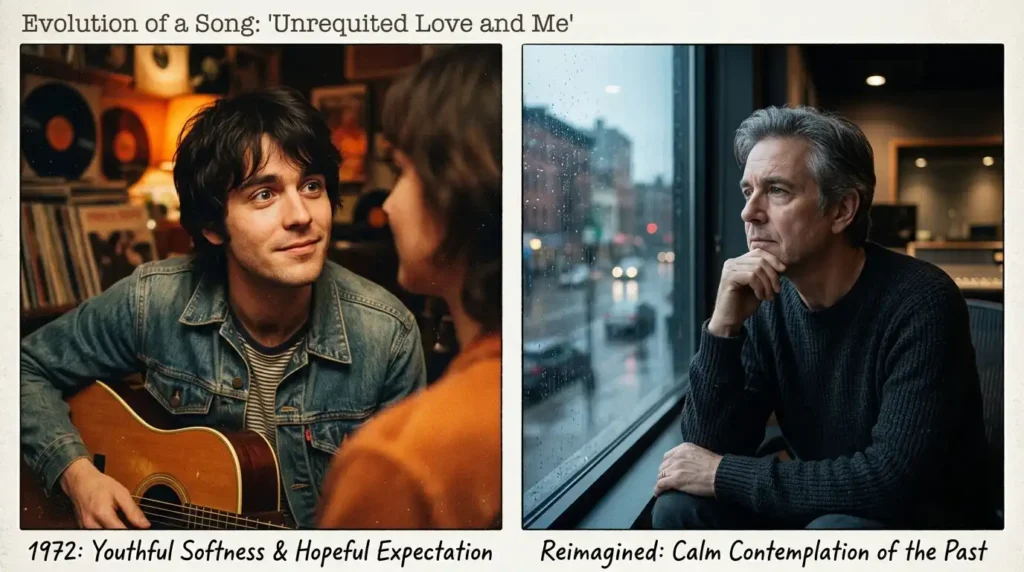
In the original 1972 recording, Lobo’s voice has a youthful softness. It suggests a young man who has seen love in the woman’s eyes and can barely contain his hope.
In the later Reimagined Version, both the texture of his voice and his phrasing have changed. Rather than a love unfolding in the present, it sounds more like a distant experience being calmly recalled.
Hearing Them as Two Different Stories
There is no need to decide whether the original or the re-recorded version is superior.
The 1972 recording preserves the atmosphere of the period in which the song was created and the freshness of Lobo’s younger voice. The Reimagined Version carries a depth that could come only from someone who has lived with the same song for many decades.
Listening to the two versions in succession allows us to hear not only the song itself, but also the long passage of time flowing through it.
An Unfulfilled Love That Has Endured for More Than Fifty Years
“I’d Love You to Want Me” has endured for reasons that go beyond its status as a major hit of 1972. There is the shock of seeing someone and falling instantly in love, followed by the joy of believing that the same feeling can be seen in her eyes. Yet there is also the pain of knowing that she will not acknowledge what she truly feels.
The forms of romance and the ways people communicate may change, but the desire to know how another person truly feels remains the same. The emotions expressed in this song do not belong to one particular generation.
For me, the song also brings back the single I bought in junior high school and the hours I spent following its English lyrics.
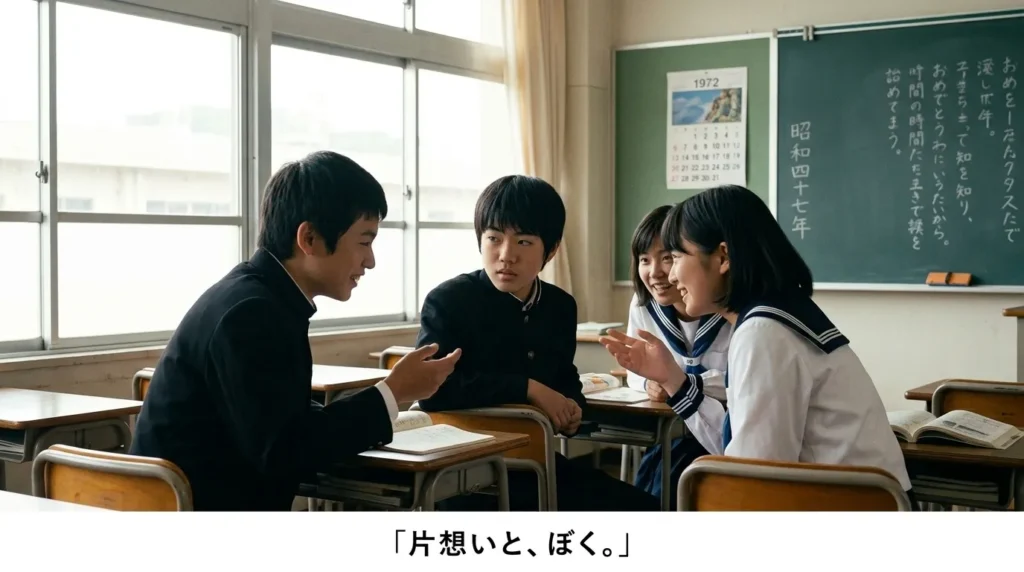
A single song can suddenly revive memories of old friends, the appearance of a room, and even the sensation of lowering a needle onto a record.
My junior high school years are permanently inscribed within “I’d Love You to Want Me.” For those hearing it for the first time today, perhaps new memories of their own will remain attached to this melody.
On July 31, Lobo’s birthday, listen once more to this beautiful love song by comparing the original 1972 recording with the later Reimagined Version.
音楽ファン同士の交流・リクエストはこちら / Connect & Request Songs Here