🌐 English|🌐 日本語
Explore Queen’s history: Part 1 | Part 2 | Part 3
- 🎧 Listen to This Article
- No. 15: Queen’s “One Vision”
- Watch the Extended Official Music Video
- From an Unsettling Introduction to Guitar-Driven Rock
- A Rhythm with Weight and Bounce
- A Collaboration That Took Shape in the Studio
- The Hope Behind the Word “One”
- The Unexpected Humor of “Fried Chicken”
- Closing Thoughts
🎧 Listen to This Article
Explore “One Vision,” No. 15 in My Personal Best Fifteen: Queen’s Hard Rock Edition.
The narration covers the performance, the collaborative recording process, and the hopes expressed in the lyrics.
🎵 English Narration
Listen to the article’s key points in English.
🎶 Japanese Narration
Listen to the article’s key points in Japanese.
No. 15: Queen’s “One Vision”
Released as a UK single in November 1985, “One Vision” reached No. 7 on the UK Singles Chart. It later became the opening track on A Kind of Magic, released in June 1986.
A guitar riff emerges from unsettling sounds, followed by a voice calling for unity. Built around the repetition of short phrases, the song grows into rock on a grand scale. Here, we explore how the performance works, how the recording took shape, and the hopes expressed in its lyrics.
The Song’s Message — A Free Interpretation
Imagine a future where race and circumstance no longer keep people apart.
Disappointment has battered that youthful ideal, but it need not destroy it.
Cooperation offers a way beyond hostility and conflict.
A shared commitment to tomorrow can give hope a fresh beginning.
Watch the Extended Official Music Video
Video courtesy of Queen Official, Queen’s official YouTube channel.
Queen — “One Vision” (Extended), Official Music Video (1985)
About the Video
Filmed at Musicland Studios in Munich, the video captures the four musicians working on the recording.
Alongside the powerful guitar riff and Freddie’s vocals, it offers a glimpse of the band’s expressions and interactions in the studio.
From an Unsettling Introduction to Guitar-Driven Rock
Setting Up the Riff
The extended version featured here opens with layers of processed voices and electronic textures. These sounds offer little of the immediate physical impact of drums or guitar, keeping the song’s direction uncertain. The wait for a steady rhythmic framework makes the transition that follows more striking.
Then Brian May’s guitar riff arrives. Its repeating pattern establishes both the pulse and a clear sense of direction. The shift from elusive sound effects to a rhythm you can physically follow is the recording’s first major attraction.
The riff’s force comes less from the number of notes than from the precision of its attacks and stops. Each sharply defined phrase creates anticipation for the next accent. The pattern is simple enough to hum, yet every repetition adds momentum to the performance.
The Guitar’s Changing Role
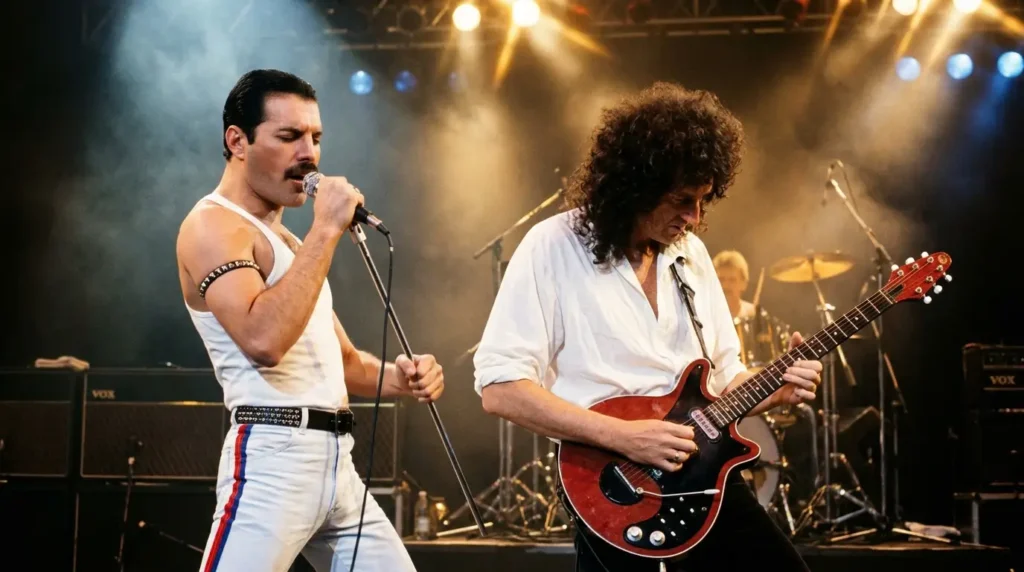
The guitar retains its presence after the singing begins. Freddie Mercury delivers short vocal phrases, with the riff filling the gaps to create an exchange between voice and instrument. The accompaniment does more than support the melody: it also makes the boundaries between vocal phrases more pronounced.
During the solo, sustained notes and layered guitar harmonies draw the ear. Moving from rhythmic punctuation to melodic expression gives the arrangement a broader sweep. The guitar develops the tension established by the recurring riff from a different angle.
A Rhythm with Weight and Bounce
Drums Mark the Beat, Bass Connects the Movement
Roger Taylor’s drums establish the beat with emphatic snare hits. They carry weight without making the performance feel sluggish. Maintaining a steady stride, the drums push the song forward.
John Deacon’s bass sometimes follows the guitar and sometimes moves independently. Beyond reinforcing the low end, it connects the spaces between drum accents and gives the accompaniment greater fluidity. Shifting attention from the guitar to the bass reveals another dimension of the song’s movement.
The combination of a clearly defined beat and smaller movements in the bass adds bounce to the song’s firm footing. The music keeps its hard-rock weight while inviting listeners to move with it. That balance gives the rhythm much of its character.
The Voice Becomes Part of the Rhythm
Freddie’s delivery also shapes the pulse. When he separates short words, the beginning of each syllable works almost like a percussive strike. When he sustains a note, the melody stretches across the moving accompaniment, creating a contrast with those clipped phrases.
Repeated words do not receive identical treatment. Freddie varies endings, accents, and breathing points to adjust the intensity of the appeal. His phrasing keeps the accessible lyrics from settling into a monotonous chant.
A Collaboration That Took Shape in the Studio
A Recording Session at Freddie’s Suggestion
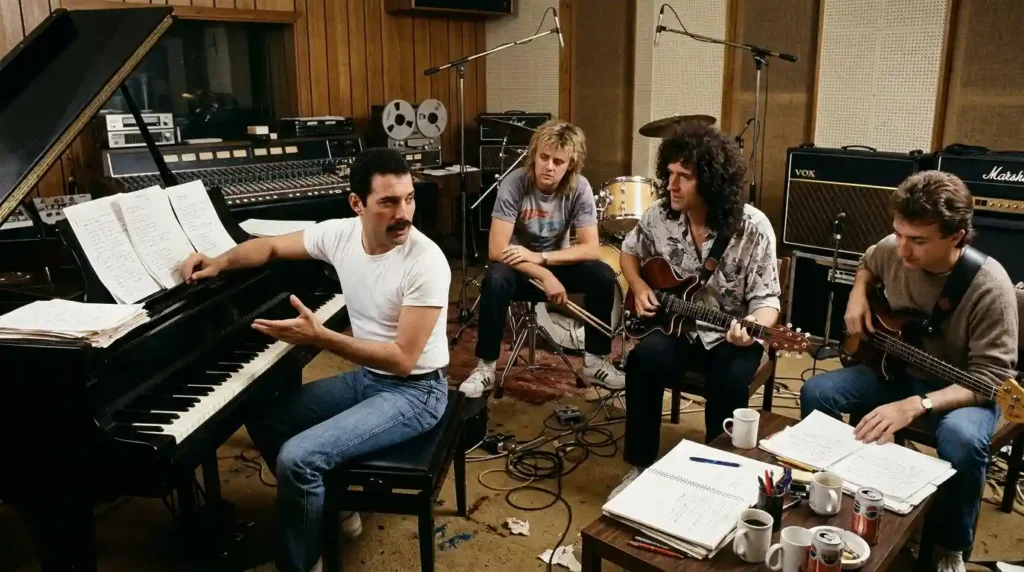
According to Queen’s official series Queen The Greatest, the band gathered at Musicland Studios in Munich in September 1985 at Freddie’s suggestion. The starting point was the idea of getting together to write a song.
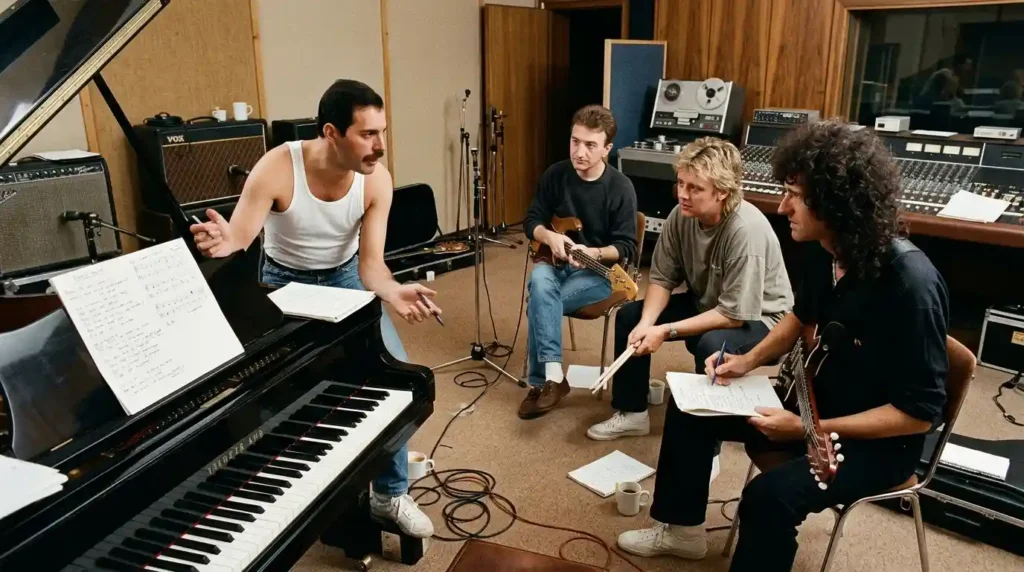
Brian’s riff and Roger’s lyrical ideas provided a foundation for the work. Roger also recalled John coming up with the bass part. Individual contributions were brought together and developed through playing.
The songwriting credit reads “Queen,” although John explained that Roger, Brian, and Freddie did most of the writing. A shared credit does not necessarily mean that everyone contributed equally to the composition. Developing ideas, revising material, and shaping instrumental parts were distinct ways of contributing.
Watching the Musicians Respond to One Another
One pleasure of the official video is the opportunity to watch gestures and glances as well as listen to the music. Passages that sound seamless on the finished recording are placed in the context of musicians testing responses and deciding how the song should take shape.
The finished performance conveys the confidence of a tightly coordinated band. The studio footage reveals the exchanges behind that cohesion, as one member’s suggestion prompts a response from another. Music that sounds inevitable still had to be worked out, and the video makes that process part of the experience.
The Hope Behind the Word “One”
Lyrics That Began with Martin Luther King Jr.
Roger said that his original lyrics were about Martin Luther King Jr. He also explained that Freddie and the others changed the words during the writing process. The initial concept and the finished song therefore need to be considered separately.
The completed lyrics contain more than a call for unity. They also express the bitterness of seeing a youthful dream damaged. Disappointment interrupts the declarations of hope, exposing the distance between an ideal and the world as it stands.
Heard in that context, the later appeals suggest more than optimism about an easy future. They can sound like an effort to reach people again after a dream has been undermined. In this reading, the disappointment beneath the forceful singing gives the words their urgency.
Distinguishing Unity from Uniformity
References to skin color and conflict suggest a desire to overcome divisions between people. Yet language that extends the idea of oneness to religion and nation can invite other interpretations. Sharing a goal is not the same as erasing differences.
The lyrics alone cannot establish support for a particular ideology or social system. Given the accounts of how the words changed during the sessions, the finished song can be heard as a rock anthem gathering a desire for solidarity into short phrases, rather than a precise statement of doctrine.
“One” is easy to remember and easy for a crowd to sing together. Its simplicity gives it force, while leaving questions about what people should share and which differences they should preserve unanswered. The strength of the rallying cry sits alongside the breadth of its possible meanings. That tension offers another way into the song.
The Unexpected Humor of “Fried Chicken”
After addressing such grand ideals, the song takes an unexpected turn at the end. Freddie sings “fried chicken.” For anyone noticing it for the first time, the phrase can sound like something they must have misheard.
In the official account of the sessions, Roger recalled Freddie joking around by reading from a Chinese takeaway menu. He explained that this was why they kept the phrase at the end. A joke from the recording session became part of the finished work.
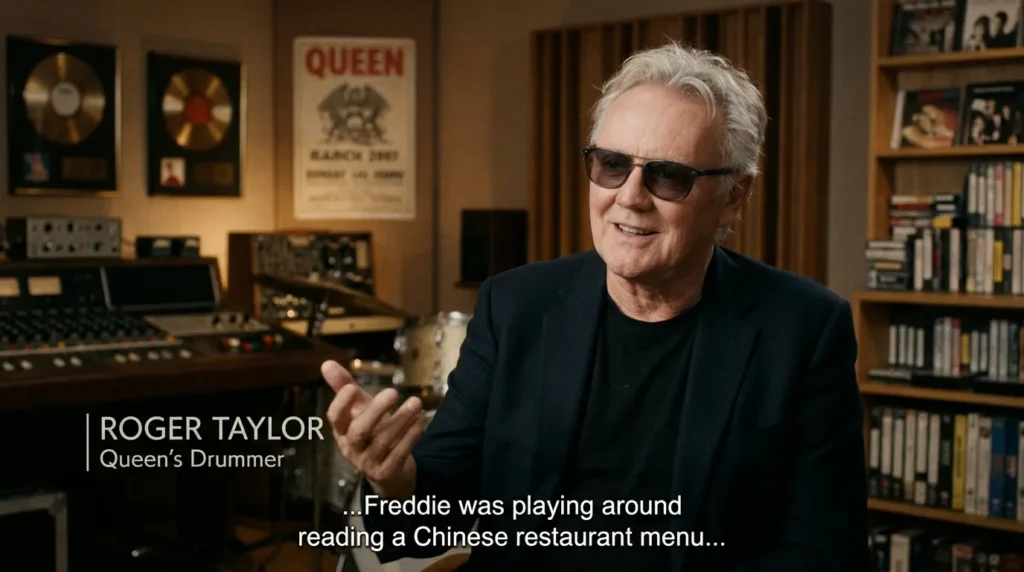
The ending feels less like a dismissal of the song’s subject than a glimpse of the singer’s mischievous side. A voice that has been making sweeping appeals suddenly turns to something thoroughly ordinary. That abrupt change brings a touch of warmth to music that might otherwise feel rather imposing.
Closing Thoughts
The riff’s force is what first catches the ear in “One Vision.” Following the lyrics reveals shades of feeling beneath that apparent directness. Learning about the sessions adds another perspective: this assured performance grew out of exchanges between musicians working together.
On the next listen, it might be a previously unnoticed bass movement that draws attention, or the voice reflecting on a damaged dream. This is hard rock that rewards a shifting focus, offering more than a single lasting impression.
音楽ファン同士の交流・リクエストはこちら / Connect & Request Songs Here