
Explore Mariko Takahashi’s Musical Journey Here!
- 🎧 Listen to This Article
- My Personal Best 10: Mariko Takahashi — No. 7, “Koi Kotoba” | Discovering Love After Taking the Long Way Around
- “Koi Kotoba” — Listen to the Song
- The Story Behind the Lyrics: Love’s Unexpected Detours
- Mariko Takahashi’s Lyrics: Old-Fashioned Language and Honest Emotion
- The Voice and Sound Behind the Song’s Mature Appeal
- “Koi Kotoba” in the Context of 1999
- What Becomes Clearer with Every Listen
- “Koi Kotoba” — The Long Road to Recognizing Kindness
- Final Thoughts — Who Truly Matters to Us?
🎧 Listen to This Article
Enjoy a convenient audio overview of the article’s key points.
Listen before reading to explore the emotions behind “Words of Love” and get a sense of what this article covers.
🎵 English Narration
Listen to an English-language narration of this article.
🎶 Japanese Narration
Listen to a Japanese-language narration of this article.
Listening first will help you appreciate the emotional depth of “Words of Love” and the key themes explored in this article.
My Personal Best 10: Mariko Takahashi — No. 7, “Koi Kotoba” | Discovering Love After Taking the Long Way Around
Released on May 5, 1999, Mariko Takahashi’s single “Koi Kotoba” was also featured in television commercials for Hakutsuru Sake Brewing. The song tells the story of a woman who, after taking a complicated path through love, comes to recognize the importance of someone who has been by her side all along.
Takahashi wrote the lyrics, Kisaburo Suzuki composed the music, and Tomoji Sogawa handled the arrangement. The song also opens her album two for nine, released on May 21 of the same year.
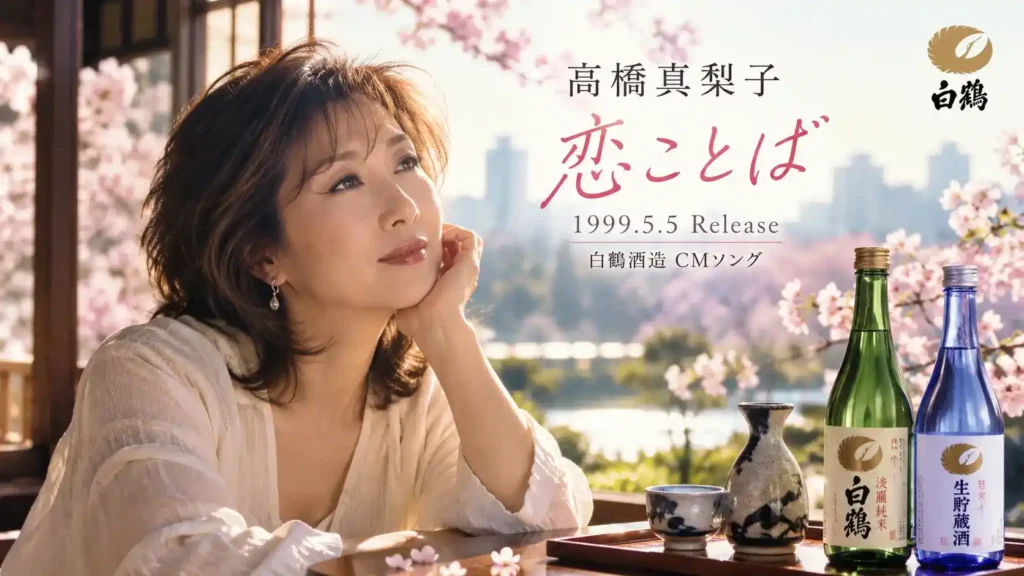
Unlike some of Takahashi’s signature songs that showcase her powerful, dramatic delivery, “Koi Kotoba” finds its strength in the way she expresses complicated romantic feelings through conversational lyrics and beautifully restrained singing.
The uncertainty woven into the lyrics, together with Takahashi’s compassionate vocal performance, makes the song more revealing with every listen.
Poetic Interpretation
Even on the nights I loved someone else, you were always there, somewhere deep within my heart.
When love left me broken and lost in tears, your quiet tenderness held me without a word.
Walking beneath the falling cherry blossoms, I finally discovered where my heart truly belongs.
After wandering through love's winding roads, I find my way back to you.
This time, I'll hold on to our love and walk beside you through every season yet to come.
💡 You might also like: View the original Japanese lyrics (External site)
If the lyrics are available only in Japanese, you can use your browser’s translation feature or an AI translation tool to understand their general meaning.
“Koi Kotoba” — Listen to the Song
🎥 YouTube Video
Song Information
Title: Koi Kotoba
Artist: Mariko Takahashi
Single Release Date: May 5, 1999
Lyrics: Mariko Takahashi
Music: Kisaburo Suzuki
Arrangement: Tomoji Sogawa
Album: two for nine (released May 21, 1999)
Commercial Tie-in: Hakutsuru Sake Brewing — Hakutsuru Tanrei Junmai and Hakutsuru Namachozo-shu
In Two Lines
The song opens with words that carry a distinctly nostalgic quality.
Beneath its gentle melody lies a story of romantic pain, regret, and rediscovered affection.
The Story Behind the Lyrics: Love’s Unexpected Detours
Someone Who Remained in Her Heart
The woman at the center of “Koi Kotoba” falls in love with a friend of a man who has long supported her. Yet even while pursuing this new relationship, she cannot completely forget the man who has always looked out for her.

This is more than a conventional love triangle. Although her feelings have turned toward someone else, she remains aware of the kindness of the man who has quietly watched over her.
Human emotions rarely follow a logical pattern. Sometimes it takes the excitement of a new relationship to make us recognize the value of a connection we had taken for granted.
The Man Who Stayed Beside Her After Heartbreak
The story takes a decisive turn when her relationship ends. On the night she is rejected by her lover, the man who has supported her for so long is there once again.

He does not offer exaggerated words of consolation. Instead, he simply stays close and treats her with his usual kindness. That unassuming response makes his affection all the more meaningful.
What makes the song interesting is that it never portrays its protagonist as entirely innocent. Her decision to pursue another relationship, and the pain she experiences when it falls apart, are both part of the story.
That honesty gives greater weight to the decision she eventually makes.
Cherry Blossoms and the Clearing Rain
Later in the lyrics, images of cherry blossoms drifting through the city and the atmosphere after rainfall become part of the story.

Cherry blossoms suggest the passing of seasons, while the clearing rain evokes a change in emotional perspective. As the scenery shifts, the woman begins to confront what she truly feels.
Eventually, she realizes that she wants to return to the man who has always been there for her.
Perhaps the heart of “Koi Kotoba” lies not in the heartbreak itself, but in recognizing who truly matters after taking a long and difficult emotional journey.
Mariko Takahashi’s Lyrics: Old-Fashioned Language and Honest Emotion
The Distinctive Expression “Koishiya Shitashiya”
One of the most memorable features of Takahashi’s lyrics is the phrase “Koishiya Shitashiya,” which expresses longing and affection in an unusually old-fashioned Japanese style.
These are not words people would normally use in everyday conversation. Their gentle, almost classical sound gives the song a distinctive character, even though the relationship it describes feels entirely contemporary.
The opening use of the English word “I” can also be heard as a play on the Japanese word ai, meaning “love.” It is a subtle example of how the lyrics draw on the sounds of both languages.
A Love Story That Refuses to Idealize Its Characters
The lyrics also suggest jealousy, regret, and a tendency to rely on another person’s kindness.
Yet the woman does not try to erase her past. Having lived through these experiences, she comes to understand that she no longer wants to leave the man who cares for her feeling lonely.

I admire the way Takahashi brings these changing emotions together into a coherent narrative without making the lyrics overly explanatory.
The Voice and Sound Behind the Song’s Mature Appeal
Mariko Takahashi’s Beautifully Restrained Vocal Performance
Mariko Takahashi is celebrated for her rich vocal power and soaring high notes. In “Koi Kotoba,” however, she seems less interested in displaying that power than in communicating the meaning of each line.
I am particularly drawn to the way she finishes her phrases. Small changes in volume, subtle pauses, and the gentle release of a final note convey the protagonist’s uncertainty without dramatic exaggeration.
To me, great vocal technique is not simply a matter of singing loudly or reaching difficult notes. It is equally evident in the ability to hold back and let the emotion speak for itself.
Kisaburo Suzuki’s Melody
Kisaburo Suzuki’s melody combines immediate accessibility with carefully shaped emotional movement.

The music moves naturally from quiet passages into moments of greater emotional intensity, supporting the story told by the lyrics.
What stays with me is not a dramatic key change or a spectacular musical flourish. Instead, the melody follows the rhythm of the words, drawing the listener into the narrative almost effortlessly.
Tomoji Sogawa’s Arrangement
Tomoji Sogawa’s arrangement plays an equally important role in bringing Takahashi’s voice to the forefront.
Soft, piano-centered textures are complemented by a spacious accompaniment, giving the entire recording a calm, reflective atmosphere.

Because the instrumentation never overwhelms the singer, the details of the lyrics and the nuances of her delivery remain clearly audible.
The melody, arrangement, and vocal performance each serve a distinct purpose, yet work together as a unified whole. That balance is one of the reasons the song is so rewarding to listen to.
“Koi Kotoba” in the Context of 1999
A Commercial Song for Hakutsuru Sake
“Koi Kotoba” was used in commercials for Hakutsuru Tanrei Junmai and Hakutsuru Namachozo-shu, two products from Hakutsuru Sake Brewing.
The song’s traditional-sounding language and Takahashi’s composed vocal style seem particularly well suited to the sophisticated, distinctly Japanese atmosphere associated with sake advertising.
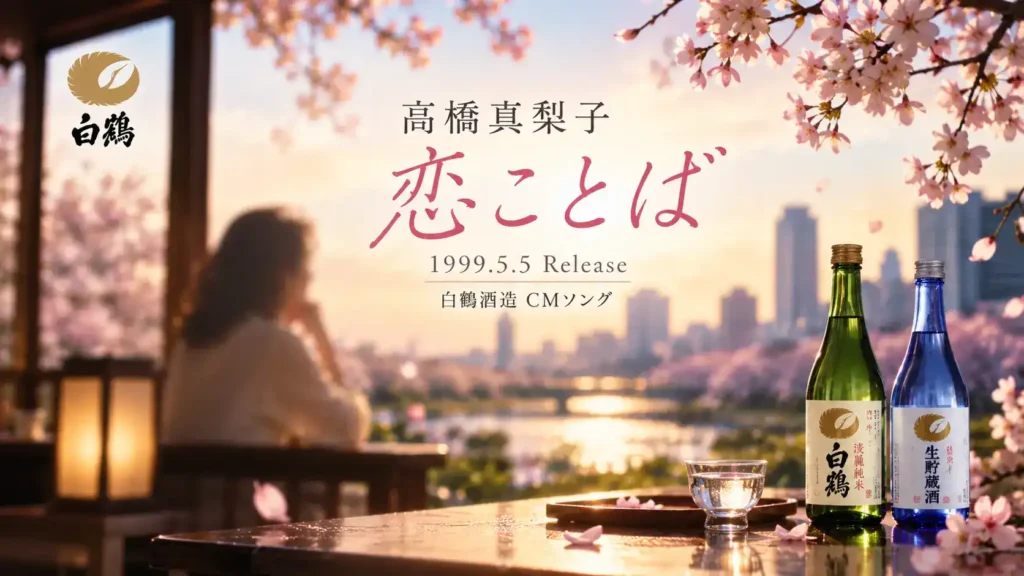
Still, the song deserves to be appreciated independently of its commercial association. Even without knowing its advertising background, listeners can enjoy it as a carefully observed portrait of a woman’s emotional journey.
A Mature Love Song from an Established Artist
By 1999, Mariko Takahashi had already built a long and distinguished career, with well-known hits such as “Momoiro Toiki” and “Hagayui Kuchibiru.”
Released at this stage of her career, “Koi Kotoba” explores emotions shaped by experience rather than the headlong excitement of young romance.
Even after making mistakes and taking the long way around, a person may discover the desire to care deeply for someone again. Takahashi gives that realization a convincing voice.
What Becomes Clearer with Every Listen
On a first listen, “Koi Kotoba” might seem like a gentle, straightforward romantic ballad.
But when I listen more closely to the lyrics, I hear a story filled with emotions that are anything but simple.

The woman depends on someone who has always supported her, yet chooses to pursue another relationship. Only after that romance ends does she fully recognize what the other man means to her.
Different listeners may judge her choices differently.
Nevertheless, many of us may recognize something familiar in the experience of taking another person’s kindness for granted, or understanding someone’s importance only after a painful experience.
“Koi Kotoba” captures those delicate complications of human relationships without ever raising its voice.
“Koi Kotoba” — The Long Road to Recognizing Kindness
What I find especially interesting about “Koi Kotoba” is that its protagonist does not understand her own feelings from the beginning.
She becomes absorbed in a relationship with another man, experiences heartbreak, and only then begins to reconsider the person who has always been close to her. There is something almost selfish about that journey.
But love does not always follow reason. Someone who genuinely cares about us does not necessarily become the person we fall in love with right away. The song acknowledges that uncomfortable truth about relationships.
What I appreciate most is the way Takahashi tells the story of one woman’s changing heart without excusing her past or condemning her for it.
And Takahashi’s voice gives the story an effortless credibility. I might have heard the song differently when I was younger, but with age comes a greater willingness to consider the feelings of everyone involved.
Final Thoughts — Who Truly Matters to Us?
“Koi Kotoba” is about more than whether a romantic relationship succeeds or fails.
Sometimes we overlook the kindness of the people closest to us. It may take an entirely different experience before we begin to understand what that kindness has meant.
Takahashi sings about this realization without making it seem more noble or beautiful than it really is. She allows the emotions to remain human and imperfect.
As you listen to “Koi Kotoba,” perhaps it is worth remembering the people who have quietly supported you along the way.

音楽ファン同士の交流・リクエストはこちら / Connect & Request Songs Here