
Bryan Ferry’s Musical Journey: Explore His History Here!
- 🎧 Listen to This Article
- My Personal miniBest7: No. 4 — “Smoke Gets in Your Eyes”
- First, Listen to the Official Audio on YouTube
- The Words of a Man Who Believed in Love
- From a 1933 Broadway Musical to an International Standard
- How Bryan Ferry’s Voice Transforms the Song
- Ferry’s Musical Curiosity Revealed Through Cover Songs
- Final Thoughts — Never Revealing the Reason for His Tears
🎧 Listen to This Article
Enjoy a narrated summary of this article and discover its key highlights.
Before reading, listen to explore the appeal of “Smoke Gets in Your Eyes,” Bryan Ferry’s distinctive vocals, and the themes discussed in this article.
🎵 English Narration
Listen to an English narration highlighting the main points of this article.
🎶 Japanese Narration
Listen to a Japanese narration highlighting the main points of this article.
Listening before reading offers a deeper appreciation of the heartbreak behind “Smoke Gets in Your Eyes” and Ferry’s distinctive interpretation.
My Personal miniBest7: No. 4 — “Smoke Gets in Your Eyes”
1974: A Timeless Classic Reimagined in Ferry’s Own Style
At No. 4 on my list is “Smoke Gets in Your Eyes.”
In July 1974, Bryan Ferry released his second solo album, Another Time, Another Place. “Smoke Gets in Your Eyes,” the song I’m featuring today, was one of the cover versions included on that album.
The album reached No. 4 on the UK Albums Chart. Released as a single in August, “Smoke Gets in Your Eyes” also reached No. 17 in the UK, demonstrating the growing appeal of Ferry’s work outside Roxy Music.
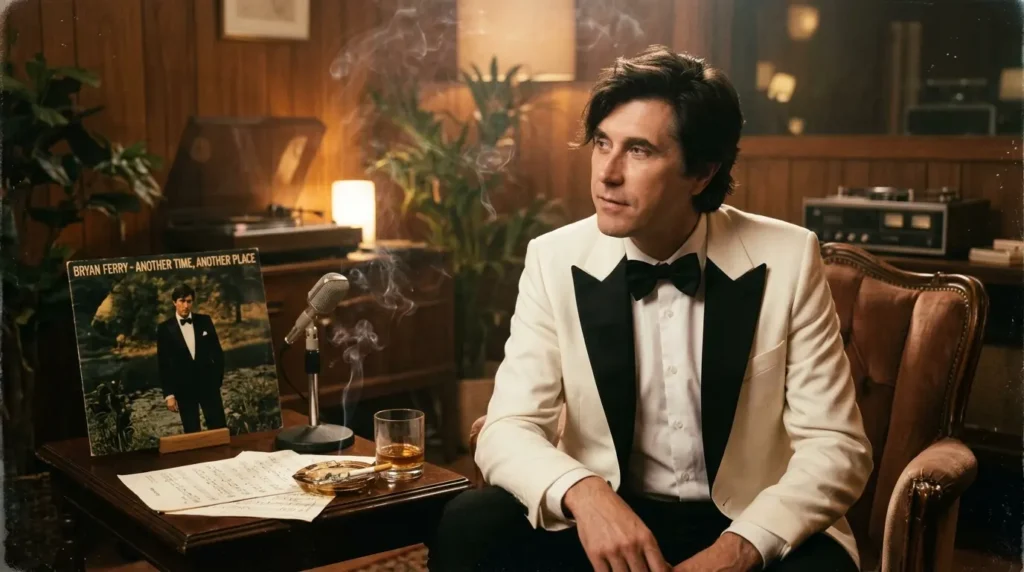
The song was originally written for the 1933 musical Roberta. It was subsequently recorded by numerous artists, including the Platters in 1958. Their version reached No. 1 in both the United States and the United Kingdom in 1959.
Ferry took a song that was already widely loved and transformed it through his distinctive phrasing and colorful musical arrangement.
His voice is sweet, slightly languid, and somehow remarkably elegant. Through Ferry’s interpretation, the universal experience of heartbreak becomes a sophisticated story of adult romance. That is what draws me to this particular recording.
My Interpretation of the Lyrics
No matter what anyone said, I believed your love was real.
Even when they warned me that love was blind, I trusted what we had.
But now you've gone, leaving memories I cannot erase.
I hide my tears behind a quiet smile.
And say, “When the flame of love dies, its smoke still stings my eyes.”
First, Listen to the Official Audio on YouTube
Credits
Song: Smoke Gets in Your Eyes
Artist: Bryan Ferry
Album: Another Time, Another Place (1974)
Lyrics: Otto Harbach
Music: Jerome Kern
Audio provided by: Universal Music Group
Video format: Official audio release
Two-Line Commentary
Bryan Ferry revisited this timeless classic from 1933 with his distinctive 1974 interpretation.
His languid vocals and colorful arrangement bring an elegant sense of melancholy to the story of lost love.
The Words of a Man Who Believed in Love
The Consequences of Laughing Off Everyone’s Warnings
The man at the center of this song never doubted his lover’s feelings. Even when others warned him about the dangers of falling in love, he remained convinced that what he felt was genuine.
He was so confident that he brushed aside their advice and laughed at their concerns. But the relationship eventually ended, and the situation was reversed. Now he was the one being laughed at.
His suffering went beyond the loss of a lover. The very belief he had defended so confidently had been contradicted by reality.

Yet he refuses to explain his tears directly. Instead, he offers a rather theatrical explanation: when the flame of love goes out, the smoke gets in your eyes.
Wounded Pride Behind a Brave Face
Most of us have probably experienced moments when we would rather not cry in front of others. For someone who had been absolutely certain about his relationship, admitting defeat might be especially painful.
He cannot change the fact that his lover has left him. What he can still control, however, is how he presents that loss to the people around him.
He does not want the love he once believed in to become someone else’s joke. That is the feeling I hear behind his carefully chosen words.

The Other Emotion Behind a Smile
The man is not smiling because he has overcome his sadness. If anything, he may be smiling precisely because maintaining his composure has become so difficult.
His expression and his true feelings do not match. That contradiction gives the lyrics both their irony and their humanity. To me, Ferry’s slightly mannered vocal style is particularly well suited to such a character.
The Brilliant Metaphor Behind “Smoke Gets in Your Eyes”
Smoke naturally brings tears to our eyes. But in this song, it also represents a love that has burned itself out.
The passion that once burned so brightly has disappeared. Yet the smoke left behind continues to irritate the man’s eyes.
Even after a relationship ends, the sadness it leaves behind does not simply disappear. I find it remarkable how the song connects such a familiar physical experience with a complicated emotional truth.

Part of the song’s appeal lies in its refusal to describe heartbreak too plainly. By listening to the man’s indirect explanation, we understand his feelings more clearly than we might through a straightforward confession.
I also admire the Japanese title, “Kemuri ga Me ni Shimiru,” which closely preserves the meaning of the English original. It sounds entirely natural in Japanese while suggesting the bittersweet nature of love.

From a 1933 Broadway Musical to an International Standard
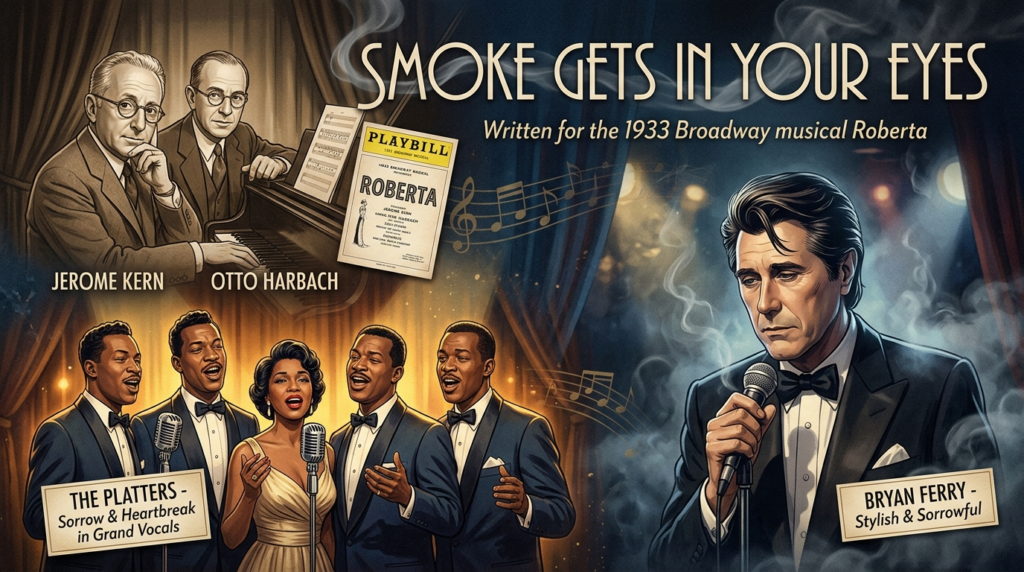
Jerome Kern and Otto Harbach
“Smoke Gets in Your Eyes” was created by composer Jerome Kern and lyricist Otto Harbach.
It was written for Roberta, a Broadway musical that premiered in 1933. Kern was one of the major figures in the development of American musical theater, leaving behind an extraordinary collection of songs that would become standards.
The melody itself helps explain why the song has endured. Its musical progression feels natural and memorable, capturing both the happiness of being in love and the pain of losing it.
Although it originated in a 1930s stage production, the composition proved remarkably adaptable. Singers from later generations could interpret it through their own musical styles without diminishing its essential character.
The Platters and Their Definitive Hit Recording
The Platters played an essential role in bringing this song to a wider audience. Their recording, released in 1958, spent three weeks at No. 1 on the Billboard Hot 100 in 1959. It also topped the UK Singles Chart.
Lead vocalist Tony Williams delivers an extraordinarily rich and powerful performance. As his voice climbs toward the higher notes, the emotion intensifies, bringing the pain of heartbreak directly to the listener.
Ferry, however, approaches the same composition from a very different direction.
Where the Platters express sorrow through the sheer power of their singing, Ferry uses his distinctive phrasing to reveal the more complicated personality of the man behind the lyrics. That, to my ears, is the essential difference between these two interpretations.
How Bryan Ferry’s Voice Transforms the Song
A Subtle Tremor Within a Graceful Melody
Ferry’s singing cannot be adequately described by the conventional idea of a beautiful voice. Rather than delivering every note with unwavering precision and strength, he lets certain phrases tremble and occasionally moves through the melody almost in a whisper.
His unusual phrasing may not appeal to everyone. For me, however, it is one of the qualities that makes him such a distinctive vocalist.
When his voice briefly wavers, something wonderfully human enters the otherwise graceful melody. Without resorting to grand emotional gestures, he reveals the character’s inner uncertainty through the smallest changes in vocal expression.
A Colorful Arrangement and a Melancholy Voice
Ferry’s interpretation is distinguished by more than his singing. While preserving the romantic melody of the original, he presents the song as a colorful piece of 1970s pop music.
The accompaniment has a lively quality, giving the recording a certain brightness. Yet once Ferry begins to sing, the overall effect becomes far more complex than a simply cheerful performance.
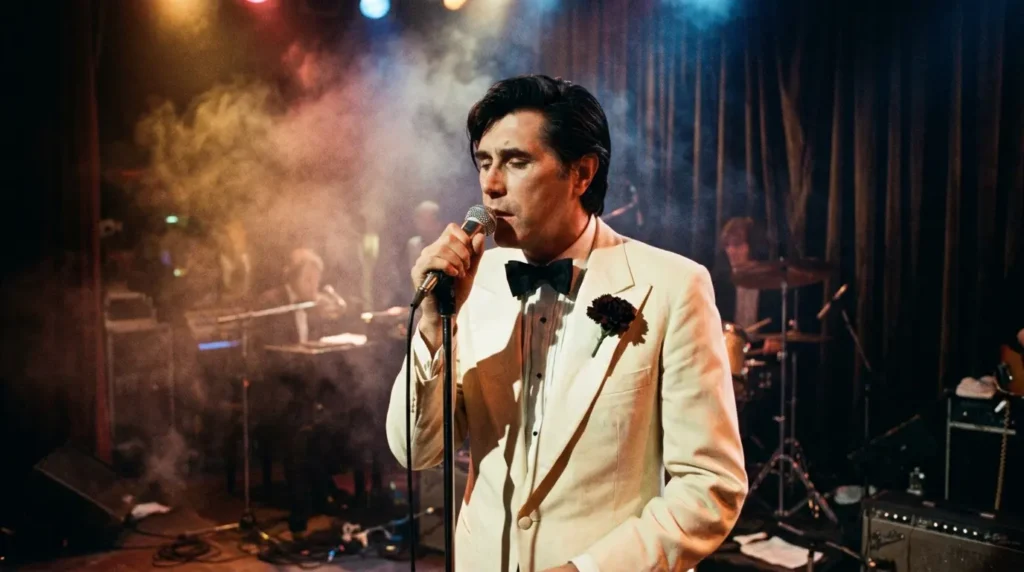
What interests me is that the instrumentation and the vocals do not always seem to express the same emotion. Against the bright musical setting, Ferry’s voice sounds faintly unsettled. That contrast creates a fascinating tension throughout the recording.
A Character Brought to Life Through the Voice
When I listen to Ferry, I imagine a well-dressed man who enjoys conversation and knows how to make others laugh. In public, he maintains an appearance of confidence. Alone, however, he finds himself thinking about a relationship that has ended.
Of course, this is simply my personal interpretation. Still, I believe Ferry has the remarkable ability to suggest gestures and personality traits that are never explicitly described in the lyrics.

Ferry’s Musical Curiosity Revealed Through Cover Songs
A Solo Career Alongside Roxy Music
In the early 1970s, Bryan Ferry was already a central figure in Roxy Music. The band stood apart from much of the British music scene through its experimental approach to rock and its striking visual presentation.
His early solo albums, however, took a noticeably different approach. They focused largely on cover versions drawn from a broad range of musical traditions, including classic popular songs and rock and roll.
On his 1973 solo debut, These Foolish Things, Ferry interpreted material associated with artists such as Bob Dylan and the Beatles. He continued exploring this approach on Another Time, Another Place the following year.
With Roxy Music, he pursued new musical possibilities. As a solo artist, he revisited established songs and reshaped them according to his own sensibilities. These activities may appear contrasting, but I think both reveal the same restless curiosity and resistance to convention.
Discovering Something New Rather Than Recreating the Past
Listening to Ferry’s cover versions, I never get the impression that he is simply trying to recreate the music of an earlier era.
Instead, he brings the sensibility of a 1970s rock singer to a song originally written for a 1930s musical. By connecting two very different musical periods, he offers listeners a fresh way to experience a familiar composition.
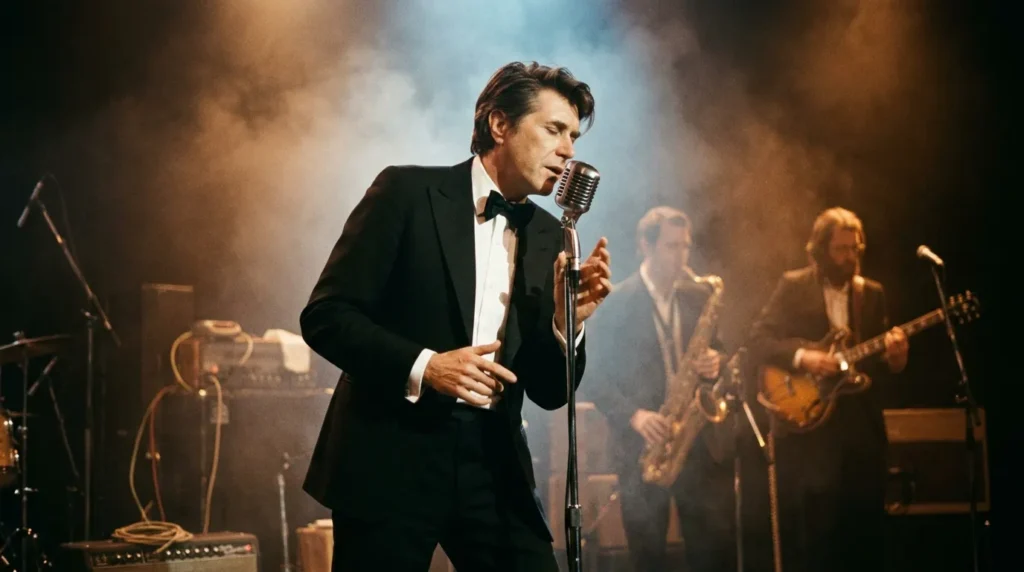
In “Smoke Gets in Your Eyes,” the essential beauty of the melody and lyrics remains intact. Yet the combination of Ferry’s vocals and the arrangement gives the recording an identity entirely its own.
Perhaps a truly great cover version is not simply about singing an existing song well. It is about discovering a quality in that song that listeners may never have noticed before.
For me, Ferry’s recording of “Smoke Gets in Your Eyes” is a wonderful example of precisely that achievement.
Final Thoughts — Never Revealing the Reason for His Tears
“Smoke Gets in Your Eyes” has remained a beloved standard for generations since its creation in 1933.
The Platters’ powerful performance is magnificent in its own right. But the version I have chosen for No. 4 on my list is Bryan Ferry’s recording from 1974.
There is something about his voice that goes beyond conventional vocal beauty. It sounds slightly affected, faintly ironic, and yet capable of touching something deeply personal in the listener.

Reading the lyrics again while preparing this article, I found myself thinking about the man’s final response to his heartbreak.
Did he really manage to convince the people around him? Or did everyone understand why he was crying and simply choose not to say anything?
Perhaps the answer does not matter. What he needed was not to justify his relationship to others, but to find his own way of coming to terms with a love that had ended.
There are nights when we cannot bring ourselves to admit why we are crying. On nights like those, perhaps “Smoke Gets in Your Eyes” says everything we cannot put into words.

音楽ファン同士の交流・リクエストはこちら / Connect & Request Songs Here