
Kyosuke Himuro’s History ➡ Click Here!
- 🎧 Listen to This Article
- No. 7 is BOØWY’s “ONLY YOU.”
- First, listen to the officially distributed audio on YouTube.
- From Album Track to Single — “ONLY YOU” in the Spring of 1987
- The BOØWY Sound That Keeps a Love Song Moving Forward
- What Creating This miniBest Revealed About My Own Taste
- No. 7 “ONLY YOU” — The Starting Point for These Seven Songs
- In Closing — Strength Within an Accessible Melody
🎧 Listen to This Article
You can quickly catch the key points of this article through narration.
Recommended if you want to get a feel for “ONLY YOU” and understand the overall flow of the article before reading.
🎵 English Narration
An English narration introducing the content of this article.
🎶 Japanese Narration
A Japanese narration introducing the content of this article.
Listening first makes it easier to grasp the mood of “ONLY YOU” and the main points of the article.
No. 7 is BOØWY’s “ONLY YOU.”
“ONLY YOU” first appeared on BOØWY’s fifth album, BEAT EMOTION, released on November 8, 1986, and was later released as the band’s fifth single on April 6, 1987.
Although it was issued as a single nearly five months after the album’s release, it debuted at No. 4 on the singles chart. That surpassed the No. 7 peak of the previous single, “B・BLUE,” and showed just how rapidly BOØWY’s popularity was expanding at the time.

While listening again to the candidates for this miniBest, I realized something about my own taste.
When it comes to Kyosuke Himuro, I seem to be drawn more strongly to medium- and up-tempo songs in which his voice pushes forward than to slow, gently delivered ballads. “ONLY YOU” turned out to be a perfect example of that preference.
The seven songs beginning here are not simply a ranking of the most famous songs associated with Himuro. They are also seven songs through which I want to trace exactly what kind of “Kyosuke Himuro vocal” makes me react, across both BOØWY and his solo career.
My Interpretation
You do not have to keep looking back at the pain of the past.
Even on the coldest nights, I will stay beside you and hold you close.
All I want is the real you, with nothing hidden or dressed up.
Leave yesterday’s tears behind, and let us walk toward tomorrow together.
💡 You might also like: View the original Japanese lyrics (External site)
If the lyrics are available only in Japanese, you can use your browser’s translation feature or an AI translation tool to understand their general meaning.
First, listen to the officially distributed audio on YouTube.
Credits
Song: “ONLY YOU”
Artist: BOØWY
Lyrics: Kyosuke Himuro Music: Tomoyasu Hotei Arrangement: Tomoyasu Hotei
Audio provided by: Universal Music Group
℗: 1986 EMI Music Japan Inc.
YouTube release: SINGLES
YouTube: BOØWY - Topic (auto-generated official audio)
Two-Line Commentary
One of BOØWY’s signature love songs, combining a driving beat and Tomoyasu Hotei’s sharp guitar with Kyosuke Himuro’s expansive vocal delivery. Beneath its immediately accessible melody runs a sense of emotional urgency, bringing together the band’s pop appeal and its unmistakable edge.
From Album Track to Single — “ONLY YOU” in the Spring of 1987
“ONLY YOU” was not originally released as a single. It first appeared as the second track on BEAT EMOTION, and was issued as a single roughly five months later.
Looking at that sequence of releases, the song arrived right in the middle of a period when BOØWY was gaining momentum at remarkable speed.
“B・BLUE” was released as the advance single on September 29, 1986, followed by BEAT EMOTION on November 8. “ONLY YOU” came next on April 6, 1987, followed by “MARIONETTE” on July 22.
Released as a Single Five Months Later — and Debuting at No. 4
What I find especially interesting is that a song that listeners could already hear on the album was released later as a single and still managed to debut at No. 4.
The previous single, “B・BLUE,” had become BOØWY’s first Top 10 single, peaking at No. 7. “ONLY YOU” went even higher. The fact that an already available album track could attract that much attention when reissued as a single says a great deal about BOØWY’s momentum during this period.
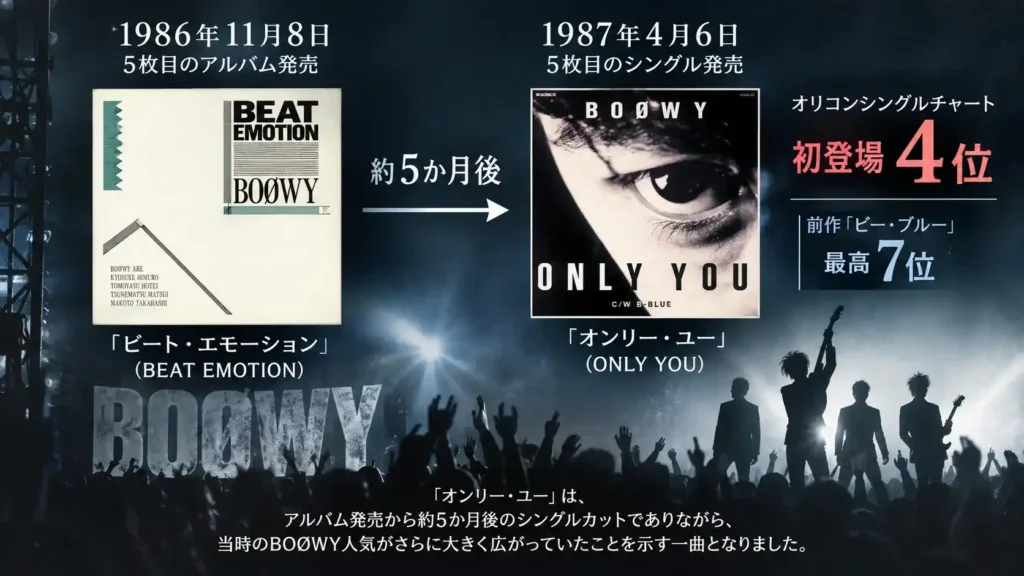
1986–1987 — When BOØWY’s Popularity Expanded at Extraordinary Speed
Rather than looking at these songs separately, I think the sequence from “B・BLUE” to BEAT EMOTION, “ONLY YOU,” and then “MARIONETTE” makes something very clear: BOØWY dramatically increased its presence in an exceptionally short period of time.
And the key songs in that sequence are not all cut from the same cloth. “B・BLUE” has the kind of momentum that seems to charge straight ahead, while “MARIONETTE” carries a tightly wound tension. Between them sits “ONLY YOU,” distinguished by its immediately approachable melody.
BOØWY did not gain popularity by repeating a single formula. The band retained its unmistakable sound while revealing a different character in each song, creating more and more points of entry for listeners.
The BOØWY Sound That Keeps a Love Song Moving Forward
The song is about accepting someone who has been hurt by the past and wanting to build a future together. Judged only by its theme, it is a remarkably straightforward love song.
Yet I never hear it as a song dominated by sweetness. The main reason is that the music keeps moving forward from beginning to end. The rhythm never allows the momentum to stall, while both the guitar and the vocal retain sharply defined identities above it.
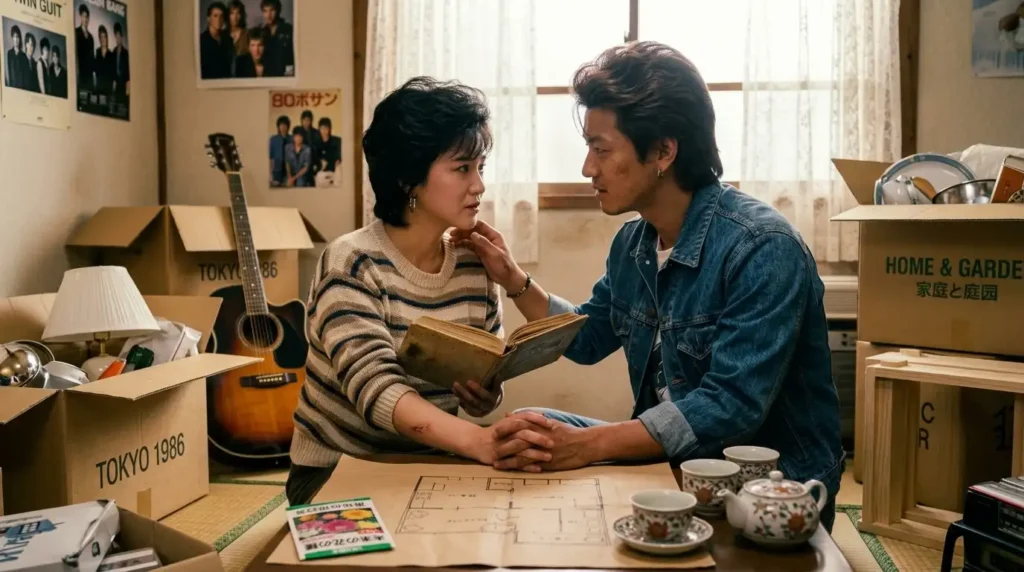
The Momentum Created by Tomoyasu Hotei’s Guitar
The music was composed by Tomoyasu Hotei. His guitar does more than support the melody with chords. It locks into the rhythm and actively drives the song forward.
Tightly articulated guitar phrases mesh with the beat of the entire band, while an instantly memorable melody rides above them. The song is pop-oriented, yet its edges never blur. That balance is one of the defining attractions of BOØWY during this period.
Tsunematsu Matsui and Makoto Takahashi Provide the Unshakable Framework
If I listen only to the guitar, I feel I am hearing only half of what gives this song its momentum.
Tsunematsu Matsui’s bass and Makoto Takahashi’s drums provide a stable foundation. That allows Hotei’s guitar to move freely in fine detail, while Himuro can shape the intensity of his vocal above it.
The four members are not simply throwing all their energy in the same direction. Their roles are clearly defined. The rhythm section maintains the song’s core, the guitar continually changes its expression, and the vocal carries the emotion at the very front. Because of that division of roles, the music feels larger than the actual number of sounds being played.
Kyosuke Himuro’s Voice Adds Urgency to the Language of Love
What attracts me most, however, is still Kyosuke Himuro’s vocal. He does not simply sing the melody neatly. There is a distinctive force in where he places his accents and how he handles the ends of phrases, and at times it sounds as though he is physically pushing his voice toward the listener.
Because of the way he sings, the words directed toward the other person become more than a gentle declaration of love. The desire to protect someone and keep that person close acquires a sense of urgency, raising the emotional temperature of the song. For me, this vocal performance is the heart of “ONLY YOU.”
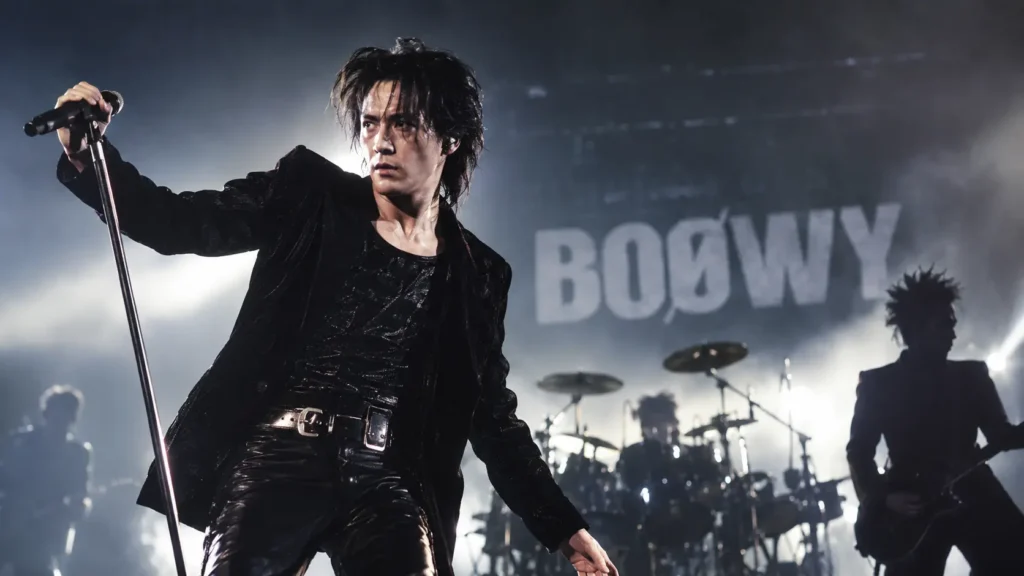
The Melody Is Accessible, but the Vocal Never Completely Settles Down
This song has the kind of melody that stays in your head after a single listen. If I focused on that quality alone, I would probably place it among the more pop-oriented songs in BOØWY’s catalog.
But Himuro does not simply smooth everything into place. He leaves strength in his voice at the ends of phrases and then pushes directly into the next words. As a result, the beauty of the melody and a certain roughness in the singing exist at the same time. I think that slight instability is exactly what prevents the song from becoming an overly polished love song.
What Creating This miniBest Revealed About My Own Taste
Before settling on these seven songs, I listened again not only to the original candidates but also to a considerable number of Kyosuke Himuro’s ballads. What surprised me was that even highly regarded ballads rarely found their way near the top of my own ranking.
Of course, I am not judging the objective quality of the songs. This ranking is entirely based on my own taste. And as I repeatedly changed the candidates and their positions, I gradually began to understand what it is about Kyosuke Himuro that draws me in.
More Important Than Tempo Is the Moment His Voice Moves Forward
Looking across the songs that ultimately remained, I noticed a very clear tendency in the way I chose them. But it is not simply a matter of liking fast songs.
What I respond to is the moment when the performance begins to move and Himuro’s voice gains force within it. I do not want only something calm and beautifully sung. I am drawn to the point where the song begins to heat up and his voice feels as though it is coming right to the front of the speakers. I think that sensation is what matters most to me.

I do not think what I love can be reduced to “ballad or rock.” What draws me in is the moment when Kyosuke Himuro’s voice gathers heat within a song and pushes itself to the front.
I did not think about Himuro’s music this way before making the ranking. I simply lined up the songs I liked, added new candidates, listened again, and kept changing the order. Only after seeing the final result did I recognize the pattern in my own taste.
“Is It a Great Song?” and “Do I Want to Hear It Again and Again?” Are Different Questions
Working through a ranking like this reminds me that the songs most highly regarded by the public are not necessarily the same songs I personally want to play repeatedly. That difference is also part of what makes ranking songs interesting.
If I based the list only on fame, sales, or fan polls, there would be little reason for me to create my own ranking at all. What matters is whether a song moves me when I hear it again, and whether I want to return to it the next day. In the end, those are the songs that survive in my “Personal Best.”
No. 7 “ONLY YOU” — The Starting Point for These Seven Songs
For this miniBest, I have not separated the BOØWY years from Kyosuke Himuro’s solo career.
Of course, BOØWY was never Kyosuke Himuro’s music alone. It was a four-member band created by Himuro together with Tomoyasu Hotei, Tsunematsu Matsui, and Makoto Takahashi.
Even so, if my criterion is simply “the Kyosuke Himuro vocals I love,” I can place BOØWY and his solo work within the same ranking.
The era changes, the musicians around him change, and the sound changes. But the vocal moments that attract me are connected by a single thread running through all of them.
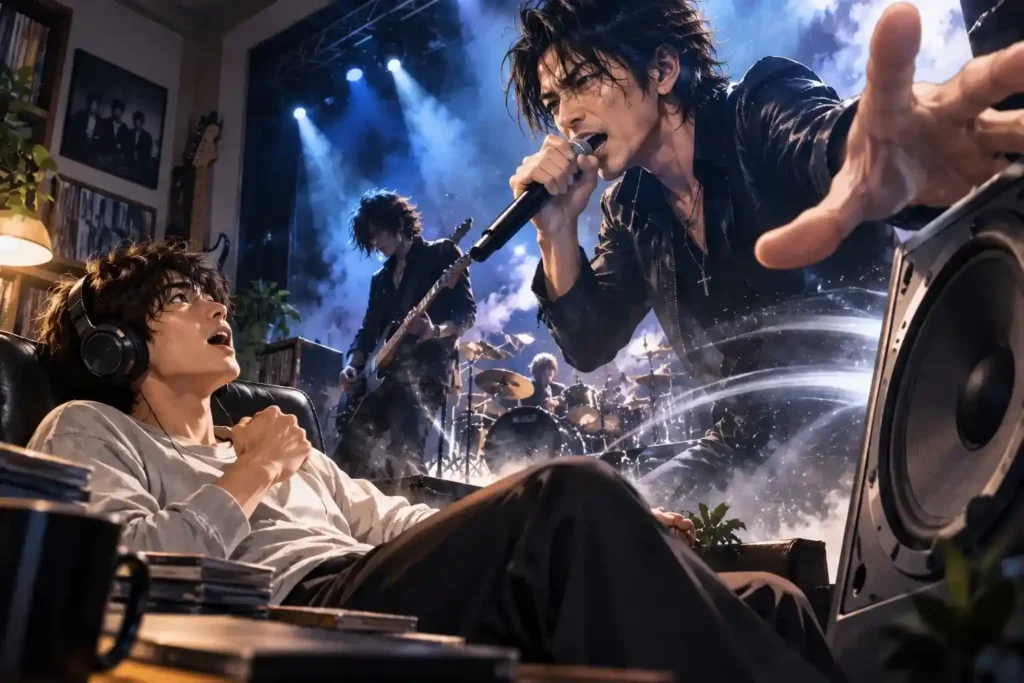
“ONLY YOU” is the song I chose as the entrance to that journey. From this starting point at No. 7, I will follow the songs that remained as I listened again and decided, one by one, where each belonged in my miniBest.
In Closing — Strength Within an Accessible Melody
“ONLY YOU” is a love song built around an immediately approachable melody. But Tomoyasu Hotei’s guitar and the band’s beat keep pushing the music forward, while Kyosuke Himuro’s voice adds increasing force above them. As a result, the song never settles into being merely a gentle love song.
Listening to it again for this ranking also helped me understand what I personally look for in Kyosuke Himuro. His voice gathers heat and seems to step forward out of the melody itself. That sensation is why I still want to return to this song today.
My Personal miniBest 7: Kyosuke Himuro begins here.

音楽ファン同士の交流・リクエストはこちら / Connect & Request Songs Here