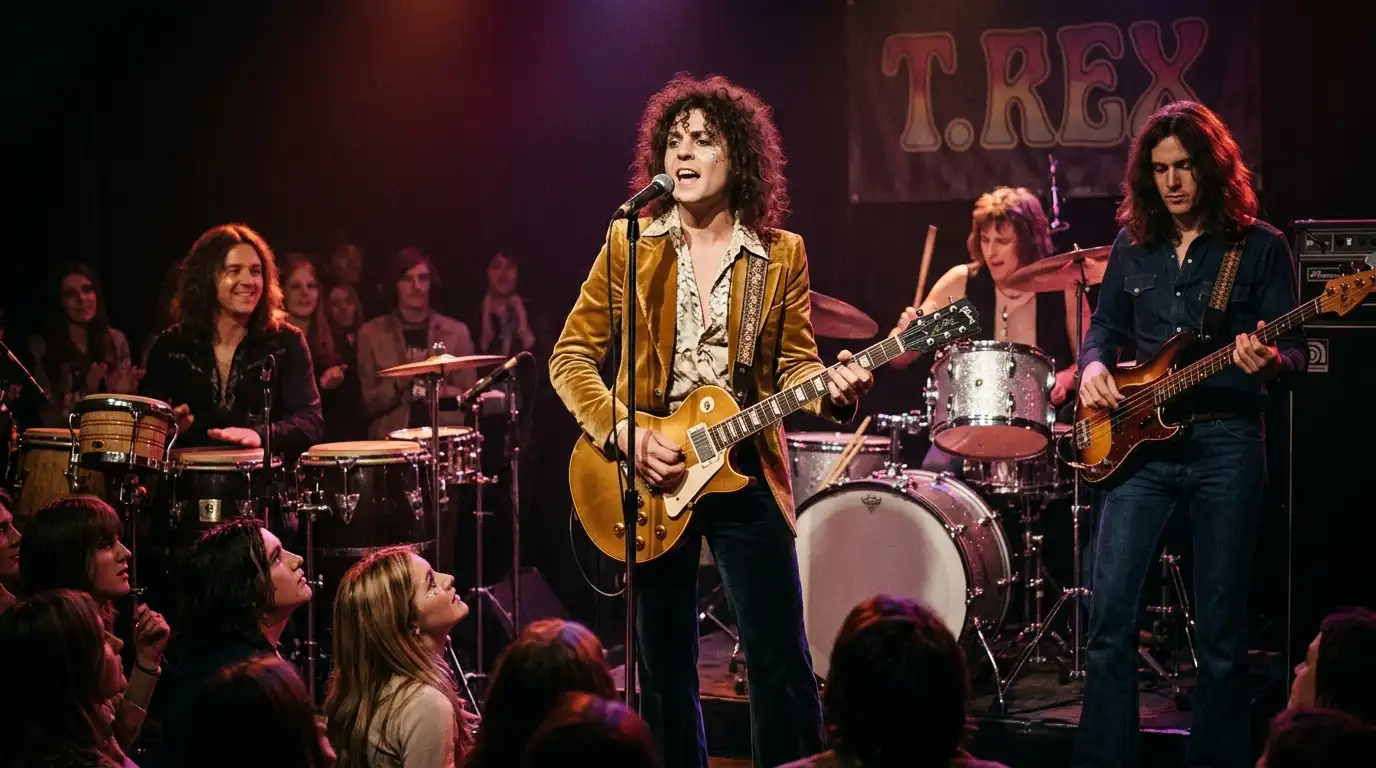
- 🎧 Listen to This Article
- Prologue — T. Rex and My Junior High School Years
- Marc Bolan’s Beginnings — The Birth of Tyrannosaurus Rex
- 1970 — The Transformation into T. Rex
- 1971–1972 — Reaching the Peak of Glam Rock
- From 1973 — Searching for a New T. Rex Beyond the Peak
- 1976–1977 — A Revival, Then a Sudden End
- The T. Rex Sound That Survived for More Than Half a Century
🎧 Listen to This Article
You can quickly explore the key points of this article through Japanese and English narration.
Recommended if you want to understand the history of T. Rex, Marc Bolan’s journey, and the background to “My Personal Top 10: T. Rex” before reading the full article.
🎶 English Narration
This audio introduces the article in English.
🎵 Japanese Narration
This audio introduces the article in Japanese.
Listening first will make it easier to follow the history of T. Rex and the rise of glam rock before reading the full article.
Prologue — T. Rex and My Junior High School Years
T. Rex is one of the artists most closely connected with my junior high school years.
The early 1970s, when the band was at its brightest, almost perfectly overlapped with the period when I was becoming deeply fascinated by Western music.
In 1971, I entered junior high school. That same year in Britain, T. Rex sent “Hot Love” and “Get It On” to No. 1 on the UK Singles Chart and released the album Electric Warrior.
In 1972, “Telegram Sam,” “Metal Guru,” “Children of the Revolution,” and “Solid Gold Easy Action” became major hits, followed by “20th Century Boy” in 1973.
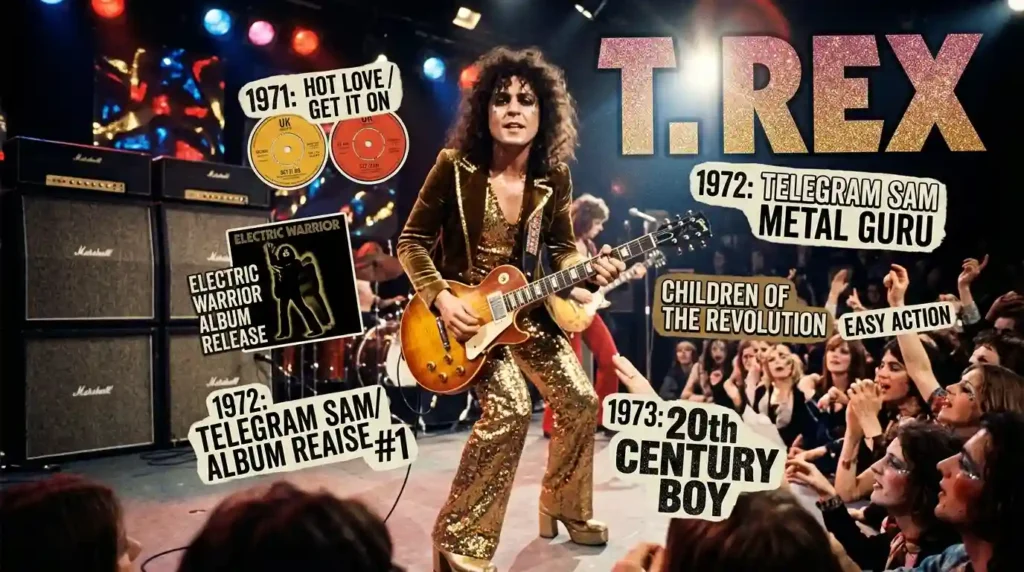
During the three years in which I moved from my first to my third year of junior high school, T. Rex rose to become one of the defining names of glam rock.
Three Songs I Couldn’t Stop Listening To
Among all their songs, “Children of the Revolution,” “20th Century Boy,” and “Solid Gold Easy Action” were the three I played especially often. Even more than half a century later, hearing them still brings back the atmosphere of my junior high school days.
At the time, the T. Rex I knew was Marc Bolan in glittering clothes, playing powerful guitar riffs with unmistakable style. But before reaching that image, he had spent years making music that sounded completely different.
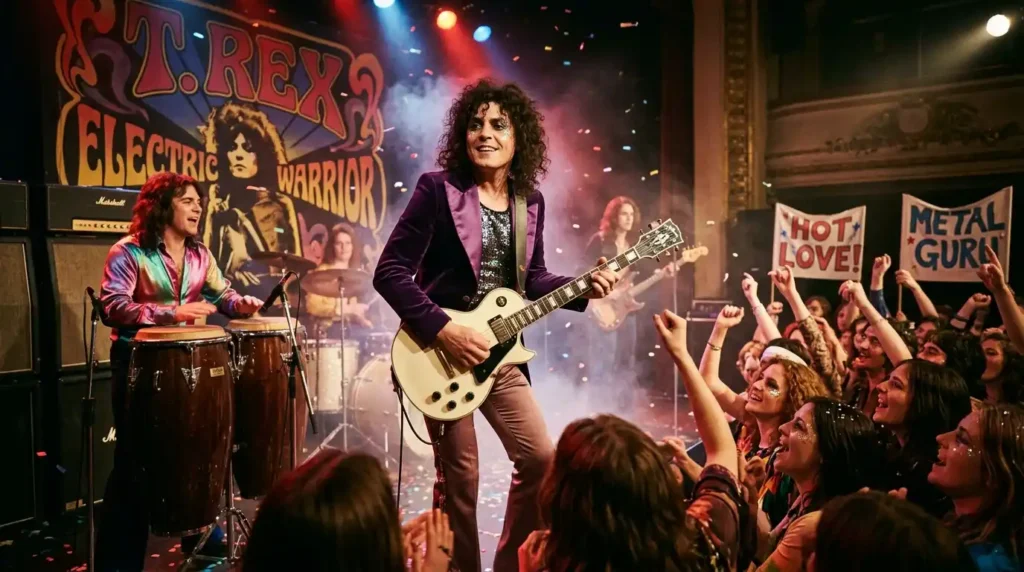
Marc Bolan’s Beginnings — The Birth of Tyrannosaurus Rex
A Boy Drawn to Rock ’n’ Roll and Fantasy
Marc Bolan was born in London on September 30, 1947. His birth name was Mark Feld. From an early age, he was strongly interested not only in music but also in fashion, and he pursued music after gaining experience as a model.
While he was attracted to American rock ’n’ roll, he was also fascinated by poetry and fantasy literature. That interest later emerged clearly in his lyrics, filled with images of fairies, magic, stars, outer space, and animals. This distinctive world of imagery would remain part of T. Rex even after the music itself changed dramatically.
From John’s Children to Tyrannosaurus Rex
During the mid-1960s, Bolan released several singles and briefly joined the rock band John’s Children. Seeking a musical world of his own, he formed Tyrannosaurus Rex in 1967 with percussionist Steve Peregrin Took.
The duo sounded very different from the later T. Rex. Bolan’s acoustic guitar and vocals were accompanied by Took’s bongos and other percussion, creating a form of psychedelic folk that gradually attracted a following in Britain’s underground scene.
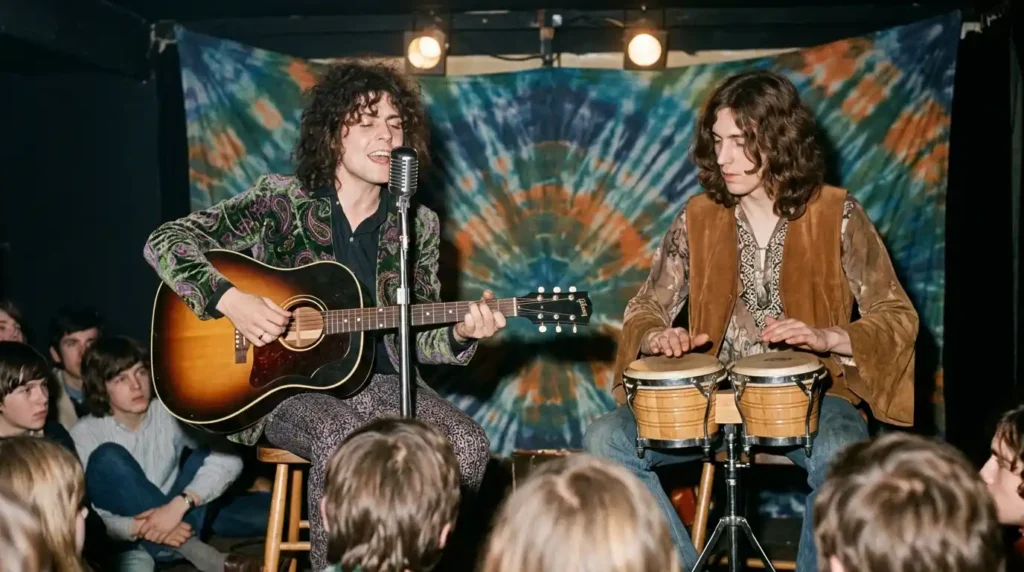
Still, it would be misleading to describe their early music simply as quiet folk. Bolan’s unusual sense of rhythm, strange and imaginative language, and high, quivering voice already gave the duo a character unlike other folk-based acts. The feeling that you could recognize Bolan almost instantly was already there.
Meeting Tony Visconti
Another crucial figure during this period was producer Tony Visconti. Beginning with their debut album in 1968, Visconti helped shape Bolan’s fantasy-driven musical world into a distinctive recorded sound.
1970 — The Transformation into T. Rex
Steve Peregrin Took left in 1969 and was replaced by Mickey Finn. Around this time, Bolan began using the electric guitar more prominently, and in 1970 the long group name was shortened to T. Rex.
“Ride a White Swan” Opens the Door
The major turning point came with “Ride a White Swan” in 1970. Retaining some of the fantasy of the acoustic era while bringing electric guitar and a rock ’n’ roll beat to the foreground, the song climbed to No. 2 on the UK Singles Chart.
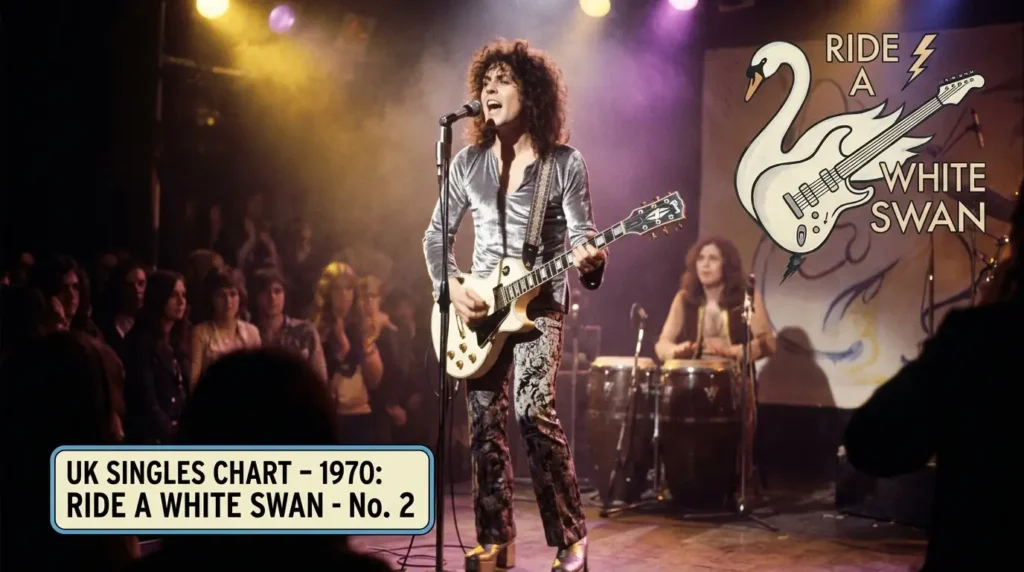
Short guitar riffs, repetitive rhythms, and Bolan’s unmistakable voice — the sound that would come to define T. Rex, simple yet impossible to forget, was now becoming clear.
1971–1972 — Reaching the Peak of Glam Rock
“Hot Love” and the Glitter
In 1971, “Hot Love” became T. Rex’s first UK No. 1 single and remained at the top for six weeks. When Bolan performed the song on the television program Top of the Pops, he appeared with glitter on his face and dressed in flamboyant clothes.
The combination of simple rock ’n’ roll and bold, androgynous fashion soon became one of the defining images of glam rock in Britain.
Electric Warrior and the Golden Era
“Get It On” also reached No. 1, and later that year T. Rex released the landmark album Electric Warrior. Featuring songs such as “Jeepster” and “Cosmic Dancer,” the album naturally combined the fantasy of the Tyrannosaurus Rex years with the charisma of Bolan as a full-fledged rock star.
By this point, Steve Currie was playing bass and Bill Legend was on drums, joining Bolan and Mickey Finn in the four-man lineup that supported T. Rex during its golden era.
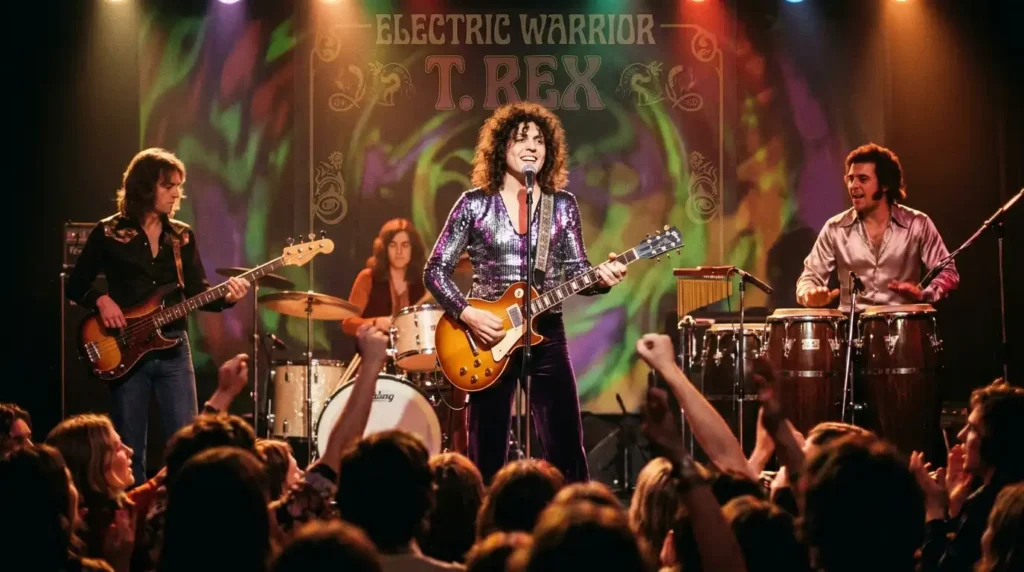
What made T. Rex special was not simply the glitter. They kept the primal pleasure of rock ’n’ roll while combining it with psychedelic fantasy and the immediacy of pop music. That mixture made the music instantly accessible to young listeners, yet it still sounds like more than a period piece today.
1972 and “T. Rextasy”
In 1972, “Telegram Sam” and “Metal Guru” both reached No. 1 in Britain. Together with “Hot Love” and “Get It On,” T. Rex had now scored four UK No. 1 singles.
“Children of the Revolution” and “Solid Gold Easy Action” both reached No. 2. The extraordinary excitement surrounding the band became known as “T. Rextasy” — a play on the name T. Rex and the word “ecstasy” — as the group became one of Britain’s biggest pop phenomena.
I was in my second year of junior high school at the time. “Children of the Revolution” and “Solid Gold Easy Action,” in particular, became inseparable from my memories of those days.
From 1973 — Searching for a New T. Rex Beyond the Peak
“20th Century Boy” and My Final Year of Junior High
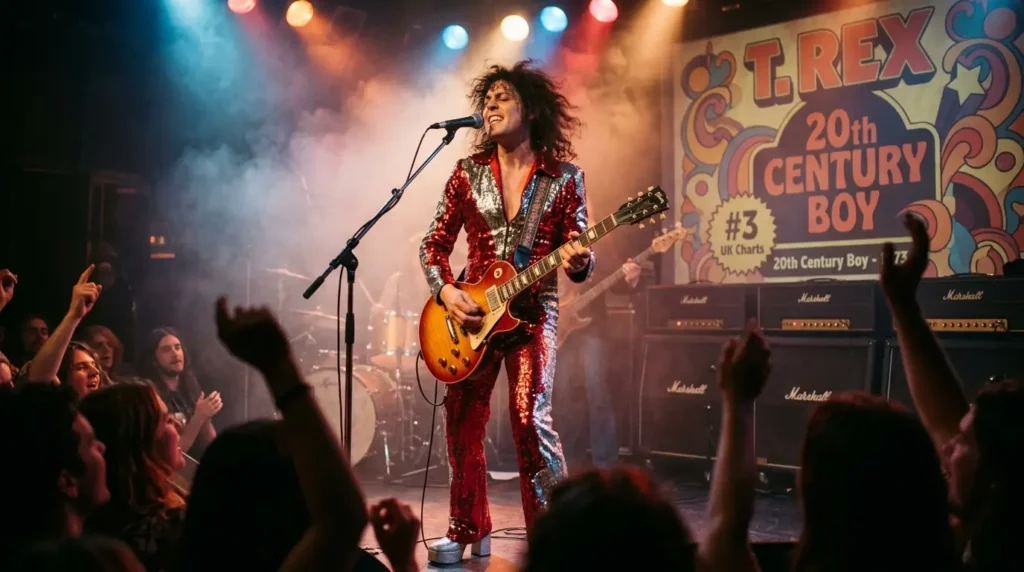
In 1973, “20th Century Boy” reached No. 3 in Britain. Its crushing opening guitar riff has lost none of its impact, even after more than half a century.
I was in my third and final year of junior high school that year. In other words, my three years from 1971 through 1973 almost exactly overlapped with the golden age of T. Rex.
Changing Music and a Changing Lineup
From Tanx onward, Bolan chose not simply to repeat the formula that had brought him enormous success. Instead, he explored new directions, drawing increasingly on soul and funk. At the same time, the British music scene was changing rapidly, while members of the classic lineup and Tony Visconti gradually moved on.
Albums such as Zinc Alloy and the Hidden Riders of Tomorrow in 1974 and Bolan’s Zip Gun in 1975 reflected that continuing search, although the period of overwhelming chart dominance had come to an end.
Still, it would be too simple to describe these years merely as a decline. Bolan continued searching for the next form his music might take.
In fact, this period reveals a problem faced by many successful artists. Repeat the sound that made you famous, and people accuse you of doing the same thing again. Change too much, and they say the old music was better. Bolan found himself caught between those expectations, using soul and funk as he tried to renew his music.
1976–1977 — A Revival, Then a Sudden End
“I Love to Boogie” Brings Bolan Back to the Charts
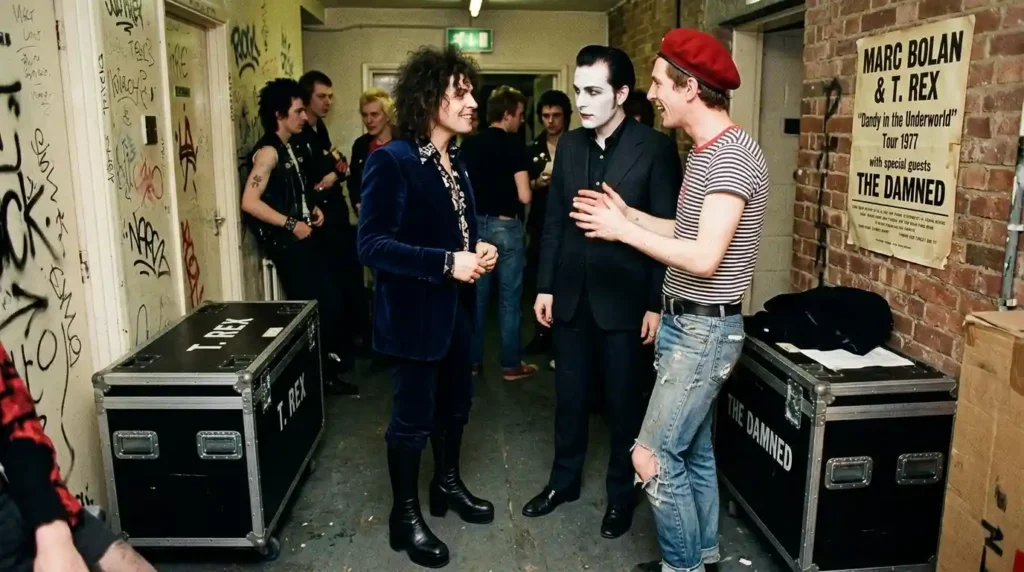
In 1976, “I Love to Boogie” reached No. 13 in Britain and helped restore Bolan’s presence on the charts. The following year, the album Dandy in the Underworld reached No. 26 on the UK Albums Chart.
Punk was rapidly emerging in Britain, but Bolan did not reject the new generation. He actively engaged with younger musicians, even taking The Damned on tour as a support act.
September 16, 1977 — A Life Stopped at 29
Just as Bolan seemed to be moving forward again, he was killed in a car accident in southwest London on September 16, 1977. He was only 29, about two weeks short of his 30th birthday.
The car was being driven by his partner, singer Gloria Jones. It left the road and struck a tree, killing Bolan, who was in the passenger seat. Because T. Rex had always revolved around Marc Bolan, his death effectively brought the band’s story to an end.
The T. Rex Sound That Survived for More Than Half a Century
T. Rex’s music was never particularly complicated. Short guitar riffs, repetitive beats, memorable choruses, and Marc Bolan’s voice. Yet “simple” and “easy to create” are two very different things.
You can often recognize T. Rex from the moment the intro begins. That unmistakable identity survived beyond the glam-rock era and left traces in later punk, new wave, and other generations of rock music. Bolan’s glittering clothes and flamboyant visual style also expanded the possibilities of how a rock star could present himself.
Inducted into the Rock & Roll Hall of Fame in 2020
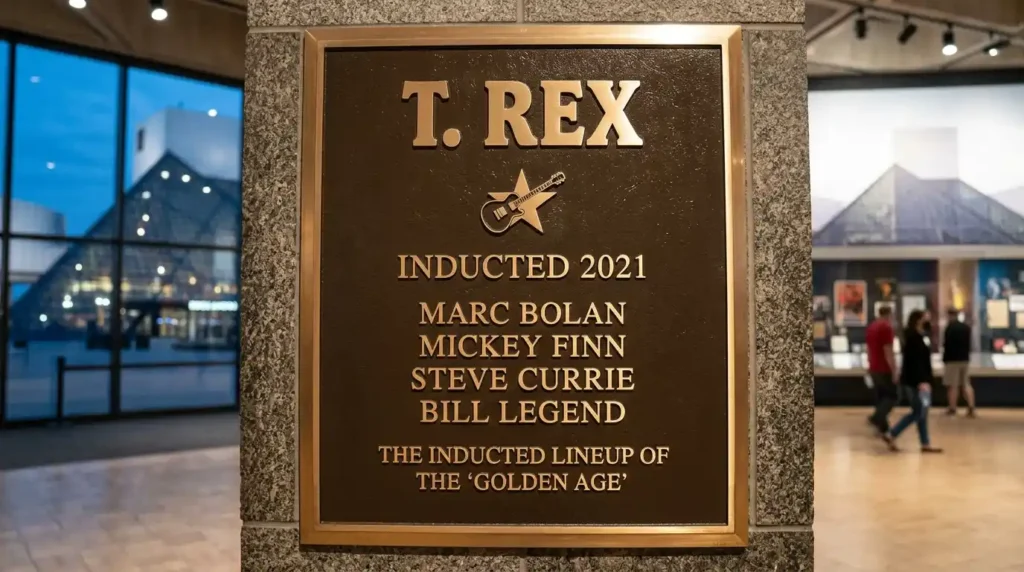
In 2020, T. Rex was inducted into the Rock & Roll Hall of Fame. The members honored were Marc Bolan, Mickey Finn, Steve Currie, and Bill Legend — the four musicians at the heart of the band’s golden era.
Listening Again to the Music of My Junior High School Years
Today, I know about the Tyrannosaurus Rex years and understand much more about the background from which glam rock emerged. But I did not come to love T. Rex because I knew their history.
It was the other way around. The music came first, and my immediate reaction was, “What an incredibly cool sound.” That was where it all began.
More than half a century later, when I listen to “Children of the Revolution,” “20th Century Boy,” or “Solid Gold Easy Action,” that feeling has hardly changed. If anything, the passing years have made me appreciate Marc Bolan’s talent for turning something simple into a sound that belonged to no one else.
When I was young, I was first attracted by the powerful guitar riffs and the flamboyant image. Today, I also hear something behind them: Bolan’s ability to strip music down to its essentials. With relatively few sounds, he could define the shape of a song and leave an unforgettable impression with a short phrase. I believe that gift is one of the reasons T. Rex has endured for so long.
In my series, “My Personal Top 10: T. Rex,” I introduce ten songs one by one, combining the music with memories of my junior high school years. Listening to those songs again after tracing the history of T. Rex makes the circumstances in which each one was created feel even clearer.


音楽ファン同士の交流・リクエストはこちら / Connect & Request Songs Here