
Explore Paul McCartney’s Journey Here!
- 🎧 Listen to This Article
- No. 3: “Jet”
- First, listen to the official YouTube videos
- A Rock Song Launched by a Single Shout: “Jet!”
- “Jet” Was Recorded in London
- So Who — or What — Is “Jet”?
- What the Studio Version and the 2010 Live Performance Reveal
- Why “Jet” Still Doesn’t Sound Dated
- In Closing — A Sound That Outruns Its Meaning
🎧 Listen to This Article
You can quickly explore the key points of this article through narration.
Recommended if you would like to get a feel for “Jet” and the overall flow of the article before reading.
🎵 English Narration
An English narration introducing the main points of this article.
🎶 Japanese Narration
A Japanese narration introducing the main points of this article.
Listening first can help you better grasp the appeal of “Jet” and the key points of the article.
No. 3: “Jet”
At No. 3 in my personal ranking is “Jet” by Paul McCartney & Wings.
“Jet” was included on the album Band on the Run, released in December 1973, and was issued as a single in the UK on February 15, 1974.
The song reached No. 7 on the UK Singles Chart and also peaked at No. 7 on the Billboard Hot 100 in the United States. Today, it stands as one of Wings’ signature rock songs.
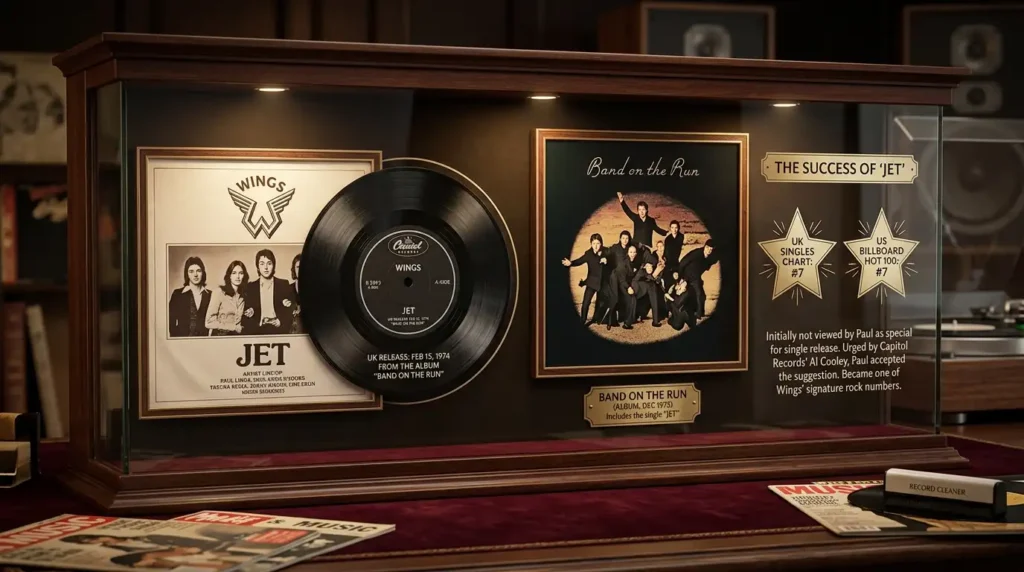
Interestingly, Paul himself did not initially regard the song as an obvious choice for a single.
After the album had been released, Capitol Records executive Al Coury strongly urged him to put out “Jet” as a single, and Paul eventually agreed.
The decision proved to be exactly right. The success of the single gave the album fresh momentum and helped turn Band on the Run into an even greater success.
The main reason this song ranks so highly for me is the sheer immediacy of its impact from the very first second. Paul shouts the title, then guitars, drums, keyboards, and saxophone surge forward, and the song is already racing ahead before you have time to prepare for it.
Interpretive Translation
Jet, I can still picture everyone’s surprise when you told them you would soon be getting married.
Did your strict father tell you that you were still too young?
With your hair blowing in the wind, you seem to race freely across the sky.
Jet — to me, you remain a mysterious little lady.
First, listen to the official YouTube videos
Common Credits
Song: Jet
Artist: Paul McCartney & Wings
Written by: Paul McCartney / Linda McCartney
Lead Vocals: Paul McCartney
Produced by: Paul McCartney
Original Album: Band on the Run (1973)
① Jet (2010 Remaster)
Audio: 2010 Remaster
Backing Vocals: Linda McCartney / Denny Laine
Recording Engineer: Geoff Emerick
Saxophone: Howie Casey
Orchestration: Tony Visconti
Provided by: Universal Music Group
Included on: The 7” Singles
About This Video
An official video featuring the 2010 remastered version of “Jet,” one of Wings’ defining rock songs from 1973.
Its powerful rhythm, richly layered arrangement, and Paul’s forceful vocal performance capture the full impact of the original studio recording.
② Paul McCartney - Jet (Live on Later... with Jools Holland, 2010)
Performance: Paul McCartney
Program: Later... with Jools Holland
Produced by: BBC
Performance Year: 2010
Copyright: © 2010 BBC
Licensed by: Concord Music Group Inc.
Published: December 9, 2010
Official Channel: PAUL McCARTNEY
About This Video
A 2010 live performance of “Jet” from the BBC music program Later... with Jools Holland.
The raw energy of the live band reveals a different side of the song and shows just how powerful “Jet” remains on stage.
A Rock Song Launched by a Single Shout: “Jet!”
What hits me first when I listen to “Jet” is not so much the beauty of the melody as the sheer momentum of the sound.
The brief cry of “Jet!” rings out almost like a starting gun, defining the character of the entire song in an instant.
In 2021, Paul recalled writing the song on his farm in Scotland. With a guitar in his hands, the name “Jet” came to mind, and he began shouting it while playing an A chord. That was the spark from which the song began to take shape.
Paul Was More Than a Great Melodist
When I think of Paul McCartney, one of the first things that comes to mind is his extraordinary gift for melody. But with “Jet,” melody alone cannot fully explain what makes the song so compelling.
Cutting guitars, hard-driving drums, thick keyboards, saxophone, and orchestration that adds even greater weight. Rather than competing with one another, these elements merge into a single driving force that pushes the song forward.

Yet this is not simply a song that relies on sheer volume. The phrases shift, the choruses enter in different ways, and the musical texture keeps changing throughout its roughly four-minute running time.
The Orchestration That Enlarged the Finished Recording
A major contributor to the song’s scale is Tony Visconti’s orchestration. Howie Casey’s saxophone adds another important layer, bringing a brightness and sharpness that the core Wings arrangement alone could not have produced.
Adding more instruments can sometimes weigh a rock song down, but “Jet” works in the opposite way. The extra layers actually increase its momentum, giving me the impression of something bursting upward and taking flight — an image that fits the sound of the title itself.
“Jet” Was Recorded in London
Whenever Band on the Run is discussed, Lagos, Nigeria, inevitably enters the story.
Two members left Wings shortly before the trip, leaving Paul, Linda, and Denny Laine to continue the sessions as a trio. I discussed that episode in more detail in my No. 11 article on the album’s title track.
However, the basic recording of “Jet” was not made in Lagos. It was recorded at AIR Studios in London in October 1973, after the band had returned to the UK.
A Dense Sound Built Around Just Three Musicians
In addition to lead vocals and bass, Paul played several instruments, including drums and guitar. Linda and Denny Laine also contributed instruments and backing vocals, while Visconti’s orchestration and Casey’s saxophone further expanded the arrangement.

The finished recording can sound as though it was performed by a large ensemble, yet only three musicians formed its core. The fact that the track never feels limited by that small lineup is one of the most fascinating aspects of the recording.
The “Underdubbed Mix” Released in 2024
One particularly fascinating way to hear how the album was constructed is through Band on the Run (Underdubbed Mixes), released in 2024.
These recordings are rough mixes prepared at AIR Studios by Geoff Emerick and Pete Swettenham on October 14, 1973, before the orchestral overdubs had been added.
“Jet” is one of the tracks included. Comparing it with the finished version reveals just how strong the basic rock-band performance already was, while also showing how the additional layers transformed the final recording.
So Who — or What — Is “Jet”?

This is where another fascinating aspect of the song emerges. You might expect the lyrics to become clearer as you follow them line by line, but the opposite happens: the closer you look, the stranger they become.
First there is talk of marriage, then a seemingly strict father appears, followed by the peculiar phrase “Lady Suffragette.” Trying to interpret the lyrics as a single, coherent narrative quickly leads to contradictions.
A Puppy or a Pony? Paul Has Told Both Stories
There is also an intriguing difference in Paul’s own explanations of where the name “Jet” came from.
In 1973, around the time the album was released, Paul explained that Jet was the name of a black Labrador puppy born to one of his dogs. In a 2017 interview, he again described Jet as a little black puppy.
But in a 2021 conversation with Nile Rodgers, Paul said that Jet had been the name of a small black pony the family kept for the children.
With nearly half a century separating some of these recollections, I do not think we need to force them into a single definitive answer. What seems clear is that the name “Jet” became a starting point for the songwriting process and then evolved into something resembling a female character within the song itself.
How Linda’s Father Entered the Lyrics
When it comes to the father figure in the song, Paul has offered a somewhat more concrete explanation.

When Paul married Linda, he recalled feeling somewhat intimidated by her father, Lee Eastman.
That does not mean he simply turned the experience directly into a song. Paul has explained that if he merely reproduced real events exactly as they happened, the result would read more like a newspaper report. Instead, he reshapes reality and allows it to enter a song in altered form.
In 2021, Paul even joked that “Jet” was a mixture of such elements as a little black pony, marital issues, and the Latin word for “mother.”
In other words, “Jet” is probably not the kind of song in which every lyrical clue can be solved until one final answer emerges. Memories from real life, the sound of particular words, and images that sprang from them were woven together freely. That sense of mystery is part of the song’s character.
What the Studio Version and the 2010 Live Performance Reveal
For this article, I included not only the 2010 remastered recording but also the live performance from Later… with Jools Holland. Listening to them back to back makes it clear that “Jet” is more than simply an outstanding studio creation.
The studio version uses a multilayered arrangement, including orchestration, to give the song tremendous scale. In the 2010 performance, by contrast, the presentation is more direct, bringing the strength of the melody and rhythm themselves to the foreground.

Its Impact Has Survived the Decades
Even in a performance recorded more than 36 years after the original 1973 session, the feeling that the temperature suddenly rises the moment the title is shouted remains remarkably intact.
You do not need to know the historical background or fully understand the lyrics to be drawn in by the rhythm and the strength of its phrases. That is surely one reason “Jet” has remained such an enduring part of Paul’s live repertoire.
Why “Jet” Still Doesn’t Sound Dated
“Jet” was released in 1973. Yet even today, it does not strike me simply as a piece of rock music locked into its era, because the song’s strength lies not only in the spectacle of its sound but in the construction underneath it.
That opening cry of “Jet!”, the short and powerful phrases, the constantly shifting sections — then the guitars, drums, keyboards, and saxophone all entering the picture. The song gives the listener almost no opportunity to stand still.
And yet it does not rely on momentum alone. The melody has Paul’s characteristic accessibility, while the arrangement remains bold and adventurous. Familiarity and excitement coexist naturally within the same song. That, I think, is one of the greatest strengths of “Jet.”
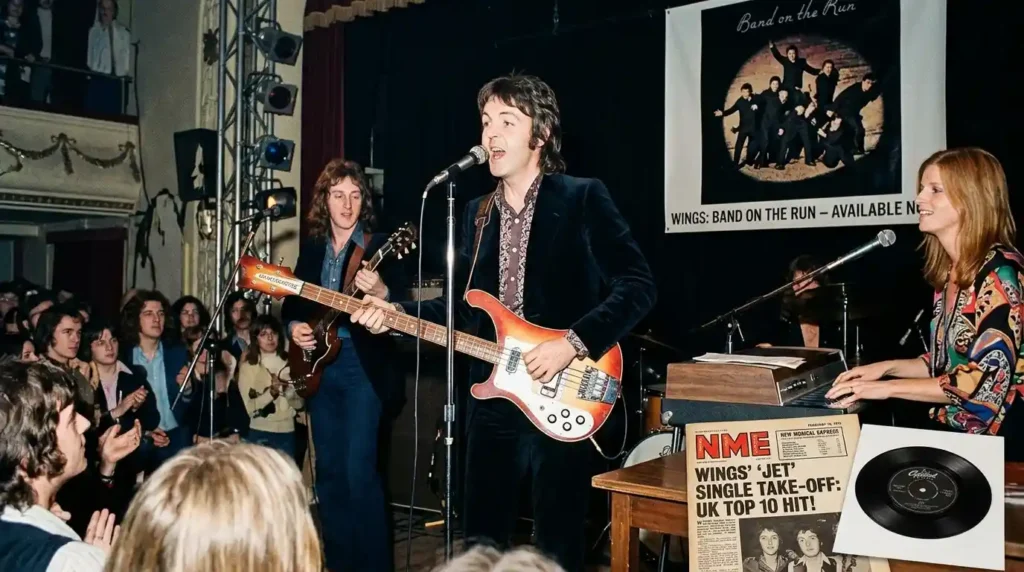
The reason the song retains its character both in the studio and on stage is that its central melody and rhythm remain strong even when the surrounding layers are stripped away. The production may reflect the sound of its time, but the song underneath still has more than enough power of its own.
In Closing — A Sound That Outruns Its Meaning
There are still parts of “Jet” that resist a clear explanation. Even the origin of the title has been described by Paul himself in two different ways — as a puppy and as a pony.
But I do not think that uncertainty weakens the song. Even without fully understanding every lyric, once the voice, rhythm, and instruments begin moving together, the music itself comes rushing toward you.
For me, “Jet” is a song that grabs me through the sheer force of its sound before I ever stop to ask exactly what it is about.
“Jet!” — no other word captures this song more perfectly than that one brief shout.

音楽ファン同士の交流・リクエストはこちら / Connect & Request Songs Here