
Read about the history of Mayumi Itsuwa here!
- 🎧 Listen to This Article
- No. 5 is “Tabako no Kemuri.”
- First, listen to the official YouTube audio.
- A Landscape Half Hidden by Smoke
- The Sound of 1973 Becomes Part of the Scene
- A Song Born from Her Second American Recording Session
- The Song Never Explains Why the Person Left
- Building an Entire Song from Only a Few Motifs
- Why I Ranked It No. 5
- In Closing
🎧 Listen to This Article
You can quickly grasp the main points of this article through narration.
Recommended if you would like to get a feel for “Tabako no Kemuri” and understand the overall flow of the article before reading.
🎵 English Narration
An English audio introduction to the content of this article.
🎶 Japanese Narration
A Japanese audio introduction to the content of this article.
Listening first will help you better understand the mood of “Tabako no Kemuri” and the key points of the article.
No. 5 is “Tabako no Kemuri.”
“Tabako no Kemuri” was included on Mayumi Itsuwa’s second album, Kaze no Nai Sekai, released in July 1973. Itsuwa wrote both the lyrics and the music. Later that year, the song was used in a Pilot fountain pen commercial and was also released as the second single taken from the album.
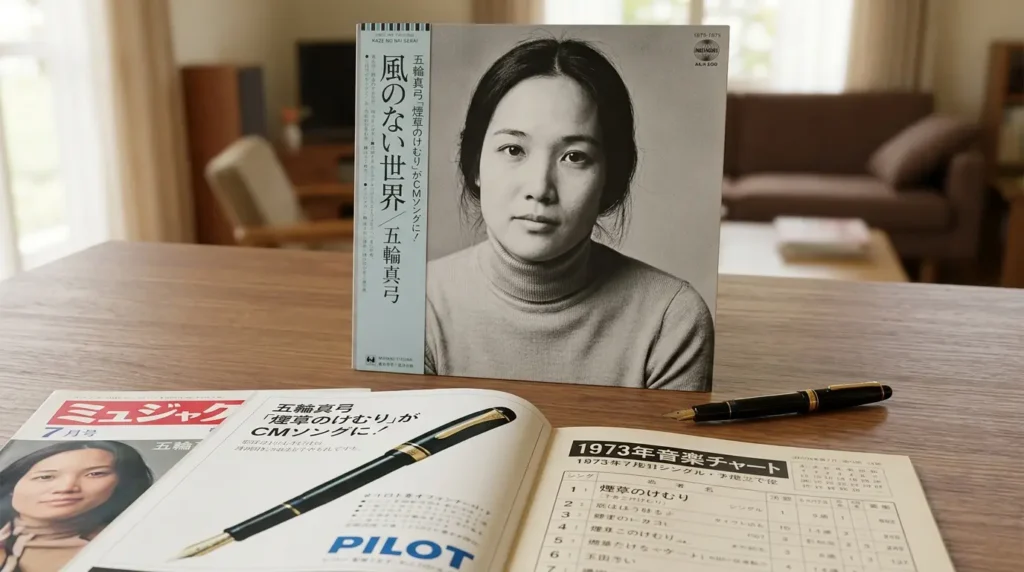
Itsuwa had made her debut the previous October, in 1972, with her first album and the single “Shōjo” on CBS/Sony. She traveled to the United States that June to record at Crystal Sound Studios in Los Angeles. Carole King also took part on piano, giving Itsuwa an unusual connection with the American music scene from the very beginning of her career.
Created the following year, “Tabako no Kemuri” has a youthful texture quite different from the grandeur of later songs such as “Koibito yo.” Within the restrained arrangement, the piano gives the music its shape, while Itsuwa’s slightly steely voice brings to life a scene filled with drifting smoke. Without relying on dramatic twists, the song moves from a single intimate moment to the loneliness left after someone is gone.
My Interpretation
You were always there beyond the smoke, lighting a flame inside my heart.
I wanted to see your face, but it remained hidden until the very end.
Then, when the smoke finally cleared, you had disappeared as well.
All that remained was the memory of a red match that once lit my darkened heart.
💡 You might also like: View the original Japanese lyrics (External site)
If the lyrics are available only in Japanese, you can use your browser’s translation feature or an AI translation tool to understand their general meaning.
First, listen to the official YouTube audio.
Credits
Audio: Mayumi Itsuwa “Tabako no Kemuri”
Provided to YouTube by Sony Music Direct (Japan) Inc.
℗ 1973 Sony Music Entertainment (Japan) Inc.
Two-Line Commentary
Originally included on the 1973 album Kaze no Nai Sekai, “Tabako no Kemuri” later became a single and remains one of Itsuwa’s notable early works.
Using cigarette smoke and a red match as striking motifs, the song quietly portrays emotional distance and the disappearance of someone who seemed close at hand.
A Landscape Half Hidden by Smoke
The Idea Is Already Built into the Title
The first thing that catches my attention is that the title is not simply “Tobacco,” but “Tabako no Kemuri” — “Cigarette Smoke.” A cigarette has a fixed shape. Smoke, however, may be clearly present and yet never hold the same form for long.
The “you” in the song is similar. The person is physically close to the narrator, but the face remains difficult to see. Even when the narrator wants to look more closely, smoke stands between them. From the beginning, the other person is portrayed as someone both near and strangely distant.
Only the Red Match Remains Vivid
Within this blurred scene, the red match is the one object with unmistakable color. Smoke softens the field of vision, while the flame of a match carries both brightness and warmth. An unseen person and a red flame burned into memory. That contrast becomes the visual core of the song.
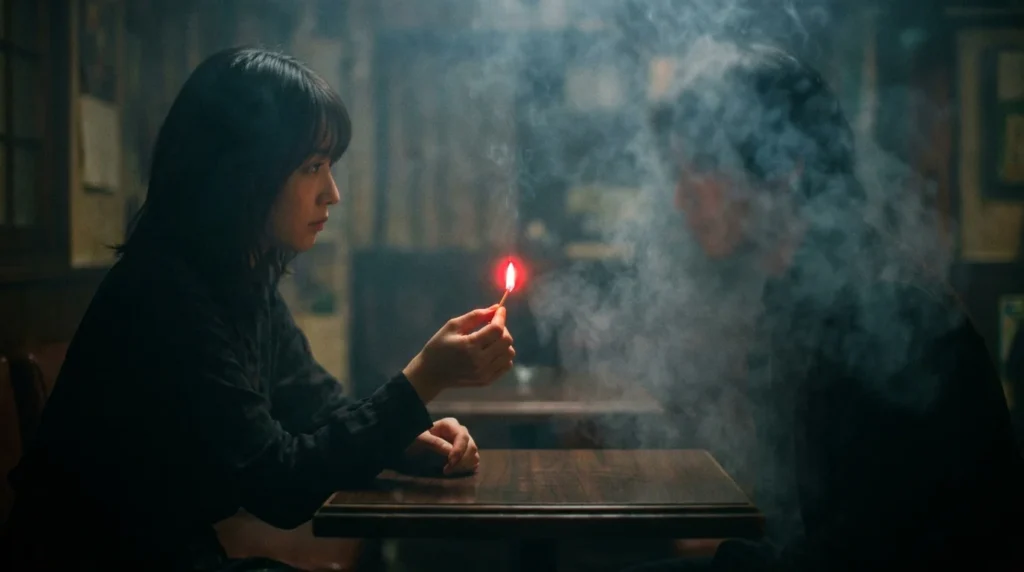
Even more striking is how brief the act itself is. Lending someone a light takes only a second, yet for the narrator it becomes a moment that illuminates an otherwise darkened heart. The song does not need a major incident. A single small gesture is enough to suggest the nature of their relationship.
The Sound of 1973 Becomes Part of the Scene
A Dry Texture Shaped by Piano and Voice
When I listen to “Tabako no Kemuri,” the piano is one of the first elements that stays with me. It does not dominate with ornate phrases. Instead, it places notes around the vocal line and quietly defines the scene. The arrangement avoids excessive decoration and carries the muted texture of a dimly lit room.
The rhythm does not hurry either. That gives the listener time to watch the two figures inside the smoke, almost as if the scene were unfolding slowly before the eyes. The obscured vision described in the lyrics and the restrained feeling of the performance naturally reinforce one another.
The Voice of a Young Mayumi Itsuwa
Itsuwa’s voice here also differs from the sound heard in her later signature works. Before the weight and richness associated with “Koibito yo,” her singing carried a mixture of sharpness and unpolished directness.

Rather than enlarging the emotion, she delivers each phrase as if she were carefully confirming what lies in front of her. Even after “you” disappear, she does not dramatize the sorrow. Instead, her voice seems to preserve the narrator’s bewilderment at not fully understanding what has happened.
The appeal does not come simply from the fact that this is an old recording. The smoke described in the lyrics, the piano-centered arrangement, and the young Itsuwa’s voice all point in the same direction. Because of that unity, the sound recorded in 1973 becomes part of the song’s visual world.
A Song Born from Her Second American Recording Session
Back in the United States Only Months After Her Debut
The background to “Tabako no Kemuri” reflects the unusual circumstances of Itsuwa’s early career. After recording her first album, Shōjo, in the United States, she returned there in April 1973.
The sessions again took place at Crystal Sound Studios in Los Angeles. From those recordings came her second album, Kaze no Nai Sekai, released in July. Before even a full year had passed since her debut, Itsuwa had already completed her second American recording project.

At the time, Itsuwa had not yet acquired the fixed public image that would later come with her major hits. She was still exploring how her own compositions should sound in her own voice. “Tabako no Kemuri” captures both the tension of that formative period and the individuality of a young singer-songwriter finding her musical identity.
From Album Track to Single
The song was not originally released as a stand-alone single. After first appearing on Kaze no Nai Sekai, it was used later that year in a Pilot fountain pen commercial and then issued as the second single taken from the album.
Simply hearing the title can bring smoke, flame, and two figures to mind. There is already a story contained within that compact scene. That strong visual quality may also help explain why the song worked effectively in the limited time available to a television commercial.
The Song Never Explains Why the Person Left
The Focus Is on the One Left Behind
Near the end of the song, “you” are suddenly gone. Yet the reason is never explained. We are not told whether the two were lovers, how close they truly were, or where the other person went afterward.
If those circumstances had been described in detail, the song would have become a specific story about one particular couple. Instead, Itsuwa does not pursue the cause. She leaves the narrator facing only the fact that the other person is no longer there.
What remains after someone has gone is not always an important conversation or a decisive event. Sometimes an ordinary gesture, the light in a room, or even a certain smell survives in memory with surprising clarity.
What “Tabako no Kemuri” examines is not the reason for the separation, but the scene that remains when the narrator remembers the person who has disappeared. That is why the song feels different from a conventional heartbreak story that explains every circumstance.
Building an Entire Song from Only a Few Motifs
Her Identity as a Songwriter Was Already Visible
When you count the elements that appear in this song, there are surprisingly few: cigarette smoke, the other person’s face, a darkened heart, a red match, and finally the person who is no longer there.
Yet those elements are enough to suggest the passage from intimacy to separation and the narrator’s bewilderment afterward. Rather than explaining emotion at length, Itsuwa places visible objects and small actions in front of the listener and allows the relationship to emerge through them.

Itsuwa was still only at the beginning of her career when this song appeared. Even so, her ability to take an ordinary scene and use it to reveal something deeper about human emotion was already clearly present in “Tabako no Kemuri.”
Why I Ranked It No. 5
Mayumi Itsuwa has songs that portray love and separation on a far larger scale. Even so, I placed “Tabako no Kemuri” at No. 5 because few of her songs connect sound and imagery in quite the same way.
Two people are separated by smoke. Within that blurred scene, only the red match carries a vivid color. Then, just when the narrator wants to see the other person clearly, that person is already gone. Nothing unnecessary is added to this progression.

Over that scene comes the young Itsuwa’s 1973 voice and the restrained instrumental backing. The sound itself supports the image created by the words. For me, that unity is the strongest reason “Tabako no Kemuri” deserves such a high position in this ranking.
In Closing
“Tabako no Kemuri” was born from Mayumi Itsuwa’s second American recording project, only a year after her debut. After appearing on Kaze no Nai Sekai, it was used in a commercial and later released as a single, becoming one of the defining songs of her early period.
Yet its appeal more than half a century later does not depend on that history alone. Smoke that cannot hold its shape and a red match that flashes vividly for only a moment — with those two images, the song captures both encounter and separation in a way that still feels fresh.
Even after a person disappears from sight, one small scene from that day can remain in memory. “Tabako no Kemuri” has a sharpness that belongs to the young Mayumi Itsuwa and differs from the grandeur of her later masterpieces.


音楽ファン同士の交流・リクエストはこちら / Connect & Request Songs Here