
Read about the history of Mayumi Itsuwa here!
- 🎧 Enjoy This Article in Audio
- No. 7 is “Kokoro no Tomo.”
- First, listen to the official YouTube video.
- A Song That Cannot Be Contained by the Word “Friend”
- Why Love Is Described as a Lullaby
- How “Kokoro no Tomo” Grew in Indonesia
- The Strength of Itsuwa’s Voice in Concert
- A New “KOKORO NO TOMO” Born After the Disaster
- Conclusion
🎧 Enjoy This Article in Audio
These narrations offer a convenient overview of the article’s key points.
Listen before reading to understand the appeal of “Kokoro no Tomo” and the overall direction of the article.
🎵 English Narration
This audio introduces the article in English.
🎶 Japanese Narration
This audio introduces the article in Japanese.
Listening first will make it easier to understand the world of “Kokoro no Tomo” and the article’s main points.
No. 7 is “Kokoro no Tomo.”
“Kokoro no Tomo” is a song from Mayumi Itsuwa’s original album Shiosai, released on October 21, 1982. Itsuwa wrote and composed the song herself.
It was not heavily promoted as a single in Japan. In Indonesia, however, the song became widely known and eventually took such deep root in everyday life that it came to be described as a “second national anthem.”
Its popularity in Indonesia is said to have spread through radio broadcasts. An album track created in Japan reached one listener after another without being launched through a major overseas promotional campaign. That unusual path is an essential part of the history of “Kokoro no Tomo.”
In May 1986, Mayumi Itsuwa held a solo concert at the Senayan Convention Hall in Jakarta. Before the songwriter who had travelled from Japan, members of the audience sang “Kokoro no Tomo” with her in Japanese. The connection created by its melody and voice could not be explained through translated words alone.
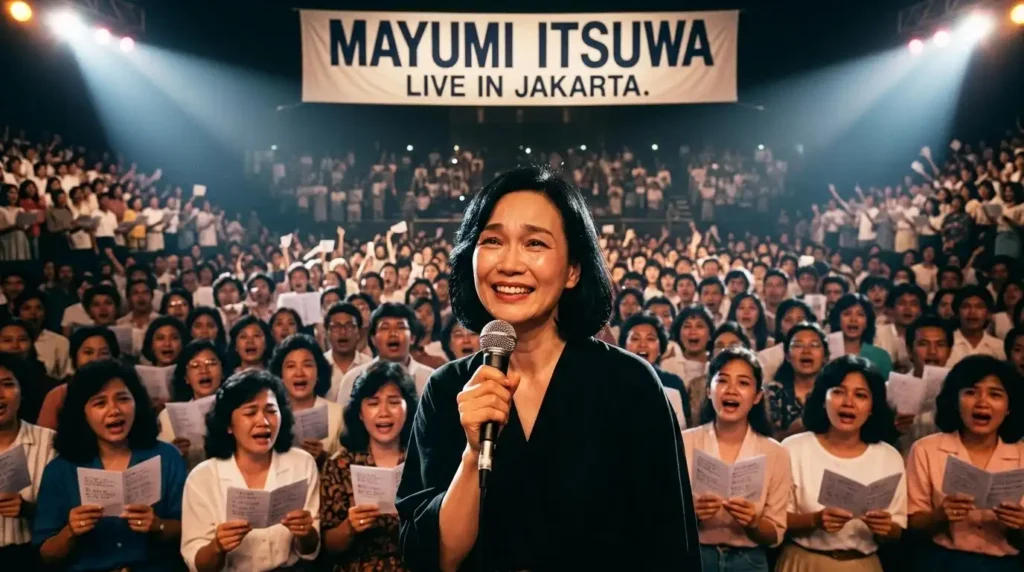
The considerable difference between the song’s position in Japan and its reception in Indonesia is another important feature of its history. A track first released as one song on an album grew beyond its creator’s expectations and became a musical link between the people of Japan and Indonesia.
A Free Interpretation
I want to hold your sorrow within my heart.
When the long journey leaves you weary, come home to me.
No matter how far apart we may be, my heart will always think of you.
You are the one true companion my heart needs in order to live.
💡 You might also like: View the original Japanese lyrics (External site)
If the lyrics are available only in Japanese, you can use your browser’s translation feature or an AI translation tool to understand their general meaning.
First, listen to the official YouTube video.
Video Credit
Official live performance
Mayumi Itsuwa performs “Kokoro no Tomo” during her 1986 Autumn Tour, Toki no Nagare ni.
Her unwavering voice and composed stage presence bring the emotions within the song vividly to life.
Two-Line Commentary
Originally included on the album Shiosai, “Kokoro no Tomo” became widely loved in Indonesia and has continued to be sung there in Japanese.
Mayumi Itsuwa portrays two people who share their suffering through a voice that combines warmth with inner strength.
A Song That Cannot Be Contained by the Word “Friend”
A Title That Does Not Define the Relationship
The title “Kokoro no Tomo,” meaning a companion of the heart, may lead many listeners to regard it as a song about friendship. Yet the two people depicted in the song cannot be understood solely within the boundaries of an ordinary friendship.
The narrator longs to remove the other person’s suffering and, at the same time, gains the courage to live through that person’s warmth. The lyrics do not identify them as lovers, spouses, relatives, or members of any other clearly defined relationship. Instead, their emotional bond occupies the centre of the song.

The Person Offering Support Also Needs the Other
At the beginning of the song, the narrator says that being able to relieve the other person’s suffering would also give her the courage to continue living. This is not a structure in which a strong person rescues someone weaker.
The other person’s recovery allows the narrator to move forward as well. Their warmth changes the narrator, who has also experienced loneliness. Although neither person is complete or invulnerable, each draws strength from the other’s presence.
The person offering encouragement is not necessarily stronger. The wish to protect someone can also rescue the protector from isolation. “Kokoro no Tomo” does not sound like a conventional song of encouragement because the positions of supporter and supported are never fixed.
Why Love Is Described as a Lullaby
Offering Rest Rather Than an Answer
At the centre of the song is an image that compares love to a lullaby. A lullaby does not analyse the cause of someone’s troubles or tell that person which path to follow.
Instead, it sounds gently beside someone who is exhausted and creates a moment in which that person can close their eyes without fear. Itsuwa portrays love not as a blazing passion, but as a voice that allows a wounded person to stop and steady their breathing.
When someone is exhausted by a long journey, advice may not be what they need. On a night when suffering cannot be explained clearly, the presence of someone who will remain even in silence can provide the greatest support.

Sleep does not erase the problems of the waking world. Even so, resting the mind and body prepares a person to face another morning. The word “lullaby” expresses a desire not to force someone to recover quickly, but to protect the time that person needs.
A Bond That Survives the Sight of Tears
The song does not condemn weariness, tears, or the loss of faith. People cannot remain strong at every moment, and there are times when they long to return to the happiness of the past.
At such a moment, the person who matters is not someone whom we may approach only after overcoming our weakness. What we need is someone we can call while still vulnerable, without fearing that our tears will destroy the relationship.
The plea to be called a companion of the heart expresses a determination not to abandon the bond, regardless of the condition in which the other person appears.
At the same time, the narrator also wants to be needed. She does not merely want to protect the other person; she hopes that they can continue to remain companions of the heart. That desire gives the song an intimacy that extends beyond ordinary friendship.
How “Kokoro no Tomo” Grew in Indonesia
An Album Track That Found Its Own Audience
One of the most remarkable aspects of “Kokoro no Tomo” is that it was not already a major Japanese hit that simply travelled overseas. In Japan, it was one song on an album, but in Indonesia it developed an independent life of its own.
After being introduced on local radio, the song became known among listeners and continued to be sung for many years. The important point is that it entered people’s lives before Mayumi Itsuwa had carried out sustained promotional activity in Indonesia.
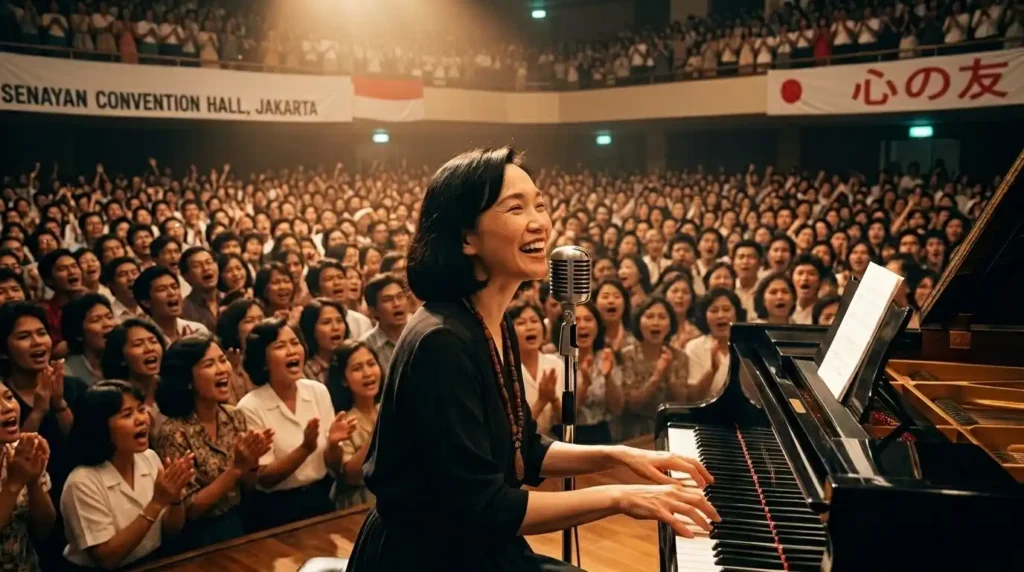
Not every listener would have understood each Japanese word. Nevertheless, the approachable melody, Itsuwa’s articulation, and the urgency carried within her voice could still be felt.
Music can communicate emotion through vocal tone and melodic movement before the literal meaning of its words is understood. “Kokoro no Tomo” is one of the songs that crossed national borders through that power.
The Japanese Performance Was Preserved
Japanese songs that become popular overseas are sometimes introduced through covers in local languages. “Kokoro no Tomo,” however, was embraced in Indonesia through its Japanese-language performance.
The Japanese title itself was remembered as a phrase in which meaning and sound were inseparable. The work was not preserved solely through translated explanations; the act of singing it in Japanese also became part of its continuation.
By the time Mayumi Itsuwa held her solo concert in Jakarta in May 1986, the song had already become part of the Indonesian audience’s musical world. A song familiar to the listeners and the person who created it finally met in the same hall. The occasion carried a significance unlike that of an ordinary overseas concert.
The place where the song was created was not the place where it became most deeply embedded in everyday life. The history of “Kokoro no Tomo” shows that a work’s destination is shaped not only by its creator, but also by the people who receive it.
The Strength of Itsuwa’s Voice in Concert
A Melody That Opens Out from the Lower Register
The melody of “Kokoro no Tomo” begins like a quiet conversation and rises as it approaches the heart of the song. Its lower opening register conveys a sense of approaching another person’s suffering with care.
When the image of the lullaby appears, the melody begins to expand. Even as the vocal range rises, however, the emotional distance between singer and listener does not increase.
Although Itsuwa is singing to a large audience, she sounds as though she is addressing one person directly. The ability to fill a hall while preserving the intimacy of a private appeal is one of the song’s defining qualities.
A Performance That Does Not Exaggerate Emotion
Itsuwa does not sing as though she were forcing a suffering person to rise through sheer determination. She carries each phrase carefully, as though waiting for the other person to recover through their own strength.

Even within her gentle delivery, the core of her voice remains firm. Comfort and determination coexist in the same performance, allowing the listener to feel not only reassurance but also the strength needed to begin moving again.
In the 1986 live performance featured in this article, Itsuwa sings with her eyes directed forward, without relying on exaggerated gestures or elaborate staging. The contrast between her composed posture and the voice extending across the hall is particularly striking.
Even as she reaches the higher notes, the outlines of the words remain clear, and the meaning of each phrase is delivered precisely. Her technique is used not to display vocal ability for its own sake, but to carry the words directly to the listener.
A New “KOKORO NO TOMO” Born After the Disaster
A New Recording Prompted by the Indian Ocean Earthquake
The relationship between “Kokoro no Tomo” and Indonesia did not end with its popularity during the 1980s. The earthquake and tsunami that struck off the coast of Sumatra in December 2004 caused catastrophic damage across Indonesia and a wide surrounding region.
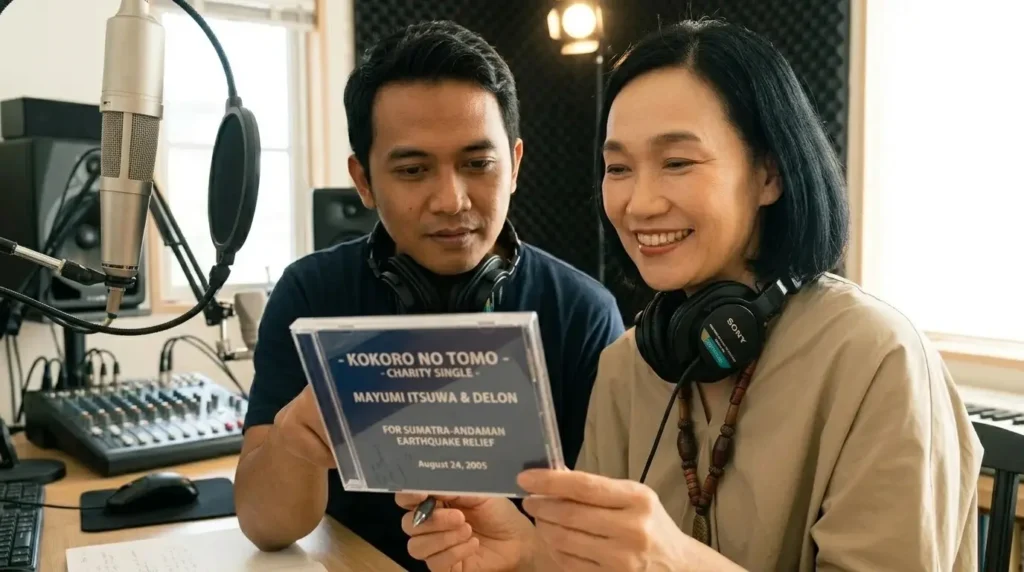
In response to the disaster, Mayumi Itsuwa recorded “KOKORO NO TOMO” with the Indonesian singer DELON. The recording was released on August 24, 2005, as a charity CD supporting those affected by the Sumatra earthquake and tsunami.

“Kokoro no Tomo” was not originally written as a song for disaster relief. Nevertheless, its appeal to people exhausted by their journey, overcome by tears, or unable to sustain their faith acquired new meaning within a society that had experienced enormous loss.
A Japanese song once embraced by the people of Indonesia was now sung again as a work intended to carry compassion toward the disaster-stricken region. Through this development, “Kokoro no Tomo” became more than a popular song from the past. It continued to serve a purpose within the realities of the present.
What the Duet with DELON Represents
DELON is an Indonesian singer. In the new recording, his voice and Itsuwa’s meet within the same song, reshaping “Kokoro no Tomo” as a collaborative work between Japan and Indonesia.
The project did more than simply deliver the original Japanese recording overseas once again. Its significance lay in acknowledging the many years during which the song had been sung in Indonesia and renewing it together with a local singer.
The melody carried different memories when it appeared on Shiosai in 1982 and when it was released as a charity CD in 2005. A work of music is not merely preserved in an unchanged form; historical events can give it a new responsibility.
“Kokoro no Tomo” cannot be fully described merely as a Japanese song that succeeded overseas. Born in Japan, nurtured in Indonesia, and later recorded again by singers from both countries, it also stands as a record of a long cultural exchange.
Conclusion
“Kokoro no Tomo” was born in Japan, crossed the sea in its original language, and became part of everyday life in a distant country.
Such a development cannot be explained by fashion or the momentum of a particular era alone. A song written by one singer-songwriter crossed borders and languages and continued to live for decades. That is why it still remains in the hearts of so many people.
For that reason, I hope this song will continue to be someone’s “companion of the heart,” not only in Japan but somewhere in the wider world.

音楽ファン同士の交流・リクエストはこちら / Connect & Request Songs Here